How To Become More Self-Sufficient Without Starting a Full-Blown Farm…
Want to start preserving your harvest, making your own soap, or building a backyard root cellar — but not sure where to begin? “Homesteading Advice” gives you instant lifetime access to 35+ practical homesteading books on food preservation, veggie gardening, DIY natural cleaning products (save over $250 per year with this skill alone), brewing, off-grid energy, and a whole lot more…
Click Here To Check It Out Now!
Why the world’s most expensive cured meats are never preserved in a box that plugs into a wall. If your smoke is standing still, your meat is just getting bitter. True preservation requires the ‘Dynamic Siphon’—a physics-based design that uses a separate firebox and the Venturi effect to pull clean, cool smoke over your food. Stop relying on electricity and start relying on pressure differentials to build a larder that lasts for years.
The modern world wants everything fast, easy, and plastic. We have been sold the lie that a thermostat and a heating element are the only things needed to cure meat. But if you talk to the old-timers in the Alpine regions of Austria or the hill-country smoke-masters of the American South, they will tell you that a box with a heating element is just an oven that happens to produce soot. It doesn’t preserve; it par-cooks.
To truly preserve meat—to build hams and bacons that can hang in a cellar for three years without rotting—you have to step away from the circuit board and toward the laws of thermodynamics. You need a system that breathes. You need a smokehouse that acts less like a cupboard and more like a living lung. This is the art of the thermal siphon.
When you build a system based on pressure, you aren’t just adding flavor. You are performing a chemical transformation. The “Dynamic Siphon” ensures that the smoke is always moving, never resting long enough to deposit heavy, bitter creosote, but staying long enough to drop its preservative phenols and carbonies into the muscle fibers. This is how you build a legacy in your larder.
Building A Thermal Siphon Smokehouse For Meat
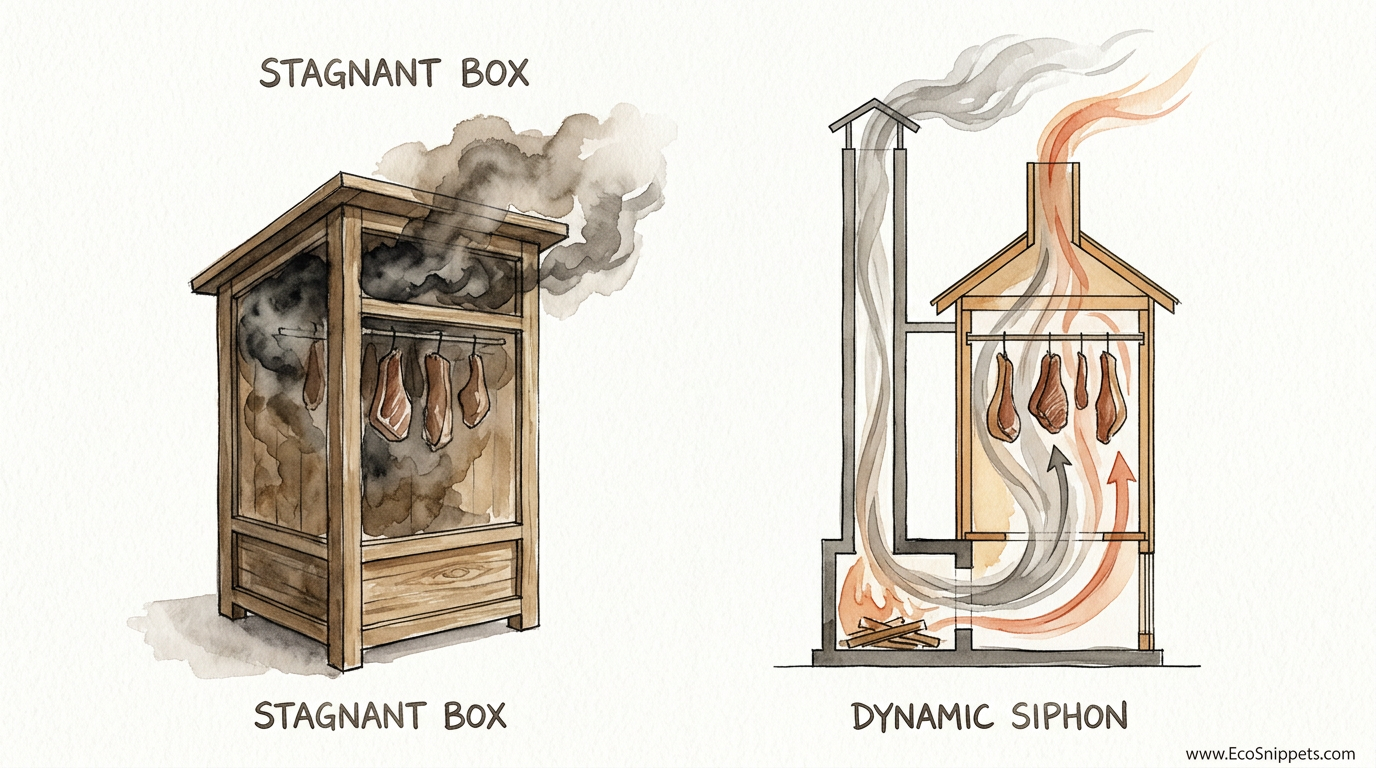
A thermal siphon smokehouse is a meat preservation structure where the fire is physically separated from the curing chamber. Unlike a standard vertical smoker where the fire sits directly beneath the meat, this design uses an external firebox connected by an underground or external flue. It is the gold standard for cold-smoking, a process that requires the smoke to be rich in preservative compounds but low in actual heat.
In the real world, you see this design in the traditional *Selchhütte* of central Europe or the hillside smokehouses of early Appalachia. These builders didn’t have thermometers or electric fans. They had an understanding of how air behaves. By placing the firebox lower than the smokehouse—often by digging into a hillside—they created a natural “draw.” This is the “Dynamic Siphon” in its purest form.
The separate firebox serves as the engine. As the fire burns, it consumes oxygen and creates a column of hot, buoyant air. Because the smokehouse chamber is at a higher elevation and connected by a pipe, that hot air is forced to travel upward. As it moves through the pipe (the flue), it loses its heat to the surrounding earth or air, entering the chamber as a cool, dense fog. This allows you to smoke meat at temperatures below 90°F, even when a fire is roaring just a few feet away.
This setup exists because it solves the primary problem of meat preservation: the battle between smoke and spoilage. If you smoke meat at high temperatures, you cook the proteins, which makes the meat delicious but short-lived. If you smoke it cold but with stagnant air, you create a breeding ground for mold and “off” flavors. The thermal siphon provides a constant stream of fresh, cool, moving smoke that dries the meat’s surface and inhibits bacterial growth simultaneously.
How the Dynamic Siphon Works
Understanding the physics of a thermal siphon is what separates a backyard tinkerer from a master of the craft. The system relies on three specific principles: the stack effect, the Venturi effect, and the heat sink. When these three work in harmony, you create a self-regulating environment that requires almost no intervention once the fire is set.
The stack effect is the most basic component. Hot air is less dense than cold air, so it wants to rise. In a properly designed smokehouse, the vertical distance between the firebox and the top of the smokehouse chimney creates a pressure differential. The taller the “stack,” the stronger the “pull.” This pull acts as a vacuum, sucking air in through the firebox intake and pushing it out through the roof vents.
The Venturi effect comes into play where the flue pipe meets the smokehouse chamber. By narrowing the entrance or using a specific pipe diameter, you can cause the smoke to accelerate as it enters the larger volume of the chamber. This acceleration creates a low-pressure zone that helps “siphon” more smoke from the firebox. It prevents the smoke from backing up or becoming “lazy.” If your smoke is lazy, it starts to drop heavy soot and moisture, which leads to the dreaded bitter “ashy” taste.
Finally, the flue itself acts as a heat sink. Most traditional designs bury the connecting pipe three to four feet underground. The earth stays at a relatively constant temperature. As the 400°F smoke leaves the firebox and travels through fifteen feet of buried clay or steel pipe, it sheds its thermal energy into the soil. By the time it reaches the meat, it has been “conditioned.” It is the perfect preservative: chemically active, but thermally inert.
The Benefits of Moving Air
The most immediate advantage of a thermal siphon is the quality of the finished product. Because the smoke is constantly moving, you achieve a level of flavor clarity that is impossible in a stagnant box. Heavy particles of wood resin and tar are heavy; they require high velocity to stay airborne. In a “stagnant box” (like most electric or propane units), these particles fall out of the air and coat the meat in a sticky, bitter film. In a dynamic siphon, these particles are swept away, leaving only the lighter, sweeter aromatic compounds behind.
Another practical benefit is capacity and duration. A hillside smokehouse can be the size of a small shed, capable of holding the harvest of three or four hogs at once. Because the fire is separate, you can tend the firebox without ever opening the smokehouse door. This means you aren’t constantly losing your “smoke environment” every time you add a log. You can maintain a consistent smoke density for days or even weeks at a time.
This design is also entirely energy-independent. In a grid-down scenario or a remote homestead, a “box that plugs into the wall” is a paperweight. The thermal siphon relies on the laws of nature—gravity and pressure—to do the work. As long as you have dry hardwood and a match, you have a functioning preservation system. It is a tool for self-reliance that doesn’t expire when the power goes out.
Finally, there is the benefit of temperature stability. Because the fire is located ten to twenty feet away from the meat, small fluctuations in the fire’s intensity don’t translate into radical temperature spikes in the chamber. The distance and the mass of the flue pipe act as a buffer. This makes the system much more “forgiving” than a small, direct-heat smoker where one extra log can raise the temperature by 50 degrees and ruin a batch of delicate cold-smoked salmon or lox.
Challenges and Common Pitfalls
The most common mistake beginners make is failing to account for the “draw.” If your firebox is on the same level as your smokehouse floor, the smoke will have no natural reason to move upward. You will end up with smoke backing out of the firebox door and a cold, empty smokehouse. You must have an elevation gain. Even a three-foot difference over a ten-foot run can be enough, but more is always better.
Another pitfall is the “too short” chimney. Many people build a beautiful smokehouse but put a tiny, decorative vent at the top. To create a true siphon, the chimney needs to be the highest point of the system by a significant margin. If the chimney is too low, the pressure differential isn’t strong enough to overcome the resistance of the flue pipe. The result is a smoldering fire that dies out for lack of oxygen and meat that sits in cold, stale air.
Moisture management is the third major hurdle. As hot smoke cools in a buried pipe, it releases water vapor (condensation). If your flue pipe is perfectly flat or sloped toward the smokehouse, this water will pool in the pipe or, worse, drain into your smoking chamber. This creates a humid, swampy environment that invites mold. The flue must be sloped correctly so that any condensation drains back toward the firebox (where it can evaporate) or to a dedicated “T-junction” drain point.
Finally, there is the issue of “cleaning” the smoke. If you use green wood or wood with bark still attached, you are introducing a lot of “junk” into your siphon. Even with the best design, dirty wood will eventually gunk up your flue pipe. A clogged pipe is a fire hazard and a siphon-killer. Serious practitioners always use seasoned, bark-free hardwoods to ensure the smoke remains “blue” and the air remains “clean.”
Limitations and Trade-offs
While the thermal siphon is the king of preservation, it is not a “set it and forget it” kitchen appliance. It requires a physical footprint. You cannot easily build a hillside smokehouse in a suburban backyard with a quarter-acre lot. The requirement for a separate firebox and a long flue means you need space—specifically, space that can handle a bit of drifting smoke.
Environmental factors also play a massive role. On a hot, humid summer day, the temperature differential between your firebox and the outside air might not be enough to create a strong siphon. Cold-smoking is traditionally a late-fall and winter activity for a reason. If it’s 90°F outside, your “cold” smoke will be 95°F or 100°F, which is the danger zone for bacterial growth. You are at the mercy of the seasons unless you have an exceptionally deep buried flue.
The startup complexity is also much higher than a “stagnant box” smoker. You aren’t just buying a unit; you are performing a small-scale engineering project. You have to dig trenches, lay pipe, and build a sealed structure. It requires a foundational understanding of masonry or carpentry. For someone who just wants to smoke a rack of ribs for Saturday dinner, a thermal siphon is massive overkill.
There is also the matter of fuel consumption. Because you are cooling the smoke and losing a lot of energy to the ground, you will burn more wood per pound of meat than you would in a small, insulated electric box. You are trading fuel efficiency for product quality and preservation capability. In a world of cheap electricity, this might seem like a bad trade, but in the world of high-end charcuterie, it is the only way to fly.
Comparison: Stagnant Box vs. Dynamic Siphon
To understand why the siphon is superior for preservation, we have to look at how they handle the basic elements of smoke and heat.
| Feature | Stagnant Box (Electric/Propane) | Dynamic Siphon (Pioneer Design) |
|---|---|---|
| Air Movement | Low/Passive (Smoke “hangs”) | High/Active (Smoke “flows”) |
| Temperature Range | 150°F – 275°F (Cooking) | 50°F – 90°F (Preserving) |
| Smoke Quality | Often heavy, soot-prone | Clean, “thin blue” smoke |
| Dependency | Requires Grid/Propane | Self-Sufficient (Wood) |
| Skill Level | Beginner (Set a dial) | Advanced (Manage a fire) |
Practical Tips for Success
If you are ready to move away from the “box that plugs in,” start by scouting your location. Look for a natural slope. You want your firebox to be at least four feet lower than the floor of your smokehouse. If you don’t have a hill, you can achieve this by digging a deep fire pit and burying your flue pipe at a steep angle. The pipe itself should be at least 6 inches in diameter; 8 inches is better for longer runs.
When selecting wood, think of it as an ingredient, not just fuel. For the “Dynamic Siphon” to work its magic, you need a clean burn. This means the wood must be bone-dry. Fruitwoods like apple and cherry provide a sweet, light smoke. Nut woods like hickory and pecan provide a more traditional, robust profile. Avoid “trash” woods like pine or fir, as their high resin content will coat your flue and your meat in bitter turpentine-like flavors.
Before you hang your meat, run a “dry fire.” Start a fire in the firebox and let the system warm up for two or three hours. This establishes the “draw.” If you put meat in a cold smokehouse and then start a fire, you will often get a period of back-drafting where smoke stays in the chamber and becomes stagnant. You want the siphon to be fully active before the meat ever enters the building.
Consider internal linking to guides on meat curing and salt ratios. The smoke is only half of the preservation equation; proper salt-curing (the “pellicle” formation) is what allows the smoke to adhere correctly to the meat fibers. Without a good salt cure, your “Dynamic Siphon” is just flavoring raw meat that will eventually spoil.
Advanced Considerations: The Dakota Fire Hole Integration
For those looking to push the limits of efficiency, consider using a Dakota Fire Hole as your firebox. This is an ancient design consisting of two holes in the ground connected by a tunnel. One hole holds the fire, and the other acts as an air intake. When connected to a smokehouse flue, the Dakota Fire Hole creates an incredibly intense, oxygen-rich fire that burns almost entirely without visible smoke.
Why would you want a fire with no smoke? Because the most preservative compounds—the ones that stop mold and bacteria—are actually found in the “invisible” gases produced during high-temperature combustion. By burning a hot, clean fire and then cooling the gases through a long underground pipe, you are delivering a concentrated dose of preservation without the heavy soot and ash associated with a smoldering, “dirty” fire.
Another advanced technique involves “tuning” the Venturi effect at the chamber entrance. By installing an adjustable “baffle plate” where the flue enters the smokehouse, you can control the velocity of the smoke. On a very cold day when the draw is too strong, you can restrict the flow to keep the smoke in the chamber longer. On a still, humid day, you can open it wide to maximize the siphon effect. It’s like having a manual transmission for your preservation system.
Finally, serious practitioners often use a “double-flue” system. One flue is buried deep for maximum cooling (for summer use), and a second, shorter, uninsulated flue is used for “warm smoking” in the winter. This gives you year-round control over your environment, regardless of the outside temperature.
Scenario: The Hillside Siphon in Action
Imagine a homestead in late November. The air is 40°F and crisp. The owner has just finished salt-curing four large hams and eight slabs of belly bacon. Instead of putting them in a plastic box, he carries them to a small cedar structure built into a 15-degree slope.
He starts a small fire in a brick firebox at the bottom of the hill. He uses seasoned oak and a few handfuls of juniper berries. The smoke enters a 20-foot clay pipe buried three feet deep. As the smoke travels up the hill, it drops from 300°F to 55°F. By the time it enters the cedar smokehouse through a hole in the floor, it is a cool, translucent blue mist.
Because of the 8-foot chimney on the roof, there is a constant “whoosh” of air. You can’t hear it, but you can see it. The smoke doesn’t “cloud” the room; it flows past the hams like water over river stones. Over the next seven days, this “Dynamic Siphon” will remove 20% of the moisture from the meat and replace it with a complex web of phenolic compounds.
The result is a ham that doesn’t need a refrigerator. It can hang from a rafter in a cool pantry for two years. When sliced, the meat is deep ruby red, translucent, and smells of old woods and salt. This isn’t “barbecue.” This is the ancient art of larder-building, made possible by the physics of moving air.
Final Thoughts
The “Dynamic Siphon” is more than just a way to smoke meat; it is a rejection of the “disposable” culture of modern appliances. When you build a system that relies on pressure differentials and the Venturi effect, you are tapping into a lineage of knowledge that stretches back to the first European smoke-huts. You are choosing the hard way because the hard way produces a result that no plug-in box can ever replicate.
True preservation requires patience and an understanding of the environment. It requires you to watch the wind, feel the humidity, and listen to the “draw” of your chimney. It is a partnership between the practitioner, the fire, and the laws of physics. If you put in the work to build a proper thermal siphon, you aren’t just making food; you are ensuring your family’s self-reliance for generations.
Start small if you must, but start with the right principles. Forget the thermostat and the heating element. Dig the hole, lay the pipe, and let the siphon do the work. Your larder, and your palate, will thank you.
