How To Become More Self-Sufficient Without Starting a Full-Blown Farm…
Want to start preserving your harvest, making your own soap, or building a backyard root cellar — but not sure where to begin? “Homesteading Advice” gives you instant lifetime access to 35+ practical homesteading books on food preservation, veggie gardening, DIY natural cleaning products (save over $250 per year with this skill alone), brewing, off-grid energy, and a whole lot more…
Click Here To Check It Out Now!
Instead of buying wood every spring, imagine growing an endless supply of building materials right in your backyard. Consumer culture tells us to buy a new pack of plastic or treated stakes every year. Producers know that a well-managed coppice stool provides free, flexible, and strong building material for generations without ever killing a single tree. This is the ultimate form of self-reliance, turning a small patch of land into a living lumber yard that actually gets more productive the more you harvest it.
Stepping into a coppiced woodland feels like stepping back into a time when every homestead was its own factory. Our ancestors didn’t drive to a warehouse to buy chemically-soaked pine for a garden trellis; they walked to the edge of the field and cut what they needed from a living stump. This practice, known as coppicing, is the ancient art of “cut and come again” forestry. It relies on the biological resilience of deciduous trees to sprout new, vigorous shoots after being cut to the ground.
These new shoots grow straight, fast, and remarkably strong. Whether you need bean poles, fence posts, or tool handles, a well-planned coppice system ensures you never have to reach for your wallet when a project arises. It is a partnership between the woodman and the woodland, a cycle of renewal that sustains both the hearth and the habitat.
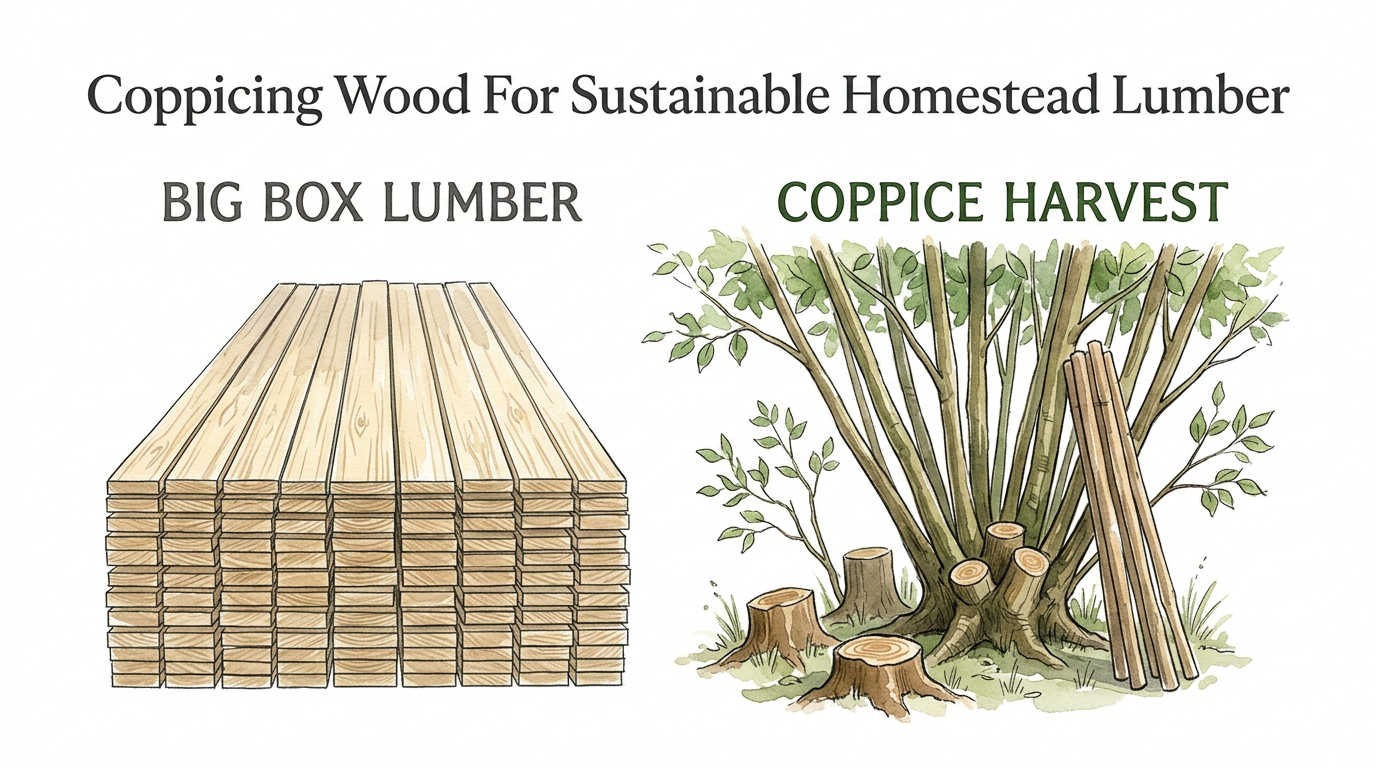
Coppicing Wood For Sustainable Homestead Lumber
Coppicing is a traditional method of woodland management where a tree is cut down to its base, or “stool,” during the dormant winter months. Instead of dying, the tree responds to this disturbance by sending up a flurry of new shoots from the dormant buds around the stump. These shoots utilize the tree’s massive, established root system to skyrocket upward, often growing several feet in a single season.
This technique exists because it mirrors the natural disturbances trees evolved to survive, such as fire, heavy ice damage, or animal browsing. On a homestead, we harness this survival instinct to produce specific types of wood. By harvesting these shoots on a regular rotation, we create a permanent source of timber that never requires replanting. It is the definition of a regenerative system.
In the real world, coppicing is used to produce everything from delicate weaving willow for baskets to heavy oak for firewood and charcoal. Historically, it was the backbone of rural economies. Hazel was cut for hurdles and bean poles, while sweet chestnut was favored for its natural rot resistance in fencing. Today, it remains a vital tool for the modern pioneer looking to decouple their life from the industrial supply chain.
How the Coppice Cycle Works
The process begins with the “establishment cut.” You select a young deciduous tree, typically between seven and ten years old, and fell it during the winter when the sap is down in the roots. This dormant-season harvest is critical because it ensures the tree has the energy reserves to push out new growth as soon as the ground warms in the spring.
Once the tree is cut, you are left with the stool. This stool is the “engine” of your wood production. From this point on, you will never need to fell the entire tree again. You simply harvest the stems that grow from it once they reach the desired thickness. The frequency of your harvest—known as the rotation—determines the type of wood you get.
- Short Rotations (3–7 years): Ideal for willow and hazel. This produces flexible, thin rods perfect for weaving, garden stakes, and “pea sticks.”
- Medium Rotations (7–15 years): Used for hazel, ash, and chestnut. This yields sturdy poles for fencing, tool handles, and small construction projects like shed framing.
- Long Rotations (20–50 years): Typically reserved for oak and chestnut. This produces heavy timber for fence posts, beams, and high-energy firewood.
Managing the stool requires a sharp eye and a clean cut. You must cut the stems as close to the ground as possible, usually within 10 to 20 centimeters. This encourages the new shoots to form their own root systems over time, further strengthening the stool. Angling the cut slightly helps shed water, preventing the center of the stool from rotting during the wet spring months.
Advantages of the Living Lumber Yard
The primary benefit of coppicing is the sheer volume of wood it produces compared to traditional felling. Research suggests that a managed coppice can produce up to 13 to 20 times more usable wood per acre than a forest where trees are left to grow to full maturity. Because you are harvesting “underwood” rather than entire trees, the canopy stays open, allowing sunlight to hit the forest floor and stimulating a massive increase in biodiversity.
Coppicing also dramatically extends the life of a tree. While an unmanaged willow might live for 70 years, a coppiced willow stool can live for centuries. Some ancient stools in Europe have been measured at over 18 feet across, indicating they have been harvested for over a thousand years. This longevity makes your woodlot a legacy project that will serve your grandchildren better than it serves you.
Sustainability is built into the very DNA of the practice. There is no need for heavy machinery that compacts the soil, no need for chemical fertilizers, and no need for the massive carbon footprint of transporting lumber from a distant mill. The wood you harvest is carbon-neutral and perfectly adapted to your local climate because it grew right there in your soil.
Challenges and Common Mistakes
The biggest mistake beginners make is felling at the wrong time of year. Cutting a tree in the middle of summer when the sap is high can shock the system, leading to a weak regrowth or even the death of the stool. Summer-cut wood is also less durable because the high sap content makes it more prone to rot and insect infestation. Always wait for the leaves to drop and the tree to go dormant.
Neglecting protection is another common pitfall. New coppice shoots are incredibly tender and are the favorite snack of deer, rabbits, and livestock. A single hungry deer can wipe out an entire year’s growth in a few hours. You must protect your newly cut stools with fencing or by piling “brash” (the leafy tops of the harvested wood) over the stumps to create a natural thorny barrier.
Failure to thin the shoots can also lead to poor results. In the first year, a stool might send up fifty tiny shoots. If left alone, these will compete for light and space, resulting in a bundle of thin, spindly sticks. Serious practitioners often thin these out after the second year, leaving only the strongest 8 to 12 stems to grow into high-quality poles.
Limitations and Environmental Constraints
Not every tree is a candidate for this method. Most conifers, such as pine, spruce, and fir, will simply die if cut to the ground. There are a few rare exceptions like Yew and Coast Redwood, but for the most part, your coppice will be a broadleaf affair. If your land is entirely dominated by softwoods, you will need to plant a new stand of suitable deciduous species.
The physical labor involved is also a reality that cannot be ignored. While you don’t need a massive tractor, you do need a high level of “pioneer grit.” Felling, dragging, and processing poles by hand is an honest day’s work that requires stamina and the right tools. If you have physical limitations, managing a large-scale coppice on your own may prove difficult.
Environmental factors like shade can also limit your success. Coppice stools need sunlight to trigger vigorous regrowth. If your woodlot has a thick overhead canopy of “standard” trees (large, uncut trees), the stools beneath them will eventually weaken and die. You must maintain an open canopy—ideally no more than 40% cover—to keep the living lumber yard productive.
Big Box Lumber vs. Coppice Harvest
When we look at the comparison between industrial lumber and homestead-grown coppice, the differences are measurable and significant. Choosing between them is often a choice between convenience and long-term resilience.
| Feature | Big Box Treated Lumber | Homestead Coppice Wood |
|---|---|---|
| Initial Cost | Expensive; rising yearly | Free (after establishment) |
| Chemical Impact | Contains copper, biocides, microplastics | 100% Organic and biodegradable |
| Renewal | Non-renewable (requires replanting) | Indefinite; stools live centuries |
| Versatility | Standard sizes only | Infinite (weaving to heavy beams) |
| Tool Requirement | Power saws, drills | Hand tools (billhook, bowsaw) |
Purchasing lumber from a store provides immediate gratification but comes with hidden costs. Treated wood leaches chemicals into your garden soil, which can be a concern for organic growers. Coppice wood, on the other hand, is a product of your own soil. When a coppiced fence post finally rots after twenty years, it simply returns its nutrients to the earth, completing the cycle.
Practical Tips and Best Practices
Getting started requires the right tools. The billhook is the quintessential tool for the woodman. Its curved blade is designed to catch a stem and sever it with a single, powerful stroke. It also doubles as a tool for de-limbing and splitting small poles. For larger stems, a sharp folding saw or a bowsaw is indispensable. Sharpness is safety; a dull blade requires more force and is more likely to slip.
Divide your woodlot into “coupes.” Instead of cutting everything at once, harvest one small section each year. If you have a seven-year rotation, divide your land into seven sections. This ensures that you have a fresh crop of wood every single winter and creates a mosaic of habitats for local wildlife. Some sections will be fresh clearings, while others will be dense thickets of mid-growth.
Season your wood properly before use. While garden stakes can be used “green” (freshly cut), wood intended for construction or fuel should be stacked in a “cord” to dry. Small poles usually season in about a year if kept under a simple roof or tarp with good airflow. Well-seasoned coppice wood burns hot and clean, providing a superior fuel source for wood stoves and outdoor kitchens.
Advanced Considerations: Coppice With Standards
Serious practitioners often move beyond “simple coppice” to a system called “coppice with standards.” In this setup, you leave a few select trees to grow to their full, magnificent height while coppicing everything else around them. These “standards” are harvested on a much longer cycle, perhaps every 80 to 100 years, to provide massive beams for house building or high-grade saw logs.
This system is the pinnacle of multi-functional land use. The coppice layer provides your annual needs for fencing and fuel, while the standards provide shade, acorns for livestock, and long-term capital in the form of heavy timber. It creates a structured, multi-story forest that mimics an old-growth ecosystem while remaining highly productive for human use.
Layering is another advanced technique for expanding your woodlot without buying new saplings. If a stool dies or you want to fill a gap, you can take a long, flexible shoot from a nearby healthy stool, bend it to the ground, and bury a section of it. Over the next year, it will develop its own roots. Once established, you cut the umbilical cord to the parent plant, and you have a brand-new stool ready for harvest.
Scenario: Building a Garden Fence from Scratch
To understand the power of this system, consider the task of fencing a quarter-acre garden. At a big-box store, you would spend hundreds of dollars on cedar posts and wire. Using a managed sweet chestnut coppice, the process is entirely different.
First, you head to your woodlot in late January. You select 15-year-old chestnut poles for the main posts because chestnut is naturally saturated with tannins that resist rot. You fell them with a bowsaw and use your billhook to strip the bark. These posts are then driven directly into the ground.
Next, you move to your 7-year-old hazel coupe. You cut dozens of flexible rods, roughly an inch thick. These are woven between the chestnut posts in a “wattle” pattern. The result is a beautiful, wind-resistant, and incredibly sturdy fence that cost you nothing but a few afternoons of satisfying labor. This fence will last for a decade or more, and by the time it needs replacing, your hazel and chestnut stools will have regrown the materials for a new one several times over.
Final Thoughts
Coppicing is more than just a way to get free wood. It is a way of life that reconnects us to the rhythms of the seasons and the inherent abundance of the natural world. It teaches us that we do not have to be mere consumers of resources; we can be active participants in their creation.
The grit required to manage a stool and the patience to wait for a rotation are virtues that pay dividends far beyond the woodpile. By establishing a coppice system today, you are securing your homestead’s future and ensuring that you will always have the tools and materials you need to build, fix, and grow.
Start small. Plant a few willows or hazels along a fence line this spring. Learn the weight of the billhook and the feel of the grain. In a few years, when you harvest your first bundle of bean poles, you will realize that the best building materials aren’t found in a store—they are grown in the soil under your feet.
