How To Become More Self-Sufficient Without Starting a Full-Blown Farm…
Want to start preserving your harvest, making your own soap, or building a backyard root cellar — but not sure where to begin? “Homesteading Advice” gives you instant lifetime access to 35+ practical homesteading books on food preservation, veggie gardening, DIY natural cleaning products (save over $250 per year with this skill alone), brewing, off-grid energy, and a whole lot more…
Click Here To Check It Out Now!
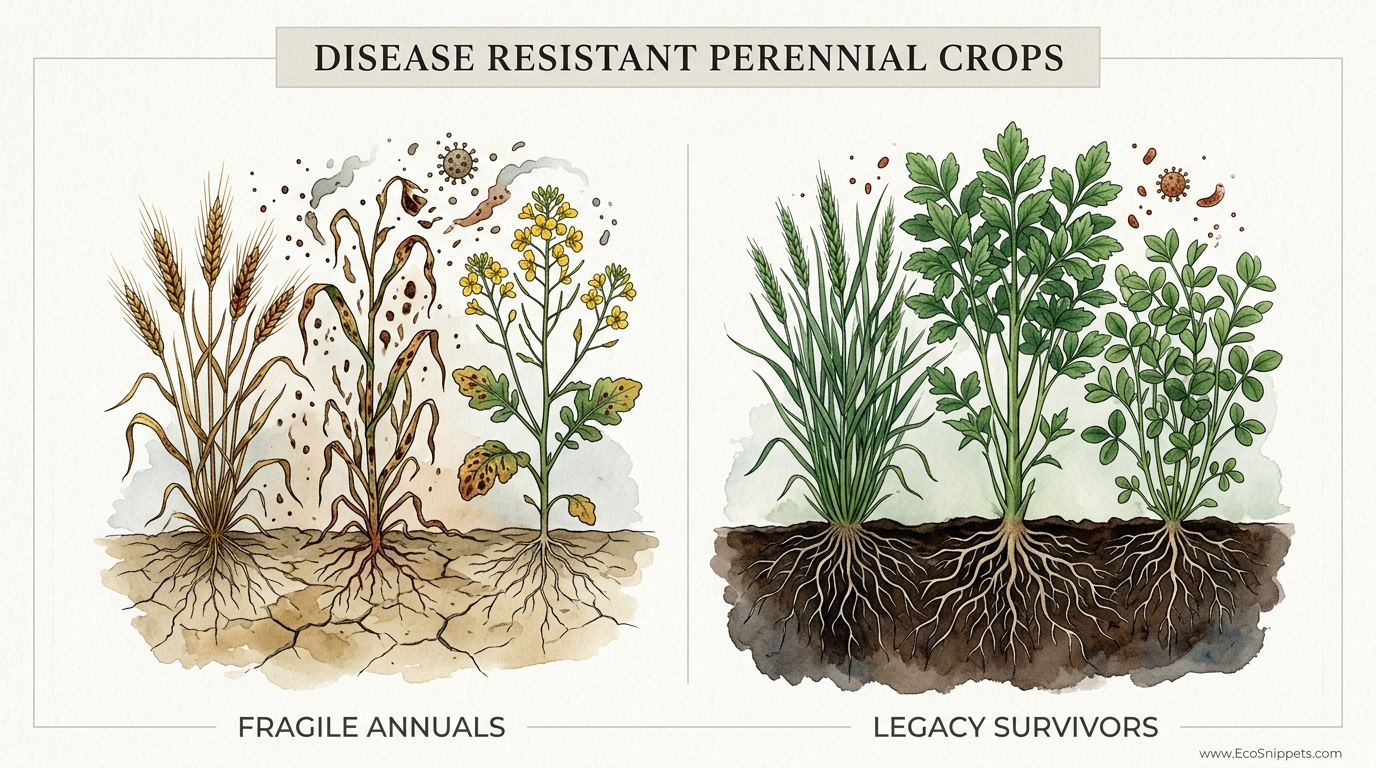
One of these plants needs a pharmacy to survive the summer; the other was built by 100 years of survival. We have traded centuries of genetic resilience for ‘bigger, faster’ annuals that fold at the first sign of a fungus. While modern hybrids require a constant cocktail of sprays to finish a single season, legacy perennials stand strong, defended by generations of adaptation. Stop medicating your garden and start planting the survivors that don’t need you to play doctor.
Modern agriculture has spent the last century sprinting toward a finish line of maximum yield. In that race, we left behind the very traits that allowed plants to thrive without human intervention. We created high-performance annuals that produce massive fruit but possess the immune system of a Victorian poet. These fragile crops depend on a life-support system of synthetic fungicides, fertilizers, and constant irrigation just to stay upright.
Legacy survivors offer a different path. These are the plants that our ancestors relied upon—crops that didn’t just grow, but endured. When you shift your focus to perennial systems, you are investing in a biological infrastructure that grows stronger every year. You are moving away from the “pharmacy model” of gardening and toward a system of self-defending resilience.
This guide explores the world of perennial crops that have earned their keep through decades of survival. We will look at why these plants are naturally resistant to the diseases that decimate modern gardens and how you can integrate them into your own landscape. It is time to stop the cycle of constant intervention and start working with the genetics of the survivors.
Disease Resistant Perennial Crops
Disease resistant perennial crops are the veterans of the botanical world. Unlike annuals that live for a single season, these plants are designed to persist for decades or even centuries. They have developed a sophisticated array of internal defenses and external partnerships that protect them from the pathogens that thrive in the soil and air.
The core difference lies in how these plants allocate their energy. An annual plant is a gambler; it puts every ounce of its resource into producing a massive seed crop before it dies. It has no “savings account” for defense. A perennial is an investor. It directs a significant portion of its energy into building a massive root system and a complex chemical defense suite. This allows the plant to survive a bad year and come back even stronger the next.
In the real world, these crops are the backbone of sustainable food forests and permaculture systems. They are found in the old farmsteads where a 150-year-old rhubarb patch still produces stalks every spring without a single drop of pesticide. They are seen in the wild elderberry thickets that shrug off the leaf spots that would kill a modern tomato. These plants are built for the long haul.
Using these crops means you are no longer fighting nature. Instead, you are harnessing the result of millions of years of evolutionary pressure. These plants don’t just resist disease; they often improve the health of the soil around them, making the entire garden more resilient to future threats.
The Mechanics of Natural Immunity
Perennial plants do not just “happen” to be healthy. Their resilience is the result of specific biological mechanisms that annuals lack. Understanding these processes helps you appreciate why a legacy survivor is a better investment than a fragile hybrid.
Deep Root Systems and Resource Buffering
The most visible advantage of a perennial is its root system. While a corn plant might have roots that reach a few feet down, a perennial grain like Kernza or a nut tree can send roots dozens of feet into the earth. These deep roots access minerals and water that shallow-rooted annuals can never reach. This nutrient abundance provides the raw materials the plant needs to synthesize defense chemicals like tannins and alkaloids.
Water stability is equally important for disease resistance. Many fungal pathogens strike when a plant is stressed by drought. Because perennials can tap into deep groundwater, they maintain their turgor pressure and metabolic functions even during dry spells. A hydrated plant is a defended plant.
The Mycorrhizal Shield
Perennials live long enough to form permanent, symbiotic relationships with arbuscular mycorrhizal fungi (AMF). These fungi weave themselves into the plant’s root cells, effectively extending the root surface area by hundreds of times. In exchange for sugars, the fungi provide phosphorus and other hard-to-find nutrients.
This partnership serves as a literal physical barrier. The fungal hyphae occupy the space around the roots, making it difficult for pathogenic fungi to gain a foothold. Furthermore, these fungi trigger “induced systemic resistance” (ISR) within the plant. This is essentially a biological alarm system that keeps the plant’s immune response in a state of high alert, allowing it to react faster to an invading pathogen.
Secondary Metabolites: The Internal Laboratory
Legacy survivors are master chemists. Over generations, they have perfected the production of secondary metabolites—compounds that aren’t necessary for growth but are essential for defense. These include salicylic acid, which acts as a signaling hormone for the immune system, and various polyphenols that make the plant’s leaves unpalatable or toxic to pathogens.
Modern breeding for “sweetness” and “size” often accidentally breeds out these bitter, defensive compounds. When you plant a legacy variety, you are bringing back the full chemical arsenal that nature intended for the plant’s protection.
Benefits of Choosing Legacy Survivors
Choosing disease-resistant perennials provides more than just a reduction in disease pressure. The benefits ripple out across your entire gardening experience, saving you time, money, and frustration.
The primary advantage is the radical reduction in labor. Annual gardens require a grueling cycle of tilling, planting, weeding, and spraying every single year. Perennials, once established, require only occasional pruning and mulching. You are building a system that does the work for you, allowing you to spend more time harvesting and less time “doctoring” your crops.
Financial savings are another major factor. While a perennial plant may have a higher upfront cost, it is a one-time investment. You aren’t buying new seeds or starts every spring. Furthermore, the need for expensive fungicides and fertilizers drops significantly. Over a ten-year period, a perennial asparagus bed is exponentially cheaper than a decade of growing annual broccoli.
Ecological benefits are perhaps the most profound. Perennial systems are carbon-sequestering machines. Because the soil is never tilled, the carbon remains locked in the earth, and the soil microbiome remains undisturbed. These systems also prevent erosion and provide a stable habitat for beneficial insects and birds that help manage pest populations naturally.
Challenges and Common Pitfalls
Moving toward a perennial-focused garden isn’t without its hurdles. The most frequent mistake is treatng a perennial like an annual. If you apply the same management techniques to both, the perennial will likely struggle.
Patience is the biggest challenge. We live in an “instant gratification” culture, and waiting three to five years for a chestnut tree to produce can feel like an eternity. Gardeners often get discouraged during the “sleep, creep, leap” phase of perennial growth. In the first year, they sleep (focus on roots); in the second, they creep (slow top growth); and only in the third do they leap into full production.
Poor Site Selection
With an annual, a bad location is a one-year mistake. With a perennial, it is a decade-long disaster. Many gardeners fail to account for the ultimate size of the plant or the long-term drainage of the soil. Because you cannot rotate these crops to a new bed every year, you must ensure the soil health and drainage are perfect before the plant ever goes into the ground.
The “Set It and Forget It” Myth
While perennials are low maintenance, they are not “no maintenance.” Neglecting to mulch or prune can lead to a buildup of old, diseased wood and competitive weeds. Even the toughest survivors need a little help during their first two years of establishment. Failure to provide consistent water during that initial phase is the leading cause of perennial failure.
Limitations and Realistic Constraints
Perennial crops are not a magic bullet for every situation. There are realistic boundaries to what they can achieve, and understanding these trade-offs is essential for a balanced garden plan.
One major limitation is climate specificity. Many legacy survivors are highly adapted to a very specific region. A pear variety that is “indestructible” in the damp heat of the South might succumb to fire blight in the cool, humid Northeast. You cannot simply pick a plant from a catalog; you must pick a plant that has a history of survival in your specific hardiness zone and soil type.
Yield timing is another trade-off. Perennials often have a very specific, short harvest window compared to the “cut and come again” nature of many annuals. An asparagus bed gives you six weeks of abundance and then requires the rest of the year for recovery. To have food throughout the season, you must plant a wide diversity of perennials that ripen at different times.
Finally, there is the issue of “the ghost of disease past.” Because perennials stay in the same spot for years, certain soil-borne pathogens can slowly build up over time. While the plants are resistant, they are not always immune. If a specific virus or fungus does manage to infect a perennial, it can be permanent, often requiring the removal of the entire plant to prevent further spread.
Legacy Survivors vs. Fragile Annuals
The following table illustrates the fundamental differences between the two systems based on maintenance, cost, and biological resilience.
| Feature | Fragile Annuals | Legacy Survivors (Perennials) |
|---|---|---|
| Immune Strategy | Dependent on human sprays | Internal chemical suites & fungi |
| Root Depth | Shallow (6-24 inches) | Deep (5-30+ feet) |
| Nutritional Density | Often lower due to fast growth | High due to deep mineral access |
| Setup Cost | Low per year, high over time | High initially, zero over time |
| Labor Requirement | High (Tilling, Weeding, Spraying) | Low (Pruning, Mulching) |
Practical Tips for Success
Implementing a resilient perennial system requires a shift in strategy. Follow these best practices to ensure your survivors have the best chance to thrive.
1. Focus on the fungal ratio. Annuals love bacteria-dominated soil (the kind found in tilled gardens). Perennials need fungi-dominated soil. Stop tilling and start using wood-based mulches to encourage the growth of the beneficial fungi that protect perennial roots.
2. Plant in “Guilds.” Never plant a single species in a large block. Instead, create a polyculture. Plant your disease-resistant fruit trees with nitrogen-fixing shrubs and pest-repelling herbs. This diversity confuses pathogens and prevents the “buffet effect” that allows diseases to sweep through a monoculture.
3. Use local genetics. Seek out the “roadside survivors.” If you see a plum tree growing in a ditch, unmanaged and producing fruit without rot, that is a goldmine of genetics. Whenever possible, buy plants from nurseries that propagate from local, resilient stock rather than national big-box stores.
4. Don’t over-fertilize. Excessive nitrogen makes a plant grow fast, but it also creates weak, watery cell walls that are easy for fungi to penetrate. Use slow-release organic matter like compost and leaf mold to provide a steady, moderate supply of nutrients that builds strong, tough tissue.
Advanced Considerations for the Serious Practitioner
For those ready to move beyond basic gardening, the study of perennial resilience offers deep insights into plant genetics and site adaptation. One of the most fascinating areas is “epigenetics”—the way a plant’s genes respond to the environment without changing the DNA sequence itself.
A perennial that survives a harsh drought or a specific fungal outbreak can “remember” that stress. It can then pass on a primed immune response to its offspring through its seeds. This is how landraces are formed. By saving seeds from your own “survivors” over several decades, you are effectively breeding a variety that is tailor-made for your specific backyard.
Furthermore, consider the role of “horizontal resistance.” Most modern hybrids have “vertical resistance,” which means they are immune to one specific strain of a disease. If that strain mutates, the plant is defenseless. Legacy perennials often have horizontal resistance—a broad, multi-layered defense that is much harder for pathogens to overcome. It may not provide 100% immunity, but it ensures the plant survives and produces even under pressure.
Examples of Resilient Crops in Practice
To visualize how this works, let’s look at three specific examples of legacy survivors that consistently outperform their annual counterparts.
The Asparagus Veteran
A well-prepared asparagus bed can produce for 25 to 50 years. Unlike annual lettuce that wilts at the first sign of heat or powdery mildew, asparagus has deep crown reserves and tough, fern-like foliage that is remarkably resistant to most common garden diseases. Its main defense is its timing; it emerges and finishes its primary growth before many summer pathogens even wake up.
The American Persimmon
While modern grocery store apples are a nightmare of scab, fire blight, and codling moth, the native American Persimmon is almost entirely pest and disease-free. It has evolved alongside local pathogens for thousands of years. It produces a high-calorie, nutrient-dense fruit with absolutely zero requirement for chemical sprays. It is the ultimate “plant and forget” tree for a survival garden.
The Sea Kale (Crambe maritima)
If you struggle with the constant battle of cabbage worms and clubroot in your annual kale and broccoli, look to Sea Kale. This perennial brassica has thick, waxy, blue-grey leaves that act as a physical armor. It is a hardy survivor of coastal environments, meaning it can handle poor soil and salt spray that would kill almost any other vegetable. It provides delicious spring shoots year after year without the need for a pharmacy.
Final Thoughts
Building a garden around disease-resistant perennial crops is an act of defiance against a food system that prioritizes fragility for the sake of profit. It is a return to the common sense of our ancestors, who knew that a plant that requires a constant “cocktail of sprays” is not a reliable source of food. By choosing the survivors, you are investing in a future that is defined by resilience rather than dependence.
Start small. Replace one row of annual vegetables with a permanent bed of rhubarb or sunchokes. Plant a single resistant fruit tree on a heritage rootstock. Watch how these plants respond to the challenges of the season. You will soon find that the less you play doctor, the more your garden thrives. The genetics for survival are already there; you just need to give them a place to grow.
As you move forward, remember that you aren’t just growing food; you are stewarding a legacy. Every year your perennials stay in the ground, they become more attuned to your soil and your climate. They are becoming the legacy survivors of the next century. Stop fighting nature and start planting the crops that were built to win.
