How To Become More Self-Sufficient Without Starting a Full-Blown Farm…
Want to start preserving your harvest, making your own soap, or building a backyard root cellar — but not sure where to begin? “Homesteading Advice” gives you instant lifetime access to 35+ practical homesteading books on food preservation, veggie gardening, DIY natural cleaning products (save over $250 per year with this skill alone), brewing, off-grid energy, and a whole lot more…
Click Here To Check It Out Now!
Will your energy storage be a pile of chemical waste in 10 years, or a legacy that still works for your grandkids? Chemical batteries are a race against time. From the day they are made, they begin to die. Gravity storage—using a simple weight and a pulley—can last for a century with nothing more than a bit of grease on the gears. It’s time to stop thinking in years and start thinking in generations.
Modern homesteading often feels like a high-tech tightrope walk. You rely on solar panels and wind turbines, but the heart of the system—the battery—is often its weakest link. We’ve been told that lithium-ion is the only way forward, yet we watch as those expensive blue or black boxes lose capacity every winter.
Mechanical energy storage offers a different path. It is the wisdom of the grandfather clock applied to the scale of a cabin or a workshop. By lifting a heavy mass when the sun is high and letting it descend when the lights go out, you are essentially storing “height” as fuel. It is simple, rugged, and entirely transparent.
DIY Mechanical Battery For Homestead Power
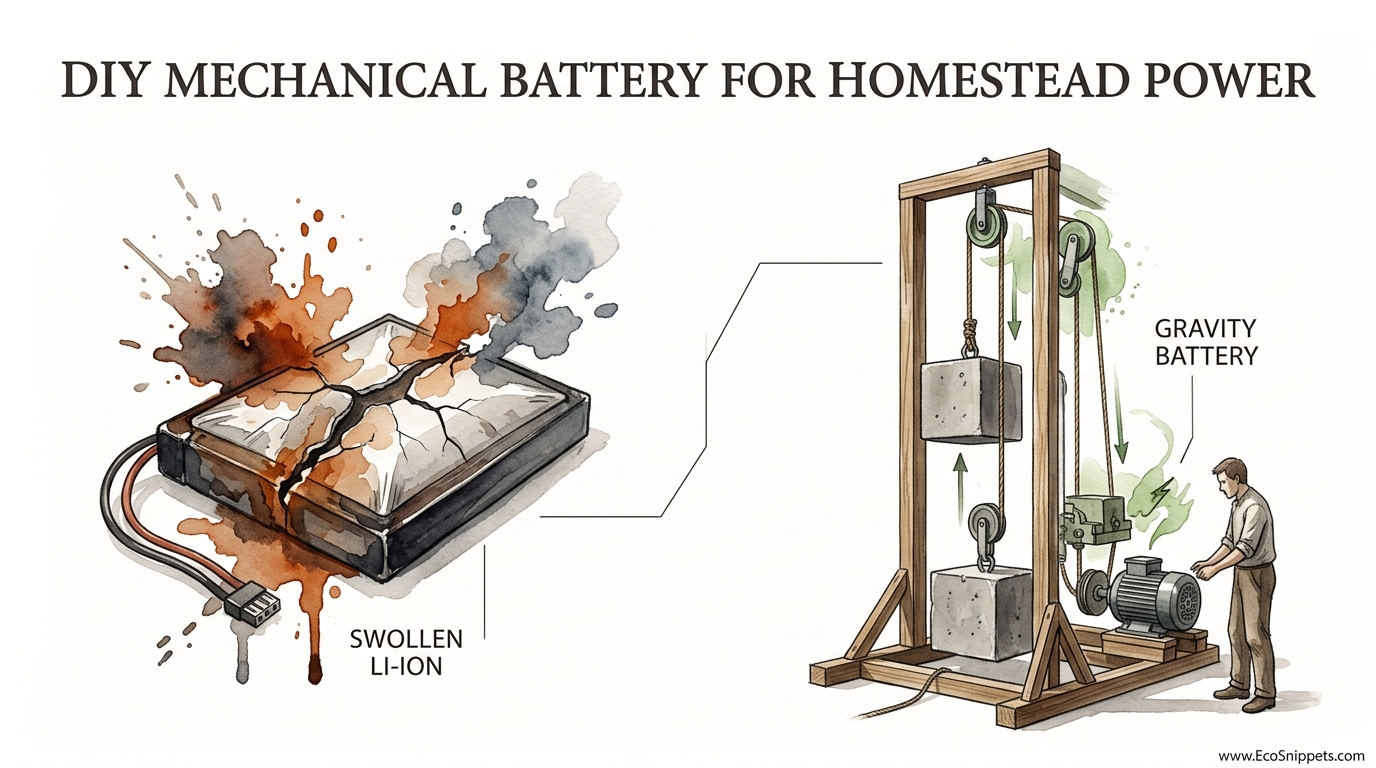
A DIY mechanical battery, specifically a gravity energy storage system, is a device that stores electricity as potential energy. Instead of moving ions through a chemical slurry, you are moving a physical weight against the pull of the earth. It is a system built of iron, stone, and cable rather than lithium and cobalt.
In the real world, this concept has existed for centuries. Water towers use gravity to maintain pressure; old-fashioned weights keep clocks ticking for days. On a homestead, this might look like a concrete block in a disused well, a sled of rocks on a steep hillside, or a heavy weight suspended from a tripod in the barn. It exists because it solves the one problem chemical batteries can’t: the inevitability of decay.
Think of it as a physical bank account. When your solar panels produce more power than you can use, a motor winds a cable, pulling a heavy weight up. When the sun sets, the process reverses. The weight pulls the cable, which spins the motor (now acting as a generator) to produce electricity. It is a slow, steady, and visible way to manage your power.
How It Works: The Physics of Potential Energy
Understanding the “battery” starts with the formula for potential energy: Energy = mass × gravity × height. Every pound you lift and every foot of height you gain adds to your energy reservoir. The system consists of four primary components that work in a closed loop.
The Weight (The Storage Medium)
Unlike a swollen li-ion cell that might bulge and fail, a block of concrete or a crate of scrap metal is immortal. You need mass, and plenty of it. High-density materials like lead, iron, or even packed earth are ideal. For a homestead, concrete is the most accessible choice because it can be cast into any shape and is weather-resistant.
The Winch and Gearbox (The Transmission)
The winch is the bridge between the electrical and mechanical worlds. To store energy efficiently, you need a high-torque gearbox. This allows a small, high-speed motor to lift a massive weight slowly. When discharging, the gearbox prevents the weight from falling too fast, ensuring a steady 60Hz or DC output for your appliances.
The Motor-Generator (The Converter)
Most DIY systems use a Permanent Magnet DC (PMDC) motor or a brushless motor. These are efficient because they can easily switch roles. Apply power, and they lift; pull the shaft with a weight, and they generate. Choosing a motor with a high “back EMF” constant ensures you get more volts at lower RPMs during the descent.
The Control System (The Brain)
You need a way to tell the weight when to stop. Limit switches at the top and bottom prevent the cable from snapping or the weight from crashing into the ground. A charge controller or a simple voltage-sensitive relay (VSR) can trigger the lifting motor when your solar panels hit “float” stage, signifying you have excess energy to burn.
Benefits of Mechanical Storage
The primary advantage of gravity storage is its unlimited cycle life. While a lithium battery might be rated for 3,000 to 6,000 cycles, a well-built mechanical system can cycle 50,000 times with no loss in capacity. A concrete block weighs exactly the same after 50 years as it did on day one.
Safety is another significant factor. Mechanical batteries do not suffer from thermal runaway. They don’t require complex cooling systems, and they won’t vent toxic gases if they are overcharged. If the system fails, it’s usually a mechanical break that can be fixed with a welder or a new length of cable, rather than a catastrophic fire that levels your shed.
Finally, there is the matter of environmental grit. You can build a gravity battery using 90% recycled materials. Old elevator motors, scrap steel, and rocks from your own land can form the bulk of the system. This reduces your reliance on global supply chains and puts the power of repair back into your hands.
Challenges and Common Mistakes
The most common pitfall for the DIYer is underestimating the mass required. Gravity is a “weak” force compared to chemical bonds. Lifting a 100-pound weight up 10 feet only stores about 0.004 kWh of energy. To power a single 100-watt lightbulb for an hour, you would need to lift that same 100 pounds nearly 300 feet in the air.
Friction is the silent thief of mechanical energy. Every pulley and gear tooth in your system introduces a loss. If you use cheap, unlubricated bushings, you might lose 40% of your energy just trying to overcome the “stickiness” of the machine. Using high-quality ball bearings and keeping your gears greased is the difference between a functional battery and a heavy lawn ornament.
Cable management is also a frequent failure point. As the weight moves, the cable must spool evenly onto the drum. If it bunches up or “birds-nest,” the effective diameter of the winch changes, which alters your gear ratio and can lead to erratic power output or snapped lines. Implementing a “level-wind” mechanism, similar to what you’d find on a fishing reel or a winch, is a best practice for long-term reliability.
Limitations: When Gravity Isn’t Enough
Gravity storage is not a high-density solution. It cannot compete with the compact nature of a swollen li-ion vs gravity battery comparison when space is at a premium. If you live in a flat area without a deep well or a high cliff, the structural cost of building a tower to get the necessary height often outweighs the benefits.
The response time is also slower than electrochemical options. A battery can react to a surge in milliseconds. A mechanical system has to overcome inertia to start moving. For this reason, gravity batteries are best used as “base load” support—running the steady, low-draw items like LED lights or a small fridge—rather than handling the massive surge of a well pump or a table saw.
Mechanical vs. Chemical Storage Comparison
| Feature | Chemical (Li-Ion) | Mechanical (Gravity) |
|---|---|---|
| Lifespan | 5–15 Years | 30–100 Years |
| Degradation | 2–5% Per Year | 0% |
| Maintenance | None (Replaceable) | Lubrication & Inspection |
| Fire Risk | High (Thermal Runaway) | Zero |
| DIY Friendly | Low (Complex BMS) | High (Mechanical Skills) |
Practical Tips for a Homestead Setup
If you are serious about building one, start with a vertical shaft. If your property has an old, dry well, you have a ready-made “battery case” that is protected from the wind and elements. A 50-foot deep well provides a significant head start on potential energy without needing to build a towering structure.
Use “block and tackle” pulleys to multiply your force. While this requires more cable and more time to lift, it allows you to use smaller, more efficient motors. For example, a 3:1 pulley ratio lets a motor that can only lift 500 pounds handle a 1,500-pound concrete block. This slow-and-steady approach is the hallmark of a reliable mechanical system.
Consider the “hybrid” approach for homesteading. Use a small chemical battery bank to handle the quick surges and “spiky” loads, and use your gravity battery to store the massive surplus of a sunny summer week. This takes the heavy cycling off your chemical batteries, extending their life significantly while providing a deep-storage backup for long-duration needs.
Advanced Considerations: Regenerative Braking
For those looking to push the efficiency of their system, look into regenerative motor controllers. These are often found in electric golf carts or industrial elevators. They are designed to take the energy generated during a descent and clean it up into a stable voltage that can be fed directly into your inverter or house bus.
Scaling is another advanced factor. Instead of one massive weight, consider a “multi-weight” system. By using several smaller weights on separate pulleys, you can engage them one by one. This allows you to “step down” your power delivery, keeping the generator in its peak efficiency RPM range regardless of how much power you are actually drawing in the house.
Scenario: The “Old Well” Powerhouse
Let’s look at a practical application. A homesteader in Appalachia has a dry well that is 60 feet deep. He casts three concrete cylinders, each weighing 1,000 pounds, for a total of 3,000 pounds of mass. He uses a 24V PMDC motor geared down 100:1 and a high-strength synthetic winch line.
On a sunny Tuesday, his 1kW solar array finishes charging his small starter batteries by noon. The control system engages the winch, and for the next four hours, the excess solar power slowly crawls those 3,000 pounds from the bottom of the well to the surface. He has effectively “stored” the afternoon sun as height.
That night, when he turns on his LED lights and a small radio, the weight begins its descent. It moves so slowly it’s almost imperceptible, but it spins the motor fast enough to generate a steady 28 volts. This trickle-charges his small battery bank all night long, ensuring he wakes up to a full system without ever having touched his “emergency” chemical storage.
Final Thoughts
Mechanical batteries aren’t about cutting-edge performance; they are about endurance. In a world that prizes the newest, thinnest, and fastest, there is a profound logic in a system that relies on the fundamental gravity of the planet. It is a technology that respects the limits of materials and the laws of physics.
Building your own gravity storage requires a shift in mindset. You have to stop measuring energy in invisible amps and start measuring it in pounds and feet. It requires more sweat in the construction phase and more grease in the maintenance phase, but the payoff is a system that doesn’t expire.
If you’re tired of the planned obsolescence of modern electronics, look to the earth beneath your feet. A heavy weight and a strong cable might be the most honest energy storage you’ll ever own. Start small, experiment with gear ratios, and build something that your grandchildren might still be using to keep their lights on.
