How To Become More Self-Sufficient Without Starting a Full-Blown Farm…
Want to start preserving your harvest, making your own soap, or building a backyard root cellar — but not sure where to begin? “Homesteading Advice” gives you instant lifetime access to 35+ practical homesteading books on food preservation, veggie gardening, DIY natural cleaning products (save over $250 per year with this skill alone), brewing, off-grid energy, and a whole lot more…
Click Here To Check It Out Now!
The Declaration of Independence was written with this simple forest-foraged liquid—and it hasn’t faded yet. We’ve traded permanent, biological ink for plastic-encased chemicals that fade the moment the sun hits them. Oak gall ink was the standard for over a thousand years because it doesn’t just sit on the paper—it bonds with it. This weekend, go to the woods, find your galls, and brew a batch of ink that your great-grandchildren will still be able to read.
Modern writers often find themselves frustrated by inks that smudge or turn a ghostly grey after a few years on a shelf. Ancestral wisdom offers a solution that is as much a chemistry experiment as it is a craft. Iron gall ink, also known as common ink or registrar’s ink, was the lifeblood of the Western written word from the 5th century until the mid-20th century. It flowed from the pens of Leonardo da Vinci, Rembrandt, and Bach, carrying their genius across centuries without losing its depth.
Understanding this ink means understanding the relationship between a tiny wasp and the mighty oak. It is a product of nature’s defense mechanisms, refined by human ingenuity to create something truly indelible. When you make your own ink, you aren’t just creating a writing fluid; you are participating in a tradition of self-reliance that spans the history of civilization.
DIY Oak Gall Ink Recipe From Foraged Materials
Oak gall ink is a permanent, blue-black or purple-black ink created through a chemical reaction between tannic acid and iron salts. Unlike modern pigment-based or dye-based inks, this solution undergoes a transformation once it touches the page. It is essentially a liquid that turns into a permanent stain as it oxidizes in the air, etching itself into the fibers of the paper or parchment.
The foundation of the recipe is the oak gall, a spherical, woody growth found on the twigs and leaves of oak trees. These galls are not actually part of the tree’s natural growth cycle; they are the result of a parasitic wasp laying its eggs in the tree’s tissue. The tree, in an attempt to protect itself from the larvae, secretes a massive amount of tannic acid and forms a hard, protective “nut” around the intruder.
This high concentration of tannins is exactly what an ink maker needs. When these tannins are extracted into a liquid and mixed with iron—historically known as “copperas” or “green vitriol”—they form a complex known as ferrous tannate. To keep the ink from being too thin and to ensure it flows smoothly from a pen, a binder like gum arabic is added. The result is a fluid that goes on the page as a pale grey and darkens to a deep, soulful black within seconds.
The Basic Ingredient List
Gathering your materials is the first step in this journey of self-reliance. You will need:
- Oak Galls: Roughly 2 ounces (approx. 60 grams) of dried, crushed galls.
- Iron Source: 1 ounce (approx. 30 grams) of ferrous sulfate. Historically, pioneers used rusty nails soaked in vinegar, but pure ferrous sulfate crystals provide a more consistent result.
- Binder: 0.5 ounces (approx. 15 grams) of gum arabic. This is the hardened sap of the acacia tree.
- Liquid Solvent: 1 pint (approx. 500 ml) of distilled water, rainwater, or white wine.
- Preservative (Optional): A few cloves or a splash of high-proof alcohol to prevent mold.
How It Works: From Wasp to Writing
The process begins long before you step into the woods. A female gall wasp (typically of the Cynipidae family) selects a tender oak bud and injects her eggs. The tree responds to the chemical irritation of the larvae by growing a gall. These galls are incredibly rich in gallotannic acid, often reaching concentrations of 50% to 70% by weight.
Foragers should look for “marble galls,” which are hard, round, and about the size of a large cherry. These are the gold standard for ink making. If you find galls with a tiny hole in them, it means the wasp has already matured and exited. These “spent” galls are perfect for harvesting because you are no longer disturbing the insect’s life cycle.
The chemistry of the ink is a two-stage act. When you mix the tannin-rich liquid with iron sulfate, you create a water-soluble ferrous tannate complex. Because it is soluble, the liquid can penetrate deep into the paper’s structure. Once the ink is on the page and exposed to oxygen, it oxidizes into ferric tannate, an insoluble black pigment. This transformation is why iron gall ink is considered indelible; you cannot simply wash it off because the pigment is now physically part of the paper.
The Extraction Process
Crushing the galls is the first manual task. You don’t need to pulverize them into a fine dust, but breaking them into small, corn-kernel-sized pieces increases the surface area for the solvent to work. Some traditionalists prefer to “ferment” their galls by letting the crushed pieces sit in water for several days or even weeks. This allows mold to form, which enzymatically converts the gallotannic acid into gallic acid, resulting in a purer, darker black ink.
If you are in a hurry, you can boil the crushed galls in your liquid of choice for about 45 minutes. This “hot method” extracts the tannins quickly, though it may result in a slightly browner ink than the fermented cold method. After extraction, the liquid must be strained through a fine cloth or coffee filter to remove all woody debris.
Benefits of Using Traditional Oak Gall Ink
One of the greatest advantages of oak gall ink is its unmatched permanence. Modern inks rely on dyes that can be broken down by UV light or pigments that sit on the surface and can be rubbed away. Oak gall ink, however, is lightfast and water-resistant. Documents written with this ink hundreds of years ago remain as legible today as the day they were penned.
Another benefit is the ink’s unique behavior on different types of paper. Unlike modern fountain pen inks that may “feather” or bleed through cheap, porous paper, oak gall ink tends to stay where you put it. The acidic nature of the ink actually helps it “bite” into the paper, creating sharp, crisp lines that are a favorite among calligraphers and artists.
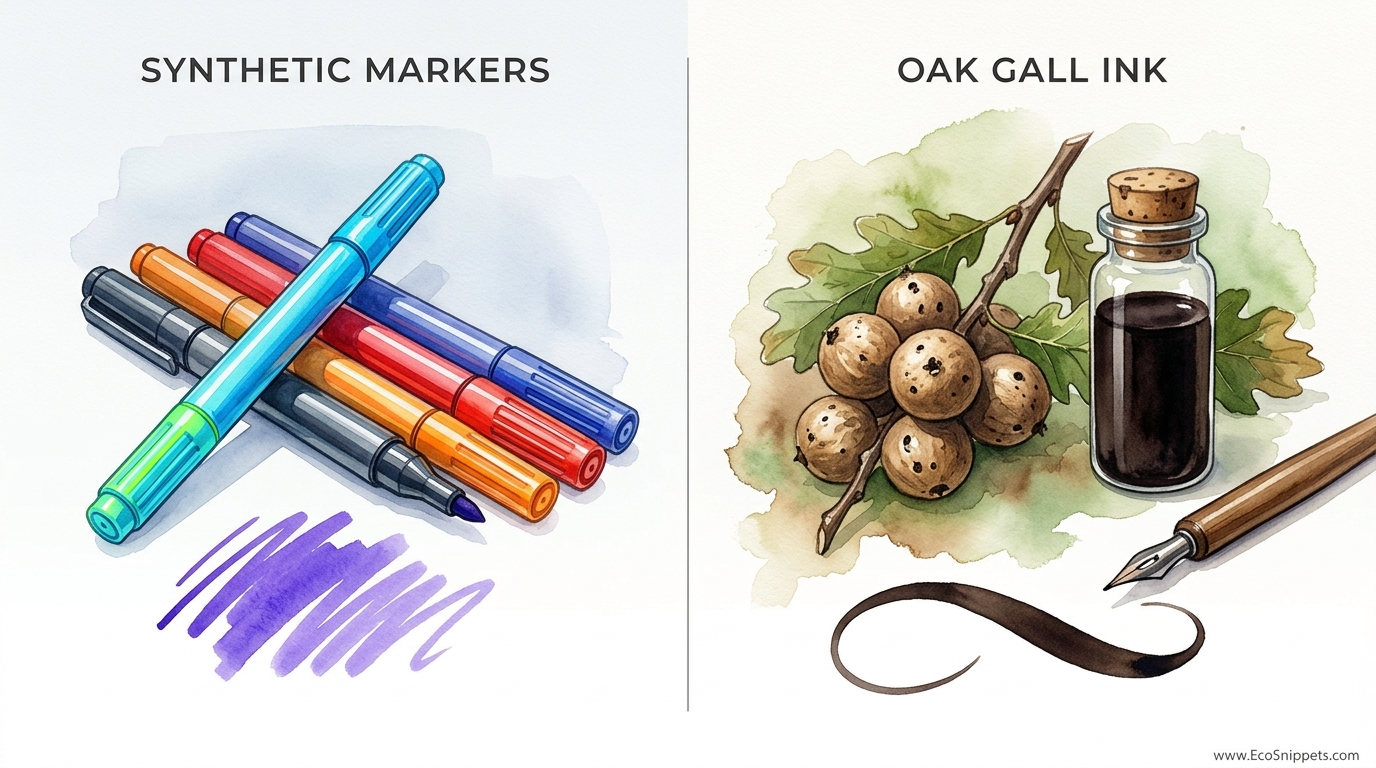
Furthermore, the “shading” of iron gall ink is legendary. As the ink oxidizes at different rates depending on how much was laid down by the pen, you get a beautiful variation in color—from deep midnight black to a soft, translucent charcoal. This gives the writing a depth and character that synthetic markers simply cannot replicate.
Challenges and Common Mistakes
The most significant challenge when working with oak gall ink is its inherent acidity. The reaction between tannins and iron produces sulfuric acid as a byproduct. In the past, poorly balanced recipes with too much iron would eventually eat through the paper, a phenomenon known as “ink corrosion.” This is why many historical manuscripts have “lace-like” holes where the letters used to be.
To avoid this, modern practitioners often follow a 3:1 ratio of galls to iron. This ensures that most of the iron is fully reacted and doesn’t remain as a “free” corrosive agent on the page. Another common mistake is using the wrong type of pen. Because the ink is acidic and contains iron, it will eventually corrode stainless steel nibs. Traditionalists use quills or reed pens, which are unaffected by the acid.
Mold is another frequent enemy of the ink maker. Since the ink is a biological product, it can easily become a breeding ground for fungi. Storing the ink in a cool, dark place and adding a few whole cloves or a small amount of alcohol can help keep the mixture shelf-stable for months or even years.
Limitations: When Not to Use Oak Gall Ink
Despite its many virtues, oak gall ink is not a universal tool. It should never be used in a high-end, vintage fountain pen with a steel nib unless the ink is specifically formulated for modern pens. The risk of corrosion and the tendency of the ink to form “sludge” or precipitates can ruin a delicate feed system. If you want to use it in a fountain pen, look for modern “safe” versions or stick to dip pens.
Environmental factors also play a role. While the ink is incredibly lightfast, the paper it is written on may not be. If you use highly acidic wood-pulp paper, the combination of the paper’s acid and the ink’s acid can accelerate the degradation of the document. For truly archival work, always pair your homemade ink with pH-neutral, high-quality rag paper or parchment.
Finally, the color development takes time. If you are looking for an “instant” jet-black experience the second the pen hits the page, you might be disappointed. The magic of oak gall ink is in the waiting—watching the pale grey lines slowly darken as they breathe in the oxygen around them.
Comparing Oak Gall vs. Synthetic Inks
| Feature | Oak Gall Ink | Synthetic Marker/Ink |
|---|---|---|
| Permanence | Centuries-long; bonds with fibers. | Decades; prone to UV fading. |
| Composition | Biological tannins & iron salts. | Petrochemical dyes & plastics. |
| Corrosivity | Acidic; can damage metal nibs. | Neutral; safe for all pens. |
| Cost | Low; mostly foraged materials. | Moderate; recurring purchases. |
Practical Tips and Best Practices
Foraging for galls is best done in late summer or early autumn. During this time, the galls have reached their maximum tannin content and have often fallen to the forest floor. Avoid green galls, as they are still “living” and difficult to process. If you are picking from the tree, a gentle twist should pop the gall off without damaging the branch.
When mixing your ink, use rainwater if possible. Tap water often contains minerals or chlorine that can interfere with the delicate chemical balance. Distilled water is a reliable alternative. If you choose to use wine, a dry white wine provides the necessary acidity to help the gallic acid develop without adding the heavy sugars found in reds, which can make the ink sticky.
Filtering is the most tedious but crucial part of the process. Use a double layer of cheesecloth for the first pass to remove the big chunks, followed by a fine coffee filter for the second pass. If your ink feels too “watery” on the pen, add a few more flakes of gum arabic. If it feels too “gloopish,” a few drops of water will thin it back out to a usable consistency.
Advanced Considerations for the Serious Scribe
Experienced ink makers often experiment with adding other botanical elements to modify the color. Logwood shavings can be added to the boil to introduce a purple or reddish tint, while pomegranate rinds provide an additional source of tannins. Some historical recipes even suggest adding a small amount of “lampblack” (soot) to the mixture so the scribe can see the ink more clearly as they write, before the oxidation process turns it black.
Another advanced technique involves managing the pH level of the ink. While the acidity is necessary for the reaction, some modern makers add a tiny amount of calcium carbonate to “buffer” the solution, slowing down the potential for paper corrosion without compromising the ink’s permanence. This is a delicate balance and requires a good understanding of the chemistry involved.
Scaling up your production requires careful storage. Always use glass or ceramic containers. Plastic can sometimes react with the acidic ink over long periods, and metal lids will corrode rapidly. A small glass jar with a glass stopper or a plastic-lined cap is the best way to keep your liquid history safe for the long haul.
Scenario: Writing the Family Journal
Imagine sitting down to start a family journal—a book intended to be passed down through five or six generations. You reach for a modern ballpoint pen, but a thought stops you. Will that ink still be there in 150 years? Likely not. It will have turned into a faint yellow smudge, or the paper will have become so brittle from the pen’s chemicals that it crumbles.
Instead, you take out your jar of homemade oak gall ink. You dip a simple glass pen or a hand-cut quill into the dark fluid. As you write, the letters appear as a soft, ethereal grey. By the time you reach the bottom of the first page, the top lines have already transformed into a deep, authoritative black. You know that as this ink dries, it is becoming one with the paper.
The entries you make today about the weather, the garden, and the milestones of your children are now effectively etched in time. If the house gets damp, the ink won’t run. If the book sits in a sunbeam, the words won’t vanish. You have used the same technology that preserved the Magna Carta and the notebooks of Leonardo, ensuring your own history remains part of the physical world.
Final Thoughts
Making your own oak gall ink is a profound act of rebellion against the disposable nature of modern life. It forces you to slow down, to walk in the woods, and to interact with the chemistry of the natural world. In an age of digital files that can be deleted with a click and plastic pens that are tossed into landfills by the billions, a bottle of forest-brewed ink is a statement of intent.
This process teaches us that the best tools are often found at our feet, hidden in the “trauma” of an oak tree or the industrious life of a tiny wasp. It reminds us that permanence is a choice—a commitment we make to the future by using materials that have already stood the test of time.
Take a Saturday to forage, a Sunday to brew, and the rest of your life to write. Whether you are signing a deed, sketching a landscape, or simply recording the quiet moments of your day, do it with an ink that is as resilient as the trees it came from. Experiment with your ratios, find your favorite oak grove, and rediscover the satisfaction of a pen that never truly fades.
