How To Become More Self-Sufficient Without Starting a Full-Blown Farm…
Want to start preserving your harvest, making your own soap, or building a backyard root cellar — but not sure where to begin? “Homesteading Advice” gives you instant lifetime access to 35+ practical homesteading books on food preservation, veggie gardening, DIY natural cleaning products (save over $250 per year with this skill alone), brewing, off-grid energy, and a whole lot more…
Click Here To Check It Out Now!
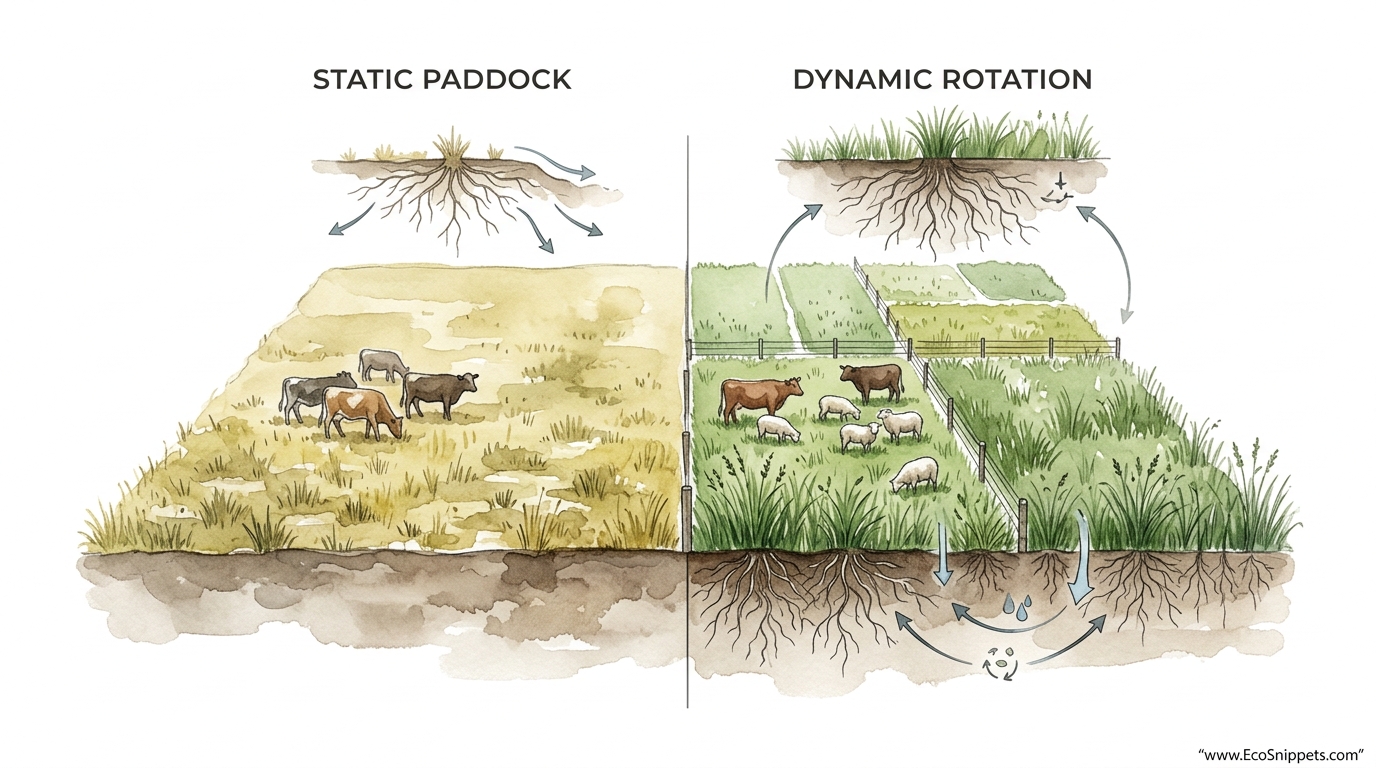
If your animals are standing on the same ground for more than three days, you aren’t farming—you’re managing a waste site. Static paddocks are a recipe for parasites and soil death. Shifting to dynamic rotational grazing turned our ‘dirt lot’ into a carbon-sequestering pasture that grows more food every year than the last. Moving the fence changes the future.
Modern farming often forgets that nature never intended for a cow or a sheep to stay in one place. Wild herds move across the plains, spurred by predators and the search for fresh forage. They graze a patch of grass once, stomp their manure into the soil, and move on, not returning for months. This natural cycle is the blueprint for self-reliance and land restoration.
Focusing on the movement rather than the enclosure is where the magic happens. Many folks see a fence as a way to keep animals in, but we see it as a tool to keep the land alive. This guide will walk you through the grit and the wisdom required to transition from a stagnant dirt lot to a thriving, perennial ecosystem.
Dynamic Pasture Management For Soil Health
Dynamic pasture management is a method of land stewardship that prioritizes the health of the soil microbiome and the recovery of forage plants. It exists as a direct alternative to continuous or static grazing, where livestock remain in the same field for the entire season. In a static system, animals selectively eat the tastiest grasses down to the roots while ignoring weeds, leading to a landscape dominated by thistles and bare dirt.
Regenerative grazing mimics the ancient relationship between ruminants and grasslands. Large herds of bison or elk once moved across the American West, providing a high-intensity “disturbance” followed by a long period of “rest.” This rest is the critical component that many modern managers miss. Soil is not just dirt; it is a living, breathing community of fungi, bacteria, and earthworms that requires organic matter and protection from the sun to thrive.
Real-world application of this concept involves dividing a large acreage into much smaller “paddocks” using portable electric fencing. Livestock are concentrated in one small area for a very short duration—often as little as 24 hours. This concentration forces them to eat more diversely and distribute their manure evenly across the entire field. Once they move to the next paddock, the previously grazed area is left untouched until the plants have fully recovered their energy reserves.
The Biology of the Bite: How It Works
Understanding the three phases of grass growth is the first step toward mastering the move. Phase one is the slow-growth period immediately after a plant has been bitten, where it relies on stored root energy to push out new leaves. Phase two is the “magic” window of rapid growth where the plant uses its broad leaves to photosynthesize and expand exponentially. Phase three occurs when the plant matures, goes to seed, and becomes woody and less nutritious.
Grazing should ideally occur at the tail end of phase two. If you let animals eat the grass too early (in phase one), you kill the roots and deplete the soil. If you wait until phase three, the forage loses its protein value and the animals won’t gain weight. Keeping the pasture in a perpetual state of phase two growth ensures the highest possible yield of high-quality feed.
The “Rule of Thirds” serves as the best practical guideline for the homesteader. Aim to let the animals eat one-third of the forage, tramp one-third into the ground as “armor” for the soil, and leave one-third standing to continue photosynthesis. Trampled grass acts as a mulch that feeds the soil microbes and prevents moisture from evaporating during the heat of the day.
Restoring the Land: The Benefits of Movement
Soil carbon sequestration is one of the most measurable benefits of a dynamic system. As plants grow deep roots during their rest periods, they pump liquid carbon (sugars) into the soil to feed beneficial fungi. This process builds topsoil much faster than any bag of fertilizer ever could. Farmers practicing these methods often report their soil organic matter increasing by several percentage points in just a few years.
Water retention is another practical advantage that protects the farm during a drought. Healthy, carbon-rich soil acts like a giant sponge. A single percent increase in soil organic matter can allow the land to hold an additional 20,000 gallons of water per acre. This resilience means your grass stays green and your animals stay fed long after your neighbor’s static pasture has turned brown and brittle.
Animal health improves dramatically when you break the parasite cycle. Most internal parasites, like the barber pole worm in sheep, hatch from eggs in manure and crawl up the first few inches of a grass blade. If you move your animals to fresh ground every few days and don’t return them for 40 to 60 days, the larvae die before they can find a host. This natural “deworming” reduces the need for chemical interventions and builds a hardier, more self-reliant herd.
Challenges and Common Mistakes
Infrastructure is the most common hurdle for those starting out. You cannot manage what you cannot control, and that means investing in high-quality perimeter fencing and a reliable energizer. Many beginners try to use cheap, thin polywire that doesn’t carry a strong enough “snap” to respect the animal’s boundaries. A weak fence leads to escaped livestock and a frustrated farmer.
Water access is the “umbilical cord” of rotational grazing. If animals have to walk a half-mile back to a central trough, they will create “cow paths” that erode the soil and compact the ground. Successful graziers often use a system of buried poly-pipe and quick-connect valves that allow them to move a portable water trough into whatever paddock the animals are currently occupying.
Waiting too long to move the fence is a mistake born of habit. It is tempting to look at a field that still has some green and think the animals can stay one more day. However, once the animals begin to “re-bite” the new growth on a plant they ate two days ago, you have officially entered the overgrazing zone. Observing the grass is more important than following a calendar.
Limitations: When the Method May Not Work
Extremely small acreages present a unique challenge for rotational systems. If you only have half an acre and three cows, no amount of fence-moving will provide enough rest for the grass to recover. In these cases, the land simply cannot support the stocking rate, and the “rotation” becomes a dry-lot management exercise where you must bring in outside hay to protect the soil.
Winter conditions in northern climates also change the rules of the game. When the grass is dormant and the ground is frozen, the biological recovery of the plants stops completely. While you can “bale graze” by moving hay rings around the field to distribute manure, you aren’t technically growing new forage. Managers in these regions must plan for a “dormant season” where the goal shifts from growth to simple maintenance.
Rugged, vertical terrain can make the physical act of moving fences a grueling chore. Lugging reels of wire and step-in posts up a 45-degree mountain slope every morning requires significant physical stamina. While the soil benefits are even greater on slopes due to erosion control, the labor requirements may be prohibitive for some operators without the help of specialized equipment or “virtual fencing” technology.
Static Paddocks vs. Dynamic Rotation
| Feature | Static Paddock (Continuous) | Dynamic Rotation (Regenerative) |
|---|---|---|
| Soil Health | Compacted, nutrient-depleted | Aerated, high organic matter |
| Forage Yield | Low; dominated by weeds | High; thick perennial cover |
| Parasite Risk | High; animals re-infect daily | Low; cycles are naturally broken |
| Labor | Low daily; high long-term (vet bills/feed) | High daily; low long-term (health/yield) |
| Drought Resilience | Poor; grass burns out quickly | Excellent; deep roots find moisture |
Practical Tips for the Pioneer Spirit
Start your journey with a single strand of temporary electric wire. Do not feel the need to build twenty permanent paddocks in your first month. Using portable reels and fiberglass step-in posts allows you to experiment with different sizes and shapes of paddocks as you learn how your specific land responds to the animals. Flexibility is the hallmark of a wise manager.
Observe the manure as a primary health indicator. A healthy ruminant on fresh, diverse pasture should produce manure that looks like a thick, flat pancake. If the manure is “stacking up” like a brick, the forage is too woody and lacks protein. If it is watery and projectile, the animals are getting too much lush, “washy” grass and need more dry fiber or a slower rotation.
Teach your animals to come to a whistle or a call. Daily moves should not be a stressful event involving shouting and dogs. If you do it right, the animals will see you and the fence reel and know that “the salad bar is opening.” They will practically move themselves into the next paddock, making the labor of the move a peaceful ten-minute chore rather than a half-day struggle.
Advanced Considerations: Multi-Species Integration
Stacking different species on the same acre can unlock new levels of productivity. This is often called “leader-follower” grazing. You might allow your high-production animals, like dairy cows or growing steers, to have the first choice of the lush paddock tops. Once they have taken the “cream,” you move them out and bring in the “clean-up crew”—sheep or goats that prefer the weeds and brush the cows ignored.
Poultry integration is the ultimate finisher for a regenerative system. Moving a mobile chicken coop (or “chicken tractor”) into a paddock two or three days after the cows have left provides several benefits. The chickens will scratch through the cow pats to find fly larvae, effectively sanitizing the field and spreading the manure into the soil. They also add high-nitrogen fertilizer to the ground, which results in a massive flush of dark green grass in the next cycle.
Silvopasture is another advanced step for those looking to maximize their land’s potential. Planting rows of fodder trees like mulberry, black locust, or willow within the pasture provides shade, windbreaks, and emergency “tree hay” during droughts. The deep roots of the trees reach minerals that the grass cannot, bringing them to the surface through fallen leaves and root exudates.
Example: A Ten-Acre Homestead Scenario
Imagine a small homestead with 10 acres of grazable land and a herd of five beef cows. In a static system, these five cows would roam all 10 acres, eventually turning it into a patchy mess of weeds and dirt. In a dynamic system, the manager uses a portable reel to give them exactly one-quarter of an acre per day.
The math works out beautifully. At one-quarter acre per day, it takes the cows 40 days to move through the entire 10-acre property. By the time they return to the first paddock, that grass has had 39 days of total rest. During a fast-growing spring, this might be too much rest, so the manager might speed up the rotation or harvest two acres for hay. During a slow summer, they might slow down the rotation or provide a small amount of supplemental feed to extend the rest period to 60 days.
This level of control allows the homesteader to “drought-proof” their operation. They aren’t guessing if the grass is enough; they are measuring it with their eyes every single morning. The cows stay fat, the soil stays covered, and the farm becomes a closed-loop system of fertility and abundance.
Final Thoughts
Embracing dynamic rotational grazing is more than just a change in fencing; it is a fundamental shift in how you relate to the earth. You cease to be a mere consumer of the landscape and become a participant in its restoration. This path requires a sharp eye and a bit of grit, but the rewards are measured in deep-rooted grass and a legacy of healthy soil for the next generation.
Success on the land isn’t found in a bag of chemicals or a new tractor. It is found in the quiet moments of the morning when you pull the first stake and watch your herd rush toward a fresh, vibrant sea of green. Every move you make is a vote for a future where the land gives back more than it takes.
Experiment with your moves, listen to what the grass is telling you, and don’t be afraid to make mistakes. The soil is a forgiving teacher if you provide it with the rest and protection it craves. Stay focused on the movement, trust in the wisdom of the herd, and watch as your “waste site” transforms into a cathedral of life.
