How To Become More Self-Sufficient Without Starting a Full-Blown Farm…
Want to start preserving your harvest, making your own soap, or building a backyard root cellar — but not sure where to begin? “Homesteading Advice” gives you instant lifetime access to 35+ practical homesteading books on food preservation, veggie gardening, DIY natural cleaning products (save over $250 per year with this skill alone), brewing, off-grid energy, and a whole lot more…
Click Here To Check It Out Now!
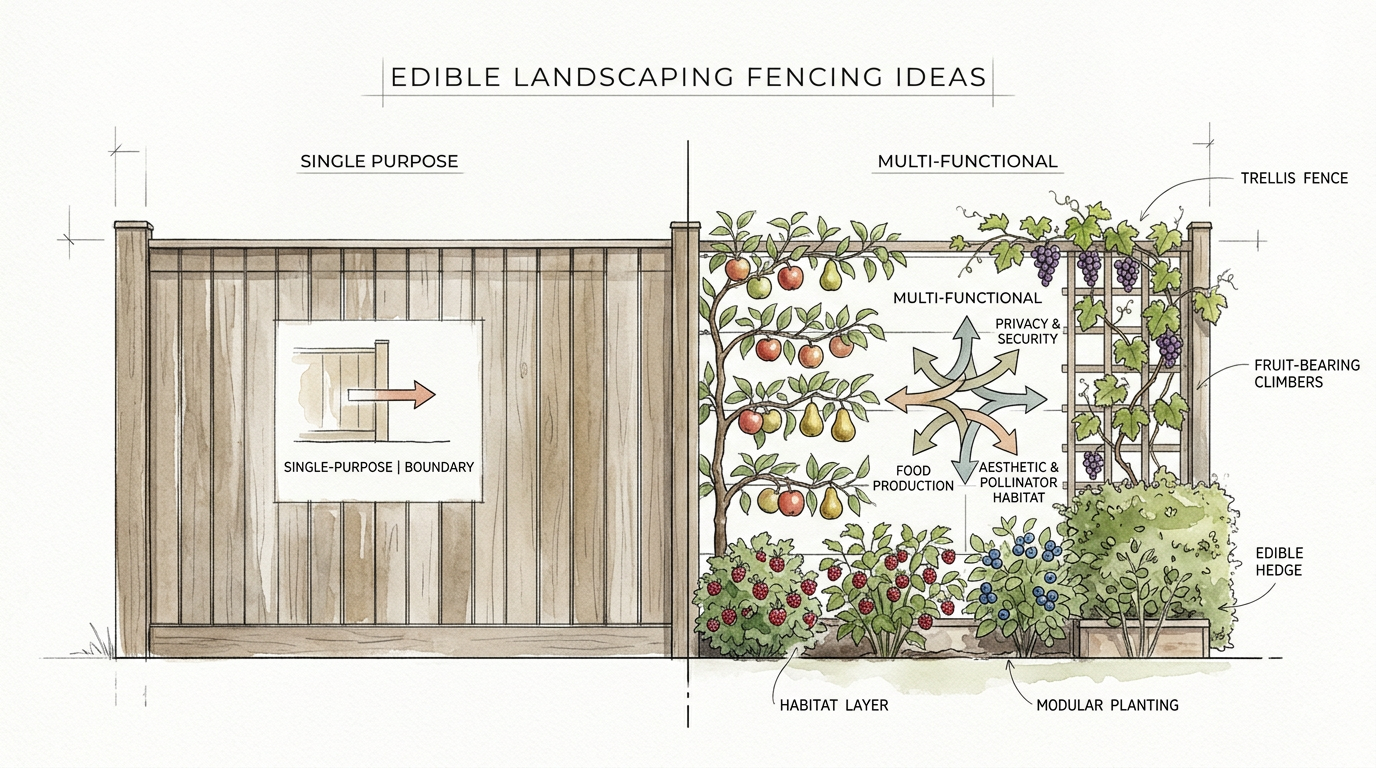
Your fence could be a wall, or it could be your grocery store. Traditional hedges are ’empty calories’ for your landscape—they take water and trimming but give nothing back. A permaculture hedge (or ‘fedge’) provides privacy, wind protection, wildlife habitat, and a massive harvest of nuts and berries. Make every inch of your boundary work for you.
For generations, our ancestors understood that every boundary was an opportunity. They didn’t just mark territory; they built systems of resilience that fed their families and sheltered their livestock. Today, we are reclaiming that pioneer grit by turning sterile property lines into thriving, multi-functional ecosystems. This guide will walk you through the transition from a single-purpose barrier to a living, breathing pantry.
Edible Landscaping Fencing Ideas
Edible landscaping fencing, often called a “fedge” (a portmanteau of fence and hedge), is a boundary created from food-producing plants. Unlike a standard chain-link or wooden fence, a fedge is a living system designed to provide physical security, privacy, and a recurring harvest of fruits, nuts, and herbs. It is the ultimate expression of multi-functional design, where every plant earns its keep by serving at least two or three purposes.
In the real world, these systems are used everywhere from small urban lots to expansive rural homesteads. An urban gardener might use an espaliered apple tree to screen out a neighbor’s window while yielding bushels of crisp fruit. A farmer might use a thicket of hazelnuts and elderberries to break the wind and provide high-protein forage for poultry. The concept dates back to the ancient hedgerows of Europe, which served as “living larders” for rural communities for centuries.
These living walls work because they utilize the “edge effect,” a principle where the boundary between two environments is often the most productive. By concentrating resources along your fence line, you create a microclimate that benefits both the plants and the creatures that inhabit them. Whether you are looking for a thorny barrier to keep out intruders or a soft, fragrant screen of rosemary and lavender, the edible fence is a tool for self-reliance.
How to Design and Build Your Living Fence
Building a productive boundary requires more than just digging holes and dropping in saplings. You are creating a permanent structure, so the preparation phase is critical to your long-term success. Follow these steps to ensure your living fence thrives for decades.
First, observe your site. You need to know where the sun hits at different times of the year and how the wind moves across your property. Most fruiting plants require at least six to eight hours of direct sunlight to produce a significant harvest. If your fence line is in deep shade, you will need to focus on shade-tolerant species like currants or certain types of hardy kiwi.
Next, prepare the soil in a strip at least three feet wide. Hard-packed earth is the enemy of a new fedge. Dig in plenty of well-rotted compost or aged manure to provide a nutrient-rich foundation. If you are planting acid-loving berries like blueberries, check your soil pH and adjust it with elemental sulfur if necessary. A thick layer of wood chips or straw mulch should be applied immediately after planting to suppress weeds and retain moisture.
When it comes to the actual planting, consider the mature width of your species. For a dense, impenetrable hedge, you might plant shrubs like hazelnuts or rugosa roses as close as two to three feet apart. If you are training fruit trees in an espalier style, you will need a sturdy trellis system with horizontal wires spaced about 15 to 18 inches apart. This framework acts as the “bones” of your fence until the trees are mature enough to support themselves.
Finally, install a temporary protective barrier. Young plants are highly vulnerable to deer, rabbits, and even curious dogs. A simple wrap of chicken wire or a light mesh fence can protect your investment for the first two or three years. Once the plants are established and have reached head-height, they can usually withstand a bit of browsing from the local wildlife.
Benefits of a Permaculture Fedge
The most obvious advantage of an edible fence is the harvest. Instead of spending your Saturday afternoons trimming a privet hedge that provides nothing but green waste, you could be picking fresh raspberries or gathering hazelnuts for the winter. This shifts the energy of your landscape from “maintenance-only” to “productive yield.”
Beyond the food, a fedge acts as a superior windbreak. A solid wall or fence creates turbulence on the leeward side, but a living hedge filters the wind, slowing it down without causing the same level of soil erosion or structural stress. This protection creates a calmer, warmer microclimate in your yard, which can even extend your growing season for more sensitive crops located nearby.
Biodiversity is another massive gain. Traditional fencing is a biological desert, but a fedge is a skyscraper of life. Bees and butterflies are drawn to the spring blossoms, and songbirds find safe nesting sites deep within the dense branches. These birds, in turn, help control pest populations in your garden by eating caterpillars and beetles. You are not just building a fence; you are inviting a team of natural allies to live on your property.
Lastly, the longevity of a living fence is unmatched. A cedar fence might rot in 15 years, and a vinyl fence can crack or fade in the sun. A well-maintained hazelnut or hawthorn hedge can live for a century or more, growing stronger and more resilient with every passing year. It is a legacy project that adds tangible value to your land.
Common Challenges and Pitfalls
The most common mistake beginners make is planting a monoculture—a fence made of only one species. If a specific pest or disease hits that one plant, your entire boundary could die at once. Diversity is your insurance policy. Mix different types of berries, nuts, and flowering shrubs to ensure that if one plant struggles, the others will fill the gap.
Another pitfall is underestimating the harvest window. Unlike a traditional hedge that stays the same all year, an edible fence has peak moments. If you have 50 feet of elderberries, they will all ripen within the same two-week period. You must be prepared to harvest and process the yield, or you will end up with a mess of rotting fruit that attracts wasps and rodents. Plan your species list so that harvests are staggered throughout the summer and fall.
Maintenance can also be a challenge if you don’t stay ahead of it. While a fedge is low-maintenance once established, it still requires annual pruning. If you let a blackberry thicket go wild, it will quickly become a tangled, thorny mess that is impossible to harvest from. Consistent, light pruning is much easier than a massive “rescue” prune every five years. Always prune for light penetration to ensure the inner branches don’t die off from shade.
Limitations and Constraints
Not every property is suited for every type of fedge. Space is the primary constraint. A natural, “wild” hedgerow can easily grow six to ten feet wide. If you have a tiny urban lot, a sprawling nut thicket will swallow your entire yard. In these cases, you are better off with narrow techniques like espaliered fruit trees or vining crops like grapes on a sturdy trellis.
Climate also dictates your options. While hazelnuts and currants thrive in northern zones, they will languish in the heat of the Deep South. Conversely, a beautiful pomegranate hedge is a fantastic boundary in California or Arizona, but it won’t survive a single winter in Minnesota. Always cross-reference your USDA hardiness zone with the specific needs of the plants you choose.
Local regulations and “curb appeal” standards can also be a hurdle. Some homeowner associations (HOAs) have strict rules about the height and appearance of fences. A wild-looking permaculture fedge might be viewed as “weedy” by less-informed neighbors. You can mitigate this by using formal training techniques or by placing the more ornamental species—like blueberries or rugosa roses—along the public-facing side of the boundary.
Comparing Living Fences to Traditional Fences
| Feature | Traditional Wood/Vinyl Fence | Permaculture Fedge (Living Fence) |
|---|---|---|
| Initial Cost | High (Materials + Labor) | Low to Moderate (Plants + Soil Prep) |
| Life Span | 10–25 Years (Subject to rot/wear) | 50–100+ Years (Self-renewing) |
| Maintenance | Occasional painting/repairing | Annual pruning/harvesting |
| Primary Yield | Privacy / Security only | Food, Privacy, Habitat, Windbreak |
| Ecological Impact | Neutral or Negative | Highly Positive (Biodiversity) |
| Installation Skill | Carpentry / Construction | Horticulture / Gardening |
Practical Tips and Best Practices
Always mulch heavily. A three-inch layer of coarse wood chips will save you hundreds of hours of weeding over the life of the fence. It also creates a “slow-release” fertilizer as the wood breaks down, mimicking the forest floor. Avoid using dyed mulches; stick to natural cedar, pine, or locally sourced arborists’ chips.
Water deeply but infrequently during the establishment years. You want the roots of your fedge to grow deep into the soil to find their own water. If you only sprinkle the surface, the roots will stay shallow and the plants will be more susceptible to drought later on. A soaker hose buried under the mulch is an efficient way to get water where it’s needed most.
Consider “layering” your fence for maximum density. Plant a row of taller nut trees like American Hazelnut in the center, and then flank them with lower-growing shrubs like currants or gooseberries. On the very edge, you can plant perennial herbs like chives or oregano. This creates a thick wall of vegetation from the ground up to the ten-foot mark, ensuring total privacy.
Advanced Considerations for the Serious Practitioner
For those who want to take their fedge to the next level, consider the ancient art of hedgelaying. This involves partially cutting the stems of the hedge plants and bending them over horizontally while they are still living. This creates a dense, interwoven barrier that is physically stronger than any wooden fence and can keep in large livestock. It is a labor-intensive skill, but it creates a boundary that is truly indestructible.
Coppicing is another technique to master. Hazelnut, willow, and elderberry all respond well to being cut back to the ground every few years. This encourages a flush of straight, vigorous new growth. You can use these harvested poles to build garden trellises, bean tepees, or even traditional wattle-and-daub structures. By coppicing different sections of your fence on a rotation, you ensure a steady supply of building materials without ever losing your privacy screen.
Strategic nutrient cycling can further optimize your yields. If you have poultry, you can design your fedge so that the birds have access to one side of it. They will eat fallen fruit, scratch for pests, and provide “free” fertilizer right at the root zone. Just ensure the plants are large enough to handle the attention, or use a “chicken moat” system to keep them from over-grazing the young shoots.
Scenario: The Edible Privacy Screen in Action
Imagine a standard suburban backyard with 60 feet of southern-facing fence line. Instead of a row of boring arborvitae, the homeowner plants a diverse fedge. They start with three espaliered “Liberty” apple trees, which are trained flat against a wire trellis to provide a crisp, green screen.
Between the apple trees, they plant highbush blueberries. Because these shrubs reach six feet in height and have spectacular red foliage in the fall, they act as the perfect mid-layer. At the base of the fence, they tuck in a row of strawberries and culinary herbs like thyme and sage.
By the third year, this homeowner is harvesting 40 pounds of apples, 15 pounds of blueberries, and enough herbs to last the winter. The neighborhood birds have moved into the dense blueberry branches, and the neighbor’s unsightly shed is completely hidden behind a wall of productive greenery. The total cost of the plants was less than half the price of a professional cedar fence installation.
Final Thoughts
Transforming your boundaries into productive landscapes is one of the most effective ways to build self-reliance. It turns a “dead” space into a high-performance system that works for you every single day. Whether you start with a single row of raspberries or a complex, multi-layered hedgerow, the transition from consumer to producer starts at the edge of your property.
Embrace the grit of the old ways by choosing plants that are hardy, resilient, and useful. The beauty of a living fence is that it grows with you, becoming more valuable and more beautiful with each passing season. You don’t need a massive farm to live like a pioneer; you just need to rethink the space between you and your neighbors.
Take the first step this season. Clear a small section of your fence, amend the soil, and plant something that gives back. Once you taste the difference between a grocery store berry and one picked from your own living wall, you’ll never look at a standard fence the same way again. Experiment, observe, and let your landscape feed your soul.
