How To Become More Self-Sufficient Without Starting a Full-Blown Farm…
Want to start preserving your harvest, making your own soap, or building a backyard root cellar — but not sure where to begin? “Homesteading Advice” gives you instant lifetime access to 35+ practical homesteading books on food preservation, veggie gardening, DIY natural cleaning products (save over $250 per year with this skill alone), brewing, off-grid energy, and a whole lot more…
Click Here To Check It Out Now!
In a real emergency, your high-tech gear is only as strong as a tiny disposable battery. We rely on gadgets that die the moment the store shelves go empty. Transitioning to kinetic energy means you own your light source forever. No leaks, no expiration dates, and no dependency on a global supply chain for a simple AA battery.
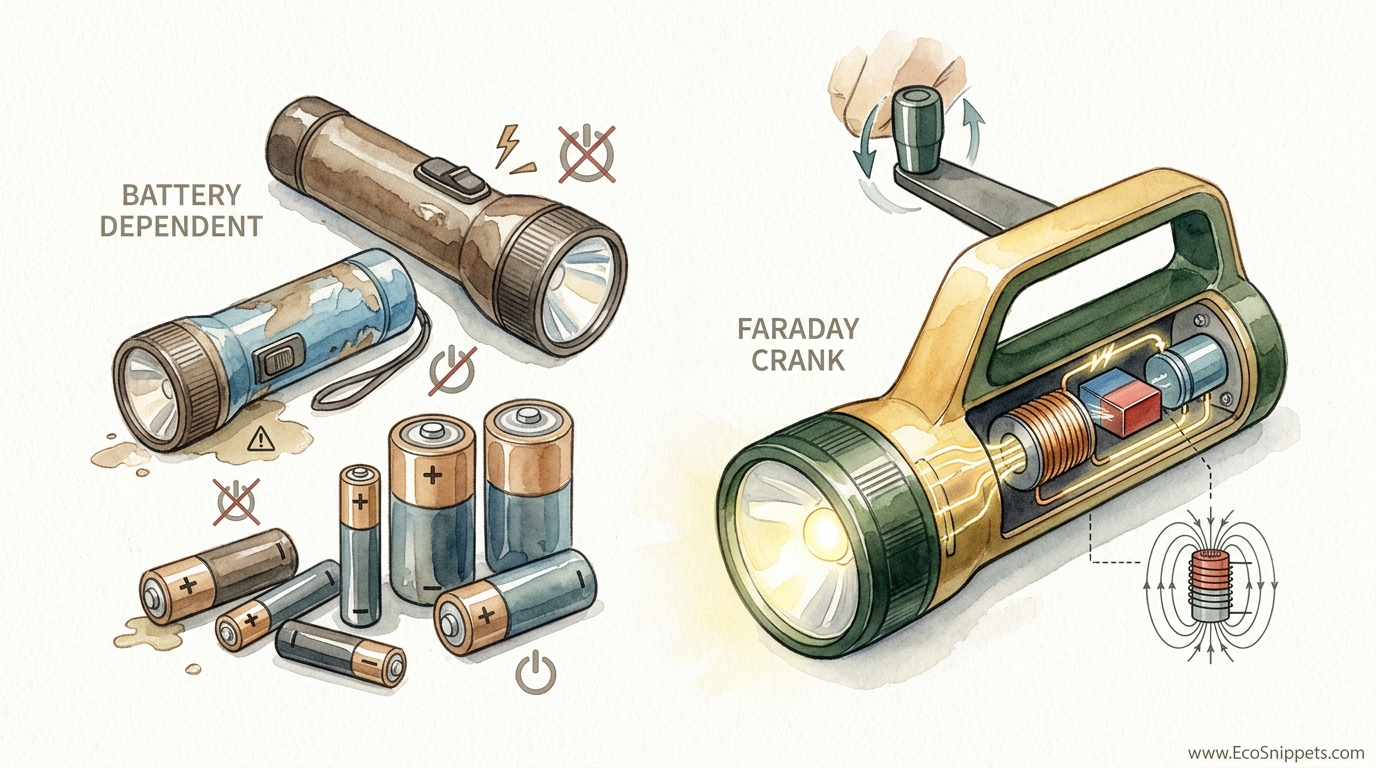
Modern survivalism often gets caught up in the allure of high-lumen tactical torches and rechargeable power banks. While these tools have their place, they all share a singular point of failure: the need for an external power source. When the grid falters and the local hardware store is picked clean, a “BATTERY DEPENDENT” setup becomes a ticking clock. Once that last cell drains, you are left in the dark.
Embracing the emergency hand crank flashlight is a return to a more resilient way of life. It is the literal embodiment of self-reliance, turning the mechanical work of your own hands into visible light. By understanding how to harness kinetic energy, you bypass the fragilities of modern logistics and ensure that your family never has to fear the sunset.
Emergency Hand Crank Flashlight Benefits
An emergency hand crank flashlight is a self-contained illumination tool that generates its own electricity through a manual dynamo or induction system. Unlike traditional flashlights that sit in a drawer waiting for their chemical batteries to slowly leak or lose charge, these devices are ready to perform at a moment’s notice, regardless of how long they have been stored.
These tools are essential in scenarios where traditional infrastructure has collapsed. Think of them as the “ancestral wisdom” of the electronics world—simple, mechanical, and dependable. Whether you are navigating a basement during a localized power outage or managing a long-term grid-down scenario, the ability to generate light on demand provides a psychological and tactical advantage that cannot be overstated.
In the real world, these lights serve as the ultimate backup. They are frequently found in roadside emergency kits, offshore lifeboats, and disaster relief packs. Because they do not rely on volatile chemicals, they are safe to store in extreme temperatures—like the glove box of a car in mid-summer—where standard alkaline batteries would likely fail or corrode the internal contacts of a more expensive light.
Think of it like a hand-operated well pump versus a modern electric tap. The tap is more convenient until the power goes out; the hand pump, though it requires effort, is the only one that guarantees water when the world goes sideways. The hand crank flashlight offers that same guarantee for your vision.
The Mechanics of Kinetic Illumination: How It Works
The magic behind these devices isn’t magic at all; it is a fundamental principle of physics discovered by Michael Faraday in the early 19th century. Faraday’s Law of Induction states that moving a magnetic field through a coil of wire creates an electric current. Every hand-powered light on the market today uses a variation of this principle to turn your muscle power into photons.
In a standard hand crank model, the handle is connected to a series of gears. These gears are designed to act as a “step-up” mechanism. When you turn the handle at a moderate pace, the internal gears spin a small DC motor—acting as a generator—at thousands of rotations per minute. This high-speed rotation generates an electrical current that is then passed through a rectifier (to ensure it flows in the right direction) and into a storage medium.
The Faraday flashlight, often called a “shake light,” takes a different approach. Instead of gears and a crank, it uses a large neodymium magnet that slides back and forth through a copper wire spool. As you shake the light, the magnet passes through the spool, inducing a current with every pass. This “FARADAY CRANK” alternative is often simpler and more durable because it has fewer moving parts to break, though it generally produces less power per minute of effort than a geared crank system.
Once the energy is generated, it must be stored. Most modern units use one of three methods:
- Rechargeable Batteries: Usually NiMH (Nickel-Metal Hydride) or Lithium-Ion. These hold a lot of power but eventually degrade over 5-10 years.
- Supercapacitors: These store energy electrostatically. They have an almost infinite shelf life and can be charged and discharged hundreds of thousands of times, but they hold significantly less energy than a battery.
- Direct Drive: Rare in modern units, this is where the light only shines while you are actively cranking. This was the design of the famous WWII “knijpkat” torches used by soldiers.
Advantages of Manual Power Over Battery Dependency
The primary advantage of kinetic lighting is the removal of the shelf-life barrier. Standard alkaline batteries lose about 2% to 3% of their charge every year just sitting on a shelf. More importantly, they are prone to “outgassing” and leaking potassium hydroxide, a caustic material that destroys the very electronics they are meant to power. A hand crank light eliminates this risk entirely.
Another benefit is the cost-to-utility ratio. While a high-end tactical light requires a constant investment in CR123A or 18650 batteries, a manual light is a one-time purchase. Over a decade of use, the hand crank light pays for itself simply by not requiring a “subscription” to the battery industry. This makes it the ideal tool for the budget-conscious prepper who wants to build depth in their gear without ongoing maintenance costs.
Furthermore, manual lights often come as “multi-tools” for survival. Because the internal dynamo is already generating 5V of electricity, many manufacturers include AM/FM/NOAA weather radios and USB charging ports. In a disaster, being able to crank for 10 minutes to get 30 seconds of emergency cell phone battery to send a “we are safe” text message is a life-saving feature that a standard Maglite simply cannot offer.
Common Challenges and Pitfalls to Avoid
The most common mistake people make is buying the cheapest possible hand crank light from a big-box store “bargain bin.” These units often utilize thin plastic gears that are prone to stripping. If you crank too hard or too fast in a moment of panic, the teeth of the gears can shear off, turning your light source into a useless plastic rattle.
Another frequent pitfall is “battery neglect.” Even though these are crank lights, most have an internal rechargeable battery. If you leave a Lithium-Ion or NiMH battery completely drained for years, the chemistry can “bottom out,” meaning the battery will no longer accept a charge from the dynamo. To avoid this, you must treat these lights like a piece of machinery: they need a “tune-up” every few months where you crank them for a few minutes to keep the internal chemistry active.
Finally, do not expect “searchlight” performance. A hand crank light is designed for task lighting—reading a map, navigating a dark hallway, or signaling for help. If you try to use it to spot a predator 200 yards away across a field, you will be disappointed. These are tools of efficiency, not raw power. Using them for high-drain tasks will only lead to physical exhaustion and frustration.
Limitations and Environmental Constraints
Physical fatigue is the most obvious limitation. To get an hour of light, you might need to crank for five to ten minutes, depending on the efficiency of the unit. In a high-stress survival situation, your calories are precious. Constant cranking is a manual labor task that consumes energy your body might need for other survival priorities like building shelter or trekking to safety.
There are also temperature limitations. While the mechanical gears of a crank light work fine in the cold, the internal rechargeable batteries do not. In sub-zero temperatures, the chemical reaction required to store electricity slows down significantly. If you are in a deep freeze, you may find that you have to crank continuously to keep the LEDs lit, as the battery may refuse to hold the “dump” of energy coming from the dynamo.
Lastly, water resistance is a major concern. Because these lights have a moving handle that enters the body of the device, creating a true “waterproof” seal is difficult and expensive. Most budget crank lights are “water-resistant” at best. If you drop a cheap model into a stream, water can enter through the crank housing and short out the circuit board or rust the internal gears.
Comparing Emergency Light Sources
Choosing the right light depends on your specific needs for duration, intensity, and longevity. The following table highlights the trade-offs between traditional battery systems and kinetic alternatives.
| Feature | Standard Battery Light | Hand Crank (Dynamo) | Faraday (Shake) Light |
|---|---|---|---|
| Energy Source | Disposable Alkaline/Lithium | Mechanical Cranking | Linear Induction (Shaking) |
| Shelf Life | 5–10 Years (leaks possible) | Indefinite (with maintenance) | Indefinite (Capacitor models) |
| Lumen Output | Very High (up to 4000+) | Low to Moderate (50–150) | Low (15–50) |
| Complexity | Low (simple circuit) | High (moving gears) | Medium (magnet/coil) |
| Maintenance | Replace batteries regularly | Quarterly “exercise” cranking | Virtually none |
As you can see, the “FARADAY CRANK” or shake light is the winner for pure, unadulterated longevity due to its lack of gears. However, the geared hand crank is far more efficient at generating usable amounts of light for a family setting. The standard battery light remains the king of brightness but fails the “forever” test.
Practical Tips for Success and Longevity
To ensure your manual light is ready when the wolves are at the door, follow these best practices for maintenance and operation:
- The “Quarterly Crank” Routine: Set a reminder on your calendar every three months. Take your light out and crank it for five minutes. This prevents the internal gears from seizing and keeps the internal battery from hitting a “dead zone” voltage.
- Check the Gear Lube: If you are comfortable with basic tools, carefully open your light and check the gears. A small dab of silicone grease on plastic gears can significantly reduce wear and prevent the teeth from shearing under high pressure.
- Manage Your Output: Most crank lights have multiple settings (e.g., 1 LED vs. 3 LEDs). Always use the lowest setting necessary for the task. This stretches your “crank-to-light” ratio, saving you physical effort.
- Solar Synergy: Many modern crank lights include a small solar strip on the top. While these are too small to fully charge the light quickly, they are great for “trickle charging.” Keep the light on a windowsill during the day so it is constantly topping off its energy reserves without you lifting a finger.
Advanced Considerations for the Serious Practitioner
For those looking to move beyond the basic consumer-grade lights, the “Gold Standard” of kinetic lighting involves units that use supercapacitors instead of rechargeable batteries. A supercapacitor doesn’t rely on a chemical reaction; it stores electricity as a static charge on a plate. This means it can sit in a bug-out bag for 30 years and still work perfectly the moment you pick it up. Brands like LightStorm focus on this high-end, capacitor-based engineering.
Another advanced technique is the “USB Bridge.” Since most high-quality crank lights now have USB outputs, you can use the light as a generator to charge a small, external power bank. Why do this? Because the internal batteries in crank lights are often low-capacity (around 500mAh to 2000mAh). By “bridging” the power to a high-quality external 18650 battery via USB, you can store more of your hard-earned kinetic energy for later use in other devices, like a GPS or a headlamp.
Finally, consider the ergonomics of the crank. A “T-handle” or a larger, foldable arm is always superior to a small “thumb-turn” crank. The more leverage you have, the less stress you place on the internal gears and your own wrist. For serious long-term survival, look for lights with metal gear assemblies—though rare, they exist in professional-grade emergency equipment and are worth the weight penalty.
Example Scenario: The 72-Hour Blackout
Imagine a scenario where a severe ice storm brings down the local power grid. It is 2:00 AM, and the house is freezing. You reach for your “reliable” tactical flashlight, but the batteries have leaked, ruining the internal spring. You are officially in the dark.
With a hand crank light stored in your bedside table, the solution is in your hands. You spend 60 seconds cranking the handle at a steady, rhythmic pace. This minute of effort provides you with 15 minutes of light—enough time to safely navigate to the kitchen, find your primary lanterns, and check on your family. You aren’t “BATTERY DEPENDENT”; you are the power station. You have successfully bypassed the failure of the modern supply chain with nothing but your own muscle and a well-engineered tool.
Final Thoughts
In a world of planned obsolescence and fragile digital systems, the hand crank flashlight stands as a testament to the power of simple mechanics. It is a bridge between our modern needs and the self-reliant spirit of our ancestors. By choosing to own your light source, you are making a conscious decision to step away from dependency and toward true preparedness.
Start by adding one high-quality crank light to your primary emergency kit. Practice with it, understand its limitations, and teach your family how to use it. Once you feel the gears turning and see the LEDs flare to life under your own power, you will realize that you don’t need the grid to keep the darkness at bay. You just need a little bit of pioneer grit and the right tool for the job.
Experiment with different types—perhaps a shake light for the car and a geared dynamo for the house. The goal is layers of redundancy. When the high-tech gear fails, you’ll be the one with the light that never dies.
