How To Become More Self-Sufficient Without Starting a Full-Blown Farm…
Want to start preserving your harvest, making your own soap, or building a backyard root cellar — but not sure where to begin? “Homesteading Advice” gives you instant lifetime access to 35+ practical homesteading books on food preservation, veggie gardening, DIY natural cleaning products (save over $250 per year with this skill alone), brewing, off-grid energy, and a whole lot more…
Click Here To Check It Out Now!
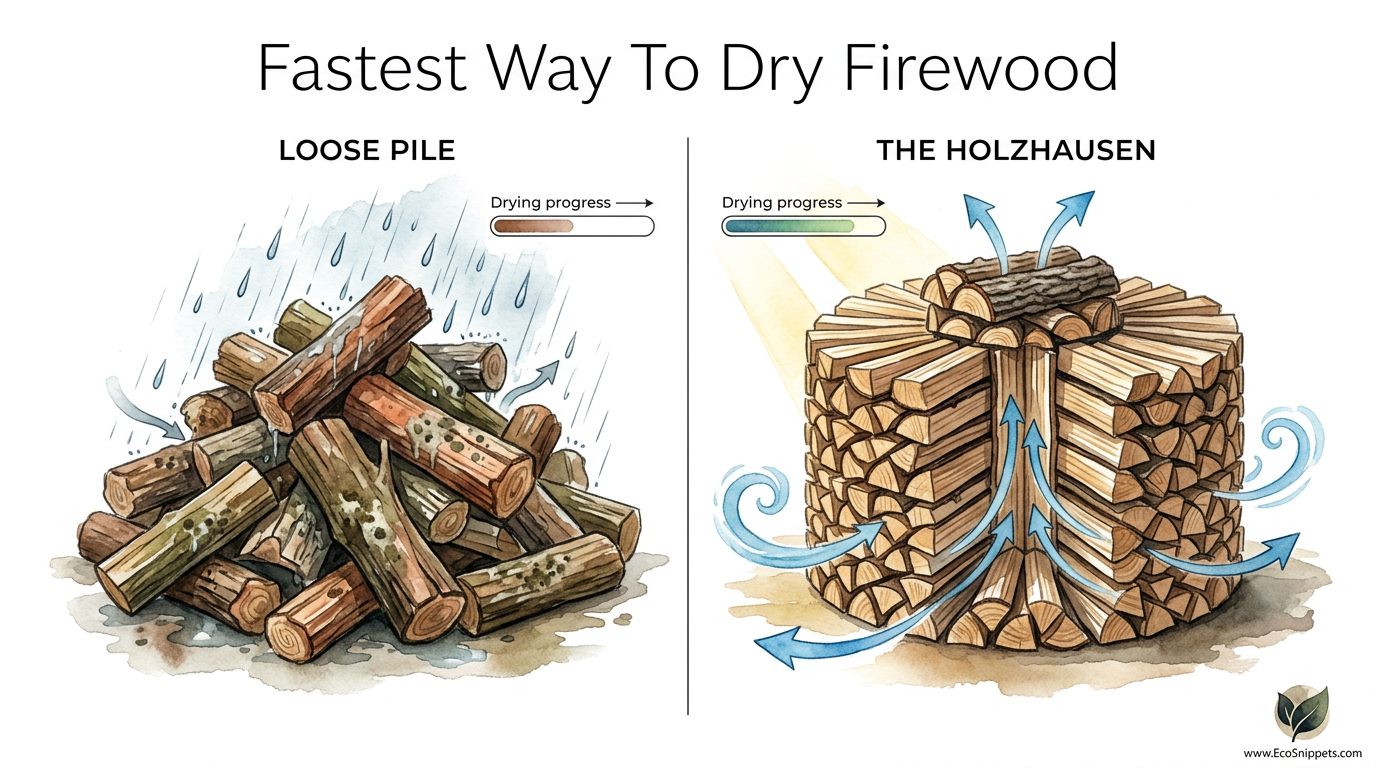
A random pile of wood is a rot-factory; a precise stack is a solar-powered dehydrator for your winter fuel. Most preppers waste half their wood’s energy just boiling the water inside the logs. Switching from a ‘dump and hope’ pile to the precision-engineered Holzhausen stack allows you to harness the chimney effect to dry wood in half the time. It’s not just a stack—it’s a piece of engineering that turns a winter chore into a self-drying asset.
Living off the land requires a shift in how you view resources. Wood is not just a pile of dead fiber; it is a thermal battery that has been charging under the sun for decades. When you fell a tree, that battery is full of sap and moisture that acts as a fire retardant. Burning wet wood is an exercise in futility and a recipe for creosote-clogged chimneys. Mastery of the hearth begins long before the match is struck, starting instead with the way you arrange your harvest.
Practical self-reliance demands efficiency in both labor and space. A traditional loose pile takes up massive amounts of real estate and leaves the bottom layers to the mercy of damp soil and insects. The Holzhausen, or ‘wood house,’ is the ancestral answer to these modern problems. This circular stacking method uses the laws of physics to pull moisture out of the grain, ensuring your family stays warm when the mercury drops.
Fastest Way To Dry Firewood
The Holzhausen is a traditional German method of stacking wood in a circular, beehive-like structure. It is designed specifically to maximize airflow and stability while using the smallest possible footprint. Unlike a long, straight row of wood that can be prone to toppling, the circular design of a Holzhausen is naturally self-supporting. The weight of the logs is distributed toward the center, creating a structural integrity that withstands high winds and heavy snow loads.
At its core, this method relies on the chimney effect. Because the stack is round and often hollow or loosely packed in the center, it creates a vertical column of air. As the sun warms the exterior logs, the temperature difference between the outside and the shaded interior creates a natural draft. This draft pulls air through the stack and out the top, whisking away the moisture evaporating from the split faces of the wood.
This technique is used across Northern Europe and North America by homesteaders who deal with high humidity or short seasoning windows. Freshly felled wood, often called ‘green wood,’ can have a moisture content of over 50 percent. Burning this wood forces your stove to waste energy evaporating water before it can produce heat. The Holzhausen can bring that moisture content down to the ideal 20 percent or lower much faster than a neglected pile in the corner of the yard.
Visualizing a Holzhausen is simple: think of a round tower with a sloped, shingled roof made entirely of wood. The outer walls are composed of split logs pointing toward the center, while the interior is filled with ‘uglies’—those knotted, twisted pieces that do not stack well. This combination of a structured exterior and a breathable interior is what makes it the gold standard for firewood seasoning.
The Science of the Chimney Effect
Understanding the thermal dynamics of a wood stack separates the amateur from the woodsman. Heat is the primary driver of evaporation, but airflow is the carrier that moves the water away from the wood fibers. In a standard row stack, air moves horizontally. If the row is too thick or placed against a fence, the air stagnates, and the wood in the middle stays damp for years.
The Holzhausen creates a vertical air current. This occurs because warm air is less dense than cool air. When sunlight hits the dark bark and split faces of the outer ring, those logs heat up. The air inside the stack remains cooler and more humid. This temperature gradient causes the warm air to rise out of the top of the stack, which in turn pulls fresh, drier air through the gaps in the outer wall.
This constant movement of air mimics a bellows, continuously stripping moisture from the wood. It is particularly effective for dense hardwoods like oak or hickory, which naturally hold onto water deep within their cellular structure. Accelerating the drying process ensures that you can move wood from the stump to the stove in a single season if the conditions are right.
How to Build a Holzhausen Step by Step
Building a proper Holzhausen requires a level of craftsmanship, but it is a skill that any beginner can master with patience. You will need a level patch of ground and a clear understanding of your local wind patterns. Placing your stack in a sunny, breezy location will amplify the drying effect significantly.
1. Prepare the Foundation
Moisture from the ground is the enemy of dry firewood. Never start your stack directly on the soil, as the bottom logs will act like a sponge, soaking up groundwater and inviting termites. Use a base of gravel, old pallets, or a thick layer of sacrificial bark to create a barrier.
Measure a circle with a diameter of approximately 8 feet. This is the standard size for a stack that will hold roughly two cords of wood. You can use a stake and a piece of string to mark the perimeter accurately. Ensure the ground is level; even a slight slope can cause the stack to lean and eventually collapse as the wood shrinks during the drying process.
2. Layout the Outer Ring
Begin laying your first layer of split logs along the perimeter of your circle. These logs should point toward the center stake like the spokes of a wheel. To ensure stability, the outer ends of the logs should be slightly higher than the inner ends. You can achieve this by placing a thin ‘stringer’ log or a piece of scrap wood under the outer edge of the foundation layer.
This inward tilt is crucial. As wood dries, it shrinks by as much as 10 to 15 percent. If your walls are perfectly vertical, the shrinkage could cause them to bow outward and fail. An inward-leaning wall becomes more stable as it settles, with the weight of the wood pressing into the core of the stack.
3. Build the Walls and Fill the Core
Continue stacking the outer ring, maintaining the inward slant. Every three feet of height, you should place ‘cross-poles’—long, thin branches or logs that span across the diameter of the stack. These act as structural ties that hold the circular wall together.
Once the outer wall reaches about two feet in height, start filling the center of the circle. This is where you put your odd-shaped pieces, branch rounds, and kindling. Do not pack them tightly. The goal is to leave enough space for air to move upward through the gaps. Think of the center as the ‘flue’ of your wooden chimney.
4. Shingle the Roof
When the stack reaches your shoulder height, it is time to cap it. The top of the Holzhausen should be built into a slight cone or dome shape. Use your best split logs for this layer, and place them with the bark side facing up. Overlap them like shingles on a house.
Bark is nature’s waterproof coat. By placing the bark side up on the top layer, you create a natural roof that sheds rain and snow away from the center of the pile. This ensures that even in a heavy downpour, the internal wood stays relatively dry.
Benefits of the Round Stack
Precision stacking offers more than just faster drying times; it provides a level of organization that makes homestead management easier. A well-built Holzhausen is a stable, self-contained unit that does not require end-stakes or complex racking systems.
One of the greatest advantages is space conservation. In a small yard or a tight wood lot, a circular stack allows you to store a massive amount of fuel in a compact area. Because the center is filled with random pieces, you are utilizing every cubic inch of the structure’s volume.
The stability of a circle is mathematically superior to a line. In a traditional row, if one log at the base shifts, the entire row can ‘domino.’ In a Holzhausen, the logs are interlocking and leaning inward, meaning the stack actually gets tighter and more secure as the wood seasons and settles.
There is also an undeniable aesthetic value. A series of neatly built Holzhausens looks like a small village of beehives. It signals to your neighbors and your family that you are prepared and that you value the craft of woodcraft. It turns a messy chore into a point of pride on the property.
Challenges and Common Mistakes
The most frequent error in building a Holzhausen is neglecting the inward slant. Beginners often try to make the walls look perfectly straight and vertical. Over months of drying, the wood will shrink, and gravity will pull those vertical walls outward. Always ensure the outer edge of your logs is higher than the inner edge to keep the stack ‘pinched’ together.
Another mistake is packing the center too tightly. If you stuff the core of the stack with small debris and leaves, you choke off the airflow. This kills the chimney effect and leads to mold growth in the heart of the pile. Treat the center like a loosely organized basket, not a packed trunk.
Location is also a major factor in success. Building a stack in a deep, shaded ravine with no wind will result in damp wood, regardless of the stacking method. You need the sun to provide the thermal energy for evaporation and the wind to carry that moisture away. Always prioritize the south side of your property if you are in the northern hemisphere.
Limitations of the Holzhausen Method
While the Holzhausen is highly efficient, it is not the ideal solution for every scenario. It is a labor-intensive process compared to simply tossing wood into a heap or a shed. If you have ten cords of wood to process in a single weekend, the time required to meticulously shingle and tilt a round stack may be prohibitive.
The method also works best with logs of consistent length. If your firewood is a mix of 12-inch and 24-inch cuts, maintaining the circular geometry and the inward tilt becomes a frustrating puzzle. It is best suited for wood that has been bucked to a uniform size, typically 16 to 18 inches.
Furthermore, extremely wet climates with constant rain and no sun may find that even a Holzhausen struggles to season wood quickly. In these environments, a wood shed with a permanent roof and open sides might still be necessary to protect the fuel from the elements while allowing the wind to do its work.
Comparing Stacking Methods
When choosing how to store your winter fuel, it helps to compare the Holzhausen against the more common alternatives. Each method has a trade-off between time, labor, and drying efficiency.
| Feature | Loose Pile | Traditional Row | Holzhausen |
|---|---|---|---|
| Drying Speed | Slow / Uneven | Moderate | Fast (Chimney Effect) |
| Stability | Low | Moderate | High |
| Labor Level | None | Moderate | High |
| Space Required | High | Moderate | Low |
| Aesthetics | Poor | Good | Excellent |
Comparing a loose pile versus the Holzhausen reveals that while the latter requires more initial effort, the long-term payoff in wood quality and space usage is significant. A loose pile is essentially a waste of good timber, as the bottom half often rots before it ever reaches the stove.
Practical Tips for Best Results
Optimizing your wood drying requires a few tricks of the trade that have been passed down through generations of woodsmen. One of the most effective techniques is to split your wood as soon as possible after felling. Sap begins to ferment and sour if left in the log, making the wood less pleasant to burn and more attractive to pests.
Always stack with the split face exposed. Bark is waterproof and designed to keep moisture inside the tree. By splitting the wood, you break that seal and expose the interior fibers to the air. The more surface area you expose, the faster the water will migrate out of the wood.
Use a moisture meter to verify your results. You can find inexpensive meters that use two metal prongs to measure electrical resistance in the wood. A reading of 15 to 20 percent indicates the wood is ready for the hearth. Testing your wood at different levels of the Holzhausen will give you a clear picture of how well your chimney effect is functioning.
Consider the species of wood you are stacking. Oak is notoriously slow to dry and may need two full years in a stack to reach optimal levels. Ash, on the other hand, is often called ‘the burner’s friend’ because it has a naturally low moisture content even when green and can be ready in a single season.
Advanced Considerations for the Serious Woodburner
For those who want to take their seasoning to the next level, consider the ‘Solar Kiln’ modification. By placing a sheet of clear polyethylene plastic over the top of the Holzhausen—leaving the bottom and the very center of the roof open—you can trap solar heat. This creates a super-charged version of the chimney effect, raising the internal temperature and significantly shortening the drying window.
Pay attention to the ‘end grain’ of your logs. Water travels through wood much faster along the grain than through the sides. In a Holzhausen, the majority of the end grain is pointing toward the center or the outside, which are the two areas with the most airflow. This orientation is scientifically the most efficient way to bleed water from a log.
Scaling your wood operation requires multiple stacks. A single 8-foot Holzhausen provides enough wood for a casual burner, but a homestead relying solely on wood heat may need four or five of these towers. Rotating your stacks ensures that you are always burning the oldest, driest wood while the newer harvests are still charging in the sun.
The Winter Prep Scenario
Imagine a late March morning on a northern homestead. The snow is melting, and the sap is starting to run in the maples. This is the time to begin your wood cycle. You fell a stand of dead-standing oak and a few live birches. By mid-April, you have the wood bucked and split.
You spend the weekend building two 8-foot Holzhausens on the south side of the barn. Throughout the summer, the sun beats down on the circular walls. You notice the stack getting shorter—the ‘settling’ that occurs as the wood loses its water weight. By October, the first frost arrives.
You take a piece from the middle of the stack and strike it against another log. Instead of a dull ‘thud,’ you hear a sharp, hollow ‘ring.’ You check it with your meter: 17 percent. When you throw that log into the stove, it catches instantly. There is no hissing, no steam, and no smoke. Just a clean, roaring flame that warms the house to the bones. This is the reward for the precision of the Holzhausen.
Final Thoughts
Mastering the art of the wood stack is a fundamental pillar of self-reliance. It is a bridge between the raw power of the forest and the controlled comfort of the home. Moving away from haphazard piles and embracing the engineering of the Holzhausen ensures that every swing of the axe results in the maximum possible heat for your family.
The chimney effect is not a myth; it is a mechanical reality that uses the sun’s energy to do the hard work of seasoning for you. While it requires a bit more sweat equity in the spring, the stability and efficiency of a round stack will save you time and frustration during the harsh winter months.
Experiment with your first stack this season. Watch how the wood changes color, listen for the sound of drying fibers, and take pride in the beehive structures dotting your land. The wisdom of the old world still holds true: a man who cuts his own wood warms himself twice, but the man who stacks it right stays warm all winter long.
