How To Become More Self-Sufficient Without Starting a Full-Blown Farm…
Want to start preserving your harvest, making your own soap, or building a backyard root cellar — but not sure where to begin? “Homesteading Advice” gives you instant lifetime access to 35+ practical homesteading books on food preservation, veggie gardening, DIY natural cleaning products (save over $250 per year with this skill alone), brewing, off-grid energy, and a whole lot more…
Click Here To Check It Out Now!
If you don’t know the difference between your 2021 and 2024 tomato sauce, you aren’t preserving – you’re gambling with botulism. The biggest waste on a homestead isn’t spoilage; it’s the jar you forgot was in the back of the shelf until it was three years past its prime. A true indexed larder turns your food storage into a professional-grade inventory system that feeds your family with zero waste.
Navigating the transition from a casual canner to a master of the winter larder requires more than just a pressure canner and a stack of lids. It demands a shift in mindset from “stashing” to “indexing.” When we talk about an indexed larder, we are discussing a living, breathing library of sustenance where every volume has a due date and a purpose.
Stepping into a well-managed pantry should feel like stepping into a sanctuary of self-reliance. You should be able to reach into the darkness and pull out exactly what you need, knowing its history, its safety, and its nutritional value. This guide will walk you through the architecture of the First-In, First-Out (FIFO) method, specifically tailored for the home canner who refuses to let their hard work go to waste.
Fifo Food Storage System For Home Canning
The FIFO system, or First-In, First-Out, is the gold standard for inventory management in everything from high-end restaurant kitchens to local grain elevators. In the context of home canning, it is the disciplined practice of ensuring that the jars you processed earliest are the ones that find their way to your dinner table first. This simple acronym hides a deep philosophy of stewardship that ensures your family is always eating the freshest possible preserves.
Ancestral wisdom often dictated this system without needing a formal name. Our great-grandmothers didn’t have the luxury of “mystery shelves” because their survival depended on the careful rotation of the root cellar. When the new harvest came in, the old jars were moved forward, checked for seal integrity, and prioritized for the autumn transition. They understood that time is the silent thief of quality, slowly leaching the vibrant color from a peach and the snap from a green bean.
In a modern homesteading environment, FIFO serves as the primary defense against the “ticking time bomb” of old food. While the USDA suggests that properly sealed home-canned goods are safe as long as the seal is intact, they also note that quality and nutritional value begin to plummet after the one-year mark. High-acid foods like tomatoes and berries can eventually react with the metal lids, leading to off-flavors or even pinhole leaks over several years.
Visualizing FIFO is easy: imagine a shelf where you load new jars into the back and pull used jars from the front. If your shelves are deep and static, you might find yourself shuffling thirty jars of applesauce just to get to the 2023 batch hidden in the corner. A dedicated FIFO system eliminates this manual labor by using specialized shelving designs or strict labeling protocols that make the age of every jar immediately obvious.
How the Indexed Larder Works
Building an indexed larder is a three-part process involving physical organization, meticulous labeling, and a tracking system that lives outside the pantry. You cannot manage what you do not measure, and you cannot rotate what you cannot see.
Physical Rotation Strategies
Physical organization is the foundation of the FIFO method. Gravity-fed shelving is a popular choice for those with the space and carpentry skills. These shelves are built on a slight incline, allowing jars to roll or slide toward the front as one is removed. While common for commercial tin cans, home canning jars require more care to prevent breakage, often utilizing specialized wooden dividers that keep the glass from clashing.
If you use standard flat shelving, the “U-Turn” method is often the most effective. Dedicate specific rows to specific foods—green beans in row one, corn in row two. When you bring in a new batch, you move the existing jars to the front and place the new jars behind them. This ensures that the oldest jar is always the one closest to the kitchen door.
The Art of the Label
Labeling is where many homesteaders fall short. Slapping a piece of masking tape that says “Salsa” on a jar is a recipe for future confusion. A professional-grade label in an indexed larder should include the month and year of processing, the batch number if you ran multiple canner loads, and even the specific variety of produce used.
Using a lot or batch number allows you to track potential failures. If you open a jar of corn and find it has lost its seal or tastes “off,” you can check your index to find every other jar from that same batch. This allows you to prioritize those jars for inspection, potentially saving your family from a foodborne illness before it happens.
The Inventory Log
The final component is the index itself. This can be a simple three-ring binder, a chalkboard on the pantry door, or a digital spreadsheet. Every time a jar goes into the larder, it gets a “plus” in the log. Every time a jar comes out, it gets a “minus.” This allows you to know your exact stock levels without having to count cold jars in a dark basement during a winter storm.
Benefits of the FIFO System
Adopting a FIFO approach offers immediate rewards that go beyond simple organization. It is an investment in your health, your wallet, and your peace of mind.
Enhanced Food Safety
Food safety is the paramount concern for any home preserver. While botulism is rare in properly processed foods, the risk of seal failure increases as the years tick by. By ensuring you never have jars sitting for three or four years, you significantly reduce the statistical likelihood of consuming a jar with a compromised seal. Regular rotation also forces you to handle the jars more frequently, making it easier to spot “bubblers” or “leakers” early.
Maximum Nutritional Value
Vitamins are not immortal. Studies have shown that vitamin C and other heat-sensitive nutrients in canned vegetables can drop by 50% to 80% after just two years of storage, especially if temperatures fluctuate. Eating your way through your larder in a structured, chronological order ensures that your family is receiving the highest possible nutrient density from your harvest.
Economic Efficiency
Homesteading is often about saving money, yet millions of dollars in home-grown food are thrown away every year because jars were forgotten. A FIFO system ensures that your labor—those hot hours spent over a boiling water bath—actually results in calories on the plate. It also prevents “panic canning” where you put up fifty jars of pickles only to realize later you still had forty left from the previous season.
Challenges and Common Mistakes
Even the most disciplined homesteader can stumble when setting up an indexed larder. Recognizing these pitfalls is the first step toward avoiding them.
The “Good Enough” Labeling Trap
Human memory is a fickle thing. You might think you’ll remember that the salsa in the blue-rimmed jars is the extra-spicy batch, but six months later, it all looks the same. Skipping the date or the variety on your labels is the most common mistake. Over time, labels can also fall off in humid root cellars. Using high-quality adhesive labels or writing directly on the lid with a permanent marker is the only way to ensure the data stays with the jar.
Ignoring the Burn Rate
A major challenge is canning more than you can actually eat. If your family eats one jar of green beans a week, canning 150 jars creates a backlog that FIFO cannot fix. You eventually end up with a growing mountain of old food that pushes your system toward failure. Part of indexing is calculating your “burn rate”—the actual speed at which your family consumes a specific item—and adjusting your garden plans accordingly.
Failure to Involve the Whole Family
An indexed larder is a team effort. If you are the only one who understands the rotation system, but your spouse or children are pulling jars from the back of the shelf because they “look prettier,” the system collapses. Everyone in the household must be trained to “pull from the front” and to alert the record-keeper when a jar is removed.
Limitations of the FIFO System
While FIFO is powerful, it is not a magic wand. There are physical and environmental constraints that can limit its effectiveness on a homestead.
Space and Infrastructure
True FIFO shelving requires more depth or specialized racks than standard storage. If you are canning in a small apartment or a house with limited closet space, you may find it difficult to implement a gravity-fed or deep-rotation system. In these cases, you are forced to rely more heavily on your written index and frequent manual reorganizing, which increases the labor cost of your food.
Environmental Volatility
A FIFO system assumes that all jars are stored in a stable environment. However, if one section of your pantry is near a heater vent and another is against a cold exterior wall, the “oldest” food might actually be in better shape than the “newest” food stored in the heat. Temperature is the greatest enemy of canned goods, and no organizational system can compensate for a pantry that swings between 40 and 80 degrees Fahrenheit.
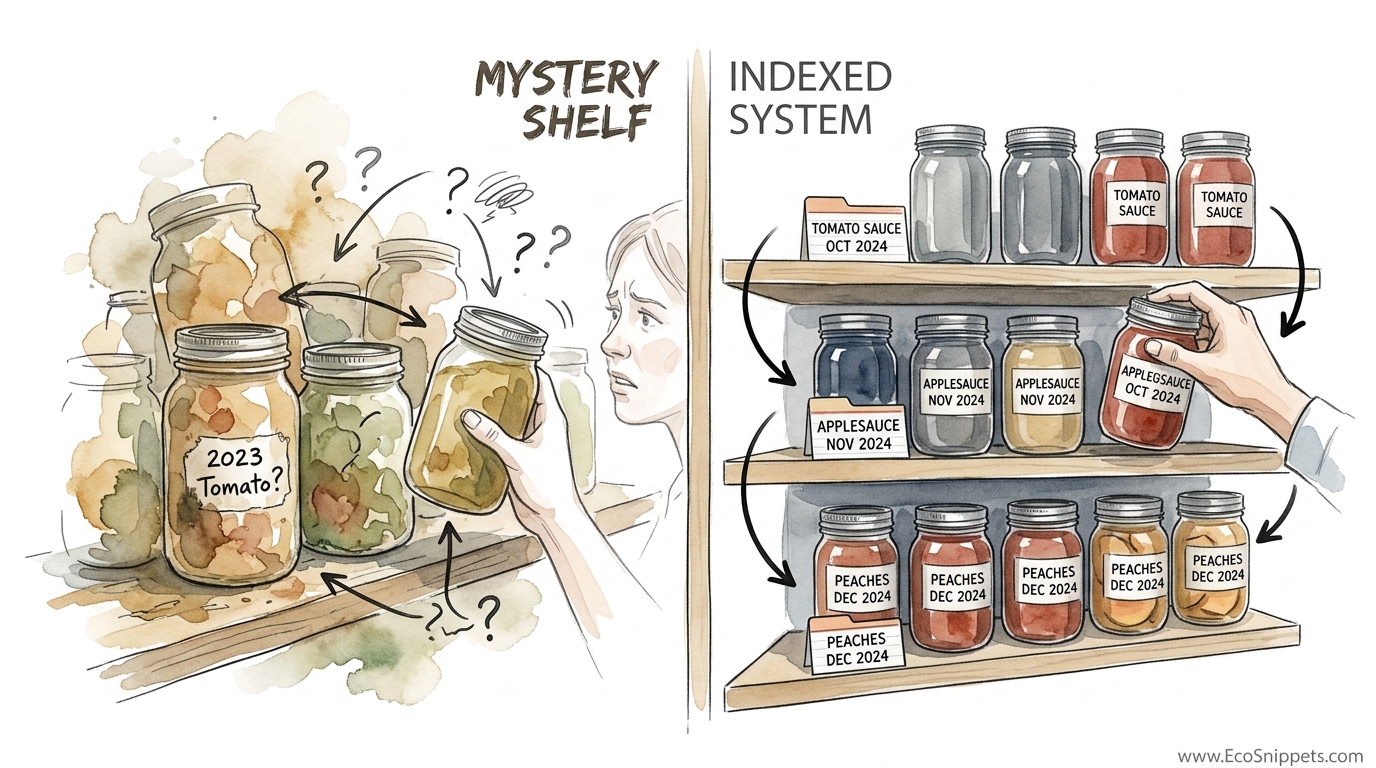
Mystery Shelf vs. Indexed System
To understand the value of an indexed larder, we must compare it to the “Mystery Shelf” method common in many households.
| Feature | The Mystery Shelf | The Indexed Larder |
|---|---|---|
| Organization | Random placement based on available space. | Strategic placement based on date and variety. |
| Inventory Knowledge | Requires a manual, jar-by-jar count. | Instantly available via log or spreadsheet. |
| Food Waste | High; jars frequently lost and aged out. | Near zero; oldest items are prioritized. |
| Safety Checks | Reactive; check when you happen to find a jar. | Proactive; regular rotation involves inspection. |
| Planning | Guesswork leads to over-planting or shortages. | Burn rate data informs next year’s garden. |
Practical Tips and Best Practices
Implementing an indexed larder doesn’t have to happen overnight. Start small and build the habit of discipline.
- Use the “Lid Only” Rule: Write your dates and contents on the lid rather than the glass. This makes the jars easier to wash and reuse, and ensures the information is visible even when jars are packed tightly together.
- Color-Coded Stickers: Assign a specific color to each year. For example, 2024 gets a red dot, 2025 gets a green dot. This allows you to spot an “out-of-place” jar from across the room without having to read small print.
- Build Slanted Inserts: If you have existing deep shelves, you don’t need to rebuild them. You can create simple slanted wooden inserts that sit on top of your flat shelves to provide a gravity-fed effect for your jars.
- The “One-In, One-Out” Habit: Every time you bring a flat of empty jars back to the pantry from the kitchen, use that moment to check your index and adjust the row for that specific food.
Calculating your burn rate is perhaps the most advanced “best practice” you can adopt. To do this, simply track how many jars of a specific item you use over a three-month period during the winter. Multiply that by four, and you have your annual needs. If you find you used 12 quarts of tomatoes in 90 days, you need 48 quarts for the year. Canning 100 quarts is a waste of time and space; canning 30 is a recipe for a hungry spring.
Advanced Considerations for the Serious Practitioner
For those who have mastered the basics of FIFO, the next level of indexing involves tracking the “science” of your larder. Serious practitioners often keep notes on the specific pH levels of batches (if they use a pH meter) or the source of the produce.
If you find that your “Batch 4” tomatoes from 2023 are consistently losing their vibrant red color faster than “Batch 1,” you can look at your notes. Perhaps Batch 4 was processed during a heatwave, or maybe the tomatoes were slightly overripe. This level of indexing turns your larder into a laboratory, allowing you to refine your canning techniques for better long-term storage quality.
Another advanced technique is the “Alt-Pantry” storage. If you have an abundance of one crop, consider indexing some of it for long-term (2-3 year) emergency use in a cooler, more stable environment like a dedicated root cellar, while keeping your “working larder” in the kitchen focused on a 12-month FIFO rotation.
Example: A 180-Day Winter Larder Plan
Consider a family of four living in a climate where fresh garden produce is unavailable for six months (180 days). To maintain self-reliance without waste, their indexed larder might look like this:
The Tomato Goal: They eat pasta once a week, chili once every two weeks, and stew once a week.
– Pasta: 26 jars (1 quart each)
– Chili: 13 jars (1 quart each)
– Stew: 26 jars (1 pint each)
– Total Index: 39 Quarts, 26 Pints.
The Rotation:
When August 2024 rolls around, they find they still have 5 quarts of 2023 tomatoes. These jars are moved to a “Priority Use” shelf near the kitchen. The new 2024 batch is labeled with “2024-LOT-A” and placed in the back of the main tomato row. The inventory log is updated to reflect the new total. Because they know their burn rate, they don’t can 60 quarts “just in case.” They can exactly what they need plus a 10% safety margin, ensuring the FIFO system never becomes bogged down by excess.
Final Thoughts
Mastering the indexed larder is the final step in closing the loop of homestead productivity. It is the bridge between the chaotic abundance of the summer garden and the lean, quiet security of a well-fed winter. By treating your food storage with the same respect a librarian treats a collection of rare books, you ensure that every drop of sweat spent in the field and every hour spent over the stove is honored.
The FIFO system is more than just a way to stack jars; it is a commitment to quality and a safeguard against the unknown. It transforms your pantry from a storage closet into a strategic asset. When you know exactly what you have, how old it is, and where it came from, you move from a state of “hoping it’s still good” to “knowing it’s the best.”
Start your index today. Take a notebook into your pantry, pull every jar forward, and find the oldest ones. Those are your dinner tonight. From this point forward, let no jar be forgotten and no harvest be wasted. The peace of mind that comes with a truly organized, indexed larder is the greatest harvest of all.
