How To Become More Self-Sufficient Without Starting a Full-Blown Farm…
Want to start preserving your harvest, making your own soap, or building a backyard root cellar — but not sure where to begin? “Homesteading Advice” gives you instant lifetime access to 35+ practical homesteading books on food preservation, veggie gardening, DIY natural cleaning products (save over $250 per year with this skill alone), brewing, off-grid energy, and a whole lot more…
Click Here To Check It Out Now!
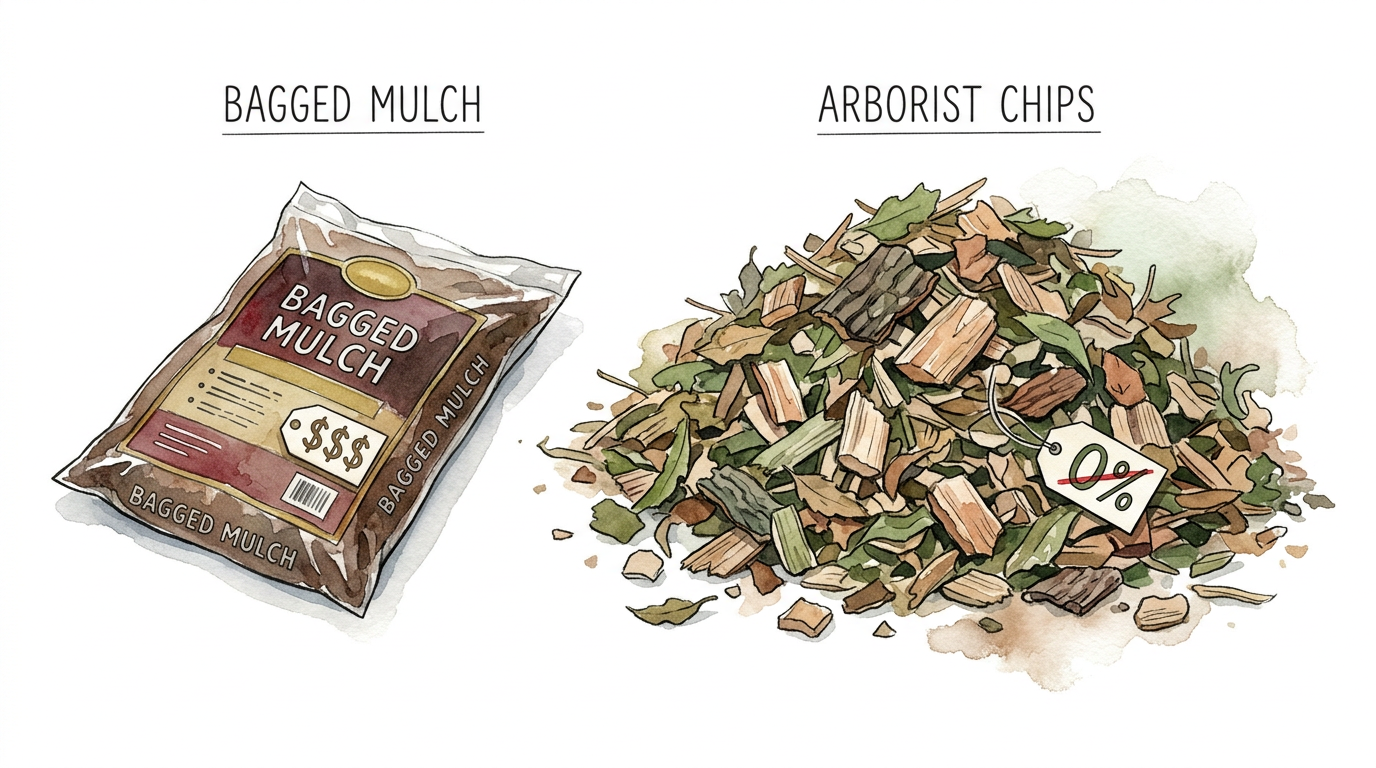
Stop paying hundreds for plastic bags of dyed wood when your local tree crew is looking for a place to dump soil-building gold for free. Why trade your hard-earned cash for chemical-dyed mulch in plastic waste? Arborist chips are the ultimate homesteading cheat code. They suppress weeds, retain moisture better than the store-bought stuff, and feed the soil fungal network as they break down. Here is how to get 20 yards of organic matter delivered to your door for exactly zero dollars.
Free Wood Chips For Garden Mulch
Arborist wood chips are the coarse, irregular byproduct of professional tree maintenance. Unlike the uniform, triple-shredded mulch found in big-box stores, these chips consist of everything that went through the chipper: heartwood, sapwood, bark, twigs, and even green leaves or pine needles. This diversity is precisely what makes them a powerhouse for the home garden and orchard.
Tree services generate massive quantities of this material every single day. For a tree crew, wood chips are often a liability. They have to pay “tip fees” at local landfills or recycling centers to dispose of the load, which eats into their profit margins and burns expensive diesel. When you offer your driveway as a dump site, you are performing a service for them, and in return, you receive a mountain of organic matter that would cost a fortune if purchased by the yard.
This material exists because trees in our neighborhoods need pruning or removal due to storm damage, utility line clearance, or landscape changes. In nature, a forest floor is constantly being replenished by “branch drop” and decaying logs. Using arborist chips in your garden is essentially mimicking the ancestral wisdom of the forest floor, bringing that same self-sustaining cycle to your own backyard. It is the bridge between modern waste and ancient soil building.
Think of arborist chips as a “whole food” for your soil. While bagged bark mulch is a single-ingredient product—often stripped of its most nutritious components—arborist chips provide a balanced diet of carbon-heavy wood and nitrogen-rich green material. This blend fuels a complex ecosystem of soil life that simple bark cannot sustain on its own.
How to Source Your Free Wood Chip Delivery
Getting a pile of free wood chips delivered requires a mix of digital savvy and old-fashioned networking. The most popular modern tool is a service called ChipDrop, which acts as a matching service between arborists and gardeners. You sign up, pin your location on a map, and wait for a crew in your area to need a place to unload. It is a passive way to get chips, though it requires patience as you might wait days or months depending on local tree work volume.
Active sourcing often yields faster results. Look for the bright orange or white tree service trucks in your neighborhood. When you hear the sound of a wood chipper, grab a cold drink or a snack and walk over to talk to the crew lead. Be respectful of their time—they are working a dangerous job—but let them know you have a wide-open spot for a full load of chips. Many crews will be thrilled to save a thirty-minute drive to the dump.
Municipalities are another excellent source. Many cities and counties have a central yard where they dump chips from public works projects. Some cities will deliver a load for a small fee, while others allow you to bring your own truck or trailer and load up for free. Check your local public works website or call the city arborist to see what programs are available in your zip code.
Utility companies are the unsung heroes of free mulch. Power companies hire contractors to clear branches away from high-voltage lines year-round. These crews move fast and generate enormous amounts of chips. If you see them working on your street, ask them where they are dumping. Often, they are looking for the closest possible spot to keep their trucks moving efficiently.
Etiquette for a Successful Delivery
Preparation is the key to staying on a tree crew’s good side. Ensure your delivery spot is easily accessible by a large, heavy truck. These vehicles can weigh 20,000 pounds or more; they will sink into soft turf or crack thin asphalt. A gravel driveway or a spot right off the curb is usually best. Mark the spot clearly with a sign that says “DUMP CHIPS HERE” so the driver doesn’t have to guess if you aren’t home.
Be prepared for the sheer volume of a professional load. A standard arborist truck holds between 10 and 20 cubic yards of chips. To visualize this, a single load will cover a 1,000-square-foot garden about 3 to 6 inches deep. Do not request a delivery if you only need a few wheelbarrows full. These crews do not do partial drops; you get the whole mountain or nothing at all.
The Practical Benefits of Arborist Chips
Moisture retention is the most immediate benefit you will notice. A thick layer of wood chips acts like a giant sponge, absorbing rainfall and slowly releasing it into the soil over time. Research shows that wood chips are among the best-performing mulches for preventing evaporation. In times of drought, a mulched garden can survive weeks longer than one with bare soil, reducing your water bill and your labor.
Temperature regulation is another “silent” benefit. In the heat of summer, bare soil can reach temperatures that literally cook the microbial life and stress plant roots. A 4-inch layer of chips can keep the soil 10 to 20 degrees cooler. Conversely, in the winter, that same layer acts as an insulating blanket, protecting the root zones of perennials and fruit trees from the “freeze-thaw” cycles that can heave plants out of the ground.
Weed suppression is the primary reason most people mulch, and arborist chips excel here. Because they are chunky and irregular, they create a physical barrier that prevents sunlight from reaching weed seeds. Any seeds that do land on top of the mulch find it difficult to send roots down through the dry, airy upper layer of chips before they wither. This significantly reduces the time you spend on your hands and knees weeding.
Soil building is the long-term “pioneer-grit” advantage. As the chips break down, they don’t just disappear; they transform into rich, dark humus. The lignin and cellulose in the wood provide a steady food source for beneficial fungi. These fungi build vast networks of hyphae that help transport nutrients and water directly to your plants’ roots. Over several years, even the hardest clay or the sandiest soil can be turned into a friable, nutrient-dense loam through the consistent application of arborist chips.
Debunking the Nitrogen Depletion Myth
One of the most persistent old wives’ tales in gardening is that fresh wood chips “steal” nitrogen from the soil and will kill your plants. This misunderstanding stems from the fact that soil microbes do indeed use nitrogen to break down carbon-rich wood. However, this process occurs only at the very thin interface where the wood chips touch the soil surface. It is a localized effect that does not reach down into the root zone of your trees, shrubs, or established perennials.
Scientific research, including studies by Dr. Linda Chalker-Scott at Washington State University, has confirmed that wood chip mulches do not cause nitrogen deficiencies in established plants. In fact, as the chips decompose, they eventually release nitrogen back into the soil in a more stable, slow-release form. The only time you need to worry about nitrogen tie-up is if you make the mistake of tilling fresh wood chips *into* the soil. As long as they remain on top as a mulch, your plants are safe.
Young, shallow-rooted annuals or vegetables are the exception to this rule. Because their roots reside in that top inch of soil where the nitrogen tie-up occurs, they might show signs of yellowing (chlorosis) if mulched heavily with fresh chips. For these plants, it is better to use a fully finished compost or a lighter mulch like straw. For everything else—orchards, berry patches, and ornamental beds—fresh chips are a net positive for nitrogen levels over time.
Common Challenges and Mistakes to Avoid
Volcano mulching is the most frequent error made by beginners and professional landscapers alike. This is the practice of piling mulch high against the trunk of a tree. Tree bark is designed to be exposed to air and light; when it is buried under moist wood chips, it becomes a breeding ground for rot and fungal diseases. It also provides a hidden highway for voles and other rodents to chew on the bark during winter. Always keep mulch at least 3 to 6 inches away from the trunk, creating a “donut” shape rather than a volcano.
Depth matters more than most people realize. If you apply the chips too thinly (less than 2 inches), you won’t get the weed suppression or moisture retention benefits. In fact, a thin layer can sometimes act as a seedbed for weeds. Aim for a consistent 4 to 6 inches of depth. It will settle over the first few weeks, so don’t be afraid to go a little thick initially. This is especially true if you are trying to kill off an existing lawn using the sheet mulching method.
Trash and “extras” can occasionally be an issue with free chips. Because these are a raw byproduct, you might find the occasional piece of plastic, a stray soda can, or a bit of candy wrapper that was on the curb when the crew sucked up the brush. You might also find large “chunks” of wood that didn’t get fully pulverized. This is the price of “free.” A few minutes of hand-picking after the pile is dumped is usually all it takes to clean up the load.
Access is the final hurdle. A 15-yard pile is a massive amount of physical labor to move by hand. Many people underestimate the work involved and let the pile sit in their driveway for months, which can lead to complaints from neighbors or the city. Have your wheelbarrow, pitchfork, and a plan ready before the truck arrives. Moving five yards a day is a manageable goal for a single person in decent shape.
Limitations and When Not to Use Arborist Chips
Steep slopes can be a challenge for coarse wood chips. While they are better than light mulches like straw, a heavy rainstorm on a significant incline can wash chips down into drains or neighbor’s yards. For slopes, you may need to use a more “shredded” style of mulch that knits together better, or utilize terracing to hold the chips in place. However, on most typical garden grades, arborist chips stay put quite well once they have been rained on once or twice.
Fire risk is a consideration in wildland-urban interface areas. While fresh, green wood chips are surprisingly difficult to ignite, dried-out chips can become a fuel source in a forest fire. If you live in a high-risk fire zone, follow local building codes which often suggest a 5-foot “non-combustible” zone around the foundation of your home. Use gravel or stone in that immediate perimeter and keep your wood chip mulching for the outer garden beds and orchards.
Specific “toxic” trees like Black Walnut (Juglone) often scare gardeners. While the roots and leaves of a walnut tree can inhibit the growth of some plants, the juglone compound breaks down rapidly during the chipping and aging process. Science shows that even walnut chips used as a surface mulch are generally safe for most landscape plants. If you are particularly concerned, you can let a load of walnut chips age for a few months before use, but for most applications, it is a non-issue.
Disease transmission is another common worry. Gardeners often fear that chips from a diseased tree will infect their healthy ones. However, most tree pathogens are host-specific and require living tissue to survive. The heat generated inside a large wood chip pile—which can easily reach 140 degrees Fahrenheit—kills off the vast majority of fungal spores and pests. Unless you are mulching a healthy Oak with chips from an Oak that died of Oak Wilt yesterday, the risk is statistically near zero.
Comparing Mulch Types
| Feature | Bagged Bark Mulch | Arborist Wood Chips |
|---|---|---|
| Cost | $4 – $7 per bag (Expensive) | $0 (Free) |
| Nutrient Profile | Low (Mostly bark/carbon) | High (Includes leaves/needles) |
| Durability | Medium (Breaks down quickly) | High (Chunky, lasts 2-3 years) |
| Chemicals | Often dyed with pigments | Natural and untreated |
| Soil Biology | Minimal fungal support | Excellent for Mycorrhizae |
Practical Tips for Managing Your Chip Pile
Timing your request can make a big difference in the quality of the chips you receive. If you want high-nitrogen chips with plenty of green matter, request them in the late spring or summer when trees are in full leaf. If you prefer a “cleaner” look with mostly wood and bark, winter is the best time for a delivery. Pine and cedar chips are excellent for pathways and acid-loving plants like blueberries, though most garden plants aren’t picky about the species.
Use the “Mulch Sandwich” technique for a massive fertility boost. Before you spread your wood chips, lay down a thin layer of high-quality compost or aged manure directly on the soil. Cover this with your 4-6 inches of arborist chips. The chips protect the compost from drying out and provide a stable environment for worms and microbes to process the nutrients and pull them down into the soil. This mimics the natural “duff” layer found on the forest floor.
Invest in a high-quality pitchfork rather than a shovel. Shovels are for moving dirt; pitchforks are for moving woody debris. A ten-tine mulch fork will make the job 50% easier because it allows you to “stab” into the pile and lift a large volume with minimal resistance. Pair this with a large-capacity, two-wheeled wheelbarrow to save your back and your sanity during the moving process.
If you find yourself with more chips than you can use immediately, don’t worry. Wood chips only get better with age. A pile left to sit for six months will start to break down internally, turning into “partially composted” wood chips that are even richer in fungal life. This “aged” mulch is less likely to have any remaining allelopathic chemicals and is safer to use around delicate garden starts.
Advanced Considerations: Mycorrhizae and Soil Respiration
For the serious practitioner, arborist chips are more than just a weed barrier; they are a tool for managing soil respiration and gas exchange. Fine mulches like sawdust or double-shredded bark can “felt” together, creating a hydrophobic layer that sheds water and prevents oxygen from reaching the soil. Because arborist chips are chunky and varying in size, they maintain large pore spaces. This allows the soil to “breathe,” ensuring that the aerobic microbes responsible for nutrient cycling have the oxygen they need to thrive.
Encouraging mycorrhizal fungi is the “holy grail” of organic gardening. These fungi form a symbiotic relationship with plant roots, effectively increasing the root surface area by hundreds of times. In exchange for sugars from the plant, the fungi forage for phosphorus and water in the soil. Arborist chips, particularly those with a high wood-to-bark ratio, provide the complex carbon chains these fungi need to build their networks. Over time, a chip-mulched garden becomes a massive, interconnected fungal web that makes your plants incredibly resilient to stress.
Thermal mass is another advanced concept to consider. A large, thick area of wood chips holds a significant amount of heat. In the spring, this can actually delay the warming of the soil by a few days, which might be a disadvantage for heat-loving crops like peppers. However, for fruit trees, this is often a benefit as it can delay early blooming and protect the blossoms from a late spring frost. Understanding these subtle micro-climate shifts allows you to use wood chips strategically across different zones of your property.
Real-World Scenario: The Orchard Transformation
Imagine a homeowner with three newly planted apple trees in a backyard of compacted, heavy clay. Traditionally, they might dig a small hole, plant the tree, and leave the grass growing right up to the trunk. The grass competes for nutrients, and the clay stays waterlogged and anaerobic.
Now, consider the arborist chip approach. The homeowner gets a 15-yard drop in the driveway. They clear a 6-foot circle around each tree, laying down a thin layer of compost followed by 6 inches of arborist chips. Within one season, the clay under the chips begins to soften as earthworms move in to eat the decaying wood. The moisture levels remain steady even during a July heatwave. By year three, the “soil” under the chips has transformed into 2 inches of rich black humus, and the apple trees show twice the growth of trees in bare soil. This is the power of free organic matter put to work correctly.
Final Thoughts
Arborist wood chips represent one of the few remaining “something for nothing” opportunities in the modern world. By understanding the needs of local tree crews and the biology of your soil, you can opt out of the expensive, chemical-heavy commercial mulch cycle. You are not just saving money; you are participating in a grander cycle of renewal that honors the life of the trees that provided the material.
The transition from a high-maintenance garden to a self-mulching, fungal-dominant landscape doesn’t happen overnight. It takes a bit of “pioneer grit” to move those mountains of chips and a bit of patience to let the fungi do their work. But the result—dark, crumbly soil, resilient plants, and far fewer chores—is worth every drop of sweat. Start by making that first phone call or signing up for a delivery today, and watch your soil transform from a stagnant substrate into a thriving ecosystem.
