How To Become More Self-Sufficient Without Starting a Full-Blown Farm…
Want to start preserving your harvest, making your own soap, or building a backyard root cellar — but not sure where to begin? “Homesteading Advice” gives you instant lifetime access to 35+ practical homesteading books on food preservation, veggie gardening, DIY natural cleaning products (save over $250 per year with this skill alone), brewing, off-grid energy, and a whole lot more…
Click Here To Check It Out Now!
The best fruit trees aren’t found in a catalog; they are hidden in abandoned orchards waiting for you to find them. Most nursery trees are bred for appearance and shipping, not for your specific soil or climate. By foraging scion wood from local ‘survivor’ trees and grafting it yourself, you unlock a century of resilience and flavor that money simply cannot buy. It’s time to take control of your orchard’s genetics.
Old-growth orchards dot the landscape of North America, remnants of a time when every homestead produced its own cider, sauce, and winter storage crops. These trees have survived over a century of drought, record-breaking freezes, and local pests without a single drop of chemical spray or irrigation. They are the ultimate survivors, yet they are slowly disappearing as old farms are subdivided and forgotten.
Learning to graft these heritage varieties is more than a hobby; it is an act of preservation. You are essentially cloning a living piece of history. When you take a cutting from a tree planted in 1910 and graft it onto a modern rootstock, you aren’t just planting a tree; you are continuing a lineage of proven performance that modern nurseries often ignore in favor of patented, “pretty” varieties like Gala or Honeycrisp.
Grafting allows you to be the architect of your own food security. You can choose a rootstock that matches your specific soil—be it heavy clay or sandy loam—and pair it with a fruiting variety that has already proven it can thrive in your local microclimate. This guide will walk you through the grit and the glory of heritage grafting, from the winter hunt for scion wood to the spring miracle of a successful union.
Grafting Heritage Fruit Trees For Beginners
Grafting is the ancient art of joining two different plants so they grow together as one. In the world of heritage fruit, this involves taking a small branch, called a scion, from a “survivor” tree and attaching it to a rootstock—a young tree specifically grown for its root system. This process is necessary because most fruit trees do not grow “true to seed.” If you plant a seed from a Granny Smith apple, you will likely get a sour, small crabapple-like fruit rather than a clone of the parent.
Vegetative propagation via grafting is the only way to ensure the fruit remains identical to the parent. This technique has been used for thousands of years to preserve the best flavors and most resilient genetics. In a real-world situation, you might find a massive, gnarled apple tree in a state park or an abandoned farm. The fruit might be the most delicious thing you’ve ever tasted, or perhaps the tree is simply impressive because it is 120 years old and still bearing. You can take a six-inch cutting from that tree in February and have a clone of it growing in your yard by April.
Think of grafting like a blood transfusion between two plants. You are aligning the cambium—the thin, green, “slimy” layer just beneath the bark where all the growth happens. When the cambium of the scion meets the cambium of the rootstock, they form a callus, knit together, and begin exchanging nutrients. The rootstock provides the foundation, determining how tall the tree will grow and how well it handles the soil, while the scion provides the genetics for the fruit.
How the Hunt Works: Identifying and Collecting Scion Wood
Finding the right wood is the first step in successful heritage grafting. You must collect scion wood while the parent tree is in deep dormancy, typically between late January and early March. Looking for trees in the middle of winter requires a keen eye for “pioneer-grit” survivors—trees that stand alone in overgrown fields or along old stone walls.
Identifying “Survivor” Trees
Abandoned orchards are the primary hunting grounds. Look for trees with massive trunks and signs of age, such as peeling bark or hollow centers, that still show signs of life in their upper canopy. You are looking for health in the midst of neglect. If a tree has survived 80 years of pests and disease without human intervention, it carries genetics that are invaluable for a low-maintenance home orchard.
Selecting the Right Cuttings
Success depends on choosing one-year-old wood. This is the growth that occurred during the previous summer. It is usually found at the very tips of the branches and is identifiable by its smooth, shiny bark and distinct “growth rings” where the previous year’s growth ended. On old, unmanaged trees, new growth can be stunted, sometimes only an inch or two long. If the tree is in poor health, look for “water sprouts”—vigorous, vertical shoots that grow directly from the trunk or main limbs. These are excellent for grafting as they are packed with energy and easy to handle.
Identifying Buds
You must distinguish between vegetative (leaf) buds and flower buds. Leaf buds are narrow, pointy, and sit close to the stem. Flower buds are round, plump, and often “fuzzy.” If you graft a piece of wood that only contains flower buds, the scion will try to bloom and fruit in its first year, exhausting its energy before the graft union can fully heal. Always aim for scions with at least three healthy leaf buds.
How to Collect and Store Your Scions
The collection process requires a sharp pair of sterilized bypass pruners. Using dull tools can crush the delicate cambium, leading to graft failure months later. Always dip your pruners in a 70% isopropyl alcohol solution between trees to prevent the spread of diseases like fire blight.
Cut sections of wood that are about the thickness of a pencil, ideally 8 to 12 inches long. Once harvested, the biggest threat to your scions is desiccation. A dried-out scion is a dead scion. Moisture management is critical for success.
- The Three-Bag Method: Place your labeled scions in a plastic bag with a slightly damp (not soaking) paper towel. Place that bag inside a second bag, and then a third. This creates multiple layers of protection against the drying effects of a frost-free refrigerator.
- Avoid Ethylene: Never store your scions in a refrigerator with ripening fruit like apples or bananas. These fruits emit ethylene gas, which will cause the scion buds to wake up and die before they ever hit the rootstock.
- Maintain Cold Temperatures: Keep the scions between 34°F and 38°F. You want them to stay in a state of “suspended animation” until the spring sap begins to flow in your rootstocks.
Core Grafting Techniques for Heritage Wood
Mastering the actual physical connection between the plants is where the magic happens. While there are dozens of methods, two primary techniques dominate the world of heritage fruit: the Whip and Tongue graft and the Cleft graft.
The Whip and Tongue Graft
Commonly used for “bench grafting,” this method is ideal when the scion and the rootstock are the same diameter—typically pencil thickness. This technique provides the most surface area for cambium contact and creates a very strong mechanical bond. You make a long, sloping cut on both the scion and rootstock, then a small “tongue” slice in the middle of each. The two pieces then interlock like a puzzle. This mechanical “lock” prevents the scion from shifting while you wrap it.
The Cleft Graft
Field grafters prefer this method when they want to “top-work” an existing tree or graft onto a rootstock that is much thicker than the scion. You cut the rootstock off flat, split the center of the trunk or branch (the cleft), and then insert two wedge-shaped scions into the edges of the split. The pressure of the wood helps hold the scions in place. The most critical part of a cleft graft is ensuring the thin green line of the scion’s cambium crosses the thin green line of the rootstock’s cambium. Precise alignment is the difference between a thriving tree and a dead stick.
Sealing the Deal
Every cut surface must be sealed to prevent moisture loss. Use parafilm or specialized grafting tape to wrap the union tightly. For cleft grafts, many practitioners use grafting wax or a non-toxic pruning sealer to cover the exposed “shoulder” of the rootstock. Protection from the elements allows the tree to focus all its energy on callusing the wound.
Benefits of Grafting Heritage Fruit
Choosing heritage grafts over commercial nursery stock offers advantages that go far beyond nostalgia. These benefits are practical, measurable, and essential for those seeking a self-reliant lifestyle.
- Superior Flavor Profiles: Commercial apples are bred for “crunch” and shelf life. Heritage varieties like the Ashmead’s Kernel or the Roxbury Russet offer complex flavors involving hints of nut, spice, and honey that haven’t been seen in grocery stores for decades.
- Innate Disease Resistance: Survivor trees have already passed the ultimate test. If a tree has lived 100 years in your county without being sprayed for scab or cedar apple rust, it possesses a natural immunity that a laboratory-bred tree cannot match.
- Local Adaptation: A tree found in your specific region is tuned to your local frost dates, soil pH, and rainfall patterns. This reduces the need for supplemental watering or soil amendments.
- Genetic Diversity: By grafting rare varieties, you are preventing the extinction of unique genetic traits. This diversity is our best defense against future agricultural pests or climate shifts.
Challenges and Common Mistakes
Grafting is a skill that requires patience, and failure is part of the learning curve. Most beginners fail not because of lack of talent, but because of small, avoidable errors in the process.
Bad cambium alignment is the most frequent cause of failure. If the green layers do not touch, the plants cannot communicate. Beginners often align the outer bark rather than the inner cambium. Since bark thickness varies between old scions and young rootstocks, the cambium layers may be deeper than they appear.
Timing is another pitfall. Grafting too early in the spring, before the rootstock is awake, can cause the scion to dry out before the sap begins to flow. Conversely, grafting too late, after the scion has already begun to leaf out in storage, usually results in death because the leaves will pull moisture out of the scion faster than the unhealed union can provide it.
Dull knives are dangerous to both the grafter and the tree. A dull blade tears the wood cells rather than slicing them cleanly. A ragged cut creates air pockets in the union, preventing the “knitting” process. Investment in a high-quality grafting knife and a sharpening stone is non-negotiable for anyone serious about heritage preservation.
Limitations of Heritage Grafting
While heritage grafting is powerful, it is not a silver bullet. There are realistic constraints that every practitioner must understand to manage their expectations.
Rootstock compatibility is a hard limit. You cannot graft an apple onto a cherry tree, nor a pear onto an oak. While apples generally graft to any apple rootstock, pears can be more finicky. Some heritage pears require an “interstem”—a middle piece of compatible wood—to bond with certain dwarfing quince rootstocks. Always research the genus and species of your foraged wood before ordering rootstock.
Viral loads are a significant concern with very old trees. Many survivor trees carry latent viruses that they have “learned” to live with over decades. When you graft that wood onto a modern, sensitive rootstock, the virus may kill the young tree or cause it to grow poorly. This is a risk you accept when working with wild genetics.
Time to fruit is another consideration. If you graft onto a “standard” rootstock (Antonovka or seedling), it may take 7 to 10 years for your heritage tree to produce its first crop. While dwarfing rootstocks (M9 or B9) can speed this up to 2 or 3 years, they are less resilient and require more support and irrigation, which may contradict your goal of a “survivor” orchard.
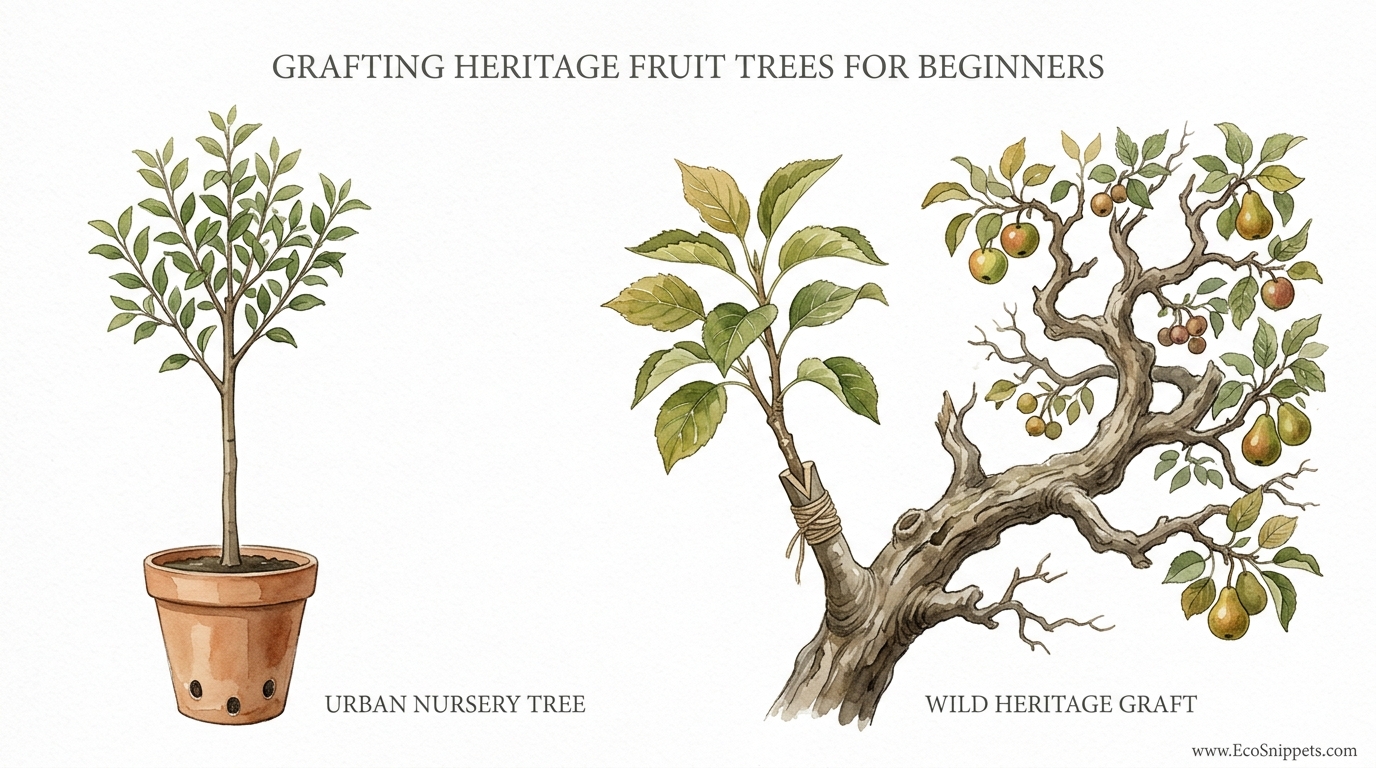
Urban Nursery Tree vs. Wild Heritage Graft
Comparing these two options reveals why the extra effort of foraging and grafting is worth the labor for the serious homesteader.
| Feature | Urban Nursery Tree | Wild Heritage Graft |
|---|---|---|
| Cost | $40–$70 per tree | $3–$5 (Price of rootstock) |
| Flavor | Standard, one-dimensional | Complex, heirloom, historical |
| Resilience | Dependent on chemicals/care | High; proven survival genetics |
| Adaptability | General (National) | Local (Regional/Micro-climate) |
| Maintenance | High (Pruning, spraying) | Low (Self-sufficient) |
Practical Tips for Success
Application of these best practices will significantly increase your “take” rate when working with difficult foraged wood.
- Practice on Willow or Hawthorn: Do not let your first cut be on a rare, one-of-a-kind scion. Practice your whip and tongue cuts on wild willow or hawthorn branches until you can make a flat, clean slice in a single motion.
- Hydrate Your Scions: If your foraged wood looks a bit shriveled, soak the bottom inch in water for 2–4 hours (but no longer) before grafting. This “plumps up” the cambium cells and gives them a better chance of survival.
- Label Everything: Use metal tags or permanent markers on the rootstock immediately. It is heartbreaking to have five successful grafts and no idea which one is the “Mystery Cider Apple” from the old red barn.
- Manage the Shade: If you are field grafting in a sunny spot, consider wrapping the scion in a small piece of aluminum foil (leaving the buds exposed) to reflect heat and prevent the wood from baking before it can heal.
Advanced Considerations: Top-Working and Interstems
Serious practitioners often go beyond simple bench grafting to optimize their space and tree performance. Top-working is the process of grafting multiple heritage varieties onto a single large tree. This is excellent for small properties; you can have an “all-season” tree that produces early-season transparent apples, mid-season cider fruit, and late-season keepers all on the same trunk.
Interstems provide a way to bypass compatibility issues or combine the benefits of two different rootstocks. For example, you might graft a vigorous, well-anchored rootstock to a 6-inch piece of dwarfing wood, and then graft your heritage scion on top of that. This gives you a tree with a massive root system that still stays small enough to harvest without a ladder.
DNA testing has become an affordable tool for the heritage enthusiast. If you find a tree that produces exceptional fruit but has no name, you can send a leaf sample to a lab for identification. Many “lost” varieties have been rediscovered this way, re-entering the public record after being forgotten for a century.
Example Scenario: The Homestead “Sugar Apple”
Imagine a scenario where a forager finds an old apple tree on a high-altitude mountain ridge. The tree is mostly dead, with only one living branch remaining. The fruit is small, ugly, and covered in russeting, but it is incredibly sweet and tastes like a spiced pear. This is a classic “survivor” candidate.
The forager visits the tree in February, wading through snow to take three small cuttings from the top of that living branch. These scions are stored in a triple-bagged system in the refrigerator. In April, the forager purchases three M111 rootstocks—known for being well-anchored and drought-tolerant. Using a whip and tongue graft, the forager joins the mountain scions to the new roots. Two of the three grafts “take,” and within three years, the forager has a productive version of that mountain apple growing in their backyard. The original tree on the ridge dies the following winter, but its 100-year-old genetics are now safe and thriving in a new location.
Final Thoughts
The best fruit trees aren’t found in a catalog because the commercial industry cannot monetize the patience and local knowledge required to grow them. By choosing to graft heritage “survivors,” you are reclaiming a piece of ancestral wisdom that prioritizes resilience over appearance. You are opting for a tree that doesn’t need a life-support system of fertilizers and pesticides because it has already proven its grit against the elements.
Grafting is a bridge between the past and the future. It allows us to carry the best flavors of our great-grandparents’ orchards into a world that desperately needs more biodiversity and self-reliance. Whether you are searching for the perfect cider apple or a pear that can survive a late-spring frost, the answers are already out there, growing quietly in the corners of forgotten fields.
Take up the knife, find a survivor, and start your own legacy. The reward is a tree that is uniquely yours—a living testament to the history of your land and the skill of your hands. Experiment, fail occasionally, and keep cutting; the perfect orchard is waiting for you to build it, one graft at a time.
