How To Become More Self-Sufficient Without Starting a Full-Blown Farm…
Want to start preserving your harvest, making your own soap, or building a backyard root cellar — but not sure where to begin? “Homesteading Advice” gives you instant lifetime access to 35+ practical homesteading books on food preservation, veggie gardening, DIY natural cleaning products (save over $250 per year with this skill alone), brewing, off-grid energy, and a whole lot more…
Click Here To Check It Out Now!
Hori Hori Knife: The 800-Year-Old Tool That Replaces Your Entire Garden Shed
This 800-year-old tool replaces every single gadget in your garden shed. Stop carrying a bucket of tools to the garden. The Hori Hori knife digs, saws, measures, and weeds. It’s the ultimate survivalist garden tool that lasts a lifetime.
Modern gardening has become a pursuit of plastic. We are told we need a specialized trowel for bulbs, a different one for transplanting, a dedicated saw for roots, and a serrated knife for twine. Our sheds are cluttered with “ergonomic” gadgets that snap under the pressure of real soil. It is a distraction from the true work of the land.
The Hori Hori knife, often called the “soil knife” or “mountain vegetable knife,” strips away the unnecessary. It is a tool born from Japanese tradition, designed for those who worked the rugged mountainsides where versatility was not a luxury, but a requirement for survival. When you hold a Hori Hori, you aren’t just holding a blade; you are holding centuries of pioneer grit and agricultural wisdom.
If you are tired of carrying a heavy bucket across your property every time you need to prune a stray branch or pop a dandelion, it is time to look backward to move forward. This tool is the bridge between the ancient past and your modern homestead.
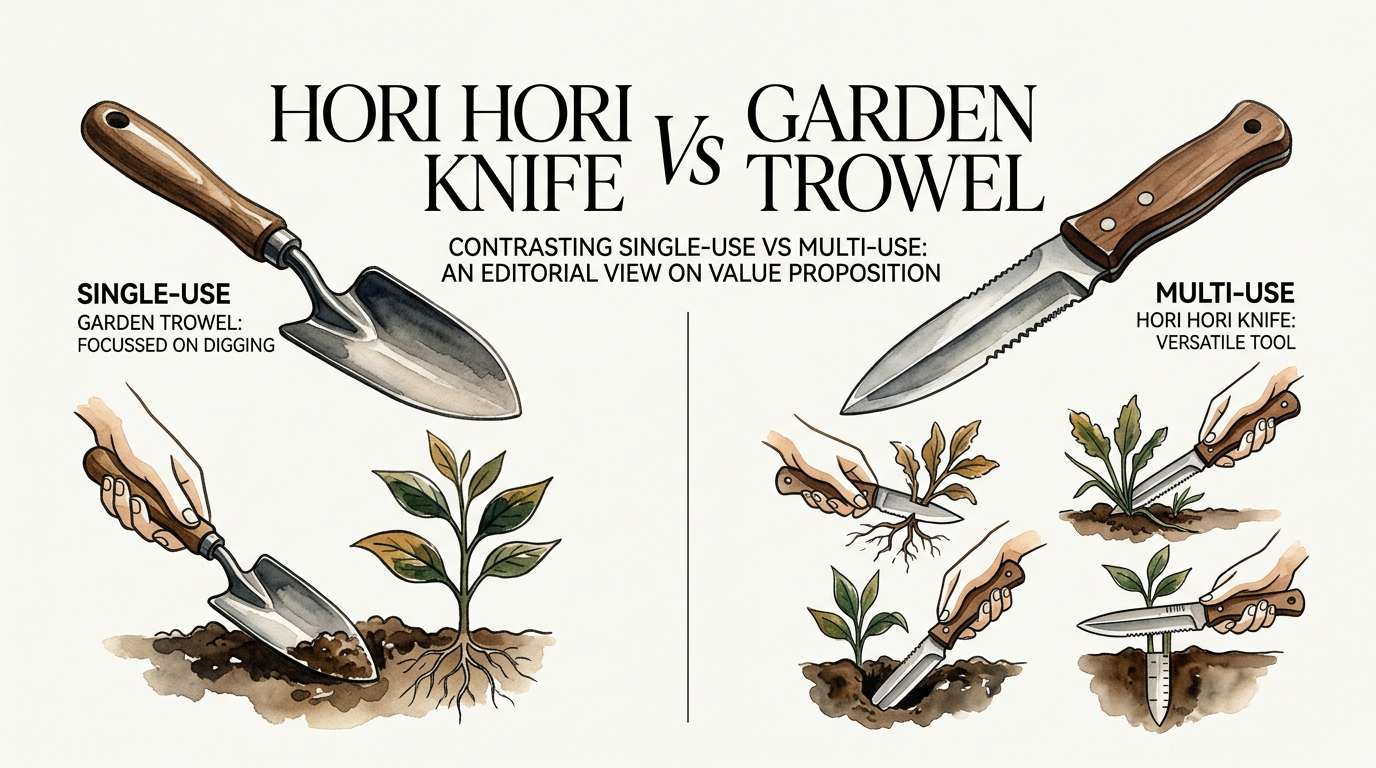
Hori Hori Knife vs Garden Trowel
To understand why the Hori Hori is superior, we must first look at the humble garden trowel. Most modern trowels are stamped from thin sheets of metal and attached to a handle with a weak weld. They are designed for “potting up” soft, nursery-bought soil. They are not built for the resistance of sun-baked clay or the tangled web of perennial roots.
The Hori Hori knife is a different beast entirely. It is essentially a heavy-duty, double-edged blade with a slight concave curve. Think of it as a cross between a dagger and a trowel. While a trowel is a blunt instrument used for scooping, the Hori Hori is a precision instrument designed for penetration and leverage.
Where a trowel bends, the Hori Hori cuts. Where a trowel fails to pierce the sod, the Hori Hori slices through like a hot wire through wax. The weight of the blade does the work for you, allowing you to use your body’s leverage rather than just your wrist strength. It is the difference between fighting the earth and working with it.
| Feature | Standard Garden Trowel | Traditional Hori Hori Knife |
|---|---|---|
| Durability | Prone to bending or snapping at the neck. | Heavy-duty steel, often full-tang, built for prying. |
| Edge | Blunt, intended for scooping only. | One sharp edge, one serrated edge for cutting roots. |
| Versatility | Limited to digging small holes. | Digs, saws, weeds, measures, and harvests. |
| Soil Type | Best for loose potting mix or light soil. | Excels in clay, rocky soil, and thick sod. |
How It Works: Mastering the Multi-Tool of the Earth
Using a Hori Hori knife effectively requires a shift in mindset. You aren’t just scooping dirt; you are performing surgical strikes on the landscape. The tool features a pointed tip that is ideal for making deep, narrow holes for seedlings or plunging into the center of a stubborn weed taproot.
The blade typically has two edges. One side is razor-sharp for slicing through sod, opening bags of mulch, or harvesting greens. The other side is serrated, acting as a hand saw. This serrated edge is your best friend when you encounter a thick woody root while digging a hole. Instead of stopping to find a pair of loppers, you simply saw through the obstruction and keep moving.
The concave shape of the blade allows it to hold a small amount of soil, making it effective for transplanting. However, its primary function is “levering.” When you insert the knife into the ground next to a weed, the heavy steel allows you to pry the plant upward, bringing the entire root system with it rather than just snapping the top off.
Step-by-Step Weeding Technique
- Identify the center of the weed (the crown).
- Plunge the Hori Hori vertically into the soil about two inches from the base of the plant.
- Push the handle away from the weed, using the curve of the blade as a fulcrum to loosen the soil.
- Grasp the weed at the base and pull; the loosened soil will release the taproot entirely.
Planting Bulbs with Precision
Most Hori Hori knives come with depth markings etched directly into the steel. This is a game-changer for autumn bulb planting. You no longer have to guess if you are four or six inches deep. Simply plunge the knife until the soil line hits the desired mark on the blade, twist it to create a pocket, and drop your bulb in. It is faster, more accurate, and far less taxing on the hands.
The Benefits of an Ancestral Approach
The greatest advantage of the Hori Hori knife is the reduction of “tool fatigue.” When you carry less, you can do more. By consolidating your kit into a single tool that fits in a belt sheath, you free up your hands for carrying harvests or moving debris. This is the essence of self-reliance: having the right tool on your person at all times.
Furthermore, the durability of this tool cannot be overstated. A well-made Hori Hori, forged from high-carbon steel or thick stainless steel, is a legacy item. It doesn’t have moving parts to break. It doesn’t have plastic hinges to sun-rot. It is a solid piece of tempered metal that stands up to the harshest conditions a garden can throw at it.
There is also a psychological benefit. Using a tool with such a deep history connects you to the generations of growers who came before. It encourages a slower, more intentional way of gardening. You become less of a consumer of garden gadgets and more of a steward of the land, using a tool that respects the resistance of the earth.
- Unmatched Versatility: One tool for ten different jobs.
- Rugged Durability: Built to withstand prying and heavy leverage.
- Portability: Fits in a sheath on your belt, leaving your hands free.
- Precision: Etched measurements ensure perfect planting depths every time.
Challenges and Common Mistakes
While the Hori Hori is nearly indestructible, it is not magic. The most common mistake new users make is neglecting the blade. Because it is used in the dirt, it will eventually dull. A dull Hori Hori requires more force, which increases the risk of slipping. You must treat it like the knife it is, not just a shovel.
Another challenge is the material choice. You will often find Hori Horis in both carbon steel and stainless steel. Carbon steel holds an edge longer and is generally tougher, but it will rust if left damp. Stainless steel is more “set it and forget it,” but it can be harder to sharpen once it loses its bite. For the true pioneer spirit, carbon steel is the choice, provided you are willing to maintain it.
Safety is also a factor. Because one edge is sharp and the tip is pointed, you must always be aware of where your free hand is located. Never pull the knife toward your body when cutting roots or opening bags. Always push away. A Hori Hori is a serious tool, and it demands the same respect you would give a hatchet or a hunting knife.
Practical Tips for the Modern Homesteader
To get the most out of your Hori Hori knife, you should integrate it into your daily routine. Don’t leave it in the shed; keep it in its sheath by the door. Whether you are checking the fence line or heading out to pick a few tomatoes, having it on your hip means you can tackle small problems before they become big ones.
Maintain the edge: Once a month, take a sharpening stone or a simple file to the straight edge. You don’t need a razor edge like a kitchen knife, but it should be sharp enough to slice through a thick weed stalk with minimal pressure. For the serrated side, a round file can be used to touch up the teeth if they become clogged or dull.
Clean and oil: At the end of the day, wipe the soil off the blade. If you have a carbon steel version, rub a light coat of linseed oil or even mineral oil onto the metal. This creates a barrier against moisture and prevents the “pitting” that can weaken the steel over decades.
Use the “Twist” method: When digging in hard-packed earth, don’t just push down. Push the tip in and give the handle a firm twist. This rotational force breaks the surface tension of the soil much more effectively than downward pressure alone.
Final Thoughts on the Hori Hori Knife
In a world that wants to sell you a different plastic solution for every minor problem, the Hori Hori knife is a statement of defiance. It is a reminder that the best solutions are often the ones that have already stood the test of time. By choosing a multi-use tool with ancestral roots, you are choosing efficiency over clutter and quality over convenience.
Whether you are a casual backyard gardener or a serious survivalist looking to maintain a food forest, the Hori Hori belongs at your side. It is the only tool that bridges the gap between delicate seed starting and the brutal work of reclaiming overgrown land. It is simple, it is heavy, and it is honest.
If you take care of this tool, it will take care of you. It will be the tool you reach for every morning, and eventually, it will be the tool you pass down to the next generation of growers. Stop carrying the bucket. Strap on the sheath. Let the 800-year-old wisdom of the Hori Hori transform the way you interact with the earth.
