How To Become More Self-Sufficient Without Starting a Full-Blown Farm…
Want to start preserving your harvest, making your own soap, or building a backyard root cellar — but not sure where to begin? “Homesteading Advice” gives you instant lifetime access to 35+ practical homesteading books on food preservation, veggie gardening, DIY natural cleaning products (save over $250 per year with this skill alone), brewing, off-grid energy, and a whole lot more…
Click Here To Check It Out Now!
Your AC unit fights the heat by making the world outside hotter; these plants fight the heat by creating their own microclimate. Urban heat islands are created by concrete and cooling exhaust. You can lower your balcony temperature by up to 10 degrees just by using the power of transpiration. A ‘Green Wall’ isn’t just decoration—it’s a functional cooling engine that doesn’t use a single watt of power.
Living in a city often feels like living inside a brick oven. The sun beats down on the pavement, and the walls of your apartment soak up that energy like a sponge, only to radiate it back at you long after the sun has set. This is the heavy price we pay for modern convenience and the “noisy metal box” we call an air conditioner. But there is a quieter, older way to find relief that our ancestors understood well before the grid existed.
Working with nature isn’t about giving up comfort; it is about reclaiming the self-reliance that comes from understanding how life works. You don’t need a complex electrical system to drop the temperature of your living space. You simply need to harness the same biological processes that keep a forest cool on a blistering July afternoon. This guide will show you how to build a living coolant system right on your balcony or interior wall.
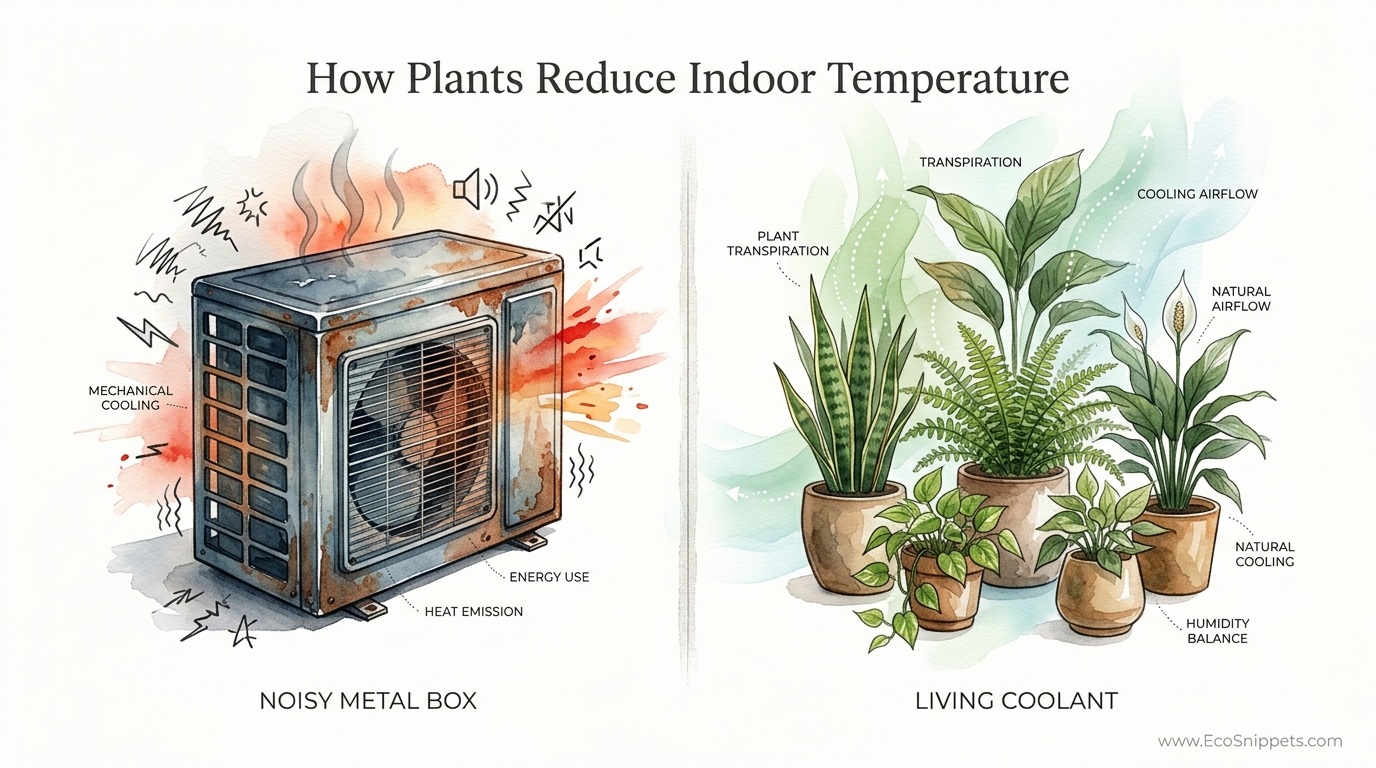
How Plants Reduce Indoor Temperature
Plants are far more than static ornaments. They are dynamic biological pumps that actively manage the climate around them to ensure their own survival. When we bring them into our urban spaces in high concentrations, they extend those benefits to us. There are three primary ways a green wall or balcony garden reduces the temperature of your home: shading, insulation, and transpiration.
Shading is the most immediate effect. A bare concrete wall can reach staggering temperatures in direct sunlight, often 20 to 40 degrees hotter than the ambient air. When you cover that wall with a layer of foliage, the leaves absorb the solar radiation for photosynthesis rather than letting it hit the building material. This prevents the “thermal mass” of your home from heating up in the first place, meaning there is less heat to bleed into your rooms at night.
Insulation works alongside shading. A thick green wall creates a “buffer zone” of still air between the plants and the structure of your home. This pocket of air acts as a natural thermal break. In the summer, it keeps the heat out; in the winter, it helps retain the warmth inside. It is a year-round shield that costs nothing to maintain once the plants are established.
The most powerful cooling mechanism, however, is transpiration. This is essentially the plant version of sweating. To move nutrients from their roots to their leaves, plants must pull water upward. This water eventually exits through tiny pores on the underside of the leaves called stomata. As this liquid water turns into vapor, it consumes heat energy from the surrounding air. This process, known as evaporative cooling, can lower the temperature of the air immediately around the plant by several degrees.
The Mechanics of the Living Coolant: Transpiration Explained
To understand the power of a green wall, you have to understand the physics of latent heat. When water changes state from a liquid to a gas, it requires energy. In the case of your balcony plants, that energy is pulled directly from the hot air around them. This isn’t a passive shadow; it is an active energy exchange that cools the atmosphere.
Scientific studies, including those conducted by NASA, have shown that a single large tree can transpire enough water to provide the cooling equivalent of five standard air conditioning units running for 20 hours a day. While a balcony green wall is smaller than an oak tree, the cumulative effect of hundreds of small plants working together creates a significant “coolth” zone. This microclimate acts as a filter, cooling the air before it ever enters your windows.
The efficiency of this system depends on the surface area of the leaves. Broad-leafed plants have more stomata and, therefore, a higher capacity for transpiration. When you group these plants together in a vertical arrangement, you maximize the “cooling surface” per square foot of floor space. This is why a green wall is vastly more effective than a few scattered pots on the ground.
Building Your High-Efficiency Green Wall
Creating a functional cooling engine requires more than just hanging some pots. You need a system that supports high-density growth and efficient water delivery. For the self-reliant pioneer in an urban setting, the goal is a robust, low-maintenance structure that can withstand the elements while providing maximum cooling.
Step 1: Planning and Wall Assessment
Start by observing the sun’s path across your balcony or wall. A southern or western exposure will get the most heat, making it the ideal candidate for a cooling wall. However, this also means your plants will need more water to stay alive. Check the weight capacity of your balcony and the structural integrity of the wall. A fully saturated green wall can be heavy, especially if you are using soil-based systems.
Step 2: Choosing Your System
There are two main ways to go vertical: green façades and living walls. A green façade uses climbing plants rooted in the ground or large bottom-dwellers that grow up a trellis or wire mesh. This is simpler to build but takes longer to provide full coverage. A living wall uses modular pockets or panels that hold plants across the entire surface of the wall from day one. Pockets made of breathable felt are excellent for transpiration because they allow air to reach the roots, further aiding in the cooling process.
Step 3: Waterproofing and Framing
Never attach a living wall directly to your home’s siding or masonry without a barrier. Moisture is the enemy of your home’s structure. Install a waterproof backing—such as a sheet of PVC or heavy-duty pond liner—onto a wooden or metal frame. Then, mount your planting pockets or trellis to that frame. This creates an air gap between the garden and your house, which prevents rot and adds an extra layer of thermal insulation.
Step 4: Irrigation Setup
A green wall dries out faster than a traditional garden. For a truly efficient “coolant engine,” you want consistent moisture. A simple gravity-fed drip system is the pioneer’s choice for reliability. A water reservoir placed at the top of the wall can slowly leak water through a series of tubes to each plant. This ensures the plants never hit “heat stress” mode, where they close their stomata and stop cooling the air to save themselves.
Top Performers for Natural Cooling
Not all plants are created equal when it comes to the “living coolant” effect. To get that 10-degree drop, you need high-transpiration species that can handle the specific light conditions of your space. Think of these plants as the “software” that runs your cooling hardware.
Peace Lilies and Ferns: If your balcony is shaded but hot, these are your best friends. Ferns, particularly Boston or Asparagus varieties, have a massive leaf surface area relative to their size. They are masters of humidifying and cooling the air. Peace Lilies are equally effective and will visibly “tell” you when they need more water by drooping, acting as a natural gauge for your system.
The Rubber Plant (Ficus elastica): With its large, waxy leaves, the Rubber Plant is a powerhouse of transpiration. It can handle brighter light and moves a significant amount of water from its roots to the air. It is a sturdy, “no-nonsense” plant that fits the pioneer-grit mindset—it does its job quietly and effectively.
Spider Plants and Areca Palms: These are the workhorses of the urban garden. Spider plants are incredibly hardy and reproduce quickly, allowing you to fill a green wall on a budget. Areca Palms are often cited as one of the best “natural humidifiers” in the botanical world, capable of pumping liters of water into the air daily.
Climbing Vines (Ivy and Bougainvillea): For a green façade, nothing beats English Ivy or the vibrant Bougainvillea. Ivy creates a thick, evergreen mat that provides superior insulation and shading. Bougainvillea thrives in the punishing heat of a south-facing wall and provides a burst of color while it shields your home from the sun.
Benefits of a Botanical Barrier
The most obvious benefit is the reduction in your energy bill. By lowering the ambient temperature around your windows and walls, your air conditioner doesn’t have to work nearly as hard. In many cases, a well-placed green wall can allow you to turn the AC off entirely during the shoulder seasons. But the advantages go deeper than just dollars and cents.
A green wall acts as a natural air filter. In the city, air is often thick with dust, soot, and volatile organic compounds (VOCs). Plants trap these particles on their leaves and “breathe” in the toxins, breaking them down in their root systems. You aren’t just getting cooler air; you are getting cleaner, oxygen-rich air that feels “crisp” in a way a mechanical filter can never replicate.
There is also the matter of noise. Concrete and glass reflect sound, contributing to the cacophony of urban life. A living wall, with its complex layers of leaves and soil, absorbs sound waves. It creates a “cone of silence” on your balcony, turning a hectic urban space into a serene retreat. This is ancestral wisdom at work: creating a sanctuary by aligning with the natural world.
Common Pitfalls and How to Avoid Them
Many well-intentioned gardeners fail because they treat a green wall like a standard flower bed. The most common mistake is inconsistent watering. Because vertical gardens are exposed to air on multiple sides, they lose moisture rapidly. If the soil dries out completely, the plant enters “survival mode,” closing its pores and stopping the cooling effect. Use a mulch layer in your pockets or a reliable drip system to prevent this.
Ignoring weight limits is another dangerous error. Wet soil is heavy. A 100-square-foot green wall can weigh several hundred pounds. Always calculate the “saturated weight” of your system before hanging it. If you are worried about weight, look into soil-less growing mediums like coconut coir or rockwool, which are lighter and hold water more efficiently.
Finally, watch out for drainage issues. If the water from your top plants simply dumps onto the floor below, you’ll end up with a slippery, moldy mess. Design your wall so that excess water is collected in a tray at the bottom. This water can be recycled back into the top reservoir, creating a “closed-loop” system that respects the scarcity of resources—a true hallmark of self-reliance.
Limitations of the Green Wall System
While a green wall is a powerful tool, it is not a magic wand. Its effectiveness is tied to the local environment. In extremely humid climates, the evaporative cooling effect is diminished because the air is already saturated with moisture. The plants will still provide shading and insulation, but you won’t get the same dramatic temperature drop from transpiration that you would in a dry, arid environment.
Scale also matters. A single small pot will not cool your apartment. To see a measurable 10-degree difference, you need a high density of foliage. You should aim to cover at least 25% to 30% of the sun-exposed wall surface. Think of it as a “cooling array”—the more surface area you have, the more “wattage” your natural engine produces.
Lastly, plants require a “lead time.” Unlike an AC unit that you can flip on with a switch, a green wall needs a few months to establish its root system and grow enough leaves to be effective. This is a long-term investment in your home’s resilience, not a quick fix for a sudden heatwave.
Comparison: Noisy Metal Box vs. Living Coolant
| Feature | Mechanical AC Unit | Living Green Wall |
|---|---|---|
| Energy Use | High (electricity) | Zero |
| Maintenance | Filter changes, repairs | Watering, pruning |
| Air Quality | Recycles dry air | Filters and oxygenates |
| Noise Level | Loud humming/vibration | Absorbs ambient noise |
| Lifespan | 10-15 years | Indefinite (with care) |
Practical Maintenance and Best Practices
Maintaining a “coolant wall” is about rhythm, not effort. Water your plants in the early morning before the sun is at its peak. This gives the plants time to absorb the moisture and prepare their “cooling pumps” for the hottest part of the day. If you water in the evening, the moisture may sit too long, leading to root rot or fungal issues.
Mulching is mandatory for the self-reliant gardener. Use a layer of straw, wood chips, or even dried moss on the surface of your pots or pockets. This acts as a lid, keeping the soil cool and preventing evaporation from the dirt itself. You want the water to exit through the leaves (transpiration), not the soil (evaporation), as the former provides more direct cooling to the air you breathe.
Don’t be afraid to prune. A dense plant is a healthy plant. By trimming back leggy growth, you encourage the plant to grow thicker and produce more leaves. More leaves mean more stomata, which means more cooling power. It is a virtuous cycle that rewards the attentive caretaker.
Advanced Scaling and Thermal Design
For those looking to go beyond the basics, consider the “chimney effect.” By arranging your plants so there is a clear path for air to flow upward behind the foliage, you can create a natural draft. As the air behind the plants cools, it becomes denser and sinks, while the hot air in front of the wall rises. This movement creates a gentle breeze that can pull cool air into your home through open windows.
Hydroponic green walls are another advanced option. By using a nutrient-rich water solution instead of soil, you can grow plants in much lighter structures. This allows for massive installations that cover entire building faces. While more complex to set up, a hydroponic system offers precise control over the cooling rate by adjusting the water flow and nutrient mix.
You can also use a thermal hygrometer to “tune” your wall. This device measures temperature and humidity. By tracking the data, you can see exactly which plant species are doing the most work and adjust your layout accordingly. Serious practitioners might even use a simple infrared thermometer to find “hot spots” on their walls and target them with high-transpiration plants like ferns or palms.
Scenario: The 10-Degree Balcony
Imagine a typical August afternoon. The temperature in the city is 95 degrees. On a standard bare balcony, the concrete floor is radiating heat at 115 degrees, and the air trapped in the corner is a stifling 102 degrees. Most people are inside with the AC blasting, watching their electric meter spin.
Now, imagine the same balcony with a full-height green wall of Areca palms, Boston ferns, and Ivy. The wall has been watered at 7:00 AM. As the sun hits the leaves, the transpiration kicks into high gear. The concrete wall behind the plants remains a cool 85 degrees because it is shaded. The air passing through the moist leaves drops to 88 degrees.
By the time the air reaches your open sliding door, it has been cooled by 10 to 14 degrees compared to the street below. You are sitting in a breeze that smells like a forest, and your home remains comfortable without the drone of a mechanical fan. This isn’t a futuristic dream; it’s a practical application of the pioneer spirit in a modern world.
Final Thoughts
The “noisy metal box” was a brilliant invention for its time, but it has disconnected us from the natural rhythms of our environment. By building a green wall, you are doing more than just cooling your home; you are reclaiming a piece of ancestral wisdom. You are proving that with a little grit and an understanding of biology, we can live comfortably and sustainably.
Embracing “living coolant” is a journey of observation and adjustment. Your garden will grow, change, and teach you about the microclimate of your specific street corner. It requires a bit of daily care, but the reward is a home that feels alive, quiet, and resilient.
Take the first step today. Buy a single high-transpiration plant, like a Peace Lily or a Fern, and place it in your sunniest window. Watch how it reacts to the heat, and imagine that effect multiplied by a hundred. The power to cool your world is already in your hands—or rather, in the soil.
