How To Become More Self-Sufficient Without Starting a Full-Blown Farm…
Want to start preserving your harvest, making your own soap, or building a backyard root cellar — but not sure where to begin? “Homesteading Advice” gives you instant lifetime access to 35+ practical homesteading books on food preservation, veggie gardening, DIY natural cleaning products (save over $250 per year with this skill alone), brewing, off-grid energy, and a whole lot more…
Click Here To Check It Out Now!
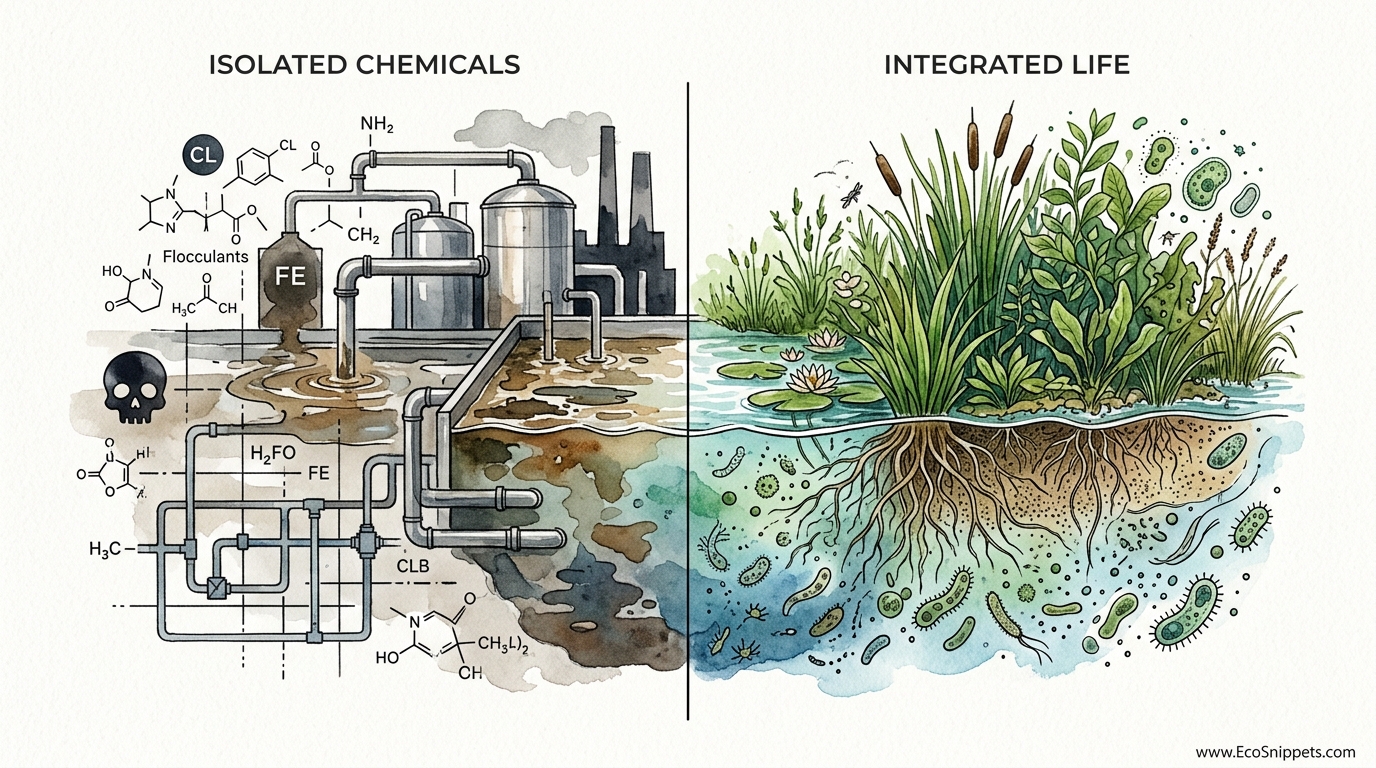
One is a hidden tomb for waste; the other is a thriving ecosystem that turns sewage into crystal-clear irrigation water. We are the only species on Earth that thinks ‘waste’ is something to be buried and forgotten. A ‘Living Machine’ uses the power of plants, snails, and microbes to treat wastewater naturally. The result? No smell, no chemicals, and a lush garden that grows 365 days a year.
Modern civilization has spent a century perfecting the art of hiding its messes. We pipe our problems into concrete bunkers, hit them with harsh chlorine, and hope the groundwater doesn’t notice. This approach represents a fundamental misunderstanding of how the world works. In nature, there is no such thing as waste; there is only food for the next layer of life.
Building a Living Machine is an act of reclamation. It is a way to take responsibility for our own footprint while creating something of immense beauty and utility. Whether you are a homesteader looking for water security or an architect designing a resilient community, understanding this biological engine is a step toward true self-reliance.
How To Build A Living Machine For Wastewater
A Living Machine is an ecologically engineered system that mimics the cleansing power of natural wetlands. Dr. John Todd, a visionary biologist, pioneered this concept in the 1970s to prove that biology could do the work of a multi-million dollar chemical plant. These systems use a series of tanks or “cells” populated by diverse life forms to break down organic matter and remove harmful nutrients.
Think of it as a specialized garden where the soil is replaced by water and gravel, and the “fertilizer” is the very waste your household produces. While a standard septic system simply leaches untreated or partially treated liquid into the soil, a Living Machine cycles that water through a gauntlet of biological filters. This process results in high-quality effluent that often exceeds municipal standards for surface discharge or reuse.
Real-world applications of these systems range from small residential setups to massive installations like the one at the San Francisco Public Utilities Commission or the Omega Center for Sustainable Living. These facilities prove that even in dense urban environments or large-scale institutions, we can harness the wisdom of the marsh to solve our most “unpleasant” problems.
The Biological Engine: How It Works
The magic of a Living Machine lies in its diversity. Most systems move water through at least four distinct stages, each hosting a specific community of organisms designed to tackle different contaminants.
The Anaerobic Stage
Wastewater first enters a sealed primary tank. This is an oxygen-free (anaerobic) environment where heavy solids settle to the bottom and lighter greases float to the top. Bacteria in this stage begin the heavy lifting, breaking down complex proteins and fats. This stage is similar to a traditional septic tank but serves as a crucial preparation phase for the more complex life ahead.
The Aerobic Reactors
Water then flows into a series of open tanks. These are the “heart” of the Living Machine. Air is pumped into these tanks, providing life-giving oxygen to aerobic bacteria. These microbes are far more efficient than their anaerobic cousins at consuming organic waste. Floating racks support plants like Canna lilies and papyrus, whose roots dangle into the water. These roots provide a massive surface area for “biofilms”—thick colonies of bacteria and protozoa that graze on the passing waste.
The Clarification Phase
Once the microbes have done their work, the water moves to a clarifier. Here, the flow slows down significantly. Any remaining biological solids—mostly clumps of dead bacteria—settle out. In many systems, snails and small fish live in these tanks, further cleaning the water and keeping the biological population in check.
Ecological Fluidized Beds (EFB)
The final stage often involves “polishing” the water through gravel-filled cells. These beds are often operated on a “tidal flow” cycle, where they are flooded and drained multiple times a day. This action pulls fresh air deep into the gravel, supporting specialized bacteria that finish the job of removing nitrogen and phosphorus. The result is water that is clear, odorless, and ready for reuse in toilets or gardens.
The Living Harvest: Benefits and Advantages
Choosing a Living Machine over a conventional treatment plant offers rewards that go far beyond basic sanitation. You are not just building a utility; you are cultivating a resource.
Water Security: In arid climates or during drought, water is more valuable than gold. A Living Machine can recover up to 60-80% of your household water for non-potable uses. This means you can keep a lush garden thriving while your neighbors’ lawns turn brown.
Chemical-Free Living: Conventional systems rely on chlorine or ozone to kill pathogens. A Living Machine uses natural competition, UV exposure, and biological predation. This keeps toxic chemicals out of your local watershed and away from your family.
Aesthetic and Psychological Value: Most people hide their septic lids with fake rocks or bushes. A Living Machine is a centerpiece. Imagine a greenhouse filled with tropical flowers and the sound of bubbling water, all while knowing this “garden” is performing a vital service.
Resilience: Because these systems rely on a diverse “web” of life rather than a single mechanical part or a specific chemical, they are remarkably stable. They can handle “shock flows” or variations in waste strength better than many high-tech alternatives.
The Fragile Balance: Challenges and Common Mistakes
Nature is resilient, but a Living Machine is a captive ecosystem that requires a basic understanding of biology to thrive. Most failures stem from treating the system like a “set-it-and-forget-it” appliance.
The Chemical Kill-Off: The most common mistake is introducing “death” into a system built on “life.” Pouring bleach, drain cleaners, or heavy antibiotics down the sink will wipe out your microbial colonies. This stops the cleaning process and can lead to odors. You must transition to “septic-safe” and biodegradable cleaning products.
Neglecting the Vegetation: The plants are not just for show; they are active participants. If you allow a single species to take over, or if you fail to harvest dead foliage, the system can become clogged. Regular “weeding” and thinning of the roots are necessary to maintain water flow and nutrient uptake.
Inadequate Aeration: Aerobic bacteria need a constant supply of oxygen. If your air pump fails or if you undersize the aeration system, the tanks will turn anaerobic. You will know this has happened immediately by the smell of sulfur (rotten eggs).
Environmental Constraints: When This May Not Be Ideal
A Living Machine is a powerful tool, but it is not a universal solution. Certain environments and situations demand a different approach.
Cold Climates: Biological activity slows down significantly as temperatures drop. In northern latitudes, a Living Machine must be housed in a well-insulated greenhouse. Without this, the plants will go dormant and the microbes will stop eating, leaving you with untreated sewage.
Small Footprints: These systems require more horizontal space than a compact, high-pressure mechanical plant. If you are on a tiny urban lot with no room for tanks or a greenhouse, a Living Machine may be physically impossible to install.
High-Toxic Industrial Waste: While these machines are great at handling human waste and food scraps, they struggle with heavy metals or synthetic industrial chemicals. These toxins can accumulate in the plants and eventually poison the entire ecosystem.
Ecological Engineering vs. Traditional Septic
Understanding the difference between these systems helps in making a responsible choice for your land.
| Feature | Traditional Septic System | Living Machine |
|---|---|---|
| Effluent Quality | Secondary (Needs Soil Treatment) | Tertiary (Often Reusable) |
| Space Required | Small (Underground) | Moderate to Large |
| Aesthetic | Hidden/Buried | Greenhouse/Garden |
| Maintenance | Pumping every 3-5 years | Weekly Plant/Pump Checks |
| Complexity | Low | High (Biological) |
Practical Tips for the Self-Reliant Homeowner
If you are ready to get your hands dirty and build a system that honors the water cycle, start with these best practices.
- Diversify Your Flora: Use a mix of plants with different root structures. Reeds (Phragmites) have deep, aggressive roots for heavy filtration, while Canna lilies offer broad leaves for high transpiration.
- Automate Your Air: Invest in a high-quality, continuous-duty linear piston pump. These are quieter and more efficient than standard diaphragm pumps.
- Monitor Your pH: Bacteria are picky eaters. Keep your water between 6.5 and 8.0 pH. If it swings too far, your “workforce” will go on strike.
- Incorporate Snails: Aquatic snails are the janitors of the Living Machine. They eat the biofilm off the tank walls, preventing clogs and keeping the system tidy.
Advanced Considerations: Nutrient Recovery and Scaling
Serious practitioners often look beyond simple treatment and toward “closing the loop” entirely. A Living Machine is essentially a nutrient-capture device.
Phosphorus Harvesting: Phosphorus is a finite resource essential for agriculture. In an advanced Living Machine, specific plants can be harvested and composted, returning that phosphorus to your garden soil. This turns your “waste” into a high-grade fertilizer factory.
Biogas Integration: On a larger scale, the primary anaerobic tank can be designed as a methane digester. This allows you to capture the gas produced during the initial breakdown of solids and use it for cooking or heating the greenhouse during winter months.
Scaling Up: While residential systems are common, the principles scale beautifully. By adding more parallel “trains” of tanks, these systems can handle the waste of entire apartment complexes or small villages. The modular nature of the design allows for growth as the community expands.
From Theory to Garden: A Residential Scenario
Let’s look at how this functions for a family of four on a one-acre homestead. Their system consists of a 1,500-gallon primary tank buried outside, followed by five 300-gallon tanks inside a small attached greenhouse.
In the first two greenhouse tanks, water hyacinths and duckweed cover the surface, while air stones create a rolling boil of oxygen. By the third tank, the water is noticeably clearer, and Canna lilies are blooming. The fourth tank houses a school of Tilapia and hundreds of pond snails that graze on the tank walls.
The final stage is a raised bed filled with lightweight expanded clay aggregate. Water is pumped into this bed every four hours and then allowed to drain back into a storage cistern. The family uses this final water to irrigate their fruit trees. They haven’t had to pay for a septic pump-out in years, and their greenhouse provides fresh flowers even in the dead of winter.
Final Thoughts
A Living Machine is more than just a plumbing solution; it is a shift in consciousness. It requires us to stop seeing ourselves as masters of a sterile world and start seeing ourselves as stewards of a living one. By inviting the marsh into our homes, we acknowledge that we are part of a cycle that is millions of years old.
The grit of the pioneer was not just about surviving; it was about thriving through a deep partnership with the land. Modern life has severed that connection, but a Living Machine offers a way to mend it. It is a testament to the fact that when we work with nature rather than against it, even our waste can become a source of life.
Take the time to observe the water. Watch how the roots grow and how the microbes respond to the change in seasons. Building this system is a masterclass in ecology, and the reward is a home that breathes, filters, and gives back to the earth that sustains it.
