How To Become More Self-Sufficient Without Starting a Full-Blown Farm…
Want to start preserving your harvest, making your own soap, or building a backyard root cellar — but not sure where to begin? “Homesteading Advice” gives you instant lifetime access to 35+ practical homesteading books on food preservation, veggie gardening, DIY natural cleaning products (save over $250 per year with this skill alone), brewing, off-grid energy, and a whole lot more…
Click Here To Check It Out Now!
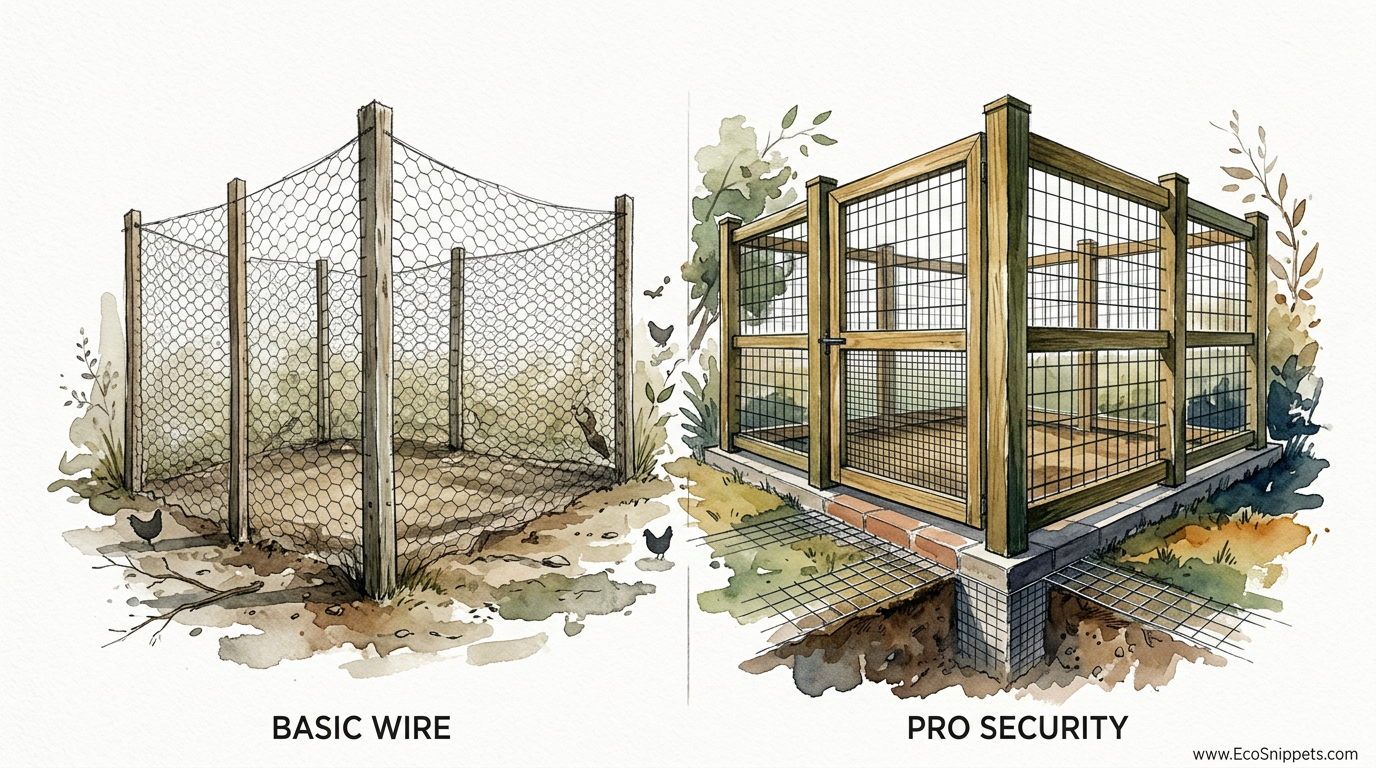
One of these setups is a dinner invitation for local predators, while the other is a fortress for your family’s protein supply. In a survival situation, your livestock is your lifeblood. Most beginners make the fatal mistake of trusting ‘chicken wire’ to actually protect chickens. Real security means thinking like a predator. See why pro-level hardware cloth and a buried apron are the only things standing between your flock and a midnight massacre.
Building a coop is one thing, but securing a run where your birds spend the majority of their daylight hours is another beast entirely. A run is often the most vulnerable part of a homestead setup because of its sheer size and exposure to the elements. If you fail to build it with the right materials, you are essentially providing a buffet for every fox, raccoon, and weasel in the county.
True predator proofing requires a shift in mindset. You must stop thinking about what keeps chickens in and start obsessing over what keeps the world out. This means understanding the anatomy of a breach and the relentless nature of a hungry animal. Whether you are a seasoned homesteader or a newcomer looking to protect your investment, this guide will walk you through the grit and grease of building a run that lasts.
How To Build A Predator Proof Chicken Run
A predator proof chicken run is a fully enclosed, heavy-duty outdoor space designed to resist physical forced entry from animals of all sizes. It serves as a secure perimeter that allows chickens to scratch, dust bathe, and forage without the risk of being snatched by a hawk or dug up by a coyote. Unlike a standard fenced area, a pro-level run incorporates specialized materials like hardware cloth and underground barriers.
This structure exists because survival is a numbers game. In the wild, everything likes the taste of chicken. To a raccoon, your flock is a high-calorie prize behind a thin veil of wire. To a hawk, it is a target in an open field. A predator proof run acts as a physical and psychological deterrent that forces these hunters to look for easier meals elsewhere.
In real-world situations, these runs are used on homesteads where owners cannot be present 24/7 to guard the flock. They are especially critical for those living near wooded areas or on the edge of town where wildlife thrives. By building a fortress-style run, you provide your birds with a permanent safe zone, reducing the stress on the flock and the constant worry for the keeper.
Think of the chicken run as the outer wall of a castle. While the coop is the inner keep where the birds sleep, the run is the courtyard. If the outer wall is weak, the entire kingdom is at risk. We build these walls not just to survive the night, but to ensure the long-term sustainability of our food source.
How It Works: Step-by-Step Construction
Building a run starts with the foundation of the frame. Use pressure-treated lumber for any part of the structure that touches the ground to prevent rot. Cedar is a fantastic alternative if your budget allows for it, as it naturally resists decay and pests. Ensure your corner posts are set deep, ideally 18 to 24 inches into the ground, to provide the stability needed to tension heavy wire mesh.
Selecting the right wire is the most critical step in the entire process. Traditional chicken wire is too thin; predators like raccoons can easily snip through it with their teeth or hands. Instead, use 1/2-inch or 1/4-inch galvanized hardware cloth. This mesh is welded together and is incredibly difficult for any animal to rip or chew through. A 19-gauge or 16-gauge wire provides the best balance of strength and flexibility.
Installing a buried apron is the secret weapon of the pro-level run. A digging predator like a fox or a dog will start digging right at the base of the fence. If you bury your hardware cloth 12 inches deep, or extend it 12 to 18 inches horizontally away from the run and pin it down, the predator will hit the wire and give up. Over time, grass will grow through this apron, hiding it from view while maintaining its protective function.
Securing the wire to the frame requires more than just standard staples. Raccoons are surprisingly strong and can pull wire right off the wood if it is only held by small staples. Use heavy-duty fencing staples or, better yet, screws paired with wide washers (fender washers). This creates a “sandwich” effect that makes it nearly impossible for a predator to pry the mesh loose from the timber.
Roofing the run is non-negotiable for total security. While bird netting can stop hawks, it will not stop a climbing raccoon or a bobcat. Ideally, the top of your run should be covered with the same hardware cloth as the sides. If your run is very large, you might use a combination of solid roofing (like corrugated metal) for shade and hardware cloth for ventilation and light.
Advantages of a Fortress-Style Run
The primary benefit of a properly built run is the peace of mind it offers the homesteader. Knowing that your birds are safe from aerial attacks and digging pests allows you to go about your day or sleep through the night without checking the coop every hour. This security directly translates to a more productive flock, as stressed birds often stop laying eggs.
Durability is another significant advantage. When you use 19-gauge galvanized hardware cloth and pressure-treated lumber, you are building a structure that will last a decade or more. Lower-quality materials like plastic netting or thin hex wire will degrade in the sun and rain, requiring constant repairs and eventually costing more in the long run.
A secure run also protects your investment in high-quality feed. Rodents like rats and mice can squeeze through the large holes in standard chicken wire to steal grain and spread disease. Hardware cloth with 1/2-inch openings is small enough to keep these pests out, ensuring your expensive feed goes to your birds rather than the local rodent population.
This level of protection also allows for “unattended” free-ranging. While it is not true free-ranging, giving your birds a large, secure run provides them with the space they need to forage for bugs and grass without the risks associated with an open yard. It is the best of both worlds: safety and freedom.
Common Mistakes to Avoid
One of the most frequent errors is assuming that a predator will only attack at night. Hawks, foxes, and even some species of weasels are active during the day. If your run is not secured from the top, a hawk can dive in and kill a bird in seconds. Never leave the top of a run open, even if you think the sides are high enough to prevent jumping.
Mistrusting the dexterity of a raccoon is another fatal mistake. These animals have “hands” that can manipulate simple latches, slide bolts, and even turn knobs. If a three-year-old human can open your run door, a raccoon can too. Always use two-step latches or carabiners to lock every gate and access point. A simple hook-and-eye latch is nothing more than a suggestion to a hungry ‘coon.
Failing to overlap the wire mesh is a subtle but dangerous error. When you are joining two rolls of hardware cloth, do not just butt them up against each other. Overlap the edges by at least three inches and secure them with hog rings or zip ties every few inches. Predators will exploit any gap or seam they can find, using their weight to push through weak spots.
Underestimating the “reach” of a predator is common. A raccoon can reach through 1-inch chicken wire and grab a chicken’s head or leg, pulling pieces of the bird through the fence. This is why 1/2-inch hardware cloth is the gold standard; it prevents those clever paws from getting a grip on your birds in the first place.
Limitations and Realistic Constraints
Cost is the most immediate limitation when building a truly secure run. Hardware cloth is significantly more expensive than chicken wire. For a large run, the price of the wire alone can reach hundreds of dollars. While this is a one-time investment in security, it can be a barrier for those starting on a tight budget.
Environmental factors also play a role. In areas with very heavy snowfall, a hardware cloth roof can act as a sieve that catches snow, leading to immense weight that can collapse the frame. If you live in a northern climate, you must ensure your run frame is engineered to handle the load or use a pitched solid roof that sheds snow efficiently.
Large-scale predators like bears or mountain lions present a level of force that standard hardware cloth cannot always withstand. While 19-gauge wire is tough, a 400-pound bear can tear through almost any wooden structure if it is determined enough. In these cases, hardware cloth must be supplemented with electric fencing or heavy-duty cattle panels.
Maintenance is a trade-off that comes with a buried apron. Once the wire is in the ground, it is difficult to move the run if you decide to change your coop layout. Furthermore, the apron can make weed whacking or mowing around the run more difficult if it is not buried deeply enough or covered with a layer of mulch or pavers.
Hardware Cloth vs. Chicken Wire
Understanding the difference between these two materials is vital for anyone serious about flock security. This table breaks down why the “pros” choose hardware cloth every time.
| Factor | Chicken Wire (Hex Netting) | Hardware Cloth (Welded Wire) |
|---|---|---|
| Primary Purpose | Containing chickens | Excluding predators |
| Strength | Low; easily torn or cut | High; resists teeth and claws |
| Mesh Size | 1-2 inches (large) | 1/4 – 1/2 inch (small) |
| Durability | Rusts quickly; sags over time | Heavy galvanization; remains rigid |
| Pest Control | Does not stop rats or snakes | Stops nearly all rodents and snakes |
While chicken wire is cheaper, it is fundamentally the wrong tool for the job. Hardware cloth provides a rigid, structural barrier that acts as a second skin for your run. If you must use chicken wire for budget reasons, use it only for the upper sections of the run and only if you have no climbing predators in your area—a rare scenario on most homesteads.
Practical Tips for Immediate Application
- Use Fender Washers: When screwing your hardware cloth to the wooden frame, use wide fender washers. These provide more surface area and prevent a predator from ripping the wire over the head of the screw.
- Seal the Gaps: Inspect your run for any hole larger than a quarter. Weasels can fit through surprisingly small spaces and can wipe out a whole flock in one night just for sport.
- Install Motion Lights: While not a physical barrier, motion-activated floodlights can startle nocturnal predators and alert you to activity outside.
- Add a “Kick Plate”: Install a 12-inch board along the bottom of the run frame. This adds structural integrity and provides a solid surface to attach your buried apron.
- Hardware Quality: Use galvanized or stainless steel hardware for everything. Rust is a predator’s best friend, as it weakens the metal over time.
Training your birds to enter the coop at dusk is also part of run security. Even the best run is less secure than a locked coop. Use a consistent routine or an automatic door to ensure your chickens are behind the final line of defense before the sun goes down. A secure run is for the day; a secure coop is for the night.
Advanced Considerations for Serious Practitioners
For those in high-predator areas, adding an electric “hot wire” to the outside of the run is an excellent optimization. Running one strand of electric wire about 6 inches off the ground and another near the top of the fence will deter even the most persistent foxes and bears. This provides a psychological barrier that most animals will respect after a single shock.
Consider the use of Livestock Guardian Animals (LGAs) if your property size allows. A well-trained Great Pyrenees or an Anatolian Shepherd can provide a layer of security that no fence can match. These dogs live with the flock and act as a mobile, sentient alarm system that actively drives away threats before they even reach the run walls.
CCTV or trail cameras are another advanced tool for the modern homesteader. By monitoring your run at night, you can identify which specific predators are testing your defenses. If you see a raccoon spending hours at a specific corner, you know exactly where you need to add an extra layer of reinforcement or a trap.
Deep litter systems can be integrated into a secure run to improve bird health and reduce maintenance. If your run has a secure, buried foundation, you can fill it with 6-12 inches of wood chips, leaves, and straw. This creates a bio-active environment that manages waste and provides the birds with endless opportunities for scratching, which is their natural behavior.
Example Scenario: The Raccoon Test
Imagine a scenario where a large, 20-pound raccoon approaches your run at 2:00 AM. It first tries the latch on the door. Because you used a carabiner-locked slide bolt, the raccoon’s nimble fingers cannot find a way to slide the mechanism. Frustrated, it moves to the base of the run and begins to dig.
Within seconds, its claws hit the horizontal hardware cloth apron you buried just under the sod. It moves six inches to the left and tries again, only to hit the same metal barrier. It tries to pull the wire away from the wood, but the fender washers hold the mesh firmly in place. Finally, it looks up and sees the hardware cloth roof, realizing there is no way to drop in from above.
In this situation, the raccoon spends ten minutes testing your defenses before concluding that the energy required to break in is not worth the potential reward. It moves on to the neighbor’s property where they only used chicken wire and a simple hook latch. Your flock remains sleeping and undisturbed. This is the goal of every predator-proofing project: to make your setup more trouble than it is worth.
Final Thoughts
Protecting your chickens is an act of stewardship that requires diligence and high-quality materials. By choosing hardware cloth over chicken wire and investing in a buried apron, you are building a fortress that respects the reality of the natural world. Predators are not “evil,” they are simply doing their job in the ecosystem. Your job is to ensure they do not do it at the expense of your flock.
This process of building a predator proof run is a foundational skill for any self-reliant person. It teaches you to look for weaknesses, to understand the behavior of the animals around you, and to build things that stand the test of time. While the upfront cost and effort may seem high, the long-term rewards of a healthy, safe flock are immeasurable.
Encourage yourself to start with the best materials you can afford. If you are building in stages, secure the bottom three feet of the run first, as that is where the majority of ground-based attacks occur. Over time, you can continue to refine and upgrade your setup as you learn the specific challenges of your local environment. Stay vigilant, stay gritty, and keep your birds safe.
