How To Become More Self-Sufficient Without Starting a Full-Blown Farm…
Want to start preserving your harvest, making your own soap, or building a backyard root cellar — but not sure where to begin? “Homesteading Advice” gives you instant lifetime access to 35+ practical homesteading books on food preservation, veggie gardening, DIY natural cleaning products (save over $250 per year with this skill alone), brewing, off-grid energy, and a whole lot more…
Click Here To Check It Out Now!
Are you buying a toy for a weekend camping trip or a power plant for your family’s survival? Most people think they’re ‘off-grid ready’ because they bought a portable kit on sale. But when the clouds roll in for three days straight, the difference between a gadget and a power plant becomes life-altering. Here is how to stop playing with toys and start building real energy security.
True self-reliance isn’t found in a plastic box with a handle. It is built with iron, glass, and a deep understanding of the elements. A resilient solar array is the modern homesteader’s equivalent of a well-stocked woodpile. It provides the quiet confidence that your well pump will turn, your food will stay cold, and your lights will burn regardless of what happens to the aging electrical grid.
Building a system that lasts decades requires more than just connecting wires. It demands a shift in mindset from consumer to producer. You are no longer just a customer of a utility; you are the chief engineer of your own utility. This guide will walk you through the grit and the gear needed to move from a basic kit to a professional-grade survival system.
How To Build A Resilient Solar Array For Self-Sufficiency
A resilient solar array is a permanent, hardwired electrical system designed to capture, store, and distribute energy without any reliance on a centralized grid. Unlike portable power stations that are designed for occasional convenience, a resilient array is built for 24/7/365 reliability. It exists to provide a bridge between the erratic power of the sun and the constant needs of a functional home or survival retreat.
At its core, this system is about harvesting photons and turning them into life-sustaining work. In a real-world survival situation, energy isn’t just about comfort; it is about security. It powers the communications that keep you informed, the medical devices that keep you healthy, and the security systems that keep you safe. These systems are used in remote homesteads, off-grid cabins, and by those who simply refuse to let their family’s well-being depend on a fragile infrastructure.
Imagine your solar array as a digital garden. The panels are the leaves capturing sunlight, the wires are the stems transporting nutrients, and the batteries are the roots storing energy for the winter. When you build with resilience in mind, you choose components that are oversized, overbuilt, and easily repairable. You don’t just want a system that works; you want a system that refuses to fail when the world around it does.
Choosing Your Foundation: Panels and Structure
The journey begins with the panels themselves. For a survival-grade system, monocrystalline panels are the gold standard. They offer the highest efficiency per square foot, which is critical when you need to maximize every minute of winter sun. While polycrystalline panels are cheaper, their lower efficiency means you need more roof or ground space to achieve the same results, increasing the complexity and cost of your mounting hardware.
Consider the mounting location with extreme care. A roof mount is convenient, but a ground-mounted array offers superior resilience. If a panel breaks or a connection looses, you can access it in a blizzard without a ladder. Furthermore, ground mounts allow you to clear snow or dust manually, ensuring your energy production doesn’t drop to zero just because of a heavy snowfall. Resilience means being able to maintain your gear with your own two hands while standing on solid ground.
The Case for Bifacial Technology
Modern advancements have brought us bifacial solar panels. These modules capture sunlight on both the front and the back. In a survival scenario where every watt counts, bifacial panels can increase your total energy harvest by up to 30% if placed over a reflective surface like light-colored gravel or snow. This “bonus” energy can be the difference between a depleted battery bank and a full charge during the short days of December.
How the System Breathes: Charge Controllers and Inverters
Electricity from the sun is wild and unpredictable. To make it useful, you need two critical components: the Charge Controller and the Inverter. Think of the charge controller as the brain of the operation. It monitors the state of your batteries and regulates the flow of current from the panels. For a professional-grade system, an MPPT (Maximum Power Point Tracking) controller is non-negotiable. It acts like a variable transmission, constantly adjusting to find the “sweet spot” of voltage and current to squeeze every possible drop of energy out of your panels.
The inverter is the heart that pumps power to your home. Most consumer-grade inverters are “high-frequency,” meaning they are light, cheap, and efficient for small loads. However, for a resilient setup, you want a “low-frequency” inverter. These are heavy, transformer-based machines. They can handle massive surges—up to 300% of their rated capacity—which is essential for starting heavy motors like well pumps or refrigerators. A low-frequency inverter is more durable and less likely to fry its internal electronics when a large motor kicks on.
The Lifeblood: High-Capacity Energy Storage
A solar array without a battery bank is just an expensive sunshade. For survival, your battery chemistry defines your longevity. While lead-acid batteries were the old pioneer standard, they require constant maintenance and have a short lifespan. Today, Lithium Iron Phosphate (LiFePO4) is the undisputed champion of off-grid living. These batteries can be discharged deeper, last for thousands more cycles, and require zero maintenance.
When sizing your storage, you aren’t just looking at overnight needs. You are planning for “autonomy”—the number of days your system can run without a single ray of sun. A resilient system should aim for at least three days of autonomy. If your home uses 10kWh a day, you don’t just need a 10kWh battery; you need a 30kWh bank. This provides a buffer against the inevitable storm that lasts longer than the weather report predicted.
Benefits of a Pro-Grade Solar Power Plant
Investing in a high-voltage, hardwired solar system offers advantages that no “solar generator” in a box can match. The primary benefit is absolute energy independence. You are no longer susceptible to rolling blackouts, grid failures, or skyrocketing utility rates. You own the means of production.
Beyond the independence, there is the factor of silent operation. Unlike gas generators that announce your presence to everyone for miles and require a finite fuel supply, a solar array is silent and fueled by the heavens. In a long-term crisis, silence is security. Additionally, the maintenance costs are remarkably low. Once the initial sweat equity is invested and the system is bolted down, the sun provides the “fuel” for free for the next 25 to 30 years.
Finally, there is the benefit of scalability. A professional system is modular. You can start with a 4kW array and a small battery bank, then add more panels and storage as your budget allows. You are building a living system that grows with your family’s needs, rather than a disposable gadget that ends up in a landfill when its internal battery dies.
Challenges and Common Pitfalls
The biggest mistake most beginners make is underestimating their actual energy load. They read the label on a lightbulb but forget about the “phantom loads” of a Wi-Fi router or the massive surge of a toaster. To avoid this, you must perform a rigorous load calculation. Every watt must be accounted for before a single panel is purchased.
Another common pitfall is poor wiring. Using thin, “toy” wires for a professional system leads to voltage drop and heat. In an off-grid system, heat is wasted energy and a potential fire hazard. You must use the correct gauge of copper wire, properly crimp every terminal, and use high-quality combiner boxes with built-in breakers. A resilient system is only as strong as its weakest connection.
Shading is the silent killer of solar production. Even a small shadow from a vent pipe or a tree branch can significantly reduce the output of an entire string of panels. People often assume “near the sun” is good enough, but a pro-grade setup requires a clear, unobstructed view of the sky from 9 AM to 4 PM at the very least. If you have trees in the way, the chainsaw is as much a part of your solar toolkit as the voltmeter.
Limitations and Realistic Boundaries
Solar energy is not a magic wand; it has hard physical limits. The most obvious is the weather. No matter how much you spend on panels, three weeks of heavy overcast will deplete even the best battery bank. This is why a truly resilient system always includes a secondary backup, such as a high-quality propane or diesel generator, to “top off” the batteries during extreme weather events.
There is also the limitation of upfront cost. A “Pro System” is an investment in the thousands, not the hundreds. While it pays for itself over time, the barrier to entry is high. You are essentially prepaying for 25 years of electricity all at once. If you are on a transient or highly restricted budget, you may need to phase your build, starting with critical circuits first.
Geographic limitations also play a role. If you live in a deep canyon or a region with frequent heavy fog, your return on investment will be much slower. Solar works best when the environment cooperates, and forcing it to work in a “sun-desert” requires an oversized array that may not be practical for every homesteader.
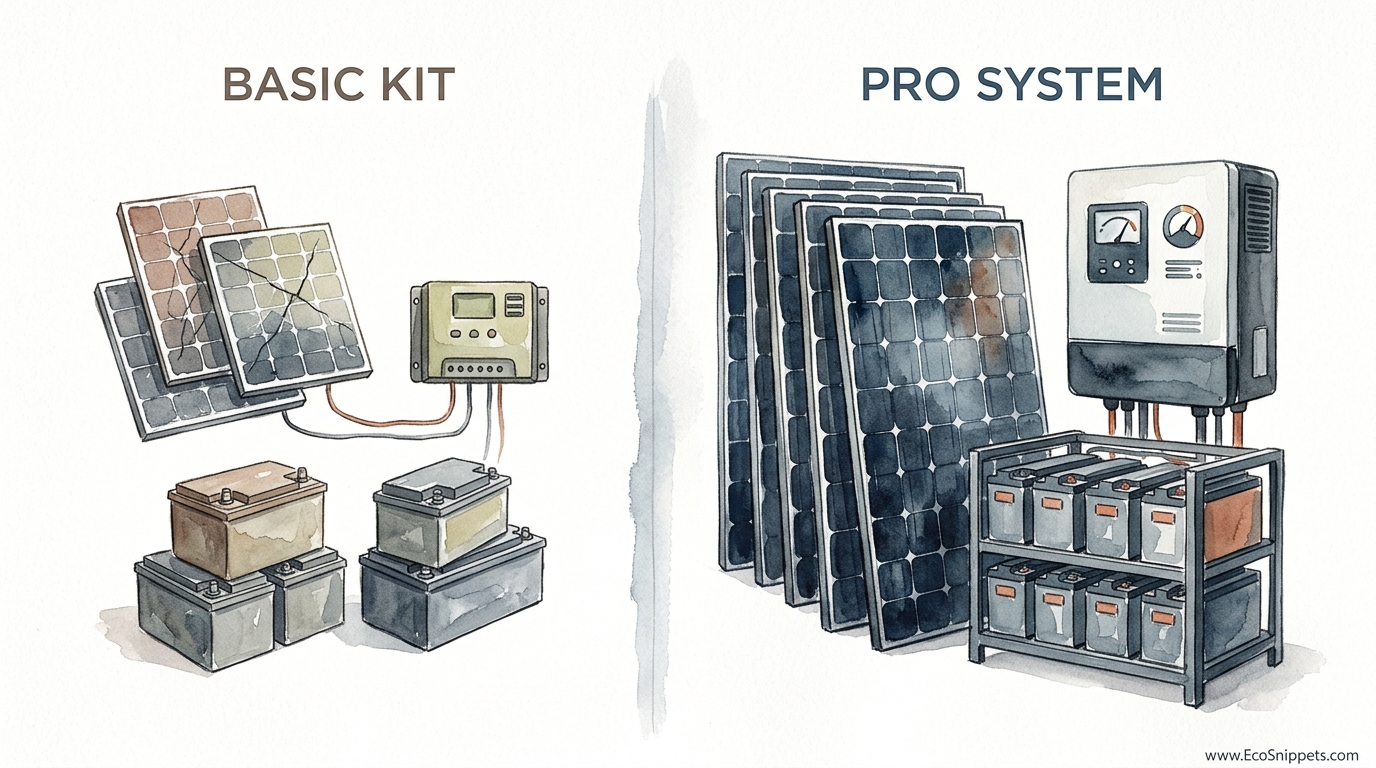
Comparison: Basic Kit vs. Pro System
| Feature | BASIC KIT (Portable/Consumer) | PRO SYSTEM (Hardwired/Resilient) |
|---|---|---|
| Inverter Type | High-Frequency (Light/Fragile) | Low-Frequency (Heavy/Transformer) |
| Battery Life | 500 – 2,000 Cycles | 6,000 – 10,000+ Cycles (LiFePO4/LTO) |
| Repairability | Proprietary / Disposable | Modular / Component-Level Repair |
| Surge Capacity | Limited (150%) | Massive (300%+) |
| Weather Resistance | Mild (IP65 at best) | Industrial (NEMA Rated enclosures) |
Practical Tips for Maximum Efficiency
To get the most out of your array, you must master the art of tilt. The angle of your panels should ideally change with the seasons. In the winter, you want them more vertical to catch the low-hanging sun and shed snow. In the summer, a flatter angle captures the sun as it passes directly overhead. If you use a fixed mount, compromise by setting the angle to your latitude plus 15 degrees for better winter performance.
Cleanliness is next to godliness in the solar world. A thin layer of pollen or dust can drop your production by 10% or more. Use soft brushes and distilled water to clean your panels every few months. Never use harsh chemicals or pressure washers, as these can micro-crack the cells or damage the anti-reflective coating on the glass.
Wiring matters more than you think. Keep your DC wire runs as short as possible. High-voltage DC strings (where panels are wired in series) are more efficient for long distances because they suffer less voltage drop than low-voltage parallel strings. However, series wiring means that if one panel is shaded, the whole string suffers. Use a smart combiner box with individual fuses for each string to mitigate this risk.
Advanced Considerations: EMP Hardening and Redundancy
For the serious practitioner, resilience goes beyond standard electrical codes. It involves protecting your system against extraordinary events like an Electromagnetic Pulse (EMP) or a massive Coronal Mass Ejection (CME). This is done through a combination of grounding, shielding, and transient voltage suppression.
An “EMP Shield” device can be wired directly into your inverter and charge controller. These devices act like high-speed lightning arrestors, shunting massive voltage spikes to the ground in less than a nanosecond. For critical spare parts—like a spare charge controller or small inverter—storing them in a nested Faraday cage (a metal box lined with non-conductive material) ensures you have a backup if a pulse fries your main system.
True resilience also means redundancy. Instead of one massive 10kW inverter, consider two 5kW inverters wired in parallel. If one fails, you still have 50% power. The same applies to your battery bank. Wiring two separate banks with a master disconnect allows you to take one offline for maintenance or repair without shutting down the entire homestead. This is the difference between a system that works and a system that survives.
Scenario: The 48-Volt Homestead
Let’s look at a practical application. A standard off-grid family might install a 5kW solar array consisting of twelve 420W panels. These are wired in four strings of three panels each, feeding into a 100-amp MPPT charge controller. This high-voltage DC setup (around 120V-150V) is efficient and uses smaller, more affordable wiring for the run from the array to the house.
This array charges a 48-volt LiFePO4 battery bank with 30kWh of capacity. Why 48 volts? Higher voltage means lower amperage, which means cooler wires and more efficient power conversion. The energy is then drawn by a 6,000-watt low-frequency inverter that can easily start the 1.5hp well pump and run the kitchen appliances simultaneously. This isn’t a kit; it’s an infrastructure project that provides the same quality of power as the city grid, but with none of the strings attached.
Final Thoughts
The transition from “buying a gadget” to “building a system” is the most important step in your journey toward self-reliance. It requires a commitment to learning the fundamentals of electricity and the patience to build for the long haul. A resilient solar array is a legacy—a piece of honest engineering that will serve you and your family long after the latest “smart” device has been forgotten.
Start small if you must, but always build with the end in mind. Choose components that speak to quality, not just price. Every bolt you tighten and every wire you crimp is an investment in your own freedom. The sun rises every day; whether you harvest its power or let it go to waste is entirely up to you.
As you move forward, continue to refine your skills. Learn how to troubleshoot a faulty bypass diode and how to read the telemetry from your charge controller. The knowledge you gain is the ultimate backup system. When you understand your gear as well as you understand your own land, you have achieved true energy independence.
