How To Become More Self-Sufficient Without Starting a Full-Blown Farm…
Want to start preserving your harvest, making your own soap, or building a backyard root cellar — but not sure where to begin? “Homesteading Advice” gives you instant lifetime access to 35+ practical homesteading books on food preservation, veggie gardening, DIY natural cleaning products (save over $250 per year with this skill alone), brewing, off-grid energy, and a whole lot more…
Click Here To Check It Out Now!
Stop buying bees that weren’t built for your climate and start catching the ones that were. Commercial bees are bred in a lab and shipped across the country, arriving stressed and weak. Wild swarms are the ‘SAS’ of the insect world, carrying the exact genetics needed to survive YOUR winters for free.
Beekeeping has shifted from a craft of observation to a cycle of consumption. Every spring, thousands of new beekeepers shell out hard-earned cash for “packages” of bees that were raised in southern states, fueled by sugar syrup, and treated with a cocktail of chemicals. These bees often struggle to adapt to the harsh realities of a northern winter or the specific pests in a different region. They are the high-maintenance livestock of the modern world, requiring constant intervention to stay alive.
Wild swarms represent a different path. This is the path of the pioneer and the observant naturalist. A swarm is not just a bunch of bees; it is the reproductive heartbeat of a successful, survivor colony. When you catch a wild swarm, you are tapping into a lineage that has already proven it can handle the local weather, find the local nectar, and fight off the local diseases without a human standing over them with a syringe or a sugar bucket.
Learning how to catch a wild bee swarm is one of the most rewarding skills you can develop on your journey toward self-reliance. It transforms you from a customer of the industrial bee complex into a steward of local ecology. This guide will walk you through the grit and wisdom required to lure these high-performing insects into your own apiary, ensuring your hives are populated with the toughest genetics available.
How To Catch A Wild Bee Swarm
Catching a wild bee swarm is the process of providing a temporary “bait hive” or “swarm trap” that mimics the ideal natural nesting site for a honeybee colony. In nature, when a colony becomes too crowded, the old queen and about half the worker bees depart to start a new home. This is the swarm. While the swarm waits on a branch or a fence post, “scout bees” fly out in all directions to find a permanent cavity—usually a hollow tree—to move into.
This biological event is a window of opportunity for the savvy beekeeper. If you place a box that meets the exact specifications these scouts are looking for, they will report back to the cluster, dance for their sisters, and lead the entire colony right into your equipment. You are essentially offering them a “turn-key” home that is better than anything they could find in the woods.
Real-world beekeeping relies on these swarms to replenish losses and expand numbers. Unlike buying a package, where you receive a random queen and a few pounds of unrelated workers, a swarm is a cohesive family unit. They are primed for work, arriving with honey-filled bellies and a desperate urge to build wax. They are the biological equivalent of a high-speed construction crew, ready to turn your empty frames into a functioning city in a matter of days.
Successful swarm catching is not about luck; it is about understanding the “mind” of the honeybee. Scientists like Dr. Thomas Seeley have spent decades studying what bees want in a home. By mimicking those natural preferences—volume, entrance size, height, and scent—you can achieve a success rate that makes buying bees look like a foolish waste of money.
How the Swarming Process Works Step-by-Step
The swarming season usually begins in early spring, triggered by the first major nectar flow and the lengthening days. As the hive fills with fresh pollen and nectar, the queen ramps up egg-laying. Soon, the hive is bursting at the seams. This congestion triggers the “swarm impulse.” The workers begin raising new queens in special peanut-shaped cells, and the old queen is put on a diet to make her light enough for flight.
Once the weather turns clear and warm, the old queen and thousands of workers rush out of the hive in a dizzying cloud of sound and movement. They typically land nearby first, forming a dense cluster on a tree limb. This is a temporary bivouac. They are not interested in stinging; they are simply protecting the queen while the scouts do their work. This stage can last from a few hours to a couple of days.
Scout bees are the elite foragers of the hive. They look for specific criteria: a cavity volume of roughly 40 liters, an entrance located near the bottom of the cavity, and a location that is high enough to be safe from predators but sheltered from the wind. When a scout finds a good spot, she returns to the cluster and performs a waggle dance to communicate the location and quality of the site. Other scouts visit the site, and once a “quorum” is reached, the entire cluster takes flight and moves to the new home.
Setting up a swarm trap involves placing a box of the correct size in a visible, elevated location. You use “lures” to attract the scouts’ attention. Lemongrass oil is a favorite because it contains citral and geraniol, which mimic the Nasonov pheromone—the “come hither” scent bees use to orient each other. Once the scouts investigate your box and find it meets their standards, the deal is often sealed.
Timing is everything in this process. You want your traps in place at least two weeks before the local nectar flow begins. If you wait until you see a swarm in the air, you are already too late. The scouts have likely been looking for homes for days. Preparation is the hallmark of the successful pioneer beekeeper.
Benefits of Catching Wild Swarms
The most immediate advantage is the financial savings. A package of bees in today’s market can cost anywhere from $150 to $250 when you factor in shipping and taxes. A swarm trap can be built from scrap wood or repurposed old hive bodies for essentially zero cost. If you hang five traps and catch three swarms, you have just “earned” nearly $600 in livestock for the price of a few drops of lemongrass oil.
Beyond the money, the genetic superiority of wild swarms is the true prize. Commercial queens are often mass-produced in environments where they are mated with a limited pool of drones. This lack of genetic diversity leads to colonies that are more susceptible to viruses and pests. In contrast, a wild queen has usually mated with a diverse group of 15 to 20 drones from various local survivor colonies. This polyandry—or multiple mating—is a key driver of colony health and resilience.
Local adaptation is another critical factor. Bees that have survived several winters in your specific county have developed “phenological synchrony.” This means they know exactly when the first maples bloom and when the last goldenrod fades. They have adjusted their brood-rearing cycles to match your local climate. Shipped bees are often “out of sync,” trying to grow too fast in a cold spring or failing to shut down early enough in the fall.
Wild swarms also offer a natural “brood break.” Because the queen stops laying for several days during the swarming process, the life cycle of the Varroa mite—the greatest enemy of the honeybee—is interrupted. This natural pest management allows the colony to start their new life with a lower mite load, giving them a significant head start over a heavily infested commercial package.
Finally, there is the satisfaction of the hunt. There is a deep, ancestral joy in checking your traps on a warm May afternoon and seeing a “beeline” of workers carrying pollen into a box you hung yourself. It connects you to the natural world in a way that simply opening a shipping crate never can. You are participating in the ancient rhythm of the seasons.
Challenges and Common Mistakes
One of the biggest hurdles is the physical demand of placing and retrieving traps. Traditional wisdom, backed by Seeley’s research, suggests that traps should be 10 to 15 feet off the ground. This requires climbing ladders and maneuvering heavy, bee-filled boxes in awkward positions. Safety must always be the priority. If a trap is in a location that feels dangerous to reach, it is not worth the risk. Many beekeepers find success at lower heights, even 5 or 6 feet, if the other conditions are perfect.
Using too much lure is a frequent error. Bees have an incredibly sensitive sense of smell—thousands of times more acute than a human’s. While a few drops of lemongrass oil mimic the scent of a welcoming home, a whole bottle will act as a repellent. It becomes an “olfactory wall” that overwhelms the scouts. A single cotton ball with two drops of oil, placed inside a small plastic baggie to slow the evaporation, is all you need for an entire month.
Neglecting to put frames in the trap is another common pitfall. If you catch a swarm in an empty box, they will immediately begin building “wild” comb from the ceiling. This comb will be cross-wise and impossible to move into a standard hive without destroying the colony’s hard work. Always include at least one frame of old, dark brood comb (if you have it) and fill the rest of the space with frames of foundation or starter strips. The scent of old wax is the most powerful lure in the world.
Wax moths can also be a significant challenge. These pests are attracted to the same old brood comb that the bees love. If your trap sits empty for too long in warm weather, wax moth larvae can shred your frames into a mess of webbing and debris. Checking your traps weekly allows you to swap out frames or remove traps that have become infested before they become a breeding ground for trouble.
Identifying “scouts” vs. “robbers” is a skill that takes time to develop. Seeing bees around a trap doesn’t always mean a swarm is coming. If the bees are flying erratically and fighting at the entrance, they might be robbing leftover honey from your old frames. If they are calmly inspecting the entrance, hovering, and crawling in and out with purpose, those are scouts. Learning to read the flight path of the bees will save you from a lot of false hope.
Limitations of Swarm Catching
The primary limitation is the lack of predictability. You cannot “order” a swarm to arrive on a specific Tuesday. This makes it difficult for beginners who are eager to start on a timeline. You might hang ten traps and catch zero bees, or you might catch five swarms in a single weekend. It requires a degree of patience and a willingness to accept the whims of nature.
Environmental constraints also play a role. If you live in an area with a very low density of wild or managed bees, your chances of catching a swarm are slim. Urban and suburban areas are actually often better for swarm catching than deep forests, as there are more managed hives nearby that are prone to swarming. If you are in a “bee desert,” you may have to travel to more promising locations to hang your traps.
There is also the risk of “Africanized” genetics in southern regions of the United States. While most wild swarms are gentle, some can be highly defensive. A pioneer beekeeper must be prepared to evaluate the temperament of a captured swarm. If a colony is excessively aggressive after it has settled in, you may need to requeen it with known gentle genetics. This is a trade-off for the hardiness you get with wild stock.
Finally, the “gear tie-up” is a real factor. If you use your best hive bodies as swarm traps, that equipment is out of commission for your main apiary until a swarm moves in. This is why many practitioners build dedicated, lightweight swarm boxes from 1/2-inch plywood or use specialized “nuc” boxes designed specifically for trapping.
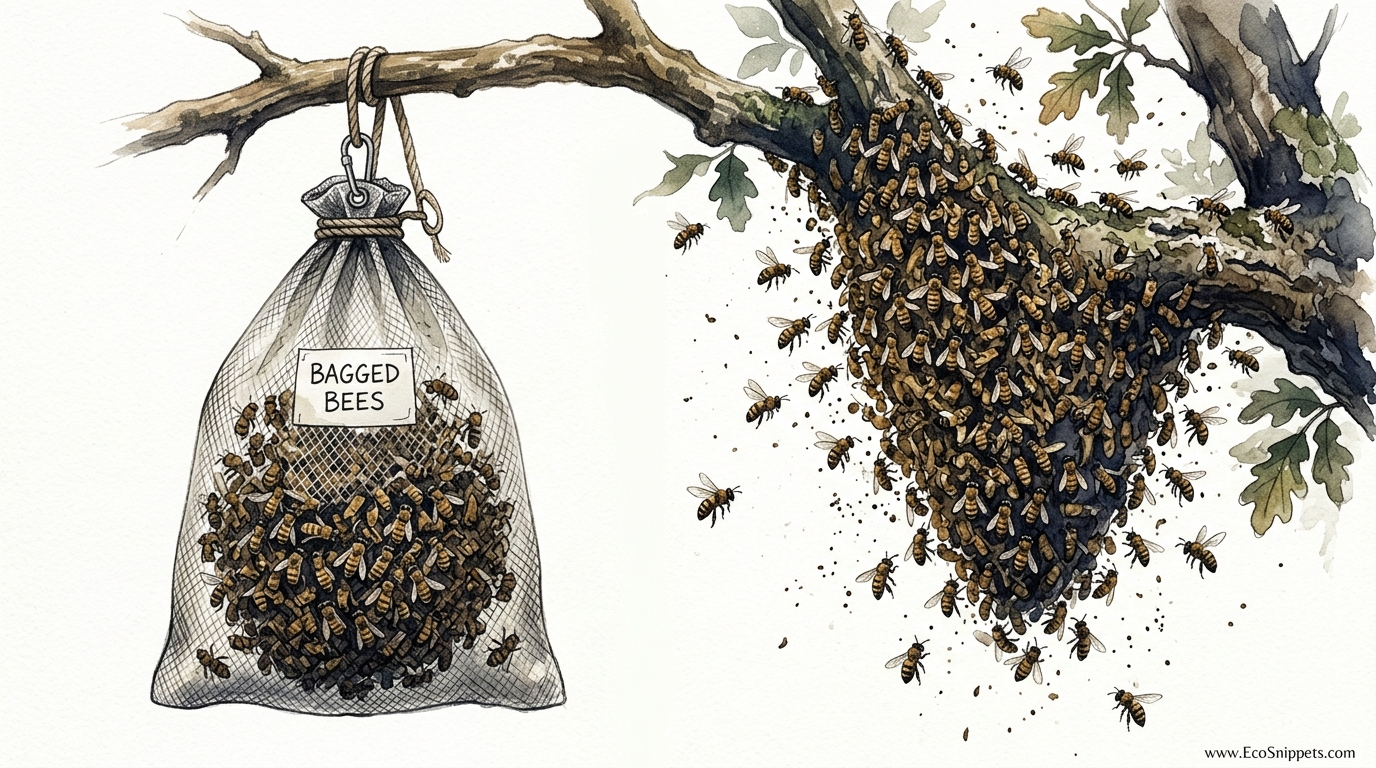
Comparison: BAGGED BEES vs WILD SWARM
To truly understand the value of a wild swarm, one must look at how they compare to the standard commercial alternative. The differences in cost, vigor, and long-term survival are staggering.
| Feature | Commercial Package (Bagged) | Wild Swarm |
|---|---|---|
| Cost | $150 – $250+ | Free ($0) |
| Genetics | Mass-bred, often southern strains | Locally adapted, survivor stock |
| Vigor | Low; stressed by shipping/handling | High; primed for wax building |
| Queen Quality | Often poorly mated or artificially inseminated | Naturally mated with local drones |
| Pest Resistance | Varies; often reliant on chemical treatments | Higher; proven survival in the wild |
| Ease of Use | Predictable arrival date | Unpredictable; requires trapping effort |
The table shows that while commercial bees offer the convenience of a scheduled delivery, they fall behind in almost every other category. For the homesteader or the serious beekeeper, the wild swarm is the clear winner for building a sustainable, resilient apiary. The “cost” of the wild swarm is not paid in dollars, but in the time spent learning the craft and the effort of hanging traps.
Practical Tips and Best Practices
Location is the most critical variable after box volume. Look for “landmark” trees. Bees love a tree that stands out—the edge of a forest, a lone oak in a field, or a tree at the end of a fencerow. South-facing entrances are preferred as they catch the early morning sun, warming the hive and encouraging the scouts to start their day early. However, the box itself should be in the shade to prevent the colony from overheating during the move-in process.
Use “slow-release” scent methods. Rather than just dabbing oil on the wood, place a few drops of lemongrass oil on a piece of paper or a cotton ball inside a small tube or a partially closed baggie. This ensures the scent remains consistent for weeks rather than evaporating in the first hot afternoon. If you have access to old propolis or “slumgum” from wax rendering, smear a little of that near the entrance. The smell of a “used” bee home is a powerful psychological trigger for scouts.
Height is important, but accessibility is king. If you can place a trap 12 feet high using a pulley system or a stable platform, do it. If you have to use a shaky ladder, keep it lower. Bees are pragmatic; they will take a 6-foot-high box that is perfect in every other way over a 15-foot-high box that is drafty or too small. Always secure your traps with heavy-duty ratcheting straps to prevent them from blowing down in spring storms.
Entrance size should be approximately 2 square inches. This is large enough for easy traffic but small enough for the bees to defend against wasps and robber bees. A simple slot 4 inches long by 1/2 inch high is perfect. Avoid using large, open entrances without a reducer, as the scouts will view the cavity as “indefensible” and move on to a better location.
Check your traps once a week. You are looking for “pollen in, bees out.” If you see workers flying back to the trap with bright orange or yellow baskets of pollen on their legs, they have moved in and have started raising brood. At this point, you can wait a few days for them to settle, then move the box to its permanent home in the evening after all the foragers have returned.
Advanced Considerations for Serious Practitioners
For those looking to scale their operation, consider the “trap line” approach. Much like a fur trapper, a beekeeper can set out dozens of traps across a county. Using lightweight boxes made of Coroplast or thin cedar allows you to move quickly. Keeping a digital log of which trees “hit” each year is vital. Bees are remarkably consistent; a tree that catches a swarm this year is very likely to catch one next year because it sits on a natural “bee highway” or flyway.
Genetic monitoring is the next level of swarm management. Once a swarm is established, observe their behavior. Are they hygienic? Do they clear out mites? Do they survive the winter without feeding? By identifying your “star” swarm colonies, you can use them to graft new queens, effectively “line-breeding” the best wild genetics into your entire apiary. This is how you move from being a swarm catcher to a master breeder of local survivor bees.
Consider the hive type you are moving them into. Many wild swarm enthusiasts prefer horizontal hives, such as the Layens or the Top Bar Hive. These designs more closely mimic the horizontal nature of a large tree limb or a hollow log. They also provide superior insulation compared to the thin walls of a standard Langstroth box. If you are catching “SAS” bees, give them a fortress that matches their elite status.
Pheromone chemistry is a deep rabbit hole. While lemongrass is excellent, some beekeepers use a blend of geraniol, citral, and nerolic acid to create a “Full Spectrum Nasonov” lure. Additionally, adding a tiny amount of “queen mandibular pheromone” (QMP) can sometimes trick scouts into thinking a queen is already present, making the site even more attractive. However, for most, the simple combination of old comb and lemongrass remains the gold standard.
Example Scenario: The Five-Trap Strategy
Imagine a beekeeper in Ohio named Silas. He refuses to buy package bees, so in late March, he prepares five swarm traps. Each trap is a repurposed deep hive body with a plywood bottom and top. He fills each with one frame of dark, five-year-old brood comb and four empty frames with wax starter strips. He adds two drops of lemongrass oil to a cotton ball in a baggie inside each box.
Silas places his traps as follows:
- Trap 1: 12 feet high in an old apple tree at the edge of his property.
- Trap 2: 10 feet high on a south-facing fencerow bordering a neighbor’s clover field.
- Trap 3: 15 feet high in a large oak tree near a local creek.
- Trap 4: 8 feet high on the side of an old barn (a known landmark).
- Trap 5: 6 feet high in a cedar grove (an experiment in lower placement).
In mid-May, after a week of rain followed by a sudden heatwave, Silas checks his traps. Trap 1 has heavy traffic and bees bringing in pollen—a success! Trap 2 has scouts investigating but no cluster. Trap 3 is empty. Trap 4 has been taken over by a squirrel (a common hazard). Trap 5, despite being low, has a massive swarm that moved in yesterday.
Silas waits until dusk on a Thursday. He climbs his ladder, staples a piece of screen over the entrances, and brings the boxes down. He has just added two high-vigor, locally adapted colonies to his yard for the cost of about an hour of labor. By the end of the season, these swarms have outperformed his neighbor’s expensive Italian packages by two to one in honey production.
Final Thoughts
Catching wild bee swarms is more than a way to save money; it is a declaration of independence from a fragile agricultural system. It forces the beekeeper to look at the landscape through the eyes of the insect, identifying the landmarks and the scents that signal life and prosperity. It is a return to the “pioneer grit” that defined beekeeping before the age of plastic crates and overnight shipping.
When you provide a home for a wild swarm, you are preserving the genetic heritage of your region. You are giving a chance to the bees that have already fought the hard battles and won. This is sustainable beekeeping in its purest form. It requires effort, patience, and a bit of a climb, but the reward is a hive full of “the right sort of bees” that will serve you and your land for years to come.
Do not be afraid of the height or the uncertainty. Start small, build your traps with care, and trust in the millions of years of instinct that drive the honeybee to find a home. The bees are out there, waiting for a place to thrive. All you have to do is build it, scent it, and wait for the dance to begin.
