How To Become More Self-Sufficient Without Starting a Full-Blown Farm…
Want to start preserving your harvest, making your own soap, or building a backyard root cellar — but not sure where to begin? “Homesteading Advice” gives you instant lifetime access to 35+ practical homesteading books on food preservation, veggie gardening, DIY natural cleaning products (save over $250 per year with this skill alone), brewing, off-grid energy, and a whole lot more…
Click Here To Check It Out Now!
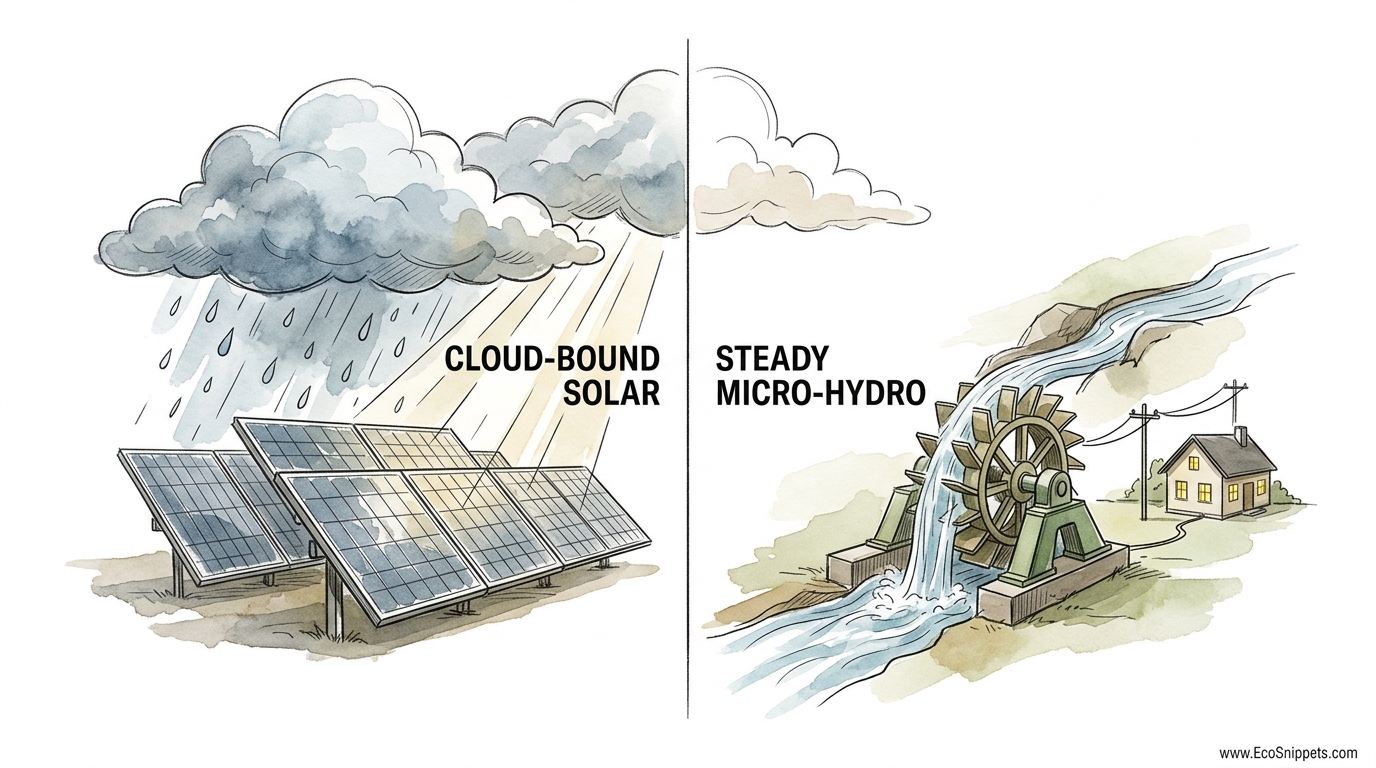
The sun goes down every night, but the water never stops flowing. Most homesteaders default to solar, but if you have a stream on your land, you’re sitting on a goldmine of base-load power. While solar owners are rationing lights during a storm, micro-hydro users are running their woodshops all night long.
Harnessing the energy of a moving stream is one of the oldest forms of human engineering, rooted in the same ancestral wisdom that powered grist mills and sawmills for centuries. Today, we have replaced the massive wooden wheels with high-efficiency turbines, yet the underlying principle remains a masterclass in self-reliance. If you are fortunate enough to possess a steady flow of water, you have the opportunity to move beyond the intermittent nature of the clouds and secure a legacy of true energy independence.
This guide will walk you through the mechanics, the math, and the grit required to turn a backyard creek into a personal power plant. We will explore the hardware that survives the seasons and the strategies that ensure your lights stay on when the rest of the world goes dark.
How To Generate 24/7 Power With Micro-Hydro Turbines
Micro-hydro power is the process of converting the kinetic energy of falling water into mechanical energy via a turbine, which then spins an alternator to create electricity. Unlike solar or wind, which are subject to the whims of the weather, a well-designed hydro system provides a steady, relentless stream of electrons every second of the day.
This system exists as a solution for remote properties where the cost of bringing in utility lines is prohibitive, or for the homesteader who refuses to be tethered to a fragile grid. In the real world, these systems are used to power everything from single off-grid cabins to small mountain villages. They are the ultimate “base-load” resource because their capacity factor—the ratio of actual energy produced to the maximum possible—often exceeds 90 percent.
Imagine your stream as a giant battery that is constantly being recharged by gravity and the water cycle. You aren’t just “gathering” energy like a solar panel; you are “harvesting” a continuous flow that has been set in motion by the geography of your land. Whether it is a fast-moving mountain rill or a slow, deep river, there is likely a way to pull usable power from it if you understand the physics of head and flow.
How It Works: The Physics of Falling Water
The heart of every micro-hydro system is the relationship between two variables: Head and Flow. Head is the vertical distance the water falls from the intake to the turbine, measured in feet or meters. Flow is the volume of water moving through the system, usually measured in gallons per minute (gpm) or cubic feet per second (cfs).
Gravity is the engine. When water is piped from a high point to a lower point, it builds pressure. This pressure is then directed through a nozzle, hitting the blades of a turbine runner. The faster the water moves and the more volume it has, the more torque it applies to the generator shaft.
A typical system consists of several key components working in unison. First, the intake or diversion captures a portion of the stream without blocking the entire flow. This water enters the penstock, a long pipe that carries the water down to the powerhouse. Inside the powerhouse, the turbine converts the water’s pressure into rotation, spinning an alternator. Finally, an Electronic Load Controller (ELC) manages the electricity, ensuring the turbine doesn’t over-speed by diverting excess power to a “dump load,” such as a water heater or air heater.
The Primary Components of a Micro-Hydro System
Building a system that lasts fifty years requires more than just a turbine. You must design a robust infrastructure that can handle floods, debris, and freezing temperatures. Each part of the chain must be sized correctly to minimize energy loss.
The Intake and Debris Screening
A great system begins with clean water. If leaves, sticks, or silt enter your penstock, they will eventually clog your nozzles or erode your turbine blades. Modern homesteaders often use a Coanda-effect screen, which uses a precision-angled stainless steel mesh to allow water to drop through while debris slides off the front.
The Penstock (The Pipeline)
The penstock is often the most expensive part of the installation. It must be strong enough to handle the static pressure of the water and the potential “water hammer” of a sudden valve closure. High-Density Polyethylene (HDPE) or PVC are the standard choices. HDPE is preferred for its flexibility and resistance to UV and freezing, though it requires specialized heat-fusion tools for joining.
The Turbine and Alternator
The turbine is the “motor” of your system. Depending on your site’s geography, you will choose between an impulse turbine (like a Pelton or Turgo) or a reaction turbine (like a Kaplan). The alternator then converts that rotation into either 12/24/48-volt DC for battery charging or high-voltage AC for long-distance transmission.
Benefits of Choosing Micro-Hydro
Micro-hydro is widely considered the “gold standard” of renewable energy for several measurable reasons. The primary advantage is its energy density. A small stream producing just 500 watts of continuous power generates 12 kilowatt-hours per day—roughly the average daily consumption of a modest energy-efficient home. To get that same 12 kWh from solar in a rainy climate, you might need a 5,000-watt array and a massive battery bank to survive three days of clouds.
Reliability is the second major benefit. Because the water flows at night and during storms, the demand on your battery bank is significantly reduced. You don’t need to store three days’ worth of power; you only need enough to handle “peak” loads that exceed the turbine’s output, such as when you run a well pump or a table saw.
Maintenance is surprisingly low for a mechanical system. A high-quality turbine with sealed bearings may only require a simple grease job once a year and a quick check of the intake screens after a heavy rain. Unlike wind turbines, which are exposed to the violent forces of the atmosphere, hydro turbines operate in a controlled, protected environment.
Challenges and Common Mistakes
The most common pitfall for beginners is failing to account for friction loss in the penstock. Water rubbing against the inside of a pipe creates resistance, which eats into your “head” or pressure. If you use a pipe that is too small for your flow rate, you might lose 50 percent of your potential power before the water even reaches the turbine. Always size your pipe so that friction loss stays below 10 to 15 percent of your total head.
Debris management is another area where many fail. A simple “screen” made of chicken wire will clog in hours during the autumn leaf drop. You must design a “trash rack” or use a self-cleaning intake. If you ignore this, you will spend your winters wading into a cold creek to clear clogs at 2:00 AM.
Winter icing can also be a formidable enemy. In northern climates, the intake can freeze solid, or “frazil ice” can form in the water and plug up the turbine. Professional installers often submerge the intake deep enough to stay below the ice line and insulate the powerhouse to keep the equipment above freezing.
Limitations: When Micro-Hydro Is Not Ideal
Micro-hydro is incredibly site-specific. You cannot “buy” your way into a hydro system if the geography isn’t there. You generally need at least 10 feet of vertical drop and a consistent flow of at least 5 to 10 gallons per minute to make a system economically viable. If your land is dead flat, no amount of expensive hardware will make the water fall with enough force to spin a turbine effectively.
Environmental regulations and water rights are the other major hurdle. In many jurisdictions, you do not “own” the water passing through your land; you only have the right to use it. Diverting a stream can affect fish populations and downstream neighbors. Most micro-hydro systems are “run-of-river,” meaning they take a little water out and put it back in exactly the same spot without changing the temperature or quality, which makes permitting easier but still necessary.
Seasonal fluctuations can also limit your output. A creek that roars in the spring might slow to a trickle in August. Serious practitioners measure their flow during the driest month of the year to ensure they are basing their power expectations on reality, not a seasonal peak.
Comparison: Cloud-Bound Solar vs. Steady Micro-Hydro
To understand why pioneers prefer hydro, we must look at the “Capacity Factor.” Solar panels only produce at full power for about 4 to 6 hours a day on average. A turbine produces 24 hours a day.
| Feature | Solar Power | Micro-Hydro Power |
|---|---|---|
| Availability | Daytime only (Weather dependent) | 24/7 (Flow dependent) |
| Energy Density | Low (Needs large surface area) | High (Relentless baseload) |
| Battery Requirement | Large (Must store for nights/storms) | Small (Used for surge loads) |
| Lifespan | 25-30 years (Efficiency degrades) | 50+ years (Infrastructure is permanent) |
| Maintenance | Low (Cleaning panels) | Moderate (Intake cleaning/bearings) |
Practical Tips and Best Practices
The most important step you can take is to measure your head and flow accurately before buying any equipment. Do not guess. You can measure head using a high-quality laser level or by using a long garden hose filled with water and a pressure gauge at the bottom. Remember that 1 PSI of pressure equals 2.31 feet of head. If your gauge says 20 PSI, you have about 46 feet of vertical drop.
When calculating your potential power, use this simple formula: (Net Head in feet × Flow in gpm) / 10 = Watts. This formula assumes a 50 to 60 percent overall system efficiency, which is realistic for most homestead setups. If you have 50 feet of head and 20 gpm of flow, you can expect roughly 100 watts of continuous power. That may sound small, but 100 watts running 24/7 is 2.4 kWh per day—enough to run a modern refrigerator and all your LED lights.
Always install a bypass valve near the turbine. This allows you to shut off the water to the turbine for maintenance without having to walk all the way up to the intake. Also, ensure your penstock has air relief valves at high points to prevent air bubbles from air-locking your pipe and reducing your flow.
Advanced Considerations for Serious Practitioners
For those looking to maximize efficiency, the Electronic Load Controller (ELC) is your most critical piece of electronics. Unlike a solar controller that just “disconnects” the panels when the batteries are full, a hydro turbine cannot just stop spinning; it would over-speed and potentially explode or burn out the alternator. The ELC shunts the excess energy into a “diversion load.” A smart homesteader uses this “waste” energy to pre-heat their domestic hot water or to keep a greenhouse above freezing in the winter.
If your powerhouse is located far from your home (more than 500 feet), you will face significant voltage drop if you try to send low-voltage DC (like 24V or 48V) over those wires. Advanced users often generate high-voltage AC (240V or even higher) at the turbine and use a transformer at the house to bring it back down. This allows you to use much thinner, cheaper wire for the long transmission run.
Consider also the type of turbine runner. A Pelton wheel is ideal for “high head, low flow”—think a steep mountain stream. A Turgo wheel can handle higher volumes of water and is less likely to clog. A Kaplan or propeller turbine is designed for “low head, high flow”—like a larger, slow-moving river with only a few feet of drop. Choosing the wrong turbine for your geography is the fastest way to waste thousands of dollars.
Example Scenario: The Mountain Creek Homestead
Let’s look at a realistic example. A homesteader has a creek that drops 60 feet over a distance of 400 feet. They measure the flow in the driest part of the year and find they have a steady 15 gallons per minute.
Using our formula: (60 feet × 15 gpm) / 10 = 90 Watts. Over 24 hours, this produces 2.16 kWh. During the spring, the flow increases to 40 gpm. If they have sized their penstock and turbine to handle this, their output jumps to 240 Watts, or 5.76 kWh per day.
The homesteader installs a 2-inch HDPE penstock. By using a 2-inch pipe for 15 gpm, the friction loss is negligible (less than 3 feet of head lost). If they had used a 1-inch pipe, the friction would have eaten almost 40 feet of their head, leaving them with practically no power. This shows that the infrastructure—the pipe size and the intake design—is just as important as the turbine itself.
Final Thoughts
Micro-hydro power is the ultimate expression of homesteading grit. It requires more initial labor, more engineering, and more interaction with the land than simply bolting solar panels to a roof. However, the reward is a level of energy security that few other systems can match. When the sun goes down and the wind dies, the water continues its silent, heavy work, pushing your turbine and keeping your home bright.
To succeed, you must respect the power of the water. This means over-building your intake to survive the hundred-year flood and choosing high-quality materials that won’t degrade in the mud. It means doing the math on friction loss and pressure ratings before you dig your first trench.
If you have the water, you have the power. Start small, measure twice, and build for the next generation. The stream has been flowing for thousands of years; with a little ingenuity, you can finally put it to work for your family.
