How To Become More Self-Sufficient Without Starting a Full-Blown Farm…
Want to start preserving your harvest, making your own soap, or building a backyard root cellar — but not sure where to begin? “Homesteading Advice” gives you instant lifetime access to 35+ practical homesteading books on food preservation, veggie gardening, DIY natural cleaning products (save over $250 per year with this skill alone), brewing, off-grid energy, and a whole lot more…
Click Here To Check It Out Now!
True food preservation starts in the soil, not the jar. High-Brix gardening isn’t just for flavor—it’s the ultimate preservation hack. Higher mineral content means a natural resistance to rot and longer shelf life.
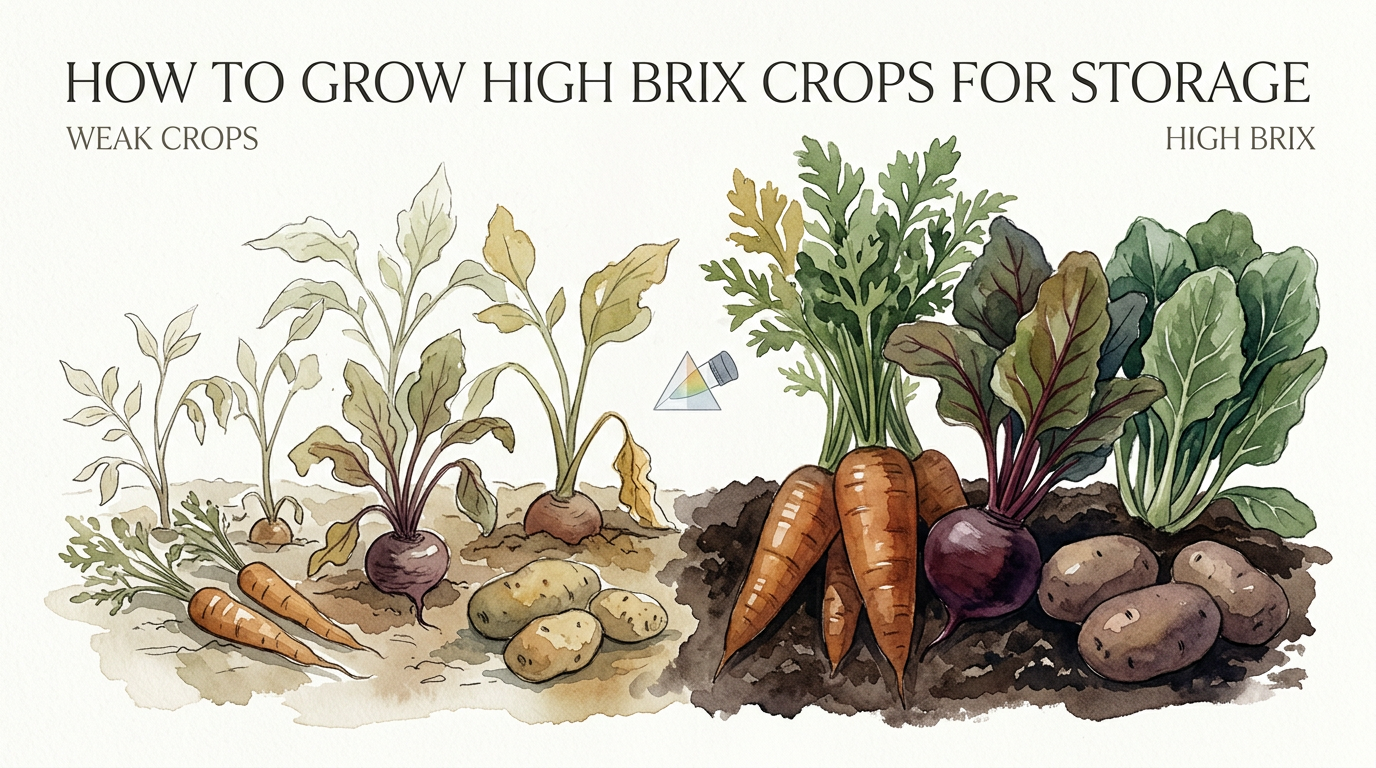
If you have ever pulled a carrot from the cellar only to find it a mushy, black mess, you have seen the failure of weak crops. For the self-reliant gardener, true success isn’t measured just by the size of the harvest, but by how long that harvest stays vital and nourishing. Growing food with high sugar and mineral density changes the very chemistry of your produce, turning your pantry into a vault of long-lasting energy.
Understanding this process requires a shift in perspective. We must stop looking at the plant as a passive consumer of water and look at it as a complex biological factory. When that factory has the right raw materials—minerals, microbes, and sunlight—it produces a crop that is structurally superior. This guide will show you how to build that foundation from the ground up.
How To Grow High Brix Crops For Storage
High-Brix gardening is the practice of increasing the Total Soluble Solids (TSS) in a plant’s sap. While “Brix” is often synonymous with sugar, it actually measures a combination of sugars, amino acids, proteins, and minerals dissolved in the plant’s fluids. These solids are the building blocks of life.
This concept exists because plants with higher dissolved solids are denser and have a higher specific gravity. In the real world, this translates to produce that feels heavier for its size and tastes significantly more complex. More importantly for the homesteader, high-Brix plants possess a higher concentration of mineral salts and organic compounds that act as natural preservatives.
Imagine two apples: one is grown in depleted soil with heavy synthetic nitrogen, and the other is grown in mineral-rich, biologically active soil. The first apple is mostly water; its cell walls are thin and stretched. When harvested, it begins to rot almost immediately as bacteria feast on the excess nitrates. The second apple has thick cell walls reinforced with calcium and is packed with complex sugars. Instead of rotting, it might simply dehydrate over several months, retaining its integrity and safety.
The Mechanics of Nutrient Density and Mineral Uptake
To grow high-Brix crops, you must focus on the efficiency of photosynthesis. Sugars are the primary product of a plant’s interaction with the sun. The more efficiently a plant can convert sunlight into energy, the more sugar it pumps into its tissues and out through its roots to feed soil microbes.
This process depends on a specific set of mineral “spark plugs.” Magnesium is the heart of the chlorophyll molecule, acting as the engine for photosynthesis. Phosphorus provides the energy transport (ATP) needed to move those sugars around. Boron acts as the “door opener,” allowing sugars to move from the leaves where they are made down into the fruit or roots.
Step one is always a soil test, but not the basic kind from a big-box store. You need a test that looks at “available” nutrients, often called a Reams or Albrecht-style test. These tests tell you what the plant can actually grab, not just what is sitting in the soil in an inert form. Once you know your deficiencies, you apply minerals—like rock dust, soft rock phosphate, or high-calcium lime—to balance the soil’s chemistry.
Benefits of High-Brix Produce
The most immediate benefit is flavor. High-Brix fruits and vegetables have a sweetness and “kick” that grocery store produce can never match. This isn’t just a culinary luxury; flavor is the human tongue’s way of detecting nutrient density. Our ancestors knew that a sweeter carrot was a healthier carrot.
Practical storage advantages are the primary reason for the serious practitioner to pursue these levels. High-Brix crops have a lower freezing point, making them more resilient to early frosts in the field and temperature fluctuations in the root cellar. They are also less attractive to pests. Most “sucking” insects and many “chewing” larvae cannot digest complex proteins and high sugar concentrations. They seek out weak, high-nitrate plants instead.
Finally, there is the benefit of nutritional fortitude. Because Brix correlates with mineral content, eating high-Brix food means you are consuming more calcium, magnesium, and trace minerals per bite. This is the definition of “food as medicine.” It provides the stamina needed for a self-reliant lifestyle.
Challenges and Common Mistakes
A frequent error is the over-application of nitrogen, especially in the form of nitrates. While nitrogen makes plants look green and grow fast, too much of it “burns” up the plant’s carbohydrate reserves. This results in watery, low-Brix tissue that is a magnet for aphids and mold. It is the gardening equivalent of building a house out of cardboard; it looks fine until the first storm hits.
Over-irrigation is another common pitfall. Excessive water dilutes the sap, dropping the Brix level instantly. If you test your plants after a heavy rain, you will see the numbers plummet. Maintaining a steady, moderate moisture level is key to keeping the sap concentrated and the plant’s internal systems running smoothly.
Many gardeners also fail to account for soil aeration. Microbes need oxygen to break down minerals into a form the plant can use. If your soil is compacted, the biological “workforce” shuts down, and your Brix levels will stall regardless of how many amendments you add. Pioneer wisdom always prioritized a “loose, friable tilth” for a reason.
Limitations of the Brix Method
Brix readings are not a static “score.” They fluctuate throughout the day. Levels are typically lowest in the morning and highest in the late afternoon after a full day of sunlight. This can be frustrating for beginners who see a high reading one day and a low one the next. Consistency in testing time is mandatory for accurate tracking.
Environmental factors like cloud cover or extreme heat can also limit a plant’s ability to reach its genetic potential. No amount of soil mineralization can fully compensate for a week of heavy smoke or thick clouds that halt photosynthesis. You must work with the seasons, recognizing that some years will naturally produce higher-quality storage crops than others.
Seed genetics also play a role. Some modern hybrids are bred for “shipping durability” rather than nutrient density. They may have a “ceiling” for Brix that they cannot cross. For the best results, use heritage or heirloom varieties that were selected by generations of farmers for their storage and flavor qualities.
Comparing Weak Crops vs. High Brix
| Feature | Weak (Low Brix) Crops | High Brix Crops |
|---|---|---|
| Internal Structure | Thin cell walls, high water content. | Thick, mineral-reinforced cell walls. |
| Pest Resistance | High; pests attracted to free nitrates. | Natural resistance; pests cannot digest complex sap. |
| Storage Behavior | Rots, melts, and develops pathogens. | Dehydrates slowly or remains crisp. |
| Freezing Point | High (freezes easily like water). | Low (acts like a natural anti-freeze). |
| Nutritional Value | Low; high in simple sugars or water. | High; dense in minerals and vitamins. |
Practical Tips for Boosting Brix
Foliar feeding is the “secret weapon” for the serious gardener. By spraying a fine mist of minerals and amino acids directly onto the leaves, you bypass soil tie-ups and give the plant an immediate boost. Seaweed extracts, fulvic acid, and liquid calcium are excellent choices. This is best done in the early morning when the plant’s stomata (pores) are open.
Microbial inoculation is equally important. Using mycorrhizal fungi and compost tea ensures that the plant has a massive “root extension” system. These microbes mine minerals from the rock particles in your soil and trade them to the plant for sugar. It is a symbiotic relationship that has sustained wild landscapes for millennia.
Timing your harvest is the final step. Always try to harvest for long-term storage during a period of high atmospheric pressure and sunny days. The plant will have maximum sugar reserves in its tissues, giving it the best “battery life” for the months ahead in the cellar.
Advanced Considerations: The Reams Ratio
For those who want to master this craft, understanding the relationship between phosphorus and potassium (P and K) is vital. Dr. Carey Reams, the father of Brix gardening, suggested that for most crops, the ratio of phosphate to potash in the soil should be roughly 2:1 or even higher. Excess potassium often leads to “large but hollow” crops that don’t store well.
Calcium is the king of minerals in this system. It is responsible for the “cement” that holds cell walls together. Without enough available calcium, your Brix might stay high in sugars, but the plant will lack the physical fortitude to resist bruising. Always ensure your soil pH is balanced not just with any lime, but with the specific type of calcium your soil profile lacks.
Specific conductivity, or ERGS (Energy Released per Gram per Second), is another metric advanced practitioners track. It measures the amount of “electricity” or ionic movement in the soil. If the ERGS are too low, the plant is starving; if they are too high, the plant is being “salted” to death. Balancing this flow is what separates a lucky gardener from a master grower.
Examples and Scenarios
Consider a homestead in the Pacific Northwest trying to store winter squash. One year, they use a standard 10-10-10 fertilizer and heavy irrigation. Their Butternut squash tests at 6 Brix. By January, half the pile is covered in grey mold and has to be thrown out. The squash tastes “watery” and bland.
The following year, they focus on mineralization. They add soft rock phosphate, reduce irrigation three weeks before harvest, and use a kelp-based foliar spray. The squash tests at 14 Brix. These squash remain solid, sweet, and vibrant until June. They don’t rot; they simply become slightly more concentrated in flavor over time. This is the power of soil-based preservation.
Another scenario involves the humble potato. A high-Brix potato (above 8 Brix) will not turn black when sliced and left on the counter. The mineral density prevents the oxidation that plagues weaker tubers. In the frying pan, a high-Brix potato carmelizes beautifully because of its complex sugar structure, whereas a low-Brix potato may remain limp and greasy.
Final Thoughts
Building high-Brix soil is not a weekend project. It is a commitment to the long-term vitality of your land and your family. By focusing on the mineral and biological foundations of your garden, you are doing more for your food security than any canning lid or vacuum sealer ever could.
True self-reliance is found in the “grit” of the soil. When you learn to read the refractometer and listen to the needs of your plants, you are reclaiming ancestral wisdom that was nearly lost in the age of industrial agriculture. You are growing food that doesn’t just fill a belly, but builds a body.
Start small. Pick one crop this season—perhaps your onions or your winter squash—and focus on raising their Brix. Observe the difference in flavor, watch how the pests react, and track how they hold up in the pantry. Once you see the results, you will never look at “dirt” the same way again.
