How To Become More Self-Sufficient Without Starting a Full-Blown Farm…
Want to start preserving your harvest, making your own soap, or building a backyard root cellar — but not sure where to begin? “Homesteading Advice” gives you instant lifetime access to 35+ practical homesteading books on food preservation, veggie gardening, DIY natural cleaning products (save over $250 per year with this skill alone), brewing, off-grid energy, and a whole lot more…
Click Here To Check It Out Now!
The Living Homestead: Cultivating Your Wild Yeast Ginger Bug
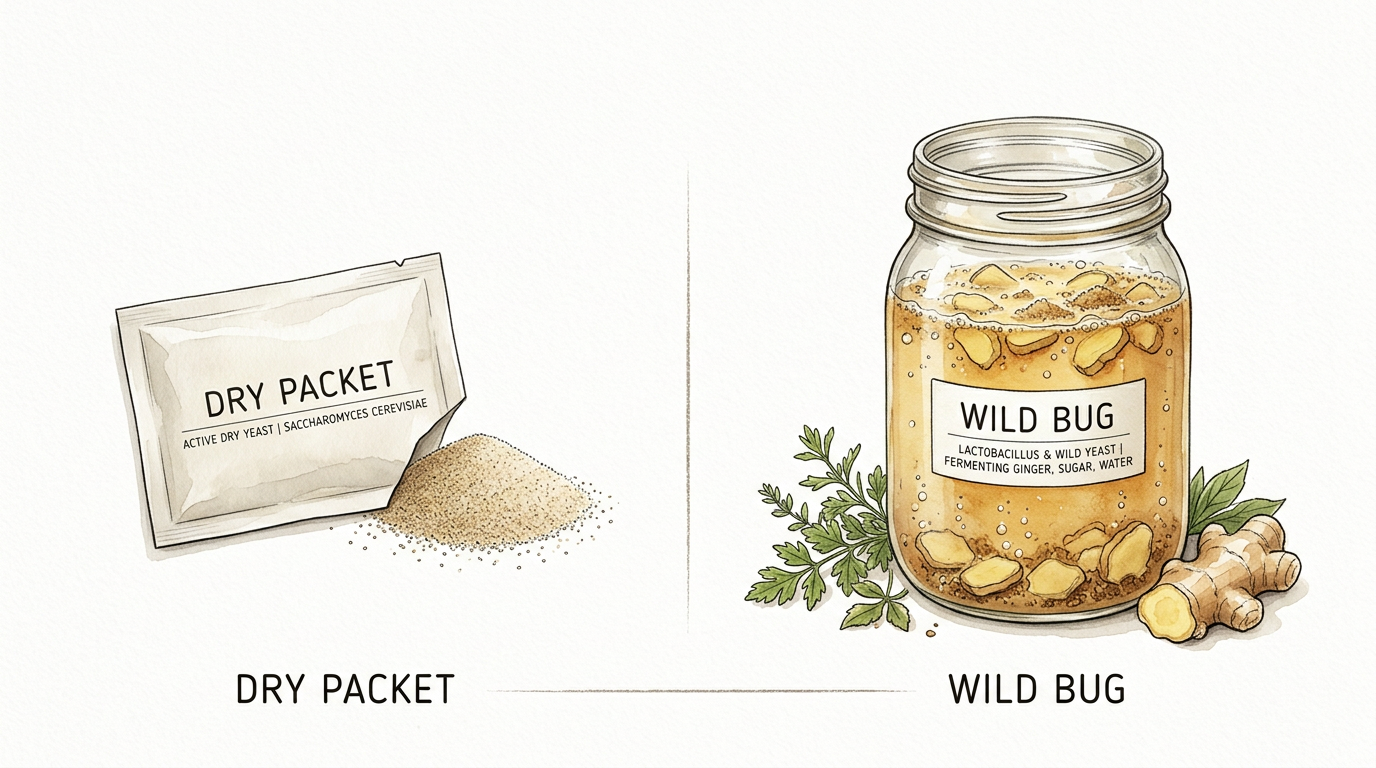
One of these creates a generic beverage, the other creates a living probiotic medicine tailored to your land. Commercial yeast is bred for speed and uniformity, but it lacks the soul of your homestead. By capturing the wild microbes on your own fruit and herbs, you aren’t just brewing; you’re cultivating a local ecosystem in a bottle. Here is why the ginger bug is the ultimate homestead hack.
The modern kitchen has become a place of sterile surfaces and pre-packaged shortcuts. We have traded the complex, life-giving tang of wild fermentation for the cloying sweetness of store-bought sodas and the predictable rise of industrial yeast packets. But for the homesteader, the pioneer, or the seeker of ancestral wisdom, there is a better way. The ginger bug is a bridge to our past and a tool for a more self-reliant future.
Think of it as the sourdough starter of the beverage world. Instead of grain and water, we use the rugged, spicy rhizome of the ginger plant to invite the invisible workers of the air and soil into our jars. These wild yeasts and lactic acid bacteria don’t just create bubbles; they transform simple sugars into a complex tonic that supports the gut and clears the mind. This guide will show you how to harness that wild energy.
How To Make A Wild Yeast Ginger Bug
A ginger bug is a concentrated starter culture made from fresh ginger root, sugar, and water. It serves as a biological engine for making naturally carbonated sodas, ginger beer, and sparkling tonics. Unlike commercial yeast, which is a single isolated strain of Saccharomyces cerevisiae, a wild ginger bug is a diverse colony of microbes that reflects the specific environment of your kitchen and the soil where your ginger grew.
In the real world, this bug is your ticket to eliminating high-fructose corn syrup from your pantry. When you have a bubbling jar of “the bug” on your counter, you can turn any fruit juice, herbal tea, or sweetened infusion into a fizzy, probiotic drink. It exists to provide carbonation without the need for pressurized CO2 tanks or laboratory-made chemicals. It is the original “natural soda.”
Visualizing a ginger bug is easy: it is a pint or quart jar filled with a cloudy, golden liquid and a pile of minced ginger. At its peak, it will hiss when stirred and show a crown of tiny, persistent bubbles. It is a living thing, requiring daily attention for the first week, much like a farm animal or a garden bed. This small investment of time yields a perpetual source of life for your homestead kitchen.
How It Works: The Step-By-Step Process
The process of creating a ginger bug relies on the fact that wild yeast and beneficial bacteria are already present on the skin of organic ginger. When we provide these microbes with sugar and water, they begin to multiply. Here is how to build your starter from scratch.
Step 1: The Initial Inoculation
Gather your materials. You will need a clean glass jar, organic ginger (non-organic is often irradiated, which kills the yeast), cane sugar, and filtered water. Chlorine in tap water is designed to kill microbes—the very thing we are trying to grow—so use spring water or filtered water instead.
Finely mince or grate about two tablespoons of unpeeled ginger. Place it in the jar with two tablespoons of sugar and two cups of water. Stir it vigorously with a wooden spoon to aerate the mixture. Oxygen is vital in these early stages to help the yeast population explode.
Step 2: The Daily Feeding
Every 24 hours, you must “feed” your bug. Add one tablespoon of minced ginger and one tablespoon of sugar. Stir it again. Covering the jar with a breathable cloth and a rubber band keeps out dust and fruit flies while allowing the gasses to escape and oxygen to enter.
Step 3: Watching for Life
Between day three and day seven, you will notice changes. The liquid will become cloudy. You will see small bubbles rising to the surface, and it will begin to smell slightly yeasty and sharp. Once the bug bubbles vigorously when stirred, it is ready to use. This indicates that the microbial colony is strong enough to dominate a larger batch of liquid.
The Benefits of Wild Fermentation
Choosing a wild ginger bug over a dry packet of yeast offers advantages that go beyond mere fizziness. It is about the quality of the medicine you are making for your family.
Bioavailable Nutrition: Fermentation breaks down the tough fibers and complex compounds in ginger, making its anti-inflammatory gingerols and antioxidants more accessible to your body. You aren’t just drinking ginger; you’re drinking a predigested, potent version of it.
Probiotic Diversity: A wild bug contains a spectrum of Lactobacillus and wild yeast strains. This diversity helps reinforce the gut microbiome, which is the foundation of the immune system. Commercial sodas destroy gut health; ginger bug tonics build it up.
Cost and Sustainability: You can keep a ginger bug alive for years with just a few pennies’ worth of ginger and sugar. There are no packets to buy, no plastic waste to discard, and no reliance on an industrial supply chain. This is true homestead economy.
Challenges and Common Mistakes
The most common hurdle for beginners is a “sluggish” bug. If your jar isn’t bubbling after five days, the environment is likely the culprit. Microbes need warmth; if your kitchen is below 65°F, the yeast will stay dormant. Move the jar to a warmer spot, such as the top of the refrigerator.
Using the wrong water is another frequent error. If you use chlorinated tap water, you are essentially poisoning your “good bugs” every time you feed them. Always use filtered or distilled water if your local tap is treated. Similarly, non-organic ginger that has been treated with pesticides or radiation will often fail to ferment because the surface microbes have been wiped out.
Mold is the final boss of fermentation. If you see fuzzy green, black, or red growth on the surface, the batch is compromised. This usually happens if the ginger pieces are left floating at the top without being stirred back in. Daily stirring keeps the surface acidic and moist, preventing mold from taking hold. White, film-like growth (Kahm yeast) is generally harmless but can affect flavor—simply scrape it off and keep going.
Limitations and Environmental Constraints
While the ginger bug is powerful, it has its boundaries. It is a “wild” process, meaning it is less predictable than a commercial yeast packet. The flavor profile will change slightly with the seasons as different wild yeasts dominate the air. If you require absolute uniformity for a commercial product, wild bugs can be a challenge.
Alcohol content is another consideration. A standard two-day secondary fermentation in bottles usually results in less than 1% ABV, making it suitable for most families. However, if left at room temperature for weeks, the yeast will continue to consume sugar and produce more alcohol. It won’t reach the levels of a wine (usually capping out around 3-5% due to the wild yeast’s lower alcohol tolerance), but it is something to monitor if you are serving children.
Temperature sensitivity is a major trade-off. In the heat of summer, a ginger bug can become “over-active,” leading to explosive carbonation in bottles if not moved to the fridge quickly. In the dead of winter, it may take twice as long to ready a batch. You must learn to read the rhythm of the seasons rather than relying on a fixed clock.
DRY PACKET vs WILD BUG: A Comparison
Understanding the difference between these two methods helps you choose the right tool for your homesteading goals.
| Feature | Commercial Dry Yeast | Wild Ginger Bug |
|---|---|---|
| Microbial Diversity | Single strain (monoculture) | Diverse colony (polyculture) |
| Speed | Fast (24-48 hours) | Slow (5-7 days for starter) |
| Cost | Ongoing purchase required | Pennies (perpetual culture) |
| Flavor Profile | Uniform, “bready” or “clean” | Complex, floral, “funk” |
| Health Benefits | Minimal probiotics | Rich in LAB and wild yeast |
Practical Tips and Best Practices
Keep your ginger bug in a designated “fermentation corner” away from direct sunlight. UV rays can be antimicrobial, which will hinder your progress. A dark, warm pantry shelf is ideal.
Master the “Burp”: When you finally move your bug into bottles with fruit juice to create soda, the pressure builds fast. Use swing-top bottles designed for high pressure. “Burp” them once a day by quickly opening and closing the cap to check the carbonation. Once it hisses like a commercial soda, move it to the refrigerator immediately to stop the process.
- Always use organic ginger to ensure a healthy yeast population.
- Grate the ginger instead of chopping for more surface area and faster activity.
- Use unrefined cane sugar or jaggery for added minerals that feed the microbes.
- Label your jar with the date it was started to track its maturity.
Advanced Considerations: The Long-Term Bug
Once your bug is established and you have made a few batches of soda, you don’t need to keep it on the counter forever. You can put your ginger bug into “hibernation” by placing it in the refrigerator. In the cold, the microbes slow their metabolism significantly.
A refrigerated bug only needs a feeding of one tablespoon of ginger and sugar once a week. When you are ready to brew again, take it out 24 hours in advance, give it a fresh room-temperature feeding, and wait for the bubbles to return. Some homesteaders have maintained the same ginger bug for over a decade, passing “starter” jars to neighbors and friends like a traditional sourdough.
You can also experiment with “terroir” in your bug. Try adding a few wild berries or a sprig of fresh herbs from your garden to the starter. This introduces local microbes specific to your land, truly making the beverage a product of your unique homestead ecosystem.
Example: Creating a Wild Herbal Root Beer
To see how theory translates to practice, consider this scenario. You have an active, bubbling ginger bug. You want to make a gallon of traditional root beer. First, you would brew a strong tea using sarsaparilla root, dandelion root, and licorice, sweetened with molasses and maple syrup.
After the tea has cooled to room temperature (never add the bug to hot liquid, or you will kill the microbes), you strain in one cup of your active ginger bug liquid. Stir it well and pour it into bottles, leaving two inches of “headspace” at the top. Let these sit on the counter for 48 hours. After two days, the wild yeast will have eaten enough sugar to create a fine, natural carbonation. Chill them, and you have a medicinal soda that far surpasses anything found on a grocery shelf.
Final Thoughts
The ginger bug is more than just a recipe; it is a philosophy of participation. It requires us to step away from the role of the passive consumer and become active stewards of the life in our kitchens. It teaches patience, observation, and the value of working with nature rather than trying to dominate it with chemicals and speed.
By mastering the wild ginger bug, you gain the ability to provide your family with sparkling, joyful beverages that actually heal the body. You reclaim a piece of domestic history and build a more resilient home. Whether you are brewing a spicy ginger beer or a delicate floral soda, you are tasting the literal spirit of your land.
Do not be afraid of the “fizz.” Start your jar today, feed it with intention, and watch as the invisible world rewards your effort with a living, bubbling testament to the power of the homestead.
