How To Become More Self-Sufficient Without Starting a Full-Blown Farm…
Want to start preserving your harvest, making your own soap, or building a backyard root cellar — but not sure where to begin? “Homesteading Advice” gives you instant lifetime access to 35+ practical homesteading books on food preservation, veggie gardening, DIY natural cleaning products (save over $250 per year with this skill alone), brewing, off-grid energy, and a whole lot more…
Click Here To Check It Out Now!
If you let your roosters choose their own mates, your food security is on a countdown to genetic collapse. Most backyard farmers are just three generations away from ‘inbreeding depression’—where egg production drops and chicks get weaker. The secret to a 50-year sustainable flock isn’t buying new birds; it’s the Clan Mating System. By separating your flock into three genetic ‘lanes,’ you can maintain 100% vigor without ever visiting a hatchery again.
How To Prevent Inbreeding In Backyard Chickens
Inbreeding occurs when closely related birds, such as siblings or parents and offspring, mate over multiple generations. This practice concentrates both good and bad traits, but in a small backyard setting, the bad traits usually win out first. You might notice smaller eggs, crooked toes, or a sudden lack of “thrifty” behavior in your chicks. These are the red flags of a narrowing gene pool that eventually leads to a dead end for your homestead.
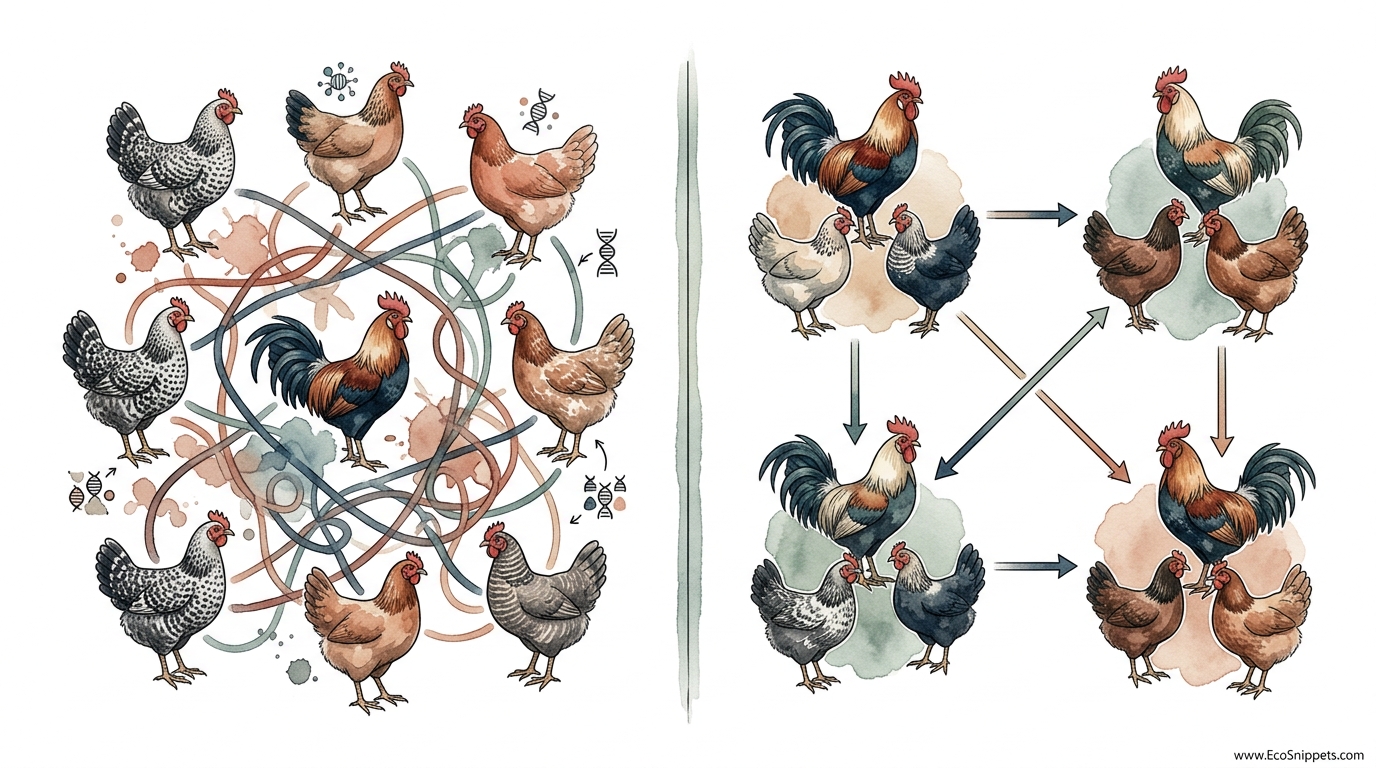
The Clan Mating System, often called the Spiral Mating System, serves as the ultimate insurance policy against this genetic decay. It is a structured method of breeding where you divide your birds into at least three distinct groups or “clans.” Instead of letting nature take a haphazard course, you manage the movement of the roosters while keeping the hens stationary in their maternal lines. This structure mimics the natural dispersal of males in the wild, ensuring that no rooster ever breeds with his own mother or sister.
Real-world conservationists and heritage breeders use this exact system to save rare breeds from extinction. It allows a farmer to keep a “closed flock,” meaning you never have to bring in outside birds that might carry respiratory diseases or mites. You become the master of your own poultry genetics, selecting for the birds that thrive specifically on your land and your feed.
Setting the Foundation: How the Clan System Works
Success with this system starts with organization and three separate breeding areas. You can name your clans anything you like, but most pioneers keep it simple with colors: Red, Blue, and Green. Each clan is a permanent maternal line, meaning a hen born into the Red Clan stays in the Red Clan for her entire life.
In the first year of the program, you mate the birds within their own clans to establish a baseline. The Red rooster breeds the Red hens, the Blue rooster breeds the Blue hens, and the Green rooster breeds the Green hens. This is the only time in the history of your flock that this will happen. From this point forward, the roosters will begin their “spiral” journey through the pens.
The golden rule of clan mating is that all chicks are assigned to the clan of their mother. If a chick hatches from an egg laid by a Red Clan hen, that chick is Red, regardless of who the father was. This maternal tracking is the only way to keep the lanes clear over several decades. Once you understand this one rule, the rest of the management becomes a simple annual routine.
The Annual Rooster Rotation
After the first year, the roosters move to the “next clan over” every breeding season. A common rotation pattern looks like this: the Red rooster moves to the Blue hens, the Blue rooster moves to the Green hens, and the Green rooster moves to the Red hens. This ensures that the genetic material is constantly flowing in one direction, preventing the same DNA from overlapping too soon.
When the next generation of cockerels is ready to work, you choose the best son from each clan to take his father’s place in the rotation. If you keep your original roosters for a second year, you must ensure they continue to move to a new clan to avoid breeding back to their daughters. Most practitioners find it easiest to use young cockerels each year to keep the cycle moving fast and the vigor high.
Infrastructure and Tools of the Trade
You do not need a massive barn to run a clan system, but you do need three secure breeding pens. These pens only need to be occupied during the breeding season, which typically lasts from late winter through spring. Once you have collected enough hatching eggs, the entire flock can be reunited in a single pasture or run for the rest of the year.
Record keeping is the backbone of the system, yet it doesn’t have to be complicated. You need a permanent way to identify which chick belongs to which clan the moment they leave the incubator or the broody hen. Pioneers have used two primary methods for over a century: toe punching and leg banding.
- Toe Punching: Using a small tool to create a tiny hole in the webbing of a chick’s foot. This is a permanent mark that never falls off or needs replacing.
- Leg Banding: Using colored zip ties or aluminum bands. These are easy to see from a distance but must be changed as the bird grows to prevent injury.
- Wing Tagging: A more professional approach used by hatcheries, involving a metal tag pierced through the wing web.
Benefits of the Clan Mating System
The primary advantage of this system is total independence from the industrial poultry complex. When you buy chicks from a hatchery, you are buying birds bred for a general climate and a high-input diet. By breeding your own clans, you are selecting for the survivors that handle your specific winters and your specific pests.
Biosecurity is another massive win for the closed-flock enthusiast. Bringing in a new “outside” rooster is the fastest way to introduce Mycoplasma or Infectious Bronchitis to your farm. With a 3-clan system, the only thing crossing your property line is the sun and the rain. Your birds develop a “herd immunity” to the local pathogens on your soil, making them much hardier than any store-bought bird.
Longevity of the flock is the ultimate goal. A well-managed 3-clan system can remain genetically viable for up to 20 generations without a single drop in production. If you expand to a 5-clan system, the math suggests your flock could last for a century or more. You are not just raising chickens; you are building a legacy strain.
Challenges and Common Pitfalls
The most common mistake beginners make is losing track of which chick came from which hen. If a Red Clan egg gets mixed into the Blue Clan basket, the entire genetic map for those birds is ruined. You must be disciplined during the hatching season, using separate incubators or clearly marked dividers to keep the “clans” separate until they are marked.
Another pitfall is “soft culling.” In a clan system, you must be the “ruthless predator” that nature intended. If a rooster in the Blue Clan has a weak constitution or poor fertility, you cannot keep him just because he is friendly. You must replace him with a superior son or a backup male. Keeping sub-par birds in the rotation will eventually weaken the entire system.
Space constraints can also pose a challenge for the smaller backyard. Managing three separate roosters requires enough distance or sturdy fencing so they don’t fight through the wire. If your roosters are constantly stressed by each other’s presence, their fertility will drop, and your spring hatch will suffer.
Limitations of the System
This method is not ideal for the casual pet owner who only wants three or four hens. To keep the genetics healthy, each clan should ideally have at least 5 to 10 hens and one or two roosters. This means you are maintaining a minimum of 18 to 30 adult birds. If you don’t have the space or the feed budget for a flock of that size, a simpler “rolling mating” or “outcrossing” method might be better.
The clan system also requires a long-term commitment. You won’t see the true benefits in the first year; the magic happens in year five, ten, and beyond. If you plan on changing breeds every season or moving frequently, the effort of setting up clans might not be worth the initial investment in housing and marking tools.
Comparing Breeding Methods
Choosing a system depends on your goals for the farm. Some prefer speed, while others prefer stability.
| Method | Complexity | Sustainability | Genetic Vigor |
|---|---|---|---|
| Random Mating | Very Low | Low (3-5 years) | Declining |
| Clan Mating | Moderate | High (20+ years) | Very High |
| Line Breeding | High | Moderate | High (Specific traits) |
While line breeding is excellent for “fixing” a specific color or comb type, it carries a higher risk of doubling up on hidden defects. Clan mating is a defensive strategy designed to keep the “wild vigor” alive while you focus on production traits like egg count and meat weight.
Practical Tips for the Homestead
Start your journey by sourcing the highest quality birds you can find. It is much easier to maintain greatness than it is to breed out mediocrity. Reach out to heritage breeders rather than big-box hatcheries to get birds that already have a foundation of health and traditional traits.
Use a “Backup Rooster” strategy. Always keep a second-best cockerel from each clan in a separate bachelor pad. If your main Red rooster is taken by a hawk mid-season, you have a genetically appropriate replacement ready to step in immediately. Without a backup, a single predator strike can stall your entire breeding program for a year.
Keep a simple “Clan Log” in your barn. Write down which rooster is in which pen and the dates you collected eggs. Even the best memory fails after a long winter. A quick glance at a clipboard ensures that you move the Blue rooster to the Green pen, not back to the Red one by mistake.
Advanced Considerations: Expanding the Spiral
Once you have mastered the 3-clan rotation, you might consider moving to a 5-clan system. This requires more housing but slows the rate of inbreeding to almost zero. It allows you to select for even more specific traits, such as “winter laying” in one lane and “broodiness” in another, before swirling those genetics back through the rest of the flock.
Serious practitioners also use “Performance Testing” within the clans. Instead of just picking the prettiest rooster, they track which hens produced the most eggs or which cockerels reached butcher weight the fastest. By only keeping the top 10% of offspring as future breeders, you are not just preventing collapse—you are actively improving the breed with every turn of the spiral.
Example Scenario: The Five-Year Timeline
Imagine you start with three pens of Rhode Island Reds in Year One. You mark them Red, Blue, and Green. You hatch 20 chicks from each pen and mark them according to their mother’s clan.
In Year Two, you eat the original roosters or sell them. You move the best Red son to the Blue pen, the best Blue son to the Green pen, and the best Green son to the Red pen. You now have “half-brother” genetics mixing with unrelated maternal lines.
By Year Five, the genetics have “spiraled” through the pens twice. Your neighbor, who buys new chicks every year, notices your birds are larger, lay more consistently through the heat of summer, and rarely get sick. You have created a “landrace”—a version of the breed that is perfectly tuned to your specific homestead.
Final Thoughts
Mastering the Clan Mating System is the ultimate step in moving from a hobbyist to a true producer. It removes the “ticking clock” of genetic decline and replaces it with a sustainable, self-perpetuating engine of food security. You no longer have to worry about hatchery shortages or price hikes because your best breeders are already in your backyard.
This system requires discipline, a few extra fences, and a simple hole punch, but the rewards are measured in decades of healthy flocks. It is the same wisdom our ancestors used when they moved livestock across valleys to find “fresh blood,” scaled down for the modern homesteader.
Start with three clans, keep your records straight, and trust the spiral. Your future self—and your future flock—will thank you for the foresight. Consistent selection and organized movement are the only things standing between a failing flock and a 50-year legacy.
