How To Become More Self-Sufficient Without Starting a Full-Blown Farm…
Want to start preserving your harvest, making your own soap, or building a backyard root cellar — but not sure where to begin? “Homesteading Advice” gives you instant lifetime access to 35+ practical homesteading books on food preservation, veggie gardening, DIY natural cleaning products (save over $250 per year with this skill alone), brewing, off-grid energy, and a whole lot more…
Click Here To Check It Out Now!
Your local forest is hiding a high-protein feast that creates the world’s most expensive pork. Why are you paying for industrial soy when your oak trees are dropping free gold? Forest-finished pork isn’t just cheaper—it’s the flavor profile found in $100-a-pound Iberian ham.
For generations, the old-timers didn’t rely on a trip to the feed store to raise a winter’s worth of meat. They relied on the “mast”—the seasonal drop of acorns, hickory nuts, and beechnuts that turns a standard woodlot into a high-calorie buffet. This isn’t just about saving money; it’s about reclaiming a lost art of animal husbandry that works with the rhythms of the land rather than against them.
If you have a few acres of hardwoods and the grit to manage a fence, you can opt out of the industrial grain cycle. You’re not just raising a pig; you’re stewarding a forest and producing a culinary masterpiece that no grocery store can replicate. Let’s look at how you can turn those falling leaves and nuts into a freezer full of the best pork you’ve ever tasted.
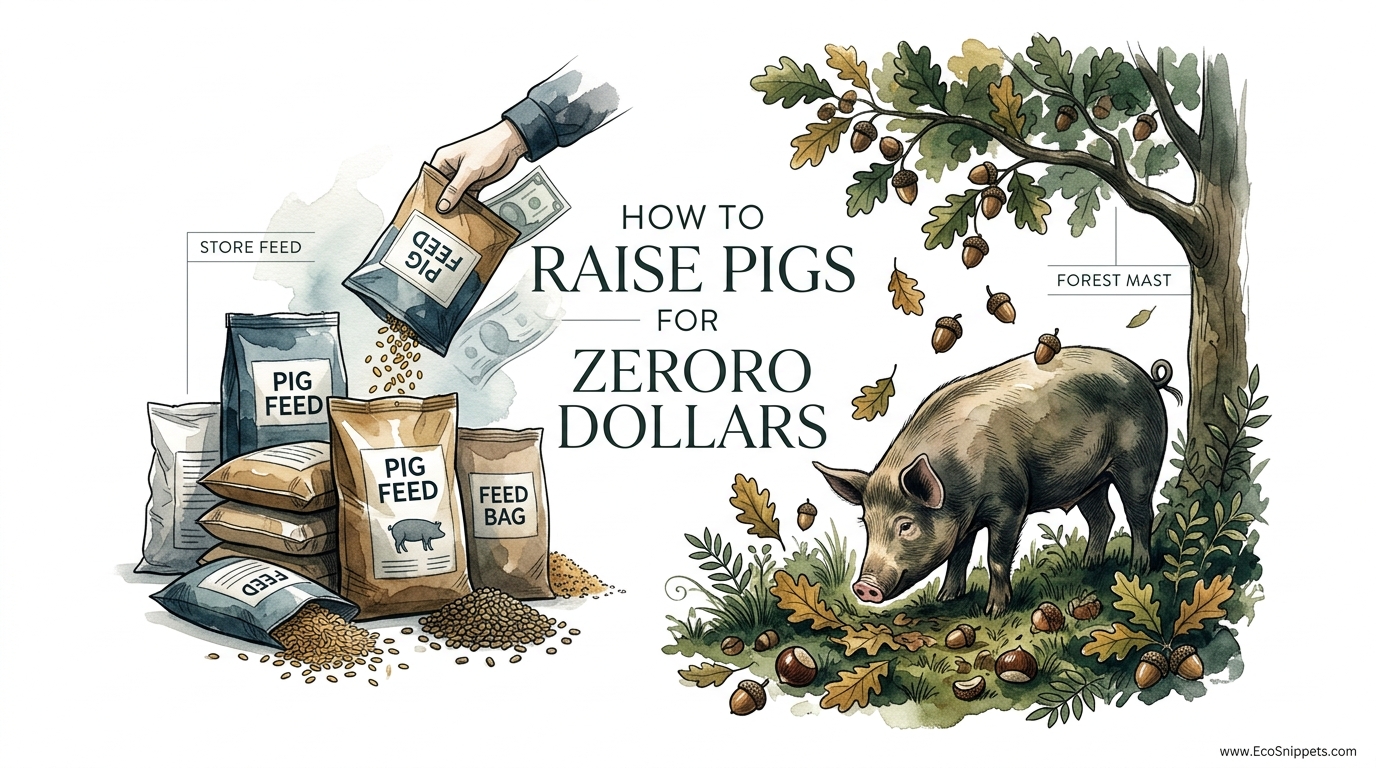
How To Raise Pigs For Zero Dollars
Raising pigs for zero dollars refers to the practice of “forest finishing” or “mast feeding,” where the primary caloric intake of the animal comes from the natural forage of a woodlot. In the traditional sense, this means timing your pig production so the animals reach their final growth stage exactly when the forest begins its annual harvest of nuts and seeds. This system effectively replaces the expensive, soy-heavy rations found at the feed store with the high-fat, high-energy bounty of the forest floor.
This method exists because pigs are essentially “forest vacuum cleaners” by nature. Unlike cattle, which are ruminants designed for grass, pigs are monogastric omnivores that thrive on energy-dense foods like acorns. In the real world, this is most famously seen in the Spanish Dehesa, where Iberian pigs are finished on acorns (bellotas) to create Jamón Ibérico. On a home scale, it’s a way to use underutilized land to offset the single highest cost of livestock: the feed bill.
Think of your forest as a seasonal warehouse of fuel. During a “mast year,” a single mature oak tree can drop up to 10,000 acorns. If you have ten such trees, you have a massive caloric reserve that is currently going to waste. By moving pigs into these areas at the right time, you are harvesting that energy and converting it into high-quality protein and lard without writing a single check to a grain mill.
The Mechanics of the Forest Buffet
To succeed without a grain bag, you must understand the “Mast Cycle.” Mast is the botanical term for the fruit of forest trees. “Hard mast” includes acorns, hickory nuts, walnuts, and beech nuts, while “soft mast” includes wild berries, persimmons, and crabapples. Each has a different nutritional profile that serves the pig at different stages of its growth.
Acorns are the gold standard for forest finishing. They are incredibly high in fats and carbohydrates but relatively low in protein. This makes them the perfect “finishing” food. When a pig eats acorns, the oleic acid—a healthy monounsaturated fat—seeps into its muscle tissue, creating a fat that is soft, creamy, and melts at room temperature. This is the secret behind the legendary texture of forest-finished pork.
However, you cannot simply dump a pig in the woods in May and expect it to be ready by October. The “zero dollar” feed model requires precise timing. You want your pigs to be “growers” (around 75 to 100 pounds) by the time the mast starts to fall in late August or September. They spend the next 60 to 90 days vacuuming up the forest floor, putting on that final, flavorful weight before the deep freeze of winter sets in.
The Best Breeds for the Bush
You cannot take a modern, industrial “pink pig” bred for a climate-controlled concrete barn and expect it to thrive in the brush. You need heritage genetics—animals that still possess the ancestral drive to forage and the hardy constitution to handle the elements. These breeds were developed over centuries to be self-sufficient.
- Tamworth: Known as the “forest pig,” they have long snouts for rooting and a lean, active build that allows them to cover miles of forest floor.
- Berkshire: Famous for their marbling, Berkshires handle the transition to a high-fat acorn diet exceptionally well, producing the “Kobe beef” of the pork world.
- Red Wattle: A hardy, fast-growing breed that is remarkably calm and excels at finding every last nut hidden under the leaf litter.
- American Guinea Hog: If you have a smaller woodlot, these “lard pigs” are perfect. They are smaller, easier on the land, and can almost live on forage alone.
- Mangalitsa: The wooly pig of Hungary. They are the undisputed kings of lard production and are specifically adapted to harsh forest environments.
Infrastructure: The Invisible Barn
While the feed is free, the containment is not. To raise pigs in the woods for “zero dollars” in the long run, you must invest in a robust, portable fencing system. The modern pioneer uses electric polywire or electrified netting. Pigs are incredibly smart; once they learn that the “thin white string” delivers a sting, they will respect it even in the middle of a dense thicket.
Rotational grazing is the key to protecting your land. If you leave pigs in one spot for too long, they will destroy the root systems of your trees and turn the forest floor into a moonscape of mud. By using portable chargers and step-in posts, you can move your “paddock” every few days. This ensures the pigs always have fresh ground to search and prevents the soil from becoming compacted or over-manured.
Water is the other non-negotiable. Even if they are eating free nuts, pigs need a constant supply of fresh water to digest that heavy mast. A mobile water trough connected to a long hose, or a gravity-fed barrel system, allows you to keep the water source moving with the pigs. This prevents the “mud hole effect” that happens when animals congregate in one spot for weeks on end.
Benefits of Forest Finishing
The advantages of this method go far beyond the bank account. When you let a pig be a pig in its natural habitat, the quality of the end product changes fundamentally. You are producing a superfood that is impossible to find in a standard supply chain.
Superior Nutritional Profile: Forest-finished pork is higher in Omega-3 fatty acids and Vitamin E. Because the pigs are eating a diverse diet of roots, nuts, and grubs, their fat contains a complex array of minerals and vitamins that soy-fed hogs simply lack. The meat is darker, denser, and carries a “nutty” undertone that is the hallmark of high-end charcuterie.
Land Restoration: Pigs are nature’s rototillers. In a managed silvopasture system, their rooting behavior helps break up the leaf litter, allowing new seeds to reach the soil. They also eat invasive species like multi-flora rose and Japanese barberry, helping to clear the understory and improve the health of your timber stand. Their manure provides a concentrated burst of fertility that stays in the forest, feeding the very trees that fed them.
Animal Welfare: There is no happier pig than one deep in the woods with its snout in the dirt. In the forest, pigs can express all their natural behaviors—nesting, rooting, and foraging. This reduces stress, which in turn reduces the likelihood of disease and eliminates the need for the antibiotics common in industrial operations.
Challenges and Common Mistakes
The most frequent error is assuming that “forest-finished” means “abandoned in the woods.” A pig left to its own devices without supervision will likely become a liability rather than an asset. You must be an active participant in their daily lives.
The Protein Gap: While acorns are high in energy, they are low in protein and essential amino acids like lysine. If you try to raise a young piglet on acorns alone, its growth will stunt. You must ensure they have reached a “frame-building” size on a balanced diet before you transition them to a 100% mast-finishing program. The “zero dollar” feed bill is most achievable in the final 60 to 90 days of the pig’s life.
Parasite Pressure: Pigs in the woods are in constant contact with the soil, which increases the risk of internal parasites like lungworms and roundworms. Experienced practitioners often use a combination of rotational grazing (to break the parasite life cycle) and natural dewormers like garlic or pumpkins, though sometimes a targeted medicinal treatment is necessary to protect the herd’s health.
Limitations and Environmental Constraints
This method is highly dependent on your geography and the specific trees on your land. Not all forests are created equal. If your woods are predominantly pine or maple, the mast yield will be insufficient to support a pig’s caloric needs. You need a “hardwood” forest, specifically one with a high density of Oak (White and Red), Hickory, or Beech.
The “Mast Failure” Risk: Forest trees do not produce a bumper crop every year. Oaks often operate on a 3-to-5-year cycle. In a “bust” year, your forest might produce almost nothing. A serious practitioner always has a backup plan—whether that’s stockpiling surplus garden produce or having a relationship with a local brewery for spent grains—to fill the caloric void when the trees don’t deliver.
Zoning and Neighbors: Just because you have woods doesn’t mean your local municipality allows livestock. Always check your local ordinances. Furthermore, while forest pigs smell far less than barn pigs due to the lack of concentrated manure, they can still be noisy. Ensure your fencing is “neighbor-proof” to avoid the headache of a loose hog in someone else’s yard.
Comparison: Store Feed vs. Forest Mast
| Factor | Commercial Store Feed | Forest Mast Finishing |
|---|---|---|
| Feed Cost | High ($400-$600 per pig) | Zero (Recurring) |
| Growth Rate | Fast (5-6 months to market) | Slower (8-10 months) |
| Fat Quality | Hard, saturated (Omega-6 heavy) | Soft, oleic (Omega-3 heavy) |
| Management | Low (Automatic feeders) | High (Active rotation/fencing) |
| Meat Flavor | Standard “white meat” | Deep, nutty, artisan quality |
Practical Tips for the Modern Pioneer
Success in the woods is a game of observation. You need to learn to “read” the forest floor as well as you read a book. Before you turn the pigs in, walk your paddocks. Are the acorns green or brown? Never let pigs gorge on green acorns; they contain high levels of tannins that can be toxic in massive quantities. Wait until they turn brown and fall naturally.
Timing your “moves” is an art form. You want to move the pigs when about 70% of the visible mast has been consumed. If you wait until it’s 100% gone, the pigs will start rooting aggressively into the soil looking for deeper treasures, which can damage tree roots. Leave a little for the squirrels and the soil, and your forest will thank you with a better crop next year.
Consider the “Garden-to-Forest” bridge. In the weeks before the mast drops, your summer garden is likely overflowing with “bolted” lettuce, overripe zucchini, and wind-fallen apples. Use these free calories to transition your pigs into the woods. This keeps their digestive systems active and ensures they are in peak condition when the heavy nut drop begins.
Advanced Considerations: Designing a Fodder Forest
For those who want to take this to the next level, you don’t have to rely on what nature gave you—you can plant for the future. This is the concept of a “fodder forest” or intentional silvopasture. By planting specific trees, you can extend the “zero dollar” feeding season by months.
Mulberry trees are a secret weapon for the spring. They drop massive amounts of sweet, high-energy fruit in June, a time when most forest floors are empty. Persimmons and Chestnuts (specifically blight-resistant varieties) provide a high-sugar and high-carbohydrate bridge in the late fall, even after the acorns have been finished. By selecting a variety of species, you create a “succession of harvest” that feeds your pigs from late spring through early winter.
Proper timber stand improvement (TSI) is also vital. By thinning out “trash” trees like diseased ash or scrub maple, you allow more sunlight to reach the crowns of your oaks and hickories. A tree with a larger, sun-drenched crown will produce significantly more mast than one crowded in a dark canopy. In this way, your “pig management” actually becomes “forest management.”
Example Scenario: The 5-Pig Forest Finish
Imagine you have a 3-acre woodlot with 40% oak coverage. You purchase five Berkshire weaners in April. From April to August, you feed them a combination of garden scraps, fermented local grains, and dairy waste (often available for free from local creameries). By September 1st, your pigs weigh approximately 150 pounds each.
As the acorns begin to fall, you move them into their first 1/4-acre forest paddock. Over the next 75 days, you rotate them through the three acres. They gain an average of 1.5 to 2 pounds per day on the mast alone. By mid-November, they have reached a market weight of 250-275 pounds. Your total out-of-pocket feed cost for the finishing stage? Zero. Your result is over 1,000 pounds of the highest-quality, nutrient-dense pork on the planet.
Final Thoughts
Raising pigs for zero dollars isn’t a “get rich quick” scheme; it is a return to a more thoughtful, integrated way of living. It requires you to trade the convenience of the feed bag for the stewardship of the land. It asks you to pay attention to the seasons, the weather, and the health of your trees. In return, it offers a level of self-reliance that few other homesteading practices can match.
When you sit down to a dinner of forest-finished pork, you aren’t just eating meat. You are tasting the hickory of the hillside, the oak of the ridge, and the result of your own grit and labor. You’ve bypassed the industrial machine and created something truly artisanal right in your own backyard. That is the real “free gold” of the forest.
Start small. Fence a half-acre. Watch how the pigs interact with the brush. Learn the cycle of your specific woods. Once you see the transformation of both the land and the animals, you’ll never want to go back to a store-bought bag of soy again. The forest is waiting—go harvest it.
