How To Become More Self-Sufficient Without Starting a Full-Blown Farm…
Want to start preserving your harvest, making your own soap, or building a backyard root cellar — but not sure where to begin? “Homesteading Advice” gives you instant lifetime access to 35+ practical homesteading books on food preservation, veggie gardening, DIY natural cleaning products (save over $250 per year with this skill alone), brewing, off-grid energy, and a whole lot more…
Click Here To Check It Out Now!
You are throwing away the world’s best soil conditioner every single autumn.
Leaves aren’t litter; they are the concentrated minerals of the deep earth brought to the surface. Turning them into Leaf Mold is the easiest way to transform sandy or clay soil into a gardener’s dream. Most people rake these treasures into plastic bags and leave them on the curb for the city to haul away, then go to the big-box store to buy expensive, sterile peat moss. This cycle is a waste of both money and the natural heritage of your land.
Our ancestors understood that the forest floor is the most fertile place on earth. They didn’t have bags of chemical fertilizers or imported coconut coir. They had the fallen leaves of the oak, the maple, and the beech. Leaf mold is the result of a slow, cold fungal breakdown of these leaves, resulting in a dark, crumbly, sweet-smelling substance that breathes life back into tired dirt.
Making leaf mold requires very little effort, but it does require the one thing modern society lacks: patience. It is not a quick process like hot composting. It is a slow conversation between the fungi and the carbon, taking anywhere from one to three years to reach perfection. Once you hold a handful of finished leaf mold, you will never look at a “messy” autumn yard the same way again.
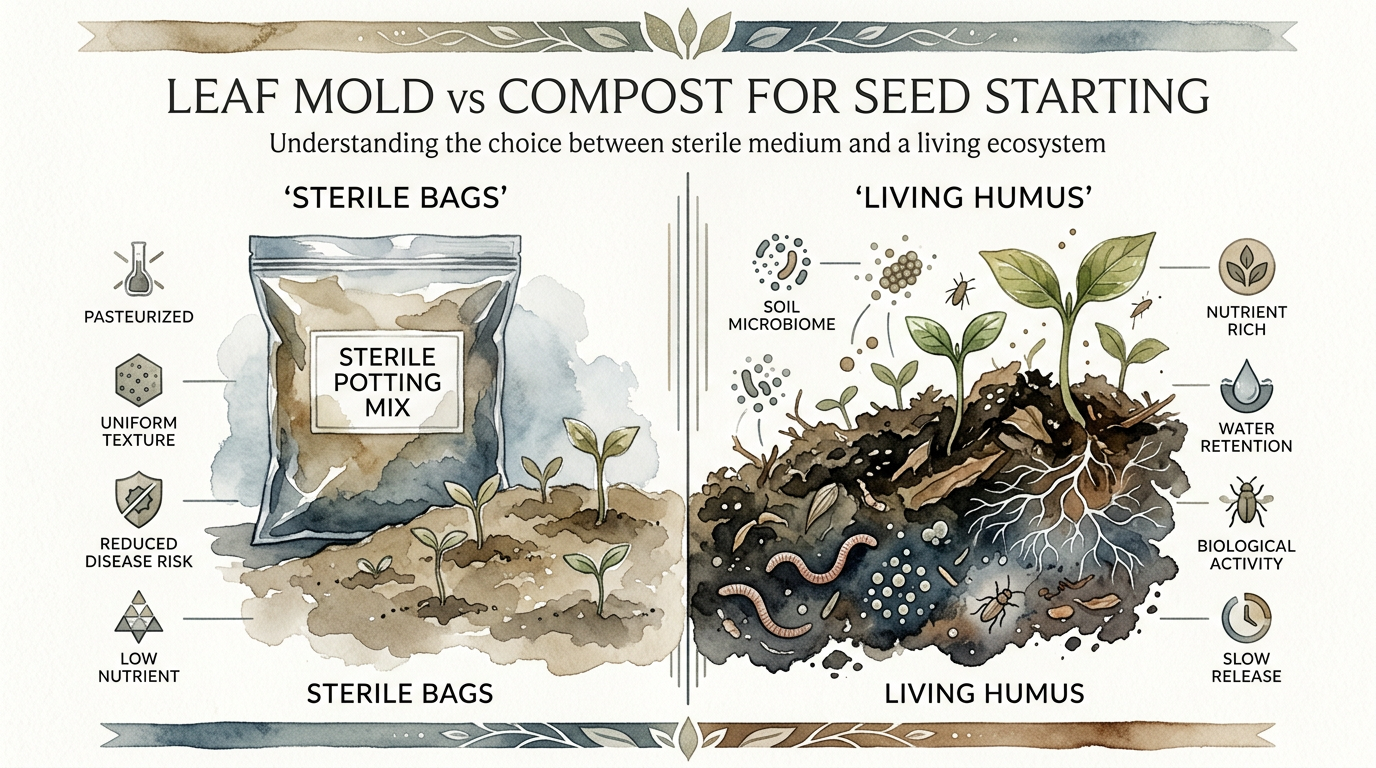
Leaf Mold Vs Compost For Seed Starting
Many gardeners confuse leaf mold with garden compost, but they serve very different roles in the ecosystem of your garden. Compost is a high-nitrogen, bacterial-driven product of green and brown materials. It is designed to feed plants. Leaf mold, on the other hand, is a fungal-driven soil conditioner that focuses almost entirely on soil structure and water retention.
Seed starting requires a medium that is light, airy, and holds moisture without becoming waterlogged. Traditional compost can sometimes be too “hot” or nutrient-dense for delicate seedlings, potentially causing damping off or nitrogen burn. Leaf mold provides a gentle, stable environment. It creates a physical structure that allows tiny roots to penetrate easily while keeping them hydrated through its incredible sponge-like properties.
Think of leaf mold as the “living humus” that mimics the natural nursery of the woods. In the forest, seeds fall into the duff—the layer of decaying leaves—and find exactly the right balance of moisture and protection to sprout. When you use leaf mold for seed starting, you are bringing that ancient forest wisdom into your greenhouse or windowsill. It offers a level of moisture consistency that even professional peat-based mixes struggle to match.
How to Make Leaf Mold: The Patient Man’s Method
The process of creating leaf mold is remarkably simple because nature does all the heavy lifting. You do not need to turn it daily or monitor temperatures with a probe. You only need to gather the leaves, keep them contained, and ensure they stay moist. The primary workers here are fungi, not the heat-loving bacteria found in a standard compost pile.
Start by gathering your leaves in the autumn. While you can leave them whole, shredding them with a lawnmower or a leaf shredder will significantly speed up the process. Shredded leaves have more surface area for fungi to colonize, potentially cutting your wait time in half. If you leave them whole, they can mat together and create an anaerobic barrier that smells foul and slows down decomposition.
Create a simple containment system. A circle of wire fencing about three feet wide and four feet high is the gold standard. It allows for plenty of airflow while keeping the leaves from blowing across the neighborhood. Pack the leaves in tightly and soak them thoroughly with water. They should feel like a wrung-out sponge. If the pile dries out, the fungal activity stops, and you are left with a pile of dry leaves that will sit unchanged for years.
If you lack space for a wire bin, you can use the “trash bag method.” Fill large black plastic bags with leaves, add a few gallons of water, and poke a dozen holes in the sides for air. Tie them shut and tuck them away in a shady corner of the yard. Check them every few months to ensure they are still damp. In a year or two, you will open the bags to find “black gold.”
The Structural Benefits of Fungal Decay
Leaf mold works its magic primarily through its physical properties. It can hold up to four times its weight in water, which is a literal lifesaver during a scorching summer drought. When incorporated into sandy soil, it acts as a glue that holds moisture and nutrients where plants can reach them. In heavy clay, it breaks up the dense particles, creating macro-pores that allow air and water to move through the root zone.
The fungal hyphae that break down the leaves also stay in the soil, forming a network that helps plants access minerals. This is quite different from the “sterile bags” of potting soil you buy at the store. Those products are often dead, relying on synthetic fertilizers to provide any value. Leaf mold is a living community of microorganisms that helps build a resilient soil food web over time.
Furthermore, leaf mold has a cooling effect on the soil. By using it as a mulch or mixing it in, you regulate soil temperatures, preventing the wild swings that stress out vegetable crops. It is a long-term investment. While compost might be used up by the plants in a single season, the carbon structures in leaf mold persist much longer, providing benefits for several years before fully disappearing into the soil matrix.
Challenges and Common Mistakes
The most common mistake people make is letting the pile dry out. Since leaf mold is a “cold” process, there is no heat to tell you it’s working. If the pile becomes bone-dry, the fungi go dormant or die. You must ensure the center of the pile stays moist, especially during the hot summer months. A pile tucked under the shade of a tree will retain moisture much better than one sitting in the direct sun.
Another pitfall is using the wrong types of leaves. Most deciduous leaves are excellent, but some require special handling. Oak leaves are high in tannins and take longer to break down. Pine needles are very acidic and can take three or four years to decompose fully. Avoid using leaves from “allelopathic” trees like Black Walnut or Eucalyptus, as they contain natural herbicides that can stunt the growth of your garden plants even after they have been processed into mold.
Patience is the final challenge. Many gardeners get eager and try to use the leaf mold before it is ready. If you can still clearly see the shape of the leaves and they feel “papery,” they aren’t leaf mold yet; they are just wet leaves. Using unfinished leaf mold can actually tie up nitrogen in your soil as the decomposition process continues. Wait until it is dark, crumbly, and looks like dark chocolate cake crumbs.
Limitations and Realistic Constraints
Leaf mold is a miracle for soil structure, but it is not a high-fertility fertilizer. If you rely solely on leaf mold to feed a heavy-feeding crop like tomatoes or corn, your plants will likely suffer from nutrient deficiencies. It lacks the significant nitrogen, phosphorus, and potassium levels found in well-made manure compost. It should be viewed as a partner to compost, not a total replacement.
Space can also be a limitation. Leaves are incredibly bulky when they first fall. You might start with a mountain of leaves six feet high only to end up with a few buckets of finished leaf mold a year later. For a large garden, you need a massive amount of raw material. This is why many serious practitioners “scavenge” leaves from neighbors who are happy to give them away.
Environmental factors also play a role. In very cold climates, the biological activity in your leaf pile will stop entirely during the winter. This can push the timeline for finished mold out to three years. Conversely, in very humid, tropical environments, the leaves might break down so fast that they don’t provide the long-lasting structural benefits typical of leaf mold in temperate zones.
Comparing Soil Amendments
To understand where leaf mold fits in your shed, it helps to compare it against other common amendments. While some people use these interchangeably, they serve distinct purposes in the life of a garden.
| Feature | Leaf Mold | Garden Compost | Peat Moss |
|---|---|---|---|
| Primary Actor | Fungi (Cold) | Bacteria (Hot) | None (Sterile) |
| Nutrient Level | Low | High | Near Zero |
| Water Retention | Excellent | Good | High (but hydrophobic when dry) |
| Cost | Free | Low/Free | Expensive |
| Sustainability | High (Local) | High (Local) | Low (Mined) |
Practical Tips for the Modern Pioneer
If you want to maximize your leaf mold production, focus on the “big three”: air, water, and surface area. Shredding your leaves is the single most effective way to speed things up. A lawnmower with a bagging attachment is a perfect tool for this. It shreds the leaves and mixes in a tiny bit of grass clippings, which provides a small nitrogen boost to kickstart the fungal colonization.
Keep your bins in a place that is easy to access with a hose. Many people tuck their leaf bins in the farthest, most forgotten corner of the property. This leads to dry piles that never decompose. Put them somewhere you walk past regularly so you can notice if they look dry. If you have a rainy day, consider uncovering the top of the bin to let the sky do the watering for you.
Mix different leaf species together. Biodiversity in your leaf pile leads to a more robust finished product. Maples break down quickly and provide calcium, while oaks provide slower-decomposing carbon that gives the mold its long-lasting structure. Mixing them ensures a steady breakdown process and a complex finished humus that caters to a wide variety of plant needs.
Advanced Fungal Considerations
For those who want to go deeper, understand that leaf mold is a gateway into the world of mycology. The primary decomposers are “white rot” and “brown rot” fungi. These organisms are capable of breaking down lignin, the tough “woodiness” of the leaf that bacteria cannot easily handle. By fostering these fungi, you are creating a soil environment that is particularly beneficial for perennial plants, shrubs, and trees, which prefer fungal-dominant soils.
You can even “inoculate” your leaf piles. If you find a patch of healthy, ancient forest nearby, take a single handful of the bottom layer of the forest floor—the part that smells like deep earth—and mix it into your leaf bin. This introduces a diverse colony of indigenous fungi that are already adapted to your local climate. This ancestral technique ensures your leaf mold is perfectly tuned to the environment of your specific region.
Scaling leaf mold production for a homestead requires a “rolling” system. Since it takes two years to finish, you should have at least three bins: one for this year’s fresh leaves, one that is halfway decomposed, and one that is ready for the garden. This three-bin system ensures that you never run out of this vital resource. Stewardship of the land means thinking in years and decades, not just weeks.
Real-World Scenario: Reclaiming a Dead Lot
Imagine a suburban lot where the topsoil was stripped during construction, leaving nothing but hard-packed, lifeless clay. A gardener tries to plant a vegetable bed, but the water just sits on top, and the plants turn yellow and stunted. This is a classic case where “sterile bags” of potting soil won’t help; they will just wash away or sit like a separate layer on top of the clay.
The gardener begins collecting leaves from the neighborhood, accumulating fifty bags in one autumn. They shred the leaves and create three large wire bins. After two years of keeping the piles moist, they have several cubic yards of dark, crumbly leaf mold. They spread a four-inch layer over the clay and Broadfork it in, gently mixing the two layers without fully inverting the soil.
The result is a total transformation. The leaf mold introduces fungal life that begins to tunnel into the clay. The organic matter opens up air channels. By the following spring, the once-dead lot is teeming with earthworms. The gardener starts their seeds in a 50/50 mix of this leaf mold and sifted compost. The seedlings grow deep, healthy roots, and the garden thrives despite a mid-summer heatwave, because the soil now has the “memory” of the forest’s moisture.
Final Thoughts
Leaf mold is more than just a garden amendment; it is a philosophy of self-reliance. It teaches us that nature does not create “waste,” only resources that we haven’t yet learned how to use. By harvesting the minerals that trees have spent all summer pulling from the depths of the earth, you close the loop on your property and reduce your dependence on industrial garden products.
The transition from “litter” to “black gold” is a slow one, but it is deeply rewarding. There is a profound sense of satisfaction in running your hands through soil that you helped create using nothing but fallen leaves and rainwater. It connects you to the rhythms of the seasons and the ancestral wisdom of those who farmed the land long before synthetic fertilizers existed.
Start small this autumn. Build one wire bin or fill a few bags. Once you see the difference it makes in your seed starting and your soil health, you will never see a falling leaf the same way again. Experiment with different leaves, observe the fungal growth, and let the slow magic of the forest floor transform your garden into a resilient, thriving ecosystem.
