How To Become More Self-Sufficient Without Starting a Full-Blown Farm…
Want to start preserving your harvest, making your own soap, or building a backyard root cellar — but not sure where to begin? “Homesteading Advice” gives you instant lifetime access to 35+ practical homesteading books on food preservation, veggie gardening, DIY natural cleaning products (save over $250 per year with this skill alone), brewing, off-grid energy, and a whole lot more…
Click Here To Check It Out Now!
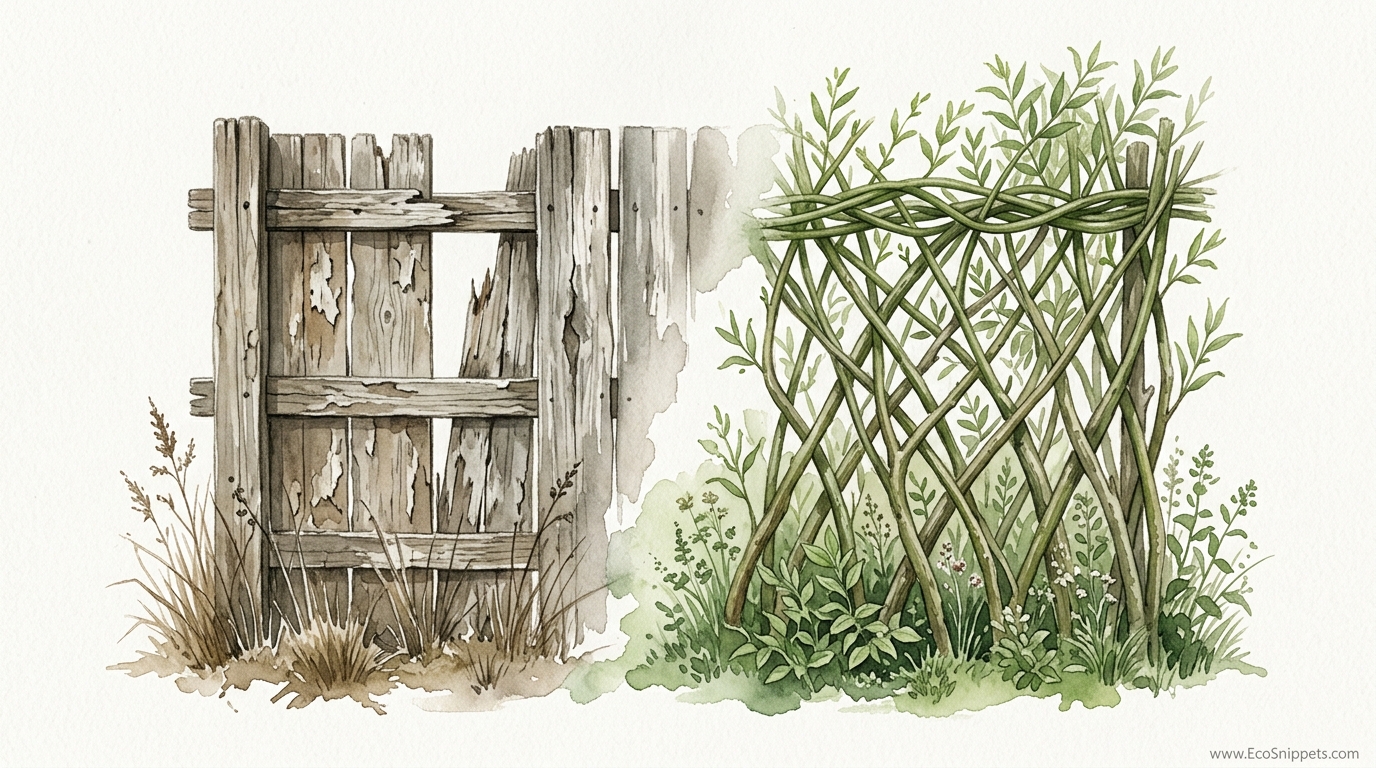
Why build a fence that starts rotting the day you finish it when you could plant one that gets stronger every year? A wooden fence is a dead structure fighting a losing battle against the elements. A living willow fence (a ‘fedge’) is a self-healing ecosystem that provides privacy, blocks wind, and creates a habitat for birds. Stop painting wood and start planting your privacy.
There is a quiet, ancestral wisdom in working with the land rather than against it. For centuries, our forebears didn’t reach for a bucket of chemical sealant when they needed a boundary; they reached for the supple, resilient branches of the willow. They understood that a barrier made of living tissue—what we now call a “fedge,” a hybrid of a fence and a hedge—offers more than just a line on a map. It offers a relationship with the seasons and a fortification that breathes.
In the modern world, we have grown accustomed to the “buy-and-replace” cycle. We build a cedar or pine barrier, watch the sun bleach it grey, and wait for the inevitable termites or rot to claim it. But the fedge turns this logic on its head. By planting dormant willow rods directly into the earth, you are essentially installing a network of solar-powered posts that anchor themselves deeper into the soil with every passing storm. This guide will walk you through the process of reviving this lost art, turning your property line into a thriving, green sanctuary.
Living Willow Fence Vs Wood Fence
To understand the fedge, you must first recognize it as a biological machine. Unlike a traditional wood fence, which relies on the structural integrity of dead fibers, a living willow fence is composed of Salix species woven into a lattice while they are still flexible. Once these rods are pushed into moist soil, they strike roots and begin to grow, eventually fusing together at the points where they touch—a process known as anastomosis or natural pressure grafting.
A wooden fence is a static object. It is at its peak strength the moment the last nail is driven. From that point forward, it is a victim of entropy. A living willow fence, however, is a dynamic participant in your landscape. In the spring, it erupts in soft green catkins and leaves, providing a lush privacy screen that a standard picket fence could never match. In the winter, its skeletal diamond pattern remains, a testament to the “growing barrier” that stands firm against the wind.
Where a traditional fence might catch the wind like a sail and blow over in a gale, a fedge acts as a filter. It breaks the wind’s force by allowing air to pass through its intricate weave, reducing turbulence on the leeward side. This makes it an ideal choice for exposed gardens or farmsteads where “cracking timber” is a common casualty of high-altitude gusts. It is not just a fence; it is a functional windbreak that cools the air and stabilizes the ground beneath it.
How It Works: From Rod to Resurrection
The magic of the willow lies in its auxins—natural growth hormones that are highly concentrated in the bark. These hormones are so potent that you can simply stick a fresh willow branch into the ground and, provided it has enough water, it will grow into a tree. To build a fedge, we harness this vitality by using “whips” or “rods” (one-year-old or two-year-old stems) and weaving them into a structural pattern before they wake up from their winter sleep.
Step 1: Timing and Site Preparation
Success with willow is dictated by the seasons. You must plant during the dormant season—typically between late November and early March. Planting while the sap is down allows the rod to focus all its energy on root development once the soil warms. Before the rods arrive, clear a strip of land about 12 to 18 inches wide. You must remove all grass and weeds, as young willow cannot compete with the aggressive root systems of turfgrass in its first year.
Step 2: Preparing the Soil and the Rods
Willow is a water-hungry species. If your soil is heavy clay, you’re in luck—willow loves it. If your soil is sandy, you will need to incorporate plenty of organic matter to hold moisture. Once you receive your dormant rods, it is a best practice to soak the bottom 6 to 10 inches in a bucket of water for 24 to 48 hours. This “primes” the rods, signaling to the cells that it is time to begin the transition from stem to root.
Step 3: The Planting Layout
To create the classic diamond lattice, you will need to plant your rods in pairs. Using a dibber or a piece of rebar, create holes at a 45-degree angle, spaced about 6 to 10 inches apart. Push the rods at least 10 to 12 inches deep. This depth is non-negotiable; shallow planting is the number one cause of fedge failure. If the rods don’t reach the consistent moisture of the subsoil, they will dehydrate and die before they can establish.
Step 4: The Weave
Working from the bottom up, weave the rods together. One set of rods will lean to the left, and the other to the right. As they cross, weave them in an “over-under” pattern. Use biodegradable twine or paper-covered wire to tie the junctions. Over time, as the stems thicken, the pressure at these junctions will cause the bark to merge, turning individual sticks into a single, solid wooden wall. This is the essence of the “self-healing” fence; if one rod dies, the neighbors often take over its job, sharing nutrients through the grafted network.
The Practical Benefits of a Living Barrier
Choosing a living willow fence is an act of stewardship that pays dividends in both aesthetics and ecology. Unlike a factory-made product, the benefits of a fedge grow over time, creating a multi-layered impact on your property.
- Unmatched Privacy: During the growing season, the foliage is so dense that it creates a total visual block. Even in winter, the tight diamond weave provides more privacy than a standard post-and-rail setup.
- Biodiversity Hub: Willows are among the most important plants for early-season pollinators. Their catkins provide vital nectar for bees waking up in early spring, and the dense interior of the fedge offers safe nesting sites for small songbirds.
- Wind and Noise Reduction: Because it is a porous, flexible structure, it absorbs sound and diffuses wind far more effectively than a hard, reflective surface like vinyl or brick.
- Sustainable Longevity: A well-maintained fedge can last for decades, if not a century. There is no need for chemical stains, pressure treatments, or the disposal of old, treated lumber in a landfill.
Furthermore, the maintenance of a fedge provides you with a yearly harvest of “withies” or rods. You can use these trimmings for basket weaving, garden supports, or even to start a new fence elsewhere on your land. It is a system that gives back, embodying the pioneer spirit of self-sufficiency.
Challenges and Common Pitfalls
While willow is resilient, it is not a “plant-and-forget” solution. Most failures occur because the gardener forgets that they are managing a group of trees, not a piece of furniture. The most common mistake is under-watering in the first two years. Willow needs the equivalent of an inch of rain per week. In a dry spring, you must be diligent with the hose, or your “growing barrier” will quickly become a “dying line.”
Another pitfall is weed competition. As mentioned, grass is the enemy of a young fedge. If you allow weeds to mat around the base of the rods, they will steal the nitrogen and water needed for the willow to strike roots. Many practitioners use a heavy mulch of wood chips or a dedicated weed membrane to give the willow a fighting chance during its first 24 months of life.
Finally, there is the issue of uncontrolled growth. If you do not prune your fedge, it will not stay a fence; it will become a row of 30-foot-tall willow trees. This can lead to the structure becoming “top-heavy,” where the bottom of the fence loses its leaves and becomes leggy, while the top becomes a massive canopy. Yearly winter pruning is the price you pay for the beauty of a fedge.
Limitations: When the Fedge is Not the Answer
A living willow fence is a powerful tool, but it has specific requirements that may make it unsuitable for certain environments. You must respect the biology of the plant to avoid future headaches.
The primary constraint is underground infrastructure. Willow roots are legendary for their ability to “sniff out” water. They can travel 30 feet or more to find a leaking pipe or a septic drainage field. Do not plant a fedge within 10 meters (33 feet) of a septic system or water mains. The roots can infiltrate even the smallest cracks in old pipes, leading to expensive plumbing disasters. If your yard is small and cross-crossed with utilities, a traditional wood fence is the safer, if less romantic, choice.
Environmental conditions also play a role. Willow requires full sun to thrive. If you attempt to plant a fedge in the deep shade of a forest edge or under the eaves of a large building, the rods will grow weak, spindly, and prone to disease. Additionally, while willow loves moisture, it does not like “standing” stagnant water. It needs soil that is moist but has some oxygen movement; a permanent swamp will rot the cuttings before they can root.
A Heritage Comparison: Fedge vs. Traditional Wood
When deciding between a living barrier and a dead one, it helps to look at the long-term investment. The “pioneer-grit” approach values durability and resourcefulness over convenience.
| Feature | Living Willow (Fedge) | Traditional Wood Fence |
|---|---|---|
| Initial Cost | Low (cost of dormant rods) | Moderate to High (lumber/posts) |
| Lifespan | 50+ years (self-renewing) | 10–20 years (subject to rot) |
| Maintenance | Winter pruning/weaving | Staining/Sealing/Painting |
| Structural Integrity | Increases with age (grafting) | Decreases with age (entropy) |
| Environmental Impact | Carbon sequestering/Habitat | High (logging/chemical treatments) |
As the table illustrates, the fedge is an investment in time and labor, whereas the wood fence is an investment in capital and chemicals. For the self-reliant homeowner, the trade-off is clear: the fedge builds equity in the land itself.
Practical Tips for a Resilient Fedge
If you are ready to put a spade in the earth, follow these best practices to ensure your fence stands the test of time. These are the “pro tips” gathered from years of willow husbandry.
- Use a “Weave-In” Strategy: During the first summer, new shoots will explode from the rods. Don’t cut them! Weave them back into the diamond lattice. This increases the density of the fence and creates more points for pressure grafting.
- The “Diagonal Cut”: When planting, always cut the base of your willow rod at a sharp 45-degree angle. This creates more surface area for the cambium layer to touch the soil, encouraging faster root initiation.
- Mulch Heavy: Apply 4 inches of wood chips or straw along the base. This keeps the roots cool and moist, mimicking the floor of a natural willow carr.
- Firm the Soil: After planting, “tread in” the rods with your heel. Air pockets around the submerged stem are the enemy; they cause the cutting to dry out and die. The soil should be tight against the bark.
Advanced Considerations: Choosing the Right Species
Not all willows are created equal. Depending on your goals—privacy, aesthetics, or deer resistance—you must select the right cultivar. Serious practitioners often mix species to create a “polyculture” fedge that is more resistant to pests and diseases.
Salix viminalis (The Common Osier): This is the workhorse of the fedge world. It produces incredibly long, straight rods (up to 10 feet in a single year) that are easy to weave and very resilient. It is the best choice for high-privacy screens.
Salix purpurea (Purple Willow): If you live in an area with high deer pressure, this is your secret weapon. The bark contains high levels of salicin, which makes it incredibly bitter. Deer will usually take one bite and move on to your neighbor’s hostas instead. It also features beautiful blue-grey foliage.
Salix triandra (Almond-leaved Willow): Known for its beautiful scent and dark, peeling bark, this species adds a touch of elegance to a structure. It is slightly less vigorous than S. viminalis, making it a good choice for smaller, more decorative garden dividers.
By blending these species, you can create a “rainbow” fedge. Imagine a wall of green that transitions from the bright yellows of Salix alba vitellina to the deep purples of S. purpurea, providing a visual feast even in the depths of winter.
Real-World Scenario: The 50-Foot Privacy Screen
Consider a homeowner, Sarah, who has a 50-foot boundary shared with a noisy road. A professional wood fence quote came in at $2,500, with an expected lifespan of 15 years. Instead, Sarah purchased 300 dormant Salix viminalis rods for approximately $450.
She spent one weekend in late February preparing the site and another weekend weaving the lattice. By May, the fence was covered in vibrant green leaves, significantly muffling the road noise. By the second year, the rods had thickened to the point where her dog could no longer squeeze through the gaps. Every winter, she spends two hours pruning the top growth, which she then uses to make garden obelisks for her pea plants. Sarah didn’t just build a fence; she started a small, sustainable wood-lot that protects her home and feeds her garden.
Final Thoughts
The choice to plant a living willow fence is a choice to step out of the cycle of decay and into the cycle of growth. It is a commitment to the land that rewards you with beauty, privacy, and a deep sense of accomplishment. While it requires more initial care than a “dead” fence, the result is a structure that possesses its own heartbeat and a resilience that purely mechanical structures can never achieve.
As you watch your fedge leaf out for the first time, you will realize that you haven’t just marked your territory. You have invited a community of birds, bees, and beneficial insects to live alongside you. You have traded a “rotting” liability for a “growing” asset. In the spirit of the pioneers who shaped this land with their hands and their wits, take the leap. Put down the hammer, pick up the willow, and plant something that will stand long after the nails have rusted away.
For those looking to expand their self-reliance, consider exploring the world of hedgelaying or coppicing. These related skills will help you manage your fedge and other woody perennials, ensuring your landscape remains a productive, beautiful, and enduring legacy for generations to come.
