How To Become More Self-Sufficient Without Starting a Full-Blown Farm…
Want to start preserving your harvest, making your own soap, or building a backyard root cellar — but not sure where to begin? “Homesteading Advice” gives you instant lifetime access to 35+ practical homesteading books on food preservation, veggie gardening, DIY natural cleaning products (save over $250 per year with this skill alone), brewing, off-grid energy, and a whole lot more…
Click Here To Check It Out Now!
Why are we buying batteries that die in a decade when 100-year-old technology is still running? We traded durability for convenience, and now our off-grid systems have an expiration date. Modern lithium packs are ‘black boxes’—when one chip fails, the whole unit is trash. But our ancestors had the Edison Cell: a battery made of nickel and iron that thrives on overcharging and can literally last for generations. If you are prepping for a truly long-term collapse, you need a battery that outlives you.
Self-reliance used to be measured in decades, not in warranty periods. We have entered an era of disposable energy, where the heart of your solar system is often its weakest link. Lithium is sleek and lightweight, but it is delicate and complex.
Traditional lead-acid batteries are even worse, often failing after a few years of heavy use. If you want a power system that survives a total societal shift, you have to look backward to move forward. The Nickel-Iron (NiFe) battery is the ultimate survivor in the world of energy storage.
Thomas Edison developed this technology to be indestructible. He wanted a battery that could take a beating, sit empty for years, and still roar back to life with a simple fluid change. This article will guide you through the world of century-scale power storage.
Longest Lasting Off-grid Battery Storage Solutions
The term “longest lasting” is often thrown around by marketing teams, but in the off-grid world, it has a very specific meaning. Most people consider ten years a “long time” for a battery. For an Edison Cell, ten years is barely the break-in period.
Nickel-Iron batteries are alkaline storage cells that use nickel oxide-hydroxide for the positive plates and iron for the negative plates. They use an electrolyte made of potassium hydroxide. This chemistry is fundamentally different from the acidic environment found in car batteries.
These batteries exist because they are practically immune to the “diseases” that kill other cells. They do not suffer from sulfation like lead-acid, and they do not have fragile internal management circuits that can fry during a solar flare or EMP. They are essentially industrial-grade tanks for electricity.
You will find these batteries used in railway signaling, mining operations, and remote telecommunications. These are places where failure is not an option and maintenance crews might only visit once every few years. They are built for the long haul in the harshest environments on Earth.
How the Edison Cell Works
Understanding the internal “magic” of an Edison Cell helps you respect its durability. In a standard battery, the plates are slowly eaten away by the chemical reaction. In a NiFe cell, the electrolyte acts more like a conveyor belt for oxygen ions rather than a corrosive bath.
Charging the battery moves oxygen from the iron plate to the nickel plate. Discharging moves it back. Because the electrolyte does not react with the plates in a destructive way, the physical structure of the battery remains intact for decades.
The container is usually made of nickel-plated steel. This is a massive departure from the thin plastic housings of modern batteries. It can withstand physical shocks, vibrations, and extreme temperature swings without cracking or leaking.
Water is the only thing that really leaves the system. During the final stages of charging, the battery “gasses,” which means it splits water into hydrogen and oxygen. This is why you must periodically add distilled water to keep the plates submerged and healthy.
The Role of Potassium Hydroxide
The electrolyte is a strong alkaline solution. It is the “blood” of the battery. Over many years, this solution can absorb carbon dioxide from the air, which slowly reduces its effectiveness.
Standard maintenance involves replacing this fluid every 10 to 15 years. Doing so is like giving the battery a complete heart transplant. Once the fresh electrolyte is added, the capacity often returns to near-original levels, effectively resetting the clock on the battery’s life.
Benefits of Century Power
Longevity is the headline, but the secondary benefits of NiFe batteries are what make them a prepper’s dream. These units are famously “abuse-tolerant.” You can overcharge them until they bubble, and they won’t catch fire like lithium.
You can also drain them down to zero volts and leave them there. In a lead-acid battery, leaving it discharged for a week is a death sentence. An Edison Cell can sit empty in a shed for twenty years, and after a good cleaning and fresh fluid, it will hold a charge again.
Environmental resilience is another huge advantage. Lithium batteries hate the cold and can be permanently damaged if charged below freezing. Nickel-Iron cells can survive deep freezes and scorching heat with much less drama, making them ideal for unheated cabins or bunkers.
Finally, there is the issue of safety. NiFe batteries do not experience “thermal runaway.” They are not prone to the explosive fires seen in some modern lithium-ion chemistries. This peace of mind is invaluable when you are sleeping in the same building where your power is stored.
Challenges and Common Mistakes
The path to century-scale power is not without its obstacles. The biggest mistake beginners make is treating a NiFe battery like a modern “drop-in” replacement. It requires a specific charging profile that many cheap solar controllers cannot provide.
Efficiency is the trade-off for durability. These batteries are only about 65% to 70% efficient. This means for every 100 watts you put in, you might only get 70 watts back out. You have to over-size your solar array to compensate for this internal waste.
Ventilation is non-negotiable. Because these batteries release hydrogen gas during charging, they must be kept in a well-ventilated enclosure. Failing to provide airflow can lead to a dangerous buildup of flammable gas in your power room.
Watering the batteries is a chore that many people underestimate. In the heat of summer, a large bank might need distilled water every few weeks. If you are the type of person who wants a “set it and forget it” system, the Edison Cell will frustrate you.
Limitations of Nickel-Iron Technology
Weight is a massive factor. These batteries are heavy—often three to four times heavier than lithium for the same amount of storage. This makes them strictly stationary. You are not going to put an Edison bank in a mobile van or a bug-out vehicle.
Physical size is another constraint. A 500-amp-hour bank of NiFe cells will take up a significant amount of floor space. You need a dedicated, reinforced area to house the hundreds or thousands of pounds of steel and liquid.
Internal resistance is high, which means they don’t like to give up their energy in huge, sudden bursts. If you plan on running a massive welder or a whole-house air conditioner off a small battery bank, you will see a significant “voltage sag.”
Voltage range is wider than other batteries. A 12-volt NiFe bank might range from 10 volts when empty to nearly 17 volts during a heavy charge. Some modern inverters will trigger an “over-voltage” alarm and shut down when the battery is charging at full speed.
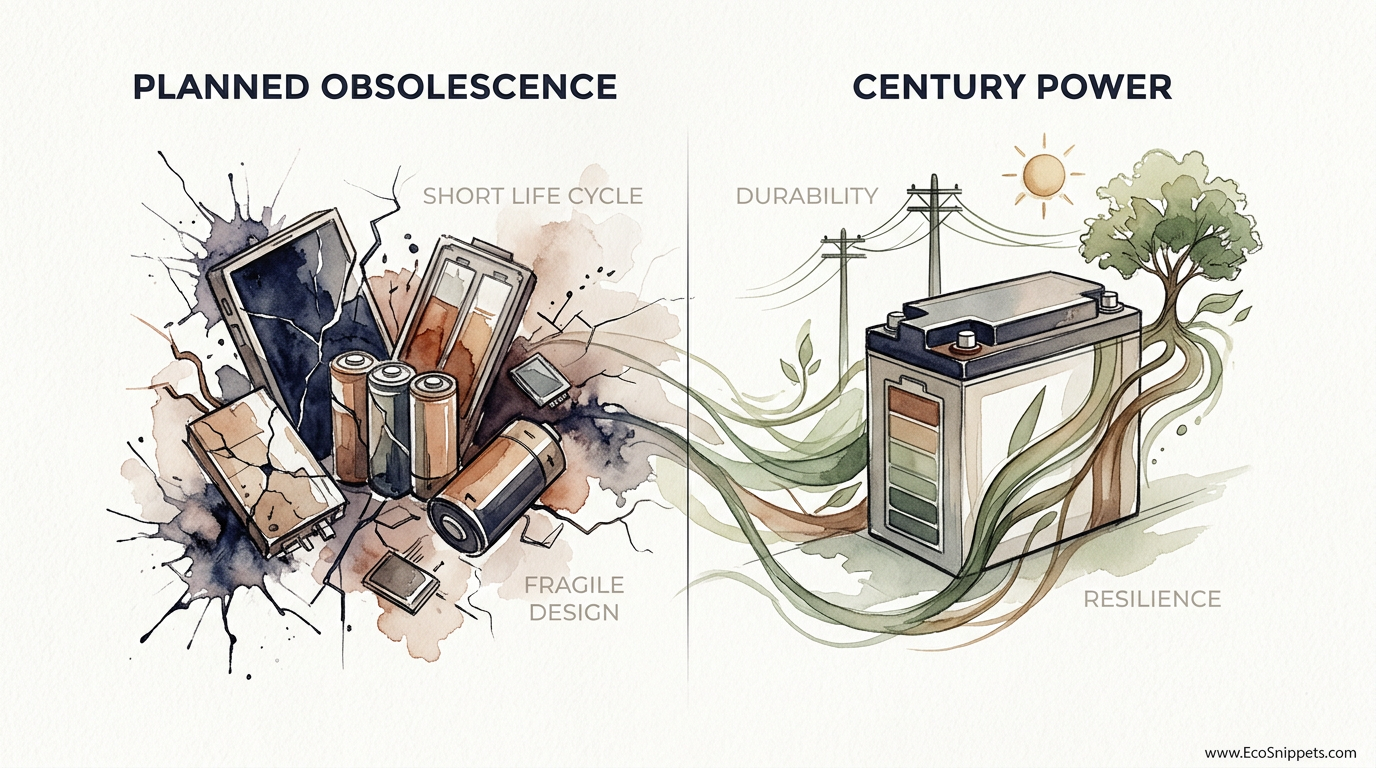
Comparison: Century Power vs. Planned Obsolescence
When choosing a storage solution, you are essentially deciding which “debt” you want to pay. Lithium has a high financial debt but low maintenance debt. Nickel-Iron has a high maintenance debt but almost zero replacement debt.
| Feature | Nickel-Iron (NiFe) | Lithium (LiFePO4) | Lead-Acid (Flooded) |
|---|---|---|---|
| Lifespan | 30–100 Years | 10–15 Years | 3–7 Years |
| Efficiency | 65%–70% | 95%–98% | 80%–85% |
| Abuse Tolerance | Extremely High | Low (BMS Dependent) | Very Low |
| Maintenance | High (Water/Fluid) | Zero | Medium |
| Self-Discharge | High (1% per day) | Very Low | Low |
Cost is a deceptive metric. A lithium battery might be cheaper over a 10-year window. However, when you calculate the cost over 50 years, the Nickel-Iron battery becomes the most economical choice by a landslide. You are essentially buying the “forever home” of batteries.
Practical Tips and Best Practices
Start by choosing a high-quality charge controller that allows for “custom” voltage settings. You need to be able to push the voltage high enough to “equalize” the cells and promote gassing, which keeps the electrolyte mixed and the plates clean.
Always use distilled water. Using tap water introduces minerals like calcium and magnesium that will “poison” the plates and slowly kill the battery. Investing in a small countertop water distiller is a smart move for any NiFe owner.
Keep the tops of the batteries clean and dry. Because the electrolyte is alkaline, it can attract moisture and create “tracking paths” for electricity to leak between the terminals. A simple wipe-down with a damp cloth once a month prevents this energy loss.
Smear the terminals with a thin layer of petroleum jelly or specialized terminal grease. This prevents the “creeping” of potassium hydroxide crystals, which can corrode your copper cables over time. Clean connections are vital for managing the high internal resistance of the system.
Advanced Considerations for Serious Practitioners
Sizing your solar array requires a different mindset. Since the battery is less efficient, you should aim for a “C/10” or “C/20” charge rate. This means if you have a 500Ah bank, you want about 50 amps of solar charging capacity to ensure you can reach a full state of charge during short winter days.
Electrolyte replacement is a skill you should learn before you need it. Storing dry potassium hydroxide flakes in airtight buckets is a great way to ensure you can “reboot” your system decades into a collapse scenario. These flakes have an almost indefinite shelf life if kept away from moisture.
Monitoring the specific gravity of the fluid is not as helpful as it is with lead-acid batteries. In a NiFe cell, the density of the fluid doesn’t change much based on the state of charge. Instead, you must rely on voltage readings and “load testing” to determine the health of individual cells.
Consider a “hybrid” approach if you have high-surge needs. Some advanced users keep a small bank of high-output capacitors or a single lithium pack to handle the initial “hit” of a well pump or motor, while the NiFe bank provides the deep, long-term storage capacity.
Real-World Scenario: The Century-Old Recovery
There are documented cases of people finding Edison batteries in abandoned mines or old farmhouses that have sat for 50 or 60 years. Often, these cells are dry and look like rusted junk on the outside.
Researchers have taken these antique cells, flushed them out with distilled water, and refilled them with fresh potassium hydroxide. Within a few charge cycles, many of these batteries regained over 80% of their original rated capacity.
Imagine a modern lithium battery sitting in a shed for 80 years. The internal electronics would be corroded, the lithium salts would have broken down, and the unit would be a brick. The Edison Cell is the only energy storage technology that can truly be “resurrected” by a person with basic tools and chemistry.
This resilience makes it the primary choice for deep-woods homesteaders. If a tree falls on your battery shed or a lightning strike fries your inverter, the batteries themselves remain untouched. They are the ultimate “hard asset” in a world of digital fragility.
Final Thoughts
Choosing the longest-lasting off-grid battery storage solutions requires a shift in perspective. You have to move away from the “disposable” mindset and embrace the role of a caretaker. You don’t just “own” an Edison battery; you maintain a legacy of power for yourself and those who come after you.
The upfront cost and the requirement for regular maintenance are the “admission price” for true energy independence. If you are tired of the cycle of buying and replacing expensive “black box” technology, the nickel-iron battery offers a way out. It is a bridge to a time when things were built to last, not just to sell.
Start small if you must, but start with the intent of never buying batteries again. Learn the chemistry, respect the maintenance, and build a system that can weather any storm. In a world of planned obsolescence, century power is the ultimate rebellion.
