How To Become More Self-Sufficient Without Starting a Full-Blown Farm…
Want to start preserving your harvest, making your own soap, or building a backyard root cellar — but not sure where to begin? “Homesteading Advice” gives you instant lifetime access to 35+ practical homesteading books on food preservation, veggie gardening, DIY natural cleaning products (save over $250 per year with this skill alone), brewing, off-grid energy, and a whole lot more…
Click Here To Check It Out Now!
We’ve been housing the world’s most important pollinators in ‘thin-walled tents’ and wondering why they don’t survive the winter. Modern beekeeping prioritizes easy honey extraction over bee health. Forcing colonies into thin pine boards forces them to spend all their energy on climate control instead of immunity. The secret to resilient bees is in the thickness of their walls.
Walking through a winter apiary, you might see rows of neat, white-painted boxes. To the untrained eye, these look like tidy homes. To a honeybee, they are drafty, uninsulated sheds that leak heat like a sieve. We have traded the thermal stability of the ancient forest for the convenience of the forklift and the honey extractor.
Every winter, beekeepers across the country hold their breath, hoping their clusters survive the long cold. We feed them sugar water and wrap them in black plastic, yet we often ignore the fundamental architecture of their survival. Nature never intended for bees to live in three-quarter-inch pine. In the wild, they seek out the deep, protective heart of a living tree, where the walls are inches thick and the temperature remains steady.
Understanding the difference between a “honey factory” and a “bee home” is the first step toward true stewardship. This guide explores why the thickness of your hive walls dictates the health of your colony. We will look at the science of thermodynamics, the history of our current equipment, and how you can return to a more resilient way of keeping bees.
Natural Beekeeping Vs Langstroth Hives
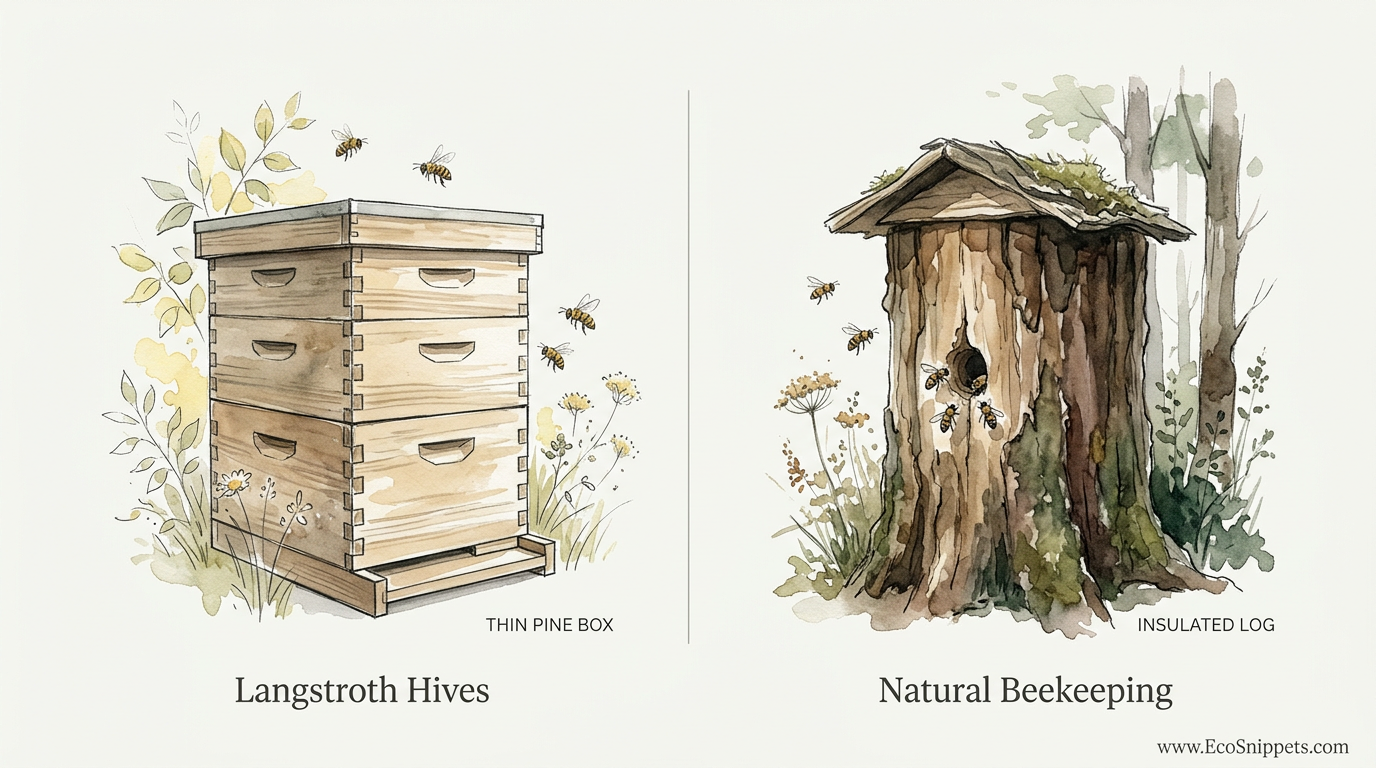
Natural beekeeping and Langstroth beekeeping represent two different philosophies of interacting with the honeybee. The Langstroth hive, patented by Reverend Lorenzo Langstroth in 1851, was a monumental shift in apiculture. It introduced the concept of “bee space”—a precise gap of about 3/8 of an inch that bees will not fill with wax or propolis. This allowed for removable frames, which meant beekeepers could finally inspect their hives and harvest honey without destroying the colony.
Standard Langstroth equipment is built from 3/4-inch pine boards. This material is light, cheap, and easy to manufacture in bulk. However, it offers almost no thermal resistance. Research shows that a standard pine hive has an R-value of approximately 1.0. In contrast, the hollow of a tree where a wild colony might reside often has walls four to six inches thick, providing an R-value between 5.0 and 8.0. Standard hives are built for the beekeeper’s ease, while natural hives are built for the bees’ biology.
Natural beekeeping focuses on mimicking the conditions bees have evolved with for millions of years. This often involves using “log hives,” “Warre hives,” or heavily insulated horizontal hives. These designs prioritize thermal mass and insulation. Instead of a stack of boxes that can be expanded indefinitely, natural hives often have a fixed or limited volume that matches the 40-liter preference bees show in the wild. This makes the environment easier for the bees to patrol and keep warm.
Real-world application of these different styles usually comes down to your goals. Commercial beekeepers need the modularity of the Langstroth system to move thousands of hives for crop pollination. A homestead beekeeper looking for self-reliance and healthy, long-lived colonies might find the low-intervention, high-insulation approach of natural beekeeping much more effective. One produces a crop; the other fosters a population.
How Thermal Regulation Works in the Hive
Honeybees are masters of climate control, but their success depends on the efficiency of their container. Inside the hive, bees must maintain a brood nest temperature of approximately 93–95°F (34–35°C) to raise healthy young. Even in the dead of winter, when outside temperatures drop below zero, the core of the bee cluster must remain warm enough to survive. They achieve this by vibrating their wing muscles to generate metabolic heat—a process that is physically exhausting and requires a massive amount of fuel in the form of honey.
Thin pine walls allow heat to escape rapidly through conduction. Imagine standing outside in a blizzard wearing only a thin t-shirt; you would have to run in place constantly just to keep your core from freezing. This is what we ask of our bees in standard equipment. They must shiver for months on end, consuming their precious winter stores at a frantic pace just to stay ahead of the cold. When the heat leaks out, the bees must cluster tighter, which can lead to stress and a weakened immune system.
Thick-walled or insulated hives work by slowing this heat transfer. High R-value walls act like a thermal blanket. Instead of the heat disappearing into the night, it is reflected back into the cluster. This allows the bees to maintain their temperature with much less effort. In a well-insulated hive, bees consume significantly less honey during the winter because they don’t have to “burn” as much of it to stay warm. This extra energy can then be diverted to immune function and early spring brood rearing.
Moisture management is another critical part of this process. In a thin-walled hive, the ceiling often becomes the coldest surface. When warm, moist air from the bees’ respiration hits that cold ceiling, it condenses into freezing water and drips back onto the cluster. Wet bees are dead bees. Thick insulation keeps the inner surfaces of the hive warmer than the dew point, preventing condensation from forming above the bees. Instead, the moisture migrates to the cooler walls or out the bottom, keeping the colony dry and healthy.
The Benefits of High-Insulation Beekeeping
Choosing an insulated or thick-walled hive approach offers measurable advantages for the health and productivity of the colony. While the initial setup might be more labor-intensive or expensive, the long-term rewards are substantial for anyone prioritizing bee welfare.
Increased Winter Survival: The most immediate benefit is a drastic reduction in winter losses. Colonies in insulated hives don’t have to work as hard to stay alive. They are less likely to starve because they consume their honey stores much more slowly. A colony that stays warm is also a colony that can move to reach its food; in a thin hive, bees can freeze to death just inches away from honey because it is too cold for the cluster to break and move.
Stronger Spring Buildup: Because the bees haven’t spent the entire winter in a state of physical exhaustion, they emerge in the spring with more vitality. Insulated hives allow the queen to start laying earlier because the colony can maintain the required brood temperature even during early spring cold snaps. This leads to a larger population of foragers by the time the first nectar flow begins, often resulting in higher honey yields later in the season despite the hive’s focus on health.
Better Immune Health: Maintaining a high-temperature environment is a form of “social immunity” for the bees. Many pathogens and parasites, including certain fungi and viruses, struggle to thrive at the temperatures bees naturally prefer. When a colony is stressed by cold, its immune system is compromised. By providing a thermally stable home, you are giving the bees the foundation they need to fight off pests like Varroa mites and nosema on their own.
Quality of Honey: Bees in thick-walled hives can ripen honey more efficiently. The process of evaporating water from nectar requires heat and airflow. In a well-insulated hive, the ambient heat is retained, making it easier for the bees to reach the 18% moisture content required for cured honey. This results in a more stable product that is less likely to ferment in the comb.
Challenges and Common Mistakes
Transitioning to natural or insulated beekeeping isn’t without its hurdles. Many beekeepers who try to “help” their bees actually end up creating new problems because they don’t fully understand the physics of the hive environment.
One of the most common mistakes is over-ventilating the hive. Beekeepers, fearing moisture buildup, often open top vents or use screened bottom boards year-round. In a thin hive, this creates a “chimney effect” where all the warm air the bees have worked so hard to create is sucked out the top and replaced by cold air from the bottom. This forces the bees to work even harder. If you have proper insulation, you don’t need excessive ventilation; the warmth will keep the air from reaching its dew point until it is safely away from the cluster.
Another pitfall is using the wrong materials for insulation. While some turn to modern foam boards, others try to use “natural” materials like straw or wood chips without protecting them from moisture. If your insulation gets wet, it loses its R-value and can become a breeding ground for mold. Any insulation added to a hive must be kept bone-dry to be effective. Likewise, using vapor barriers incorrectly can trap moisture inside the wood, leading to rot and hive failure.
Beginners often struggle with the weight of thick-walled equipment. A log hive or a double-walled insulated box is significantly heavier than a standard Langstroth deep. This can make inspections and hive movements difficult. If you have back issues or need to move your hives frequently, you must plan your hive design with ergonomics in mind. Many natural beekeepers choose horizontal “Long Hives” specifically because they provide the insulation of a log without the need to lift heavy boxes.
Limitations and Realistic Constraints
While thick-walled hives are superior for bee health, they are not a “magic bullet” that solves every problem in the apiary. There are real-world constraints that may make this approach difficult for certain beekeepers or environments.
Environmental limitations play a big role. In extremely humid, tropical climates, the primary struggle is not heat retention but heat dissipation and mold prevention. While insulation can still help keep the hive cool during the day, the strategies used in the north for winter survival might lead to overheating if not adjusted. In these areas, the “thickness” of the wall serves more as thermal mass to buffer day-to-night temperature swings rather than a trap for metabolic heat.
Regulatory and legal boundaries can also be a factor. Many states and countries have “movable frame” laws. These laws require that every comb in a hive be accessible for inspection to check for diseases like American Foulbrood. Traditional log hives or “fixed-comb” skeps are often illegal for this reason. If you want to practice natural beekeeping in these areas, you must use designs like the Warre or the Layens hive, which allow for insulation while still providing removable frames or bars to satisfy the law.
Finally, there is the trade-off of honey production. Langstroth hives are designed for maximum extraction. Natural hives, which often discourage the use of plastic foundation and promote the bees building their own wax, will inherently produce less surplus honey for the keeper. The bees must consume about 8 to 10 pounds of honey to produce a single pound of wax. For the pioneer-minded beekeeper, this is an acceptable trade for a healthier colony, but it is a limitation that must be understood from the start.
Comparing Hive Styles: Pine vs. Log vs. Insulated
| Feature | Standard Pine Box | Traditional Log Hive | Insulated Modern Hive |
|---|---|---|---|
| Wall Thickness | 3/4 inch | 4-10 inches | 1.5 – 2 inches (Foam/Wood) |
| R-Value (Approx) | 1.0 | 5.0 – 8.0 | 6.0 – 10.0 |
| Winter Survival | Variable/Low | Very High | High |
| Ease of Inspection | Excellent | Very Difficult | Good |
| Mobility | High | Very Low (Heavy) | Moderate |
Practical Tips for Transitioning
If you already have standard Langstroth equipment, you don’t have to throw it all away to improve your bees’ lives. You can significantly improve the thermal performance of your existing hives with a few thoughtful adjustments.
Retrofitting insulation is the easiest path. Adding two-inch EPS (expanded polystyrene) foam boards to the outside of your hive boxes can raise the R-value from 1.0 to nearly 8.0 instantly. Ensure you cover the foam with a protective layer, like thin plywood or a specialized hive wrap, to prevent UV damage and pecking from birds. Most importantly, insulate the top. Since heat rises, the ceiling is where you lose the most energy. A “quilt box” filled with cedar shavings or a thick slab of foam under the outer cover can make a world of difference.
Rough up the interior walls of your new boxes. Modern planed lumber is too smooth for bees to easily apply propolis. In the wild, bees coat the entire interior of their tree hollow with a “propolis envelope.” This resinous layer is anti-fungal, anti-bacterial, and anti-viral. By taking a wire brush or a rasp to the inside of your pine boxes before you hived a swarm, you encourage the bees to build this vital immune barrier. This simple step mimics the rough interior of a decayed tree.
Consider the “Long Hive” or horizontal format. These hives are easier to build with thick, two-inch lumber because they don’t need to be stacked. Using heavy cedar or oak for a horizontal hive provides the thermal mass bees love without the back-breaking work of lifting boxes. You can even build these with “dead air” space between two layers of wood, creating a thermos-like effect for the colony.
Advanced Considerations: The Propolis Envelope
The importance of the “propolis envelope” cannot be overstated. Recent research by Dr. Marla Spivak and others has shown that the resins bees collect to seal their hives act as an externalized immune system. In a standard, smooth-walled Langstroth hive, bees typically only put propolis in the cracks and gaps where they feel a draft. This leaves the colony “propolis-poor.”
Colonies with a full propolis envelope show significantly lower levels of immune system activation in individual bees. This means the bees aren’t constantly “on alert” fighting off background microbes. Instead, the antimicrobial properties of the propolis handle the environmental pathogens before they ever reach the bees. This energy saving is crucial. A bee that isn’t wasting its internal resources on a constant baseline immune response is a bee that lives longer and performs better.
Serious practitioners are now experiment with “propolis traps” or textured inserts on the inner walls of their hives to force the bees to create this envelope. Some go as far as using unplaned, rough-sawn lumber for the entire hive body. This small change in texture fundamentally changes the biological health of the colony. It is a return to the “scent of the forest” that bees have known for eons.
Example: A Tale of Two Winters
Imagine two colonies in a northern climate where winter temperatures average 20°F. Colony A is in a standard, uninsulated Langstroth hive. Colony B is in a 2-inch thick cedar horizontal hive with a 4-inch insulated “attic” (quilt box).
By December, Colony A is shivering constantly. To keep the core at 90°F, they are consuming nearly 2 pounds of honey per week. Because the walls are cold, the moisture from their breath condenses on the ceiling. Every few days, a drop of ice-cold water falls onto the outer edge of the cluster. The bees on the edge freeze and die, slowly shrinking the cluster. By February, the cluster is too small to generate enough heat to reach the honey just three inches away. They starve with full combs nearby.
Colony B, in the thick-walled hive, is in a different world. The heat they generate is trapped by the cedar and the attic insulation. They only consume about half a pound of honey per week because their “engine” doesn’t have to run as fast. There is no condensation on the ceiling because the surface stays warm. The cluster remains large and relaxed. When a warm day hits in March, they have the numbers and the energy to begin foraging immediately, while Colony A—if it survived at all—is a handful of stressed, exhausted bees.
Final Thoughts
The move toward thick-walled, natural beekeeping is a return to ancestral wisdom. For over a century, we have asked bees to adapt to our industrial needs, and we are seeing the limits of that request in the form of record-high colony losses. By shifting our focus from “how much honey can I get?” to “how can I provide the best home?”, we align ourselves with the bees’ natural resilience.
You don’t need to be a master carpenter to start this journey. Start small by insulating the hives you have and paying attention to the thermal needs of your colonies. Observe how they react to a warmer, drier environment. You will likely find that the “secret” to beekeeping isn’t a new chemical treatment or a high-tech sensor, but the simple, quiet protection of a thick wall.
True self-reliance in the apiary comes from working with nature’s designs, not against them. As you move forward, remember that the most successful beekeepers are those who think like the bees they tend. Give them the shelter they deserve, and they will reward you with the resilience that has sustained their species for millions of years.
