How To Become More Self-Sufficient Without Starting a Full-Blown Farm…
Want to start preserving your harvest, making your own soap, or building a backyard root cellar — but not sure where to begin? “Homesteading Advice” gives you instant lifetime access to 35+ practical homesteading books on food preservation, veggie gardening, DIY natural cleaning products (save over $250 per year with this skill alone), brewing, off-grid energy, and a whole lot more…
Click Here To Check It Out Now!
Your breakfast scraps are actually the most powerful (and best smelling) firestarter on earth. Commercial firestarters are made of petroleum wax and chemicals. Meanwhile, you’re tossing citrus peels that are packed with flammable limonene oil. Dry them out and you have a free, high-energy fuel source that smells incredible and costs absolutely nothing.
Walking into a kitchen during the dead of winter usually means seeing a pile of orange or grapefruit rinds destined for the bin. For the self-reliant soul, those rinds represent more than just waste; they are a concentrated source of energy that ancestors would have never dreamt of wasting. There is a deep satisfaction in taking something meant for the compost and turning it into a tool for warmth and survival.
Using citrus as a firelighter isn’t just a clever “hack.” It is a return to a more sensible way of living where every resource is squeezed for its full value. When you learn to harness the natural oils found in common fruit, you reduce your dependency on store-bought chemicals that often leave a greasy residue and an artificial smell in your home. This guide will show you exactly how to process, store, and use these natural gems to keep your hearth glowing.
Natural DIY Firestarters From Kitchen Scraps
Natural firestarters from kitchen scraps are exactly what they sound like: repurposing the organic materials we usually discard to help ignite wood fires. At the heart of this practice is the citrus peel, though other scraps like nut shells and corn cobs play a supporting role. These materials are naturally rich in oils or fibers that sustain a flame long enough to catch your kindling.
In the real world, these are used anywhere you might need a quick, reliable flame. Whether you are lighting a woodstove to heat your cabin, starting a backyard fire pit for a weekend gathering, or even prepping a small fire for a beekeeping smoker, kitchen scraps provide a clean-burning alternative. They act as a bridge between the initial spark and the larger logs, ensuring that your fire catches without the need for crumpled newspapers or toxic fire logs.
Think of a dried orange peel as a tiny, pre-packaged oil lamp. The outer skin, or the flavedo, contains microscopic sacs filled with essential oils. When heat is applied, these oils vaporize and ignite, creating a miniature flare-up that is surprisingly persistent. Unlike paper, which flashes and dies quickly, a well-dried citrus rind can burn for several minutes, providing the steady heat necessary to dry out and ignite the surrounding wood.
The Science of the Scent: Limonene
The primary reason citrus peels are so effective is a chemical compound called limonene. This is a colorless liquid hydrocarbon classified as a cyclic terpene. In nature, it serves as a defense mechanism for the fruit, but for the fire-maker, it is a high-grade fuel. Limonene has a flashpoint of approximately 119 degrees Fahrenheit, which means it doesn’t take much encouragement to get it to ignite once the water content of the peel is removed.
When you squeeze a fresh orange peel near a candle flame, you see tiny sparks. Those are the oil sacs bursting and the limonene catching fire. By drying the peel, you concentrate this oil and remove the water that would otherwise act as a fire suppressant. The result is a natural firestarter that packs more energy per square inch than almost any other organic kitchen waste.
How to Process Your Peels for Maximum Burn
Achieving the perfect firestarter requires more than just leaving a rind on the counter for an hour. You need to remove almost all the moisture while keeping the volatile oils intact. If you dry them too fast at a high heat, the oils evaporate, leaving you with a brittle piece of carbon that won’t help your fire. If you dry them too slowly in a damp environment, they will mold before they ever see a match.
The first step is always to wash your fruit. Many commercial fruits are coated in a thin layer of food-grade wax to preserve moisture. While this wax is flammable, the pesticides that might be trapped underneath it are not something you want to aerosolize in your living room. A quick scrub in warm water is usually sufficient to prepare the rind for drying.
The Oven Method (The Fastest Way)
Oven drying is the most reliable method for those who need a batch of firestarters quickly. Set your oven to its lowest possible temperature, ideally between 170 and 200 degrees Fahrenheit. If your oven has a convection setting, use it; the moving air helps strip away moisture much more efficiently than still air.
Line a baking sheet with parchment paper to prevent any residual oils from sticking to the pan. Place your peels in a single layer, ensuring they do not overlap. Thick-skinned fruits like navel oranges or grapefruits will take longer—usually between three to four hours. Thinner rinds from lemons or limes might be done in as little as two hours. You are looking for a “leather-hard” or “brittle” texture; if the peel still feels soft or bends without cracking, it needs more time.
The Air-Drying Method (The Traditional Way)
Air drying takes more patience but requires zero electricity. This is the method preferred by those looking to maximize self-reliance. Place your peels in a shallow basket or on a wire rack to ensure airflow can reach both sides of the rind. Avoid using solid plates or bowls, as moisture can get trapped at the bottom and cause rot.
Keep the basket in a warm, dry spot. On top of a refrigerator, near a sunny window, or in a well-ventilated attic are all prime locations. Depending on the humidity in your home, this process can take anywhere from three to seven days. You will know they are ready when they feel as hard as a piece of plastic and snap cleanly when bent. Once they reach this state, they can be stored indefinitely in a glass jar or a sealed bag.
Benefits of Using Kitchen Scrap Firestarters
Switching to kitchen scraps offers several practical advantages that go beyond just being “eco-friendly.” For the wood burner, efficiency and cost are usually the primary drivers. When you stop buying commercial firestarters, you are essentially reclaiming money that would have literally gone up in smoke. Over a long winter, those small savings add up to a significant amount of fuel or gear for your home.
The olfactory experience is another major benefit. Commercial firestarters, particularly those made of petroleum or recycled sawdust held together by chemical glues, often produce an acrid, “industrial” smell during the first few minutes of ignition. This scent can linger in the house long after the fire has caught. Citrus peels, conversely, release a bright, clean aroma of orange, lemon, or grapefruit. It turns the chore of lighting the fire into a pleasant ritual that freshens the air in your living space.
From a safety perspective, natural scraps are generally cleaner. They do not leave behind the greasy soot that petroleum-based products can contribute to your chimney’s creosote buildup. While any fire produces some residue, the clean-burning nature of limonene and cellulose is much more forgiving on your flue over time. Furthermore, the ash left behind by citrus and nut shells is purely organic and can be safely added to your garden soil or compost pile without introducing synthetic waxes or binders.
Common Mistakes to Avoid
The most frequent error people make is trying to use fresh peels. It is tempting to finish an orange and toss the rind directly onto a struggling flame, but this usually backfires. Fresh rinds are mostly water. When you throw them on a fire, that water has to evaporate first, which actually sucks heat away from the flame and produces a thick, white smoke. This smoke can contribute to creosote buildup in your chimney, which is exactly what you want to avoid.
Another mistake is drying the peels on top of a hot woodstove. While it seems efficient, it is a significant fire hazard. A hot stove can easily reach temperatures high enough to ignite the limonene vapor as it leaves the peel. There are documented cases of people leaving a tray of peels on a stove, only to have them smolder or burst into flames while the room was unoccupied. Always dry your firestarters at a safe distance or use the controlled environment of an oven.
Storage is the third area where things often go wrong. People frequently put “mostly dry” peels into a plastic bag and zip it shut. Any remaining moisture will quickly lead to mold growth. If you see white or green fuzz on your firestarters, they are no longer fit for use. Moldy organic material burns poorly and can release spores into your home. Ensure your peels are bone-dry—clicking when they hit a hard surface—before sealing them away.
Limitations and Practical Constraints
While citrus peels are fantastic, they are not a magic solution for every fire. They are firestarters, not primary fuel. Because they are thin and light, they burn up relatively quickly—usually between two and five minutes depending on the size and thickness of the rind. This means you cannot simply throw a handful of peels under a massive log and expect a fire to start. You still need to follow the proper “fire hierarchy” of tinder, kindling, and fuel wood.
Environmental factors also play a role. If you live in an extremely humid climate, air-drying becomes much more difficult without the aid of a dehydrator or oven. In high humidity, the peels may absorb moisture from the air even after they have been dried, making them less effective over time. In these cases, using airtight glass jars with a small desiccant pack is the only way to keep your stash ready for use.
Availability is the final constraint. Unless you are a heavy consumer of citrus, you might struggle to build up a large enough stockpile to last an entire winter. This is why it is important to view citrus peels as one part of a larger fire-starting system. Relying solely on them might leave you cold during a week when oranges weren’t on the grocery list. Integrating other scraps, like walnut shells or dried corn cobs, can help fill the gaps in your supply.
Comparing Citrus Peels to Wax Nuggets
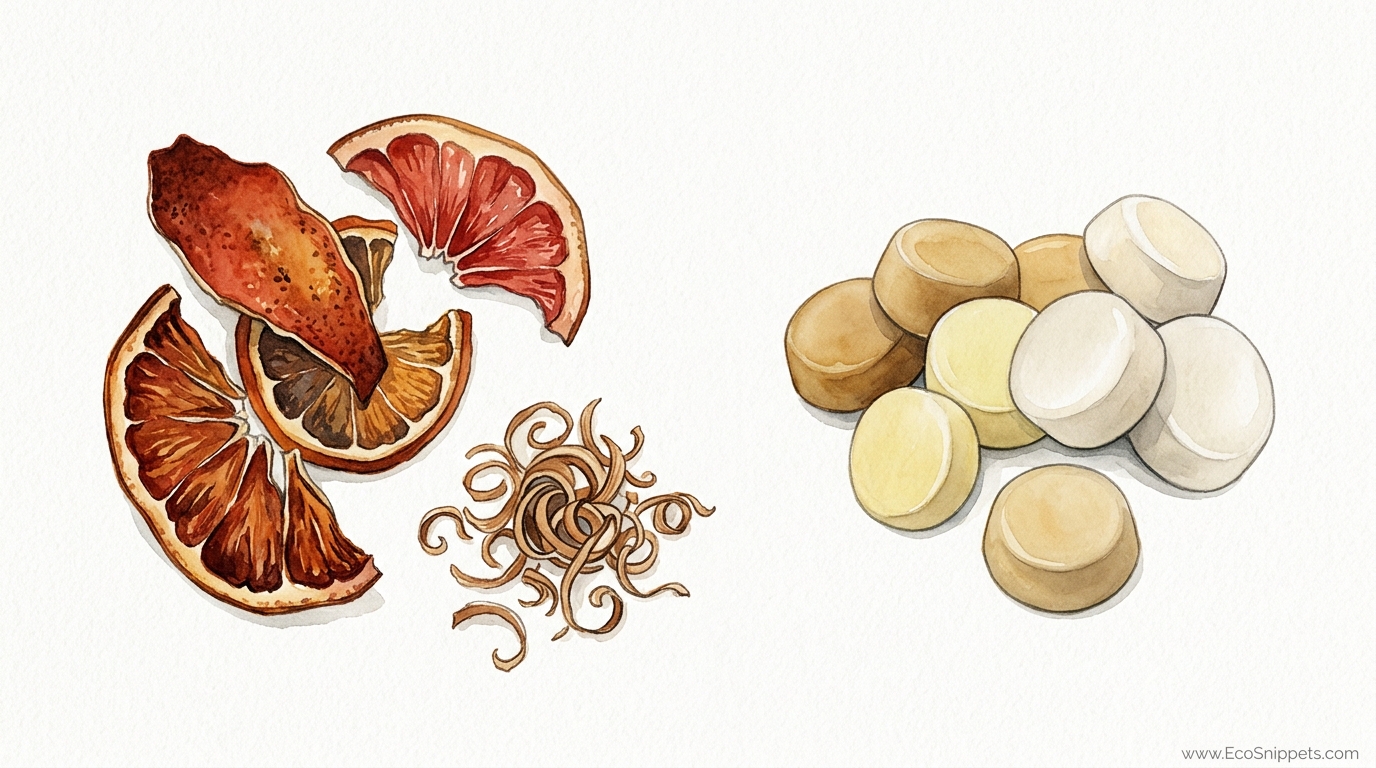
If you have spent any time in the world of wood stoves, you have likely encountered WAX NUGGETS or similar products. These are typically made from a blend of sawdust, pine shavings, and paraffin wax. They are incredibly reliable and burn for a long time, but they have a different footprint than kitchen scraps. The table below outlines the core differences to help you decide when to use each.
| Feature | Dried Citrus Peels | WAX NUGGETS / Commercial |
|---|---|---|
| Cost | Free (Waste product) | Variable (Subscription or retail cost) |
| Burn Time | 2–5 Minutes | 10–15 Minutes |
| Scent | Natural Citrus / Pleasant | Neutral or Chemical / Paraffin |
| Source | Organic Kitchen Scraps | Recycled Wood and Petroleum Wax |
| Residue | Clean Ash | Waxy Residue (if incomplete burn) |
The choice between these two often comes down to the quality of your wood. If you are trying to light slightly damp wood or you are in a rush, a heavy-duty option like a wax-based nugget might be the better tool. However, for daily lighting of well-seasoned cordwood, the citrus peel is more than sufficient and keeps your costs at zero. Many practitioners find that using one wax-based starter as a base and surrounding it with citrus peels provides the ultimate high-heat, high-reliability start.
Practical Tips for Success
To get the most out of your kitchen scrap firestarters, focus on how you build the base of your fire. Don’t just toss the peels in a heap at the bottom. The secret is airflow. Place three or four dried peels in a small cluster, but leave space between them so oxygen can reach the flames. If you pack them too tightly, they will smolder rather than flare.
- Mix your citrus: Different rinds have different oil contents. Grapefruit rinds are thicker and burn longer, while lemon rinds are thinner and ignite faster. A mix of both creates a multi-stage ignition.
- Keep the pith: While some recipes for candied peel tell you to remove the white pith, keep it for firestarters. The pith acts as a wick for the oils stored in the outer skin.
- Size matters: Large, palm-sized pieces are easier to handle and provide a longer burn than small, shredded bits. Try to peel your fruit in large spirals or quarters.
- The “Snap Test”: Before storing a batch, take one piece and try to break it. If it bends even a little, it’s not done. It should snap with a sharp sound like a cracker.
If you find your fire is still struggling, try pairing your peels with a handful of dried nut shells. Walnut, pecan, and almond shells are incredibly dense and oily. They burn like mini-coals and can provide the sustained heat needed to bridge the gap between your citrus “flare” and your kindling wood.
Advanced Considerations: The Kitchen Scrap Super-Starter
For those who want to take this to the next level, you can combine various kitchen wastes into a “super-starter.” This involves using an old cardboard egg carton as a mold. Fill each cup with a mixture of dried citrus peels, walnut shells, and a bit of dryer lint (another free “scrap”).
If you have old candle stubs or leftover beeswax, melt it down and pour a small amount over the mixture in the egg carton. This creates a high-density fire starter that combines the quick ignition of citrus oils with the long-lasting burn of wax. It is the ultimate way to ensure that nothing in your home goes to waste while providing you with a firestarter that can compete with any premium commercial product on the market.
Another advanced technique involves harvesting “pitch” or pine resin from fallen branches in your yard. Smearing a small amount of resin onto a dried orange peel creates a natural “napalm” that will burn even in windy or damp conditions. This is a favorite trick for those who enjoy winter camping or need to start fires in less-than-ideal outdoor environments.
Scenarios: Where to Use Your Scraps
Imagine it is a rainy Tuesday evening, and you’ve just come home to a cold house. Your wood is seasoned, but the air is damp. In this scenario, you place a small “nest” of dried orange peels at the center of your stove, topped with a few thin strips of cedar kindling. You strike one match, and within seconds, the limonene catches. The bright, popping flames quickly lick the cedar, and because the peels are so dry, there is no hiss of escaping steam. Within five minutes, you have a roaring fire and a house that smells like a citrus grove rather than a gas station.
Contrast this with a summer camping trip. You’ve brought a small bag of dried peels along. The communal fire pit at the campground is filled with half-burnt, damp logs from the previous night’s rain. You use your citrus peels to create a concentrated heat source under the driest twigs you can find. The high-energy burst from the peels provides just enough “oomph” to drive the moisture out of the twigs, saving you from the frustration of a smoky, smoldering pile that never quite catches.
Final Thoughts
Embracing the use of kitchen scraps like citrus peels as firestarters is a small but meaningful step toward a more self-reliant and intentional lifestyle. It forces us to look at our waste differently, recognizing the hidden energy and value in items we have been conditioned to see as useless. There is a specific kind of pride that comes from lighting a fire that warms your family using nothing but a match and the remains of your morning breakfast.
As you begin to build your stash, you’ll likely find yourself experimenting with other materials—dried corn cobs, spent coffee grounds mixed with wax, or even the papery skins of onions. Each material has its own “personality” and burn rate. This experimentation is part of the joy; it turns the mechanical act of heating a home into a craft. Start small, keep your peels dry, and enjoy the clean, natural heat of a fire started the way nature intended.
