How To Become More Self-Sufficient Without Starting a Full-Blown Farm…
Want to start preserving your harvest, making your own soap, or building a backyard root cellar — but not sure where to begin? “Homesteading Advice” gives you instant lifetime access to 35+ practical homesteading books on food preservation, veggie gardening, DIY natural cleaning products (save over $250 per year with this skill alone), brewing, off-grid energy, and a whole lot more…
Click Here To Check It Out Now!
Stop burying your liquid gold in a concrete tomb and start feeding a living landscape. Most homesteaders view wastewater as a problem to be hidden. But in a truly dynamic system, your shower and sink water can fuel a flourishing wetland that filters itself and provides irrigation. It is time to stop thinking of ‘waste’ and start thinking of ‘flow’.
Every drop of water that leaves your house carries a story of potential. When you send it to a dark, anaerobic septic tank, you are essentially killing a resource. A natural greywater filtration system mimics the way a forest floor or a riverbank cleanses water. It uses the combined power of gravity, biology, and mineral layers to turn “used” water into life-sustaining moisture for your land.
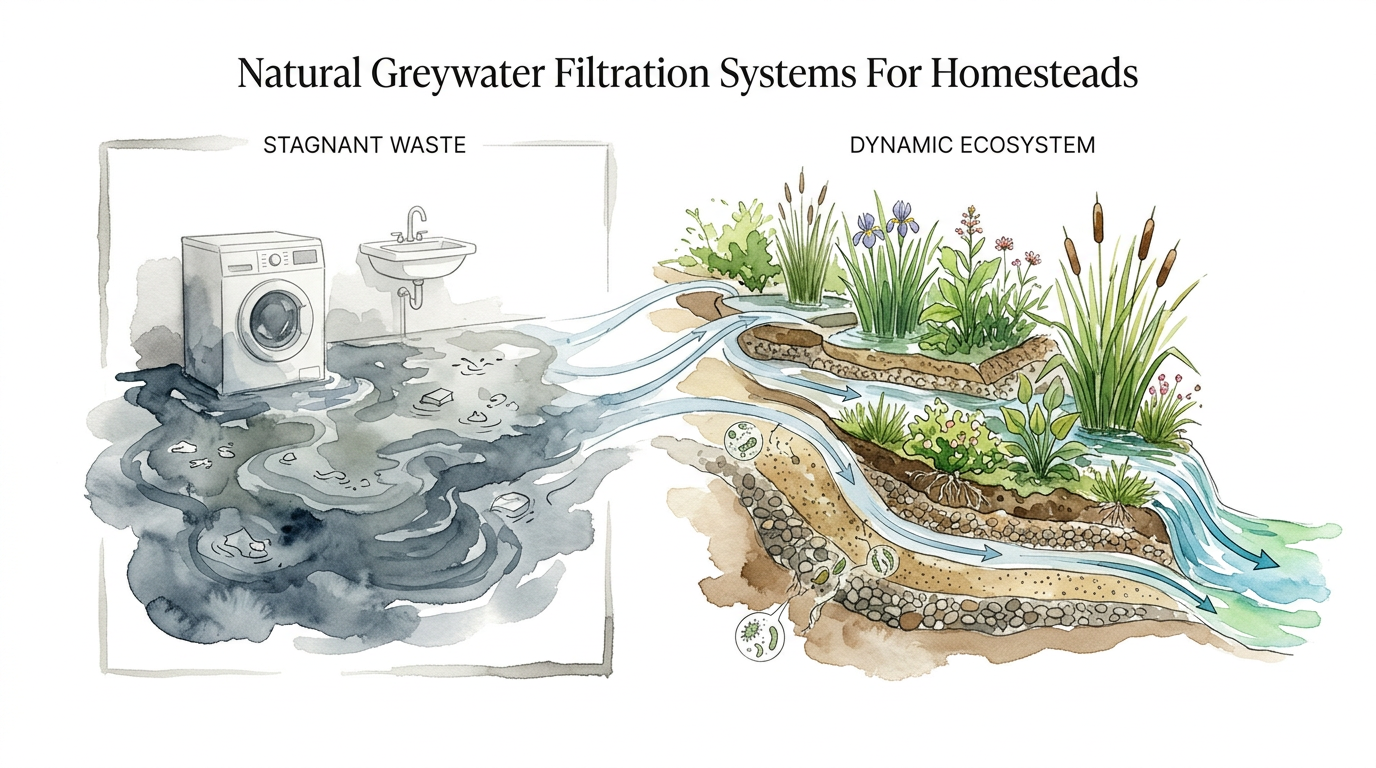
Building these systems requires a bit of pioneer grit and a deep respect for the laws of nature. This guide will walk you through the transition from a stagnant waste mindset to a dynamic ecosystem approach. You will learn how to build, maintain, and optimize a system that works with the earth rather than against it.
Natural Greywater Filtration Systems For Homesteads
Natural greywater filtration systems are biological and mechanical structures designed to treat water from showers, sinks, and washing machines without the use of industrial chemicals. This water, known as greywater, is distinct from blackwater (toilet waste) because it contains fewer pathogens and breaks down much faster in the environment. These systems are the backbone of a self-reliant homestead, acting as a bridge between indoor consumption and outdoor production.
In the real world, these systems manifest as mulch basins, constructed wetlands, or vertical sand filters. They exist to solve a fundamental homesteading problem: how to maintain a productive landscape in the face of water scarcity or high utility costs. Instead of letting water vanish into a municipal sewer or a deep underground leach field, these systems keep the moisture in the top twelve to eighteen inches of soil where roots can actually reach it.
Think of a natural filter as a living organism. It breathes, it filters, and it grows. These systems are used across the globe, from the arid deserts of the American Southwest to the temperate homesteads of the Pacific Northwest. They provide a resilient buffer against drought and turn a “waste” stream into a lush oasis of fruit trees, berry bushes, and ornamental windbreaks.
How the Flow Moves: Understanding the Mechanics
Establishing a greywater system begins at the source. Most modern homes are plumbed to combine all wastewater into a single “blackwater” line. To harness greywater, you must first separate these streams. This usually involves installing a three-way diverter valve under sinks or behind washing machines. This valve is the gatekeeper, allowing you to send water to the garden during the growing season or back to the septic system if you use harsh cleaners or during deep winter freezes.
Once diverted, the water moves through a series of stages. The first is the surge tank or settling chamber. Greywater often comes in “slugs”—a thirty-gallon blast from a washing machine or a twenty-minute shower. A surge tank temporarily holds this volume, allowing lint and hair to settle while letting the water drain at a slow, manageable pace into the filtration area. This prevents the biological filters from being overwhelmed and “drowning” the helpful aerobic bacteria.
The second stage is the distribution. In a simple gravity-fed system, the water flows through one-inch or two-inch pipes toward the filtration basins. Proper slope is essential here; a drop of a quarter-inch per foot is the standard to keep water moving without causing erosion or sediment buildup. In more complex setups, such as the “Laundry-to-Landscape” (L2L) system, the washing machine’s internal pump provides the pressure to move water across flat ground or slightly uphill.
The final stage is the infiltration zone. This is where the magic of “phyto-remediation” happens. The water enters a mulch basin or a gravel bed where it meets the roots of specific plants and the microbes living in the soil. These organisms consume the organic matter, soaps, and nutrients in the water, effectively cleaning it as it percolates back into the earth’s groundwater table.
Biological Engines: Methods of Natural Filtration
There are several ways to build a natural filter, each suited to different terrains and climates. The most common and effective for a homesteading scale include mulch basins, reed beds, and sand filters.
Mulch Basins
A mulch basin is the simplest and most cost-effective method. It involves digging a shallow trench or pit around the drip line of a tree and filling it with coarse wood chips or arborist mulch. The greywater is delivered below the surface of the mulch. The wood chips act as a massive biological sponge, providing surface area for bacteria to grow and breaking down the greywater before it reaches the soil. This prevents the “sealing” of the soil surface that often happens when raw greywater is poured directly onto the ground.
Constructed Wetlands and Reed Beds
For those with more space and a higher volume of water, a constructed wetland is the gold standard. This system uses a lined basin filled with specific grades of gravel and planted with aquatic species like cattails (Typha) or bulrushes. The water flows horizontally or vertically through the gravel. As it passes through the root zones, the plants “breathe” oxygen into the water, supporting a rich community of microbes that digest contaminants. These systems are incredibly efficient and can often produce water clean enough for secondary uses like toilet flushing.
Vertical Sand and Gravel Filters
In tight spaces or cold climates, a vertical sand filter is often used. This is a contained unit, usually a large tank or a brick-lined pit, filled with layers of graded material. A typical setup includes a twenty-centimeter top layer of coarse gravel to distribute the water, followed by a sixty-centimeter layer of fine sand (0–4mm), and finally another twenty-centimeter drainage layer of gravel at the bottom. The sand acts as a fine mechanical filter, while the gravel provides the drainage needed to prevent the system from becoming a muddy, anaerobic mess.
The Harvest of the Flow: Benefits and Advantages
The primary benefit of a natural greywater system is water security. By recycling your indoor water for outdoor use, you can reduce your total freshwater demand by thirty to fifty percent. In times of drought or water restrictions, your greywater becomes a reliable, daily “spring” that keeps your orchard alive while the rest of the neighborhood turns brown.
Beyond simple conservation, these systems build soil health. Greywater contains nitrogen, phosphorus, and potassium—the primary ingredients in commercial fertilizers. When filtered through a mulch basin, these nutrients are delivered directly to the root zones of your plants. This creates a closed-loop system where the “waste” of the kitchen and laundry becomes the fuel for next year’s fruit harvest.
Environmental stewardship is another driving factor. By treating water on-site through biological means, you reduce the load on municipal treatment plants. These plants often use massive amounts of electricity and chemicals to process water that nature could handle for free. A well-designed homestead wetland also creates habitat for beneficial insects, frogs, and birds, increasing the overall biodiversity of your land.
The Grit in the Gears: Challenges and Common Mistakes
The most frequent mistake homesteaders make is storing greywater. Unlike rainwater, greywater is rich in organic matter. If you leave it in a tank for more than twenty-four hours, the oxygen is quickly depleted, and it turns into “septically active” blackwater. This water smells like rotten eggs and can become a breeding ground for harmful pathogens. The rule of thumb is “use it or lose it”—the water should be in the ground and under a layer of mulch within a day of being produced.
Sodium and boron buildup is another silent killer. Many conventional soaps and detergents are loaded with salts and borax to help clean clothes. Over time, these minerals can build up in the soil, making it toxic to sensitive plants like citrus or avocados. Successful greywater practitioners switch to “bio-compatible” soaps that use potassium-based salts or plant-derived surfactants. These products actually benefit the soil rather than poisoning it.
Clogging is the mechanical enemy of the greywater system. Lint from the washing machine and hair from the shower will eventually stop the flow if not managed. Relying on manually cleaned filters is often a recipe for failure, as people inevitably forget to clean them. The best designs use a “coarse-to-fine” strategy: a large mulch basin can handle a significant amount of lint without clogging, whereas a drip irrigation system with tiny emitters will fail in a matter of weeks.
Limitations and Regulatory Constraints
While these systems are powerful, they are not universal. Heavy clay soils are a significant limitation. If your soil doesn’t drain, the greywater will simply pool on the surface, creating a mosquito-breeding hazard and an unsanitary mess. In these cases, you must either build “raised” mulch mounds or significantly amend the soil with gypsum and organic matter to improve percolation.
Climate also plays a role. In areas with deep-freezing winters, pipes can burst and biological activity in a wetland will slow to a crawl. Proper winterization—such as burying pipes below the frost line and heavily insulating the filtration basins—is mandatory. In extremely cold regions, it is often best to divert the water back to the septic system during the coldest three months of the year.
The regulatory landscape is the most complex hurdle. Laws vary wildly from state to state and county to county. While states like California and Arizona have relatively progressive codes that allow “permit-free” laundry-to-landscape systems, other regions still classify greywater in the same category as raw sewage. Always check your local plumbing codes. If the law is lagging behind the science, many homesteaders choose to build “stealth” systems that are entirely subsurface and invisible to the naked eye, though this carries its own risks.
Comparing Common Greywater Strategies
Choosing the right system depends on your budget, your skill level, and the volume of water you produce. The following table highlights the key differences between the three most popular approaches.
| System Type | Complexity | Cost | Maintenance | Best Use Case |
|---|---|---|---|---|
| Mulch Basins (L2L) | Low | $150 – $400 | Annual Mulch Refresh | Orchards and large shrubs |
| Constructed Wetland | High | $800 – $2,500 | Plant pruning / cleaning | High volume / Multiple sources |
| Vertical Sand Filter | Medium | $400 – $1,000 | Biannual filter rinsing | Small lots / Cold climates |
The Homesteaders Code: Practical Tips and Best Practices
If you want your system to last for decades, you must treat it like a garden, not a piece of plumbing. The quality of the water going in dictates the health of the system coming out.
- Switch Your Chemistry: Use only bio-compatible soaps. Brands like Oasis and Dr. Bronner’s are time-tested favorites. Avoid anything with “whitening” agents, boron, or high sodium content.
- Design for Maintenance: Install “clean-outs” and unions in your piping. You will eventually need to flush the lines of lint or scale, and being able to take the pipes apart without a saw is a blessing.
- Size Your Basins Correctly: A front-loading washer uses about 15 gallons per load, while an old top-loader can use 40. Calculate your weekly volume and ensure your mulch basins are deep enough to hold a full “slug” of water without overflowing.
- Protect the Roots: Never deliver greywater directly against the trunk of a tree. This can cause crown rot. Always aim for the “drip line”—the area directly under the outermost branches where the active feeder roots are located.
- Mulch Deeply: Maintain at least two to four inches of mulch over your greywater emitters. This prevents odors, keeps pets and children away from the water, and provides the dark, moist environment that beneficial bacteria crave.
Advanced Considerations: Cold Climates and Solar Integration
For those looking to push the boundaries of self-reliance, integrating solar power and cold-climate adaptations can make a system truly “off-grid.”
In freezing climates, the “subsurface flow” wetland is the best option. By keeping the water level six inches below the surface of the gravel, you use the gravel and the layer of dead plant matter on top as insulation. Some practitioners even go as far as using “earth tubes” to pre-warm the air around the pipes or installing heat tape powered by a small solar array to keep the diverter valves from freezing.
Solar pumps allow you to move greywater to higher ground. If your orchard is uphill from your house, a small 12V or 24V pump connected to a settling tank can lift the water to a header tank. From there, it can be distributed by gravity. This requires a “float switch” to ensure the pump only runs when there is water in the settling tank, preventing the motor from burning out.
Phyto-remediation can also be targeted. If you know your greywater contains specific contaminants—like heavy metals from a hobby workshop—you can plant “hyper-accumulators.” Plants like sunflowers or specific willow species are known to pull heavy metals out of the water and store them in their biomass. You then harvest the plants and dispose of them, effectively “mining” the pollutants out of your soil.
Example Scenarios
To visualize how this works, let’s look at two common homesteading setups.
Scenario A: The Small Orchard Oasis. A homesteader in a Mediterranean climate has ten fruit trees. They install a “Laundry-to-Landscape” system. The washing machine is on an exterior wall. They run a one-inch HDPE pipe out the wall and split it into ten branches, one for each tree. Each branch ends in a “mulch shield”—a small plastic bucket with the bottom cut out, buried in a mulch basin. Every time they do a load of laundry, ten trees get a deep, four-gallon drink of nutrient-rich water.
Scenario B: The High-Volume Wetland. A family of five on a rural homestead produces 150 gallons of greywater a day from showers and sinks. They dig a 100-square-foot basin, line it with pond liner, and fill it with graded river rock and gravel. They plant it with Canna indica and Yellow Iris. The greywater enters one end, moves slowly through the gravel over three days, and exits the other end through a perforated pipe into a subsurface irrigation field for their windbreak trees. The water is clear, odorless, and the wetland itself becomes a beautiful garden feature.
Final Thoughts
Natural greywater filtration is more than a plumbing trick; it is a fundamental shift in how we relate to the resources we use. By closing the loop on our water consumption, we stop being mere consumers and start being active participants in the health of our land. It takes a little extra effort to sort your soaps and dig your basins, but the reward is a landscape that stays green when the world turns brown.
These systems are resilient, low-cost, and deeply satisfying to build. They honor the ancestral wisdom of “waste not, want not” while using modern understanding of biology to solve ancient problems. Whether you start with a simple bucket-and-basin approach or a complex constructed wetland, the most important step is to simply stop burying your liquid gold.
Take the time to observe your land, test your soil, and plan your flow. Experiment with different plants and mulch types. As your trees grow taller and your soil becomes darker and richer, you will realize that “waste” was only a lack of imagination. Start your project today and watch your homestead transform into a truly dynamic ecosystem.
