How To Become More Self-Sufficient Without Starting a Full-Blown Farm…
Want to start preserving your harvest, making your own soap, or building a backyard root cellar — but not sure where to begin? “Homesteading Advice” gives you instant lifetime access to 35+ practical homesteading books on food preservation, veggie gardening, DIY natural cleaning products (save over $250 per year with this skill alone), brewing, off-grid energy, and a whole lot more…
Click Here To Check It Out Now!
Stop fighting nature with plastic and start using its own biology to protect your harvest. Netting is a nightmare for you and the local wildlife. Trap cropping is the ‘pro’ move: planting highly attractive ‘decoy’ crops that lure pests away from your main harvest. It’s cleaner, safer, and more beautiful.
You might have spent years wrestling with bird netting that tangles in your hair and traps innocent ladybugs. Modern gardening often feels like an arms race against the insects, involving expensive mesh and chemical sprays. Traditional wisdom offers a more elegant solution that works with the land instead of against it.
Ancient farmers didn’t have rolls of polypropylene to drape over their rows. They understood that every insect has a favorite food, much like a child prefers candy over broccoli. Trap cropping uses this preference to your advantage, creating a sacrificial buffet that keeps the bugs away from your prized vegetables.
This method isn’t just about saving your tomatoes; it is about building a resilient ecosystem. When you invite nature into the garden with intention, you stop being a victim of the seasons and start being a steward of the land. It takes a bit of planning and a shift in perspective, but the results are far more rewarding than any plastic barrier.
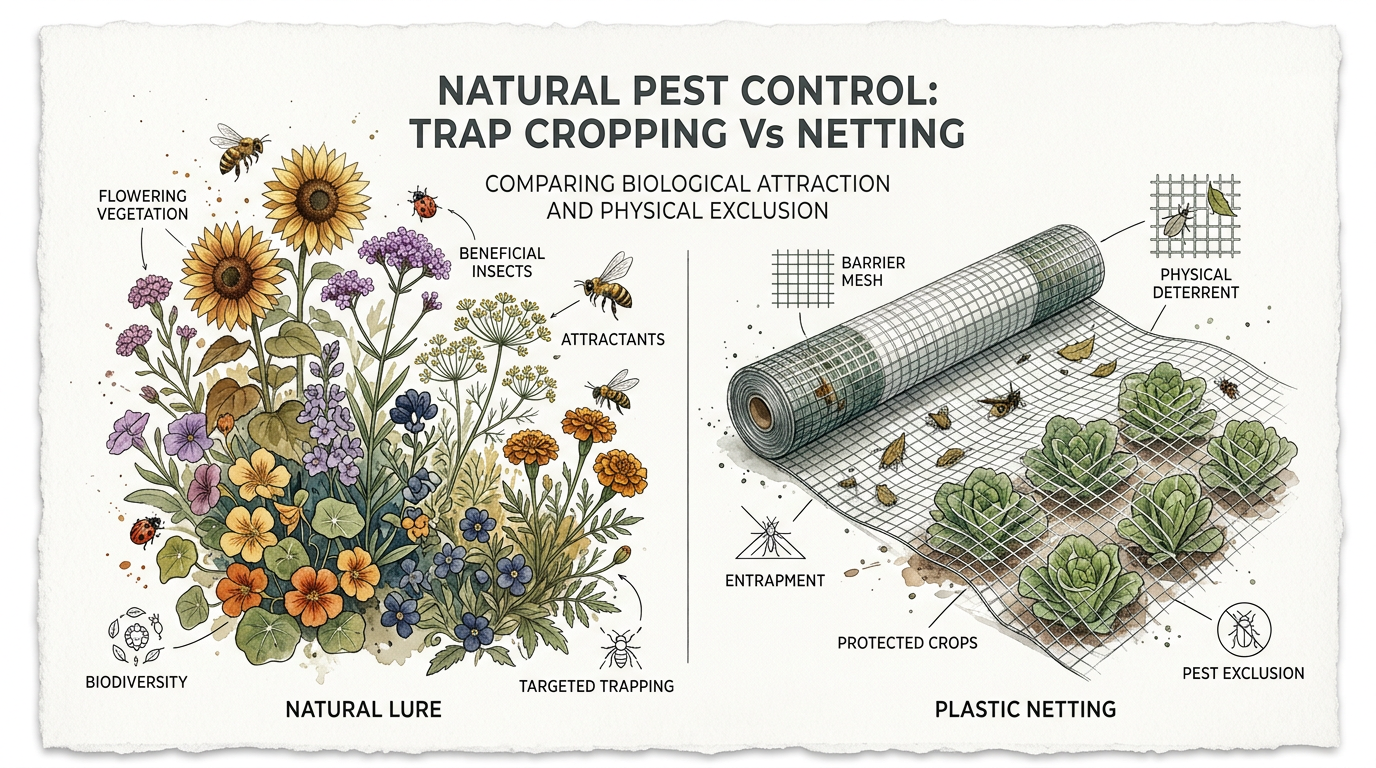
Natural Pest Control: Trap Cropping Vs Netting
Trap cropping is the practice of planting a specific plant species that is more attractive to a pest than the main crop you want to protect. Think of it as a biological “decoy” or a “distraction.” Pests are drawn to the volatile scents and colors of the trap crop, leaving your primary harvest untouched. This strategy sits at the heart of Integrated Pest Management (IPM), a system that prioritizes biological solutions over chemical ones.
Netting, on the other hand, is a mechanical barrier. While it physically blocks some pests, it often creates as many problems as it solves. Netting can trap beneficial pollinators, tear easily in the wind, and provide a hiding spot for smaller insects that crawl through the mesh. It is a temporary fix that treats the garden as a combat zone rather than a living system.
Real-world application of trap cropping can be seen in large-scale organic farms and small backyard homesteads alike. A pepper grower might plant a row of hot sunflowers to draw away stink bugs. A cabbage lover might surround their patch with mustard greens to catch the attention of flea beetles. The goal is to create a “perimeter” of protection that relies on the natural urges of the insects themselves.
This technique acknowledges a fundamental truth of the natural world: you cannot eliminate pests entirely. Instead, you manage their movement. You give them a place to go that doesn’t involve your dinner plate. This approach creates a more harmonious garden where the struggle for survival is directed toward a sacrificial plant rather than your high-value crops.
How Trap Cropping Works: The Biology of Deception
Understanding trap cropping requires a look into the mind of a bug. Insects rely heavily on chemical signals and visual cues to find food. Most pests are highly specialized, meaning they have evolved to prefer certain plant families or specific concentrations of secondary metabolites, like mustard oils or cucurbitacins.
The process begins with selection. You must identify which pest is your primary antagonist and what plant they love more than your main crop. For example, squash bugs are notoriously difficult to manage, but they find Blue Hubbard squash much more delicious than common zucchini. Planting a few Blue Hubbards on the edge of your garden draws the bugs away from your summer squash.
Timing is the next critical factor. A trap crop must be established and attractive before the main crop reaches a vulnerable stage. This often means starting your decoys indoors or sowing them several weeks before your main vegetables. If the pests arrive and find your main crop first, the “lure” effect is lost. You want the trap crop to be the biggest, smelliest, and most inviting thing in the garden when the first wave of insects emerges.
Once the pests have gathered on the decoy plants, you have a choice. Some gardeners use “trap and kill” methods, where they apply an organic spray or physically remove the pests from the sacrificial plants. Others prefer “trap and hold,” where the decoy is left alone to support a population of both pests and the predators that eat them. This creates a natural balance that can protect your garden for the entire season without constant intervention.
Placement is the final pillar of the strategy. Perimeter trap cropping involves planting a border of decoys around the entire field. Intercropping involves mixing the decoys directly among the main plants. For the home gardener, a “block” strategy often works best, where a dedicated patch of attractive plants sits 10 to 15 feet away from the main garden beds.
Benefits of Choosing Biology Over Plastic
Choosing trap cropping over plastic netting offers a range of practical and ecological advantages. First and foremost is the boost to local biodiversity. While netting keeps life out, trap crops invite life in. These decoy plants often produce beautiful flowers that attract bees, butterflies, and hoverflies, improving the pollination rates of your entire garden.
The health of your soil also benefits from this approach. Netting does nothing for the earth, but trap crops can be chosen for their secondary functions. Many common trap crops, like mustard or nasturtiums, act as living mulches or green manures. When the season is over, you can turn these plants back into the soil to add organic matter and nutrients, a far better fate than a plastic net ending up in a landfill.
Economic savings are another significant factor for the self-reliant gardener. A single packet of seeds for a trap crop costs a few dollars and can provide protection for hundreds of square feet. High-quality bird netting or insect mesh is expensive, degrades under UV light, and often needs replacement every few years. Seeds, if managed correctly, can be saved and replanted year after year, making your pest control system entirely self-sustaining.
Finally, there is the aesthetic value. A garden surrounded by sunflowers, marigolds, and lush nasturtiums is a place of beauty. A garden draped in grey or green plastic netting feels like a construction site. Reclaiming the visual appeal of your homestead is not just a matter of pride; it makes the daily work of gardening a much more joyful experience.
Challenges and Common Mistakes to Avoid
The most common mistake beginners make is “planting and forgetting.” A trap crop is not a magic shield; it is a gathering point. If you allow a pest population to explode on your trap crop without monitoring it, the sheer volume of insects may eventually spill over onto your main harvest. You must keep a close eye on the decoy plants to ensure they are doing their job and not becoming a breeding ground for a catastrophe.
Another pitfall is choosing the wrong plant for the job. Not all “companion plants” are trap crops. Some plants might actually repel pests, which is a different strategy altogether. If you plant a repellent near your main crop, you might accidentally drive the pests into the very vegetables you are trying to save. Always verify that your decoy plant is scientifically proven to be more attractive to the specific pest you are targeting.
Failure to manage the health of the trap crop itself can also lead to failure. A stunted, diseased, or dying trap crop will not produce the strong chemical signals needed to lure pests away from healthy main crops. You must treat your decoy plants with the same care—watering, weeding, and feeding—as your main harvest. If the decoy doesn’t look delicious to the bug, the bug won’t go there.
Poor timing can ruin an otherwise perfect plan. If your main crop matures and starts producing fruit or fragrant leaves before the trap crop is established, the pests will settle into your “good” plants. Once an insect colony is established, it is very difficult to convince them to move to a different plant nearby. Early planning and staggered planting are the only ways to avoid this timing trap.
When Trap Cropping May Not Be Ideal
While trap cropping is a powerful tool, it has its limits. In very small urban gardens or balcony setups, there may simply not be enough space to plant a separate decoy crop. To be effective, there needs to be enough physical distance or a large enough “volume” of decoy plants to redirect the pests. In a tiny space, the bugs may just see one giant salad bar.
Environmental constraints can also play a role. Some trap crops require specific soil types or moisture levels that may not match your local conditions. For instance, if you are in a drought-prone area, planting a water-heavy trap crop to protect a drought-tolerant main crop might not be the most efficient use of resources. You must match your decoys to your climate just as carefully as your vegetables.
High pest pressure can sometimes overwhelm the system. In years where an insect population is experiencing an “outbreak” phase, a small patch of trap crops will be buried in hours. In these extreme cases, trap cropping should be seen as one layer of a multi-tiered defense system rather than a standalone solution. It is a tool for management, not total eradication.
Lastly, some pests are generalists that aren’t easily “lured” by one specific plant over another. If you are dealing with a highly adaptable pest that eats almost anything green, trap cropping becomes much more difficult. This method works best for specialists, like the Colorado potato beetle or the squash vine borer, which have very specific preferences.
The Comparison: Plastic Trap vs Natural Lure
Understanding the differences between mechanical and biological control helps you decide which path fits your homestead philosophy.
| Feature | Plastic Netting (Mechanical) | Trap Cropping (Biological) |
|---|---|---|
| Initial Cost | Moderate to High | Very Low (Seed cost) |
| Maintenance | Repairing tears, untangling | Watering, weeding decoys |
| Eco-Impact | Produces waste, traps birds | Builds soil, feeds bees |
| Longevity | 2–5 years before disposal | Self-sustaining via seed saving |
| Complexity | Simple to install | Requires knowledge of pest cycles |
Using this table, we can see that while netting offers a “set it and forget it” simplicity, it fails in terms of long-term sustainability and ecological health. Trap cropping requires more “pioneer grit” and observation, but it pays dividends in the form of a healthier, more productive garden.
Practical Tips and Best Practices
Success in trap cropping comes down to the details. Start by keeping a garden journal. Note when specific pests arrive each year. This data allows you to time your trap crops with surgical precision. If you know the flea beetles arrive in the third week of May, ensure your mustard greens are lush and large by the second week of May.
Use “succession planting” for your trap crops. Just like your lettuce, your decoys will eventually bolt or lose their luster. By planting a new row of decoys every two weeks, you ensure that there is always a fresh, highly attractive plant available to catch any late-arriving pests. This constant renewal keeps the “lure” strong throughout the growing season.
Consider the “Physical Trap” hybrid method. For example, if you are using Blue Hubbard squash to catch squash bugs, you can place a piece of scrap wood under the decoy plants. Squash bugs love to hide under boards at night. In the morning, you can lift the board and find the entire colony gathered in one place, making it easy to dispose of them manually.
Diversify your decoys. Don’t rely on just one type of plant to protect your garden. A mix of flowering herbs, pungent brassicas, and tall sunflowers creates a complex sensory environment that confuses pests while providing multiple “distraction points.” This diversity acts as an insurance policy; if one trap crop fails due to weather, another may still thrive.
Advanced Considerations for the Serious Practitioner
For those looking to take their pest management to the next level, consider the role of pheromones. Some advanced gardeners use commercially available pheromone lures and place them directly on the trap crops. This creates a “super-stimulus” that makes the decoy plant irresistible, pulling in pests from a much wider radius than the plant could achieve on its own.
Think about the “push-pull” strategy. This involves planting a repellent (the “push”) inside the main crop rows and a trap crop (the “pull”) around the perimeter. For example, planting garlic or onions among your carrots pushes the carrot fly away, while a nearby patch of parsley pulls them toward a designated area. This dual-action approach is significantly more effective than using either method alone.
Scaling your trap cropping requires an understanding of “effective distance.” Research suggests that for most pests, the trap crop should be within 10 to 30 feet of the main crop. If the distance is too great, the pests won’t find the lure. If it’s too close, they might stumble onto the main crop by accident. Finding the “sweet spot” for your specific land layout is a hallmark of an expert practitioner.
Soil health can also influence how attractive your plants are to pests. Interestingly, some pests are actually more attracted to plants that are slightly stressed or have high nitrogen levels in their leaves. You can “tune” your trap crops by giving them slightly more nitrogen than your main crops, making them look like a more nutritious feast to an unsuspecting aphid or beetle.
Real-World Examples: Success in the Field
Let’s look at the classic case of the Cabbage White butterfly. These pests can turn a beautiful head of broccoli into a skeleton in days. A savvy gardener will plant nasturtiums around their brassica beds. The butterflies find the nasturtiums much more attractive for egg-laying. By the time the larvae hatch, they are feasting on the fast-growing nasturtium leaves, leaving your broccoli to grow thick and healthy.
Another powerful example involves the Colorado potato beetle. These beetles are the bane of potato growers, but they have a fatal weakness: they love eggplant even more. By planting a “rim” of eggplant around a potato field, the beetles stop at the edge. Because eggplants are smaller and easier to inspect, the gardener can quickly walk the perimeter and hand-pick the beetles, protecting the entire potato crop with minimal effort.
In the southern United States, many tomato growers struggle with the leaf-footed bug. These large insects pierce the fruit and cause unsightly blemishes. However, they are highly attracted to sunflowers, specifically the large, pollen-heavy varieties. A single row of sunflowers on the windward side of the tomato patch can act as a biological filter, catching the majority of the bugs before they ever reach the tomatoes.
These scenarios demonstrate that trap cropping is not just a theory. It is a functional, reliable system that has been used to secure harvests for generations. Each of these examples relies on the same principle: understanding what the enemy wants and giving it to them on your terms.
Final Thoughts
Embracing trap cropping is a step toward true self-reliance. It moves you away from a dependency on plastic products and chemical interventions, rooting your garden’s health in the very laws of nature. This method requires more observation and a deeper connection to the land, but that is precisely what makes it so rewarding for the modern pioneer.
The transition from netting to biological decoys won’t happen overnight. It takes a season or two to learn the rhythms of your local pests and the preferences of your plants. Start small by choosing one pest that gives you the most trouble and find its favorite “candy” plant. Build your system one layer at a time, and soon your garden will be a thriving, balanced ecosystem.
Protecting your harvest doesn’t have to be a battle against the wild. By using the natural urges of insects to your advantage, you create a garden that is both productive and peaceful. Put away the plastic, pick up your seeds, and let the biology of the earth do the heavy lifting for you. This is the way of the wise gardener, and the results will show in every bite of your clean, untainted harvest.
