How To Become More Self-Sufficient Without Starting a Full-Blown Farm…
Want to start preserving your harvest, making your own soap, or building a backyard root cellar — but not sure where to begin? “Homesteading Advice” gives you instant lifetime access to 35+ practical homesteading books on food preservation, veggie gardening, DIY natural cleaning products (save over $250 per year with this skill alone), brewing, off-grid energy, and a whole lot more…
Click Here To Check It Out Now!
When the grid fails or the city restricts your usage, this simple gravity-powered system keeps your food growing without a drop from the tap. Relying on the city tap for your backyard farm is a massive risk. Between rising costs and seasonal water bans, your harvest is always one utility crisis away from failure. Harvesting rain and using gravity to create pressure creates a closed-loop system that is cleaner for your plants and completely free to operate. Here is how to build a resilient water bank.
Modern living has disconnected most of us from the primary source of all life. We have been taught to believe that water comes from a pipe and goes down a drain, but our ancestors knew better. They understood that every drop falling on a roof was a gift that could be stored for the lean months ahead. Moving away from municipal dependence requires a shift in mindset from consumer to steward.
Setting up a gravity-fed system is not just about saving money on your utility bill. It is about the security that comes with knowing your garden will thrive even if the pumps in the city center stop turning. This guide will walk you through the grit and the mechanics of capturing the sky’s bounty and putting it to work for your homestead.
Whether you have a small urban plot or a sprawling acreage, the physics of water remains the same. This system works with nature rather than trying to overpower it with electricity and high-pressure pumps. You are building a reservoir of independence, one gallon at a time.
Off-grid Rainwater Harvesting Systems For Beginners
Off-grid rainwater harvesting is the intentional collection and storage of runoff from a surface—usually a roof—for later use. Instead of letting this resource wash away into the street or overwhelm your foundation, you divert it into a storage vessel. This is a practice as old as agriculture itself, refined for the modern self-reliant home.
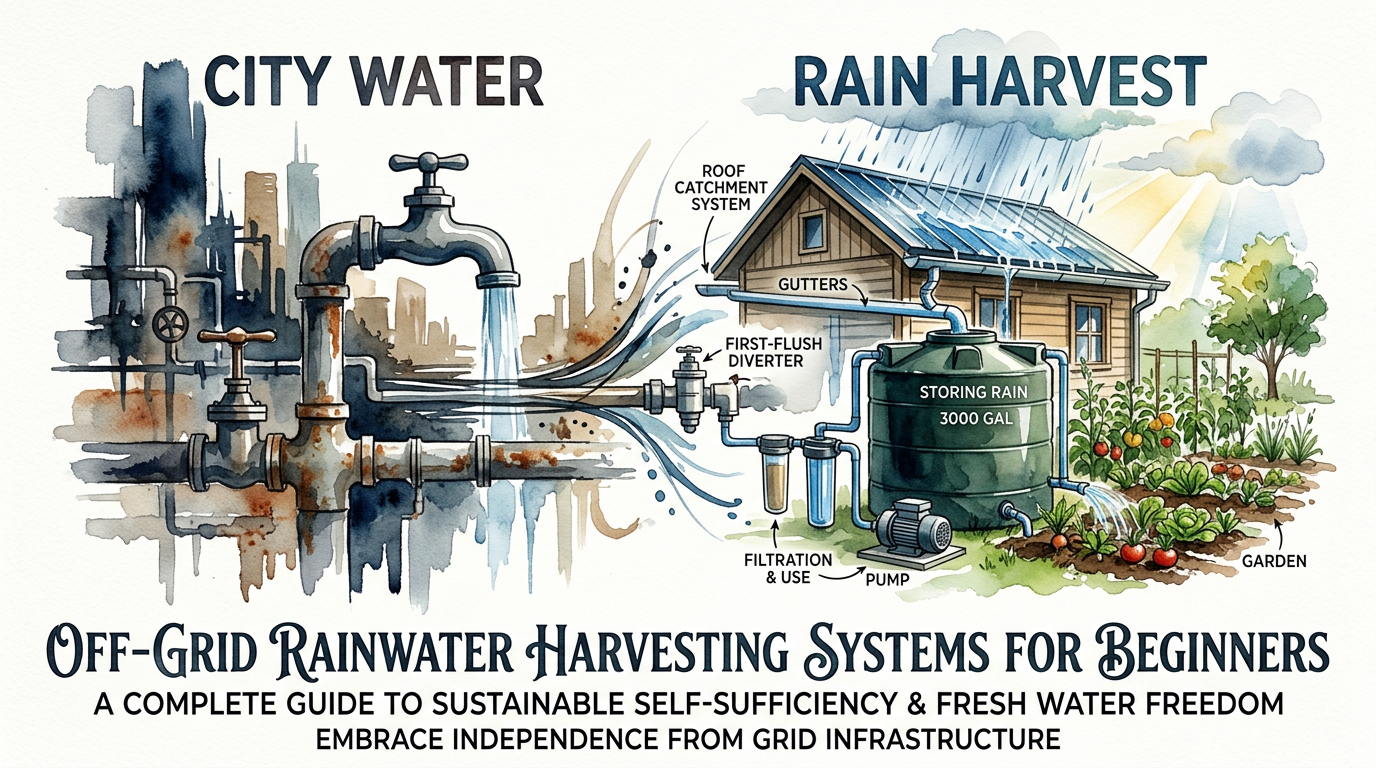
The beauty of this system lies in its simplicity. Most setups consist of a catchment area, a conveyance system like gutters, a filtration component, and a storage tank. Gravity does the heavy lifting, pulling water from the sky and pushing it through your hoses. You do not need a complex electrical grid to make this work, making it the ultimate tool for resilience.
Real-world applications range from simple 50-gallon barrels under a downspout to massive 5,000-gallon cisterns buried or elevated on platforms. In rural homesteads, these systems often provide the primary source of irrigation for orchards and vegetable patches. In suburban environments, they serve as a critical backup during summer droughts when local governments restrict hose usage.
Think of your rainwater system as a physical bank account for your land. Every storm is a deposit, and every watering session is a withdrawal. Understanding how to manage this balance is the first step toward true hydrological independence. If you can master the flow of water on your property, you have mastered one of the most vital survival skills known to man.
How To Build A Gravity-Fed Rainwater System
Building a functional system begins with understanding your roof. Almost any hard surface can act as a catchment, but metal roofs are the gold standard for purity and efficiency. Asphalt shingles can work, though they may shed small granules and chemicals that require more intensive filtration if you intend to use the water for delicate crops.
Gutters act as the arteries of your system, and they must be pitched correctly toward your storage tank. A slope of roughly 1/4 inch for every 10 feet of gutter ensures that water moves quickly and does not pool. Fast-moving water carries less debris into your tanks and prevents mosquitoes from breeding in stagnant spots.
Filtration is your first line of defense against system failure. Start with gutter guards to keep out large leaves and branches. Before the water enters your tank, use a “first flush” diverter. This simple PVC device captures the first few gallons of a storm—which contain the most dust, bird droppings, and pollen—and sends them to the ground instead of your reservoir.
Elevation is the engine of a gravity-fed system. For every 2.31 feet of elevation you gain, you create 1 pound per square inch (PSI) of pressure. Raising your tank on a sturdy platform made of pressure-treated lumber or concrete blocks can give you enough pressure to run a soaker hose or a drip irrigation line. Aim for at least four to six feet of height to ensure a steady, useful flow.
Designing Your Storage Solution
Storage tanks come in many forms, from recycled food-grade IBC totes to specialized polyethylene cisterns. IBC totes are a favorite for beginners because they are affordable, modular, and easy to transport. Ensure any container you use was never used for toxic chemicals, as those residues can leach into your soil and plants.
Opaque materials are mandatory for your storage vessels. Sunlight entering a water tank will trigger rapid algae growth, which clogs filters and fouls the water. If your tank is translucent, paint it a dark color or wrap it in a UV-resistant cover. This simple step saves you hours of cleaning and maintenance later in the season.
Plumbing for Resilience
Connect your tank to your garden using high-quality bulkhead fittings and ball valves. Avoid cheap plastic faucets that will crack under UV exposure or winter freezes. A 1-inch or 2-inch outlet will allow for much better flow than a standard 3/4-inch garden hose connection. You can always use a reducer at the end of the line, but a large outlet ensures your “mainline” stays pressurized.
Venting your tank is a step many beginners overlook. As water enters the tank rapidly during a storm, air must be able to escape, or the pressure can actually cause the tank to bulge or the gutters to back up. Conversely, as you draw water out, air must enter to prevent a vacuum from forming. Use a screened vent to keep insects out while allowing the tank to breathe.
Benefits of Gravity-Fed Rainwater Systems
Rainwater is inherently better for your soil than city water. Municipal supplies are often treated with chlorine or chloramine to kill bacteria, but these chemicals also kill the beneficial microbes in your garden’s soil. Rainwater is naturally soft, slightly acidic, and contains traces of organic nitrates that act as a mild, natural fertilizer.
The economic benefits are undeniable and grow more significant every year. As water rates climb and “tiered” pricing becomes common, the ability to irrigate for free can save a homestead hundreds of dollars annually. Once the initial investment in tanks and gutters is paid off, your operating costs drop to near zero.
Total control during a crisis is the most profound advantage. When a water main breaks or a drought causes the city to shut off the taps, your garden remains lush and productive. This independence provides a psychological peace of mind that no utility company can offer. You are no longer a victim of infrastructure failure; you are the master of your own supply.
Gravity power is also silent and maintenance-free compared to electric pumps. There are no motors to burn out, no fuses to blow, and no noise to disturb the peace of your morning chores. A well-built gravity system is a “set it and forget it” solution that works as long as the laws of physics remain in effect.
Common Pitfalls and Mistakes
Underestimating the weight of water is the most common and dangerous mistake beginners make. One gallon of water weighs approximately 8.34 pounds. A standard 275-gallon IBC tote weighs over 2,200 pounds when full. Placing this on a weak wooden deck or soft, uncompacted soil will lead to a catastrophic collapse that can destroy property or cause injury.
Neglecting the overflow is another recipe for disaster. When your tank reaches capacity during a heavy storm, that water has to go somewhere. If you don’t have a dedicated overflow pipe that directs the excess away from your home’s foundation, you risk flooding your basement or eroding your landscape. Always pipe your overflow at least ten feet away from any structure.
Poor filtration leads to “clogged pipe syndrome.” If you do not use a first flush diverter and leaf screens, organic matter will settle at the bottom of your tank and turn into a sludge. This sludge will eventually find its way into your valves and drip emitters, rendering the entire system useless. Clean your filters after every major storm to maintain optimal flow.
Choosing the wrong site for your tank can limit its usefulness. If the tank is too low, you won’t have the pressure to move water to the far corners of your garden. If it’s too far from the garden, friction loss inside the hose will eat up whatever little pressure you have. Plan your layout carefully, prioritizing elevation and proximity to the plants that need the most water.
Limitations and Realistic Constraints
Gravity systems are not high-pressure systems. You will not be able to run standard oscillating sprinklers or high-pressure spray nozzles with a simple gravity setup. These devices require 30 to 50 PSI, which would require your tank to be elevated over 70 feet in the air. This system is designed for low-pressure applications like hand-watering with a wand or using specialized gravity-drip tape.
Your storage capacity is strictly limited by the size of your tanks and the amount of rainfall you receive. In a severe multi-month drought, even the largest tank will eventually run dry. You must still practice water conservation techniques, such as heavy mulching and selecting drought-resistant crops, to make your stored water last through the heat of the summer.
Winter presents a significant challenge in colder climates. Water expanding as it freezes can easily shatter PVC pipes, ball valves, and even the tanks themselves. Most off-grid practitioners must drain their systems and bypass their downspouts during the coldest months. This means you cannot rely on the system for winter watering unless you take expensive measures to bury and insulate the entire setup.
Local regulations and “rainwater rights” can sometimes be a hurdle. While most states now encourage rainwater harvesting, some older municipal codes or HOA rules may have restrictions on the size or appearance of storage tanks. Always check your local ordinances before investing in a massive cistern to ensure you are staying within the lines of the law.
City Water vs Rain Harvest: A Comparison of Sustainability
Understanding the differences between these two sources helps highlight why rainwater is the superior choice for the serious grower. While city water offers convenience, it lacks the resilience and biological compatibility of rain.
| Feature | City Water Supply | Gravity Rain Harvest |
|---|---|---|
| Pressure | High (40-60 PSI) | Low (2-10 PSI) |
| Chemicals | Chlorine, Fluoride | None (Pure Rain) |
| Reliability | Grid Dependent | Independent |
| Initial Cost | Low (Existing Hookup) | Moderate (Tanks/Gutters) |
| Operating Cost | Monthly Fees/Usage | Free |
Using city water is like renting your survival. You pay for the privilege, and that privilege can be revoked at any time by a bureaucrat or a mechanical failure. Rain harvesting is like owning your survival. It requires more work upfront and a deeper understanding of the system, but the long-term payoff is total autonomy.
Practical Tips and Best Practices
Always place your tanks on the highest point of your property that still allows for gutter drainage. This maximizes the potential energy stored in the water. If your garden is on a slope, place the tanks at the top of the hill so that the water naturally flows downward to every plant without any assistance.
Use dark-colored hoses and pipes for your distribution lines. Clear or translucent tubing will grow algae on the inside, which is nearly impossible to clean out once it takes hold. Black polyethylene pipe is UV-resistant, affordable, and keeps the water in the dark until it hits the soil.
Install a simple “sight glass” or water level indicator on your tanks. This can be as simple as a clear vertical tube connected to the bottom of the tank. Knowing exactly how much water you have left at a glance allows you to make informed decisions about which crops to prioritize during a dry spell.
Add a small amount of vegetable oil or a specialized “mosquito dunk” to your tank if you suspect insects are getting in. The oil creates a thin film on the surface that prevents larvae from breathing, while the dunks use a natural bacteria (BTI) that kills mosquitoes but is completely safe for plants, pets, and people.
- Keep gutters clear: Check them seasonally to ensure maximum flow.
- Mulch heavily: Using rain water efficiently means keeping it in the soil longer.
- Check bulkheads: Inspect seals annually for leaks or sun damage.
- Test the pH: Rain is usually acidic, which is great for blueberries and tomatoes but may need buffering for other crops.
Advanced Considerations: Scaling and Pressure
Serious practitioners often link multiple tanks together in a “daisy chain” configuration. By connecting the bottom of several IBC totes with a large manifold, they all fill and drain at the same rate. This creates a massive, unified reservoir that is easier to manage than five or six individual barrels.
If you find that gravity alone isn’t providing enough pressure for a specific task, you can integrate a small 12-volt solar pump. These pumps can be powered by a single solar panel and a battery, providing enough boost to run a standard sprinkler or move water uphill. This hybrid approach maintains your off-grid status while giving you more flexibility in how you use your water.
Consider the “Siphon Effect” for moving water between containers or over small obstacles. Once a hose is primed with water and the discharge end is lower than the intake, it will continue to pull water without any mechanical help. Mastering siphons allows you to drain tanks or move water across your property with zero energy input.
Advanced filtration can involve slow-sand filters or UV-sterilization if you intend to use the water for more than just irrigation. While this guide focuses on garden use, a truly resilient homestead should have the capability to treat rainwater for household cleaning or even emergency drinking water. This requires a much higher level of dedication to system cleanliness and regular testing.
Real-World Example: The 1,000-Square-Foot Garden
Imagine a typical suburban home with a 1,000-square-foot roof footprint. In a climate that receives just 1 inch of rainfall, that roof will collect approximately 623 gallons of water. If your region gets 30 inches of rain a year, your roof is shedding over 18,000 gallons of potential irrigation water annually.
A gardener with a 1,000-square-foot vegetable patch typically needs about 600 gallons of water per week during the heat of summer. By installing four 275-gallon IBC totes (1,100 gallons total storage), this gardener can bridge the gap between rain events for nearly two weeks without ever touching the city tap. This setup would cost roughly $400 to $600 if using reclaimed materials.
During a particularly wet spring, the gardener fills all four tanks. As the dry July heat arrives, they use the stored water via a gravity-fed drip system. The plants receive consistent, chemical-free hydration directly at the root zone. Even if the local government declares a Stage 3 water emergency, this garden continues to produce food, while the neighbors’ lawns turn brown and their gardens wither.
The math is simple, and the results are tangible. By matching your storage capacity to your garden’s needs and your roof’s potential, you create a buffer against the unpredictability of the modern world. This is the essence of ancestral wisdom applied to modern problems.
Final Thoughts on Hydrological Independence
Building a gravity-fed rainwater harvesting system is a foundational step for anyone serious about self-reliance. It forces you to understand the rhythms of your local climate and the physical needs of your land. This system is a quiet, powerful statement of independence that yields dividends every time the clouds gather.
True resilience is found in these simple, low-tech solutions. While others worry about rising utility costs or crumbling infrastructure, the rain-harvester looks to the sky with gratitude. You are not just growing vegetables; you are cultivating a way of life that values stewardship over consumption and physics over fragile technology.
Start small if you must, with a single barrel and a length of hose, but start today. As you see your plants thrive on the pure, soft water of the heavens, you will naturally find ways to scale and improve. Every gallon you save is a step toward a future where you are no longer dependent on the grid for your daily sustenance. Experiment with your setup, observe how the water moves, and reclaim your place in the natural cycle of the Earth.
