How To Become More Self-Sufficient Without Starting a Full-Blown Farm…
Want to start preserving your harvest, making your own soap, or building a backyard root cellar — but not sure where to begin? “Homesteading Advice” gives you instant lifetime access to 35+ practical homesteading books on food preservation, veggie gardening, DIY natural cleaning products (save over $250 per year with this skill alone), brewing, off-grid energy, and a whole lot more…
Click Here To Check It Out Now!
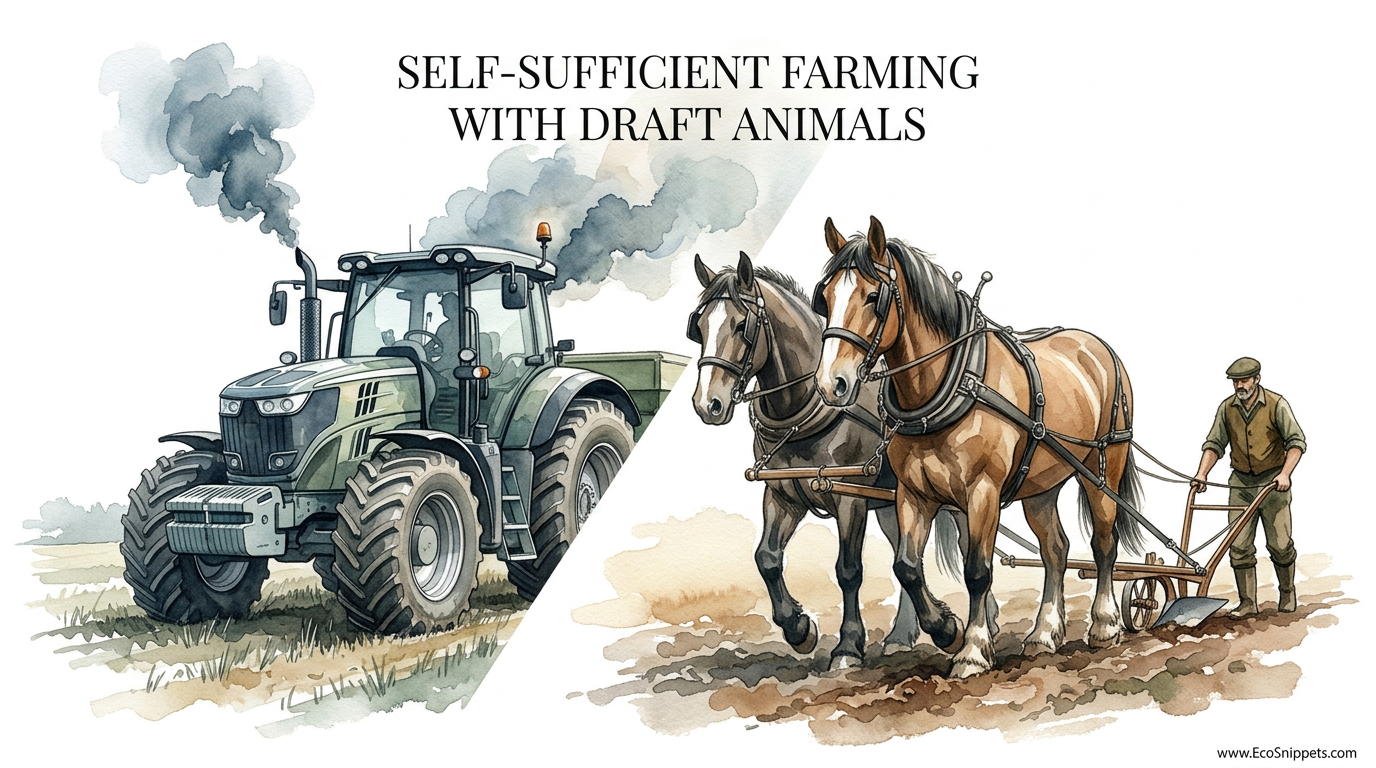
One of these requires a computer technician and a global supply chain to fix; the other just needs a fresh patch of clover and a calm voice. In a world of soaring fuel prices and fragile electronics, the tractor is becoming a liability. Our ancestors used a ‘machine’ that could heal itself, fuel itself from the ground it walked on, and even produce its own replacement. It is time to rethink the draft team.
Modern industrial farming relies on a precarious stack of technologies that often leave the small-scale producer at the mercy of distant corporations. When a sensor fails on a modern diesel tractor, the entire operation grinds to a halt. In contrast, a well-trained team of horses or oxen represents the ultimate in agricultural resilience. This transition is not about retreating into the past, but about advancing into a more stable and self-reliant future.
Choosing to work with draft animals allows you to step out of the cycle of debt and dependency. You become the mechanic, the fuel producer, and the navigator of your own land. This guide will walk you through the practicalities of integrating animal power into a modern homestead or small farm.
Self-sufficient Farming With Draft Animals
Self-sufficient farming with draft animals is the practice of using livestock—typically horses, oxen, or mules—to provide the primary motive power for agricultural tasks. This system replaces the internal combustion engine with biological energy. Instead of purchasing diesel, the farmer grows hay and grain to “fuel” the workers. Instead of disposing of exhaust fumes, the farmer collects manure to fertilize the fields.
This approach exists as a cornerstone of regenerative agriculture and small-holding resilience. It is most commonly seen today in Amish and Mennonite communities, but it is gaining traction among organic market gardeners and sustainable loggers. In regions with steep terrain or sensitive soils where heavy machinery would cause irreparable damage, draft animals remain the superior choice for moving logs or tilling soil.
Visualize a “closed-loop” system where the sun grows the grass, the grass feeds the horse, and the horse pulls the plow to grow more food. It is a biological engine that gains value as it ages and learns, unlike a tractor that begins depreciating the moment it leaves the dealership. Research indicates that interest in these systems is growing, with the horse-drawn equipment market projected to reach significant value by 2025 as farmers seek to lower their environmental footprint and input costs.
Selecting and Training the Modern Draft Team
The first step in this journey is deciding which species fits your land and temperament. Each animal brings a different rhythm and set of requirements to the farm.
Draft Horses: Power and Speed
Horses are the most common choice for modern draft work because they offer a balance of speed and power. Breeds like the Belgian, Percheron, and Suffolk Punch were specifically bred for the heavy pull. They move faster than oxen, making them ideal for tasks like raking hay or transporting goods to market. However, horses have a more sensitive constitution and require higher-quality feed, such as oats and high-protein hay, to maintain their energy levels during the working season.
Oxen: The Steady Giants
Oxen are typically steers (castrated male cattle) that have been trained for work. They are significantly slower than horses but possess immense “lugging” power. They are often preferred for breaking new ground or pulling heavy logs through thick brush. One of their greatest advantages is their diet; an ox can often thrive on lower-quality forage and grass alone, making them the most economical choice for a truly self-sufficient farm. They are also generally calmer and less likely to bolt if startled, though they are more sensitive to high heat as they do not sweat as efficiently as horses.
Mules: The Hardy Middle Ground
Mules are the offspring of a male donkey and a female horse. They are legendary for their “smart” nature and incredible endurance. A mule is often more disease-resistant and has tougher hooves than a horse, allowing it to work in rocky or difficult terrain with fewer injuries. They have a strong sense of self-preservation, which prevents them from overworking themselves to the point of collapse, a trait that some beginners mistake for stubbornness.
How the System Works: Harness and Implements
Successful animal-powered farming requires a basic understanding of how energy is transferred from the animal to the ground. The harness is the “transmission” of your biological engine.
The Harness System
A proper harness must distribute the weight of the load across the animal’s strongest points—the shoulders and chest. For horses and mules, this involves a padded collar and hames. For oxen, a wooden yoke is used, which rests either on the neck (neck yoke) or the forehead (head yoke). Poorly fitted equipment leads to sores and “balking,” where the animal refuses to work because of pain.
The Forecart: A Bridge to Modernity
One of the most important developments for the modern teamster is the forecart. This is a simple two-wheeled chassis with a seat and a hitch. It allows a farmer to use “off-the-shelf” tractor implements with a team of horses. Some forecarts even feature a ground-drive PTO (Power Take-Off) or a small auxiliary engine to run balers and mowers, creating a hybrid system that retains the benefits of animal power while utilizing modern machinery.
Benefits of the Traditional Team
The advantages of this system extend beyond simple nostalgia. They are measurable in the health of your soil and the stability of your bank account.
- Zero Fuel Costs: You can grow 100% of your power source on your own acreage. This eliminates the risk of fuel shortages or price spikes.
- Soil Preservation: A tractor’s tires compress the soil, destroying the microscopic life and drainage capacity. The “gentle tread” of a draft animal minimizes compaction and preserves soil structure.
- Fertilizer Production: Draft animals produce high-quality manure. When managed correctly, this waste becomes a valuable resource that reduces the need for synthetic nitrogen.
- Self-Reproduction: A tractor will never give birth to a smaller tractor. A mare or a cow can produce offspring, ensuring a future generation of workers or a source of income through sales.
- Emotional Connection: Working with animals fosters a deep, communicative relationship with the land. It turns a chore into a partnership.
Challenges and Common Mistakes
Transitioning to draft power is not without its hurdles. The most frequent error is underestimating the learning curve for the human operator.
Modern farmers are used to turning a key and moving. With animals, the first hour of the day is spent feeding, grooming, and harnessing. This daily commitment exists 365 days a year, whether you are in the field or not. Another common pitfall is purchasing “green” (untrained) animals. A beginner should always look for a “schoolmaster” team—older, experienced animals that know their job and can help teach the farmer.
Safety is paramount. A 2,000-pound animal that is spooked can cause significant damage. You must learn the nuances of “lines” (reins) and voice commands like “Gee” (right), “Haw” (left), and “Whoa” (stop) until they are second nature.
Limitations and Practical Constraints
While the draft team is resilient, it has clear boundaries. You cannot work a horse for 14 hours straight like you can a diesel engine. Animals need rest, water, and shade.
Scale is also a factor. A single team can comfortably manage about 5 to 20 acres of intensive cultivation. If you are farming hundreds of acres of monoculture grain, the logistics of feeding and managing the dozens of teams required would likely be overwhelming. This method is best suited for diversified farms, market gardens, and woodlots where precision and sustainability are valued over raw speed.
MODERN DIESEL vs TRADITIONAL TEAM
The choice between a tractor and a team often comes down to your specific goals for the land.
| Feature | Modern Diesel Tractor | Traditional Draft Team |
|---|---|---|
| Initial Cost | $30,000 – $100,000+ | $3,000 – $10,000 (Trained Team) |
| Fuel Source | Purchased Diesel / Fossil Fuels | On-farm Hay, Grain, and Pasture |
| Maintenance | Technician required; expensive parts | Daily care; Vet/Farrier visits |
| Soil Impact | High compaction; structural damage | Minimal compaction; adds nutrients |
| Lifespan | 15-20 years (with depreciation) | 15-20 years (with potential for offspring) |
| Complexity | High (Electronics, Hydraulics) | Low (Anatomy, Training, Leather) |
Practical Tips for the Aspiring Teamster
Success with draft animals depends on preparation and patience.
- Find a Mentor: Seek out an experienced teamster before you buy your first horse. Many skills, like properly fitting a collar or “throwing” a plow, are best learned in person.
- Check the Hooves: “No foot, no horse.” Invest in a good farrier who understands draft work. Working animals need regular trimming and, in some cases, shoes to protect their feet on hard ground.
- Start with a Single: If a team feels intimidating, start with a single horse or ox for light tasks like cultivating between rows or skidding firewood.
- Invest in Quality Leather: Cheap harness gear breaks under pressure. Buy high-quality leather or synthetic (Biothane) equipment that is easy to clean and maintain.
Advanced Considerations: Breeding and Logging
As you become more proficient, you may consider breeding your own stock or expanding into low-impact forestry.
Breeding for work requires selecting for temperament and bone density rather than just size or color. A “flashy” horse is useless if it lacks the heart for an eight-hour day in the field. For those with wooded acreage, draft animals offer a way to harvest timber without building massive logging roads. They can “snake” logs through narrow gaps between trees, allowing you to perform selective thinning that leaves the forest canopy intact. This service is increasingly in demand as landowners seek ways to manage their woods without the destruction caused by heavy skidders.
Example Scenario: The 10-Acre Market Garden
Consider a 10-acre organic vegetable farm. In a tractor-based system, the farmer might spend $4,000 annually on fuel, filters, and hydraulic fluids. The weight of the tractor requires the farmer to wait several days after a rain before tilling to avoid “mucking up” the soil.
Switching to a team of two Haflingers (a smaller draft breed), the farmer can enter the field much sooner after rain because the horses’ hooves do not smear the soil. The “fuel” for the Haflingers is grown on two acres of the farm that were previously unproductive. By the end of the season, the farmer has collected enough manure to cover the high-demand crops, reducing the fertilizer bill by 60%. The capital saved on tractor payments allows for the purchase of a high-quality greenhouse, further increasing the farm’s profitability.
Final Thoughts
Draft animal farming is a commitment to a slower, more intentional way of life. It rejects the “faster is always better” mentality of the industrial age in favor of a system that honors the biological limits of the land. This path provides a level of security that no software update or global supply chain can match.
Rethinking the draft team means recognizing that true efficiency is not measured in horsepower alone, but in the health of the soil, the depth of the farmer’s skill, and the independence of the homestead. If you are willing to learn the language of the lines and the rhythm of the seasons, you will find that these ancient machines are the most modern tools you could ever own.
Experimenting with a small team today builds the resilience you will need for tomorrow. Start with one furrow, one log, or one wagon load, and discover the quiet strength of the working team.
