How To Become More Self-Sufficient Without Starting a Full-Blown Farm…
Want to start preserving your harvest, making your own soap, or building a backyard root cellar — but not sure where to begin? “Homesteading Advice” gives you instant lifetime access to 35+ practical homesteading books on food preservation, veggie gardening, DIY natural cleaning products (save over $250 per year with this skill alone), brewing, off-grid energy, and a whole lot more…
Click Here To Check It Out Now!
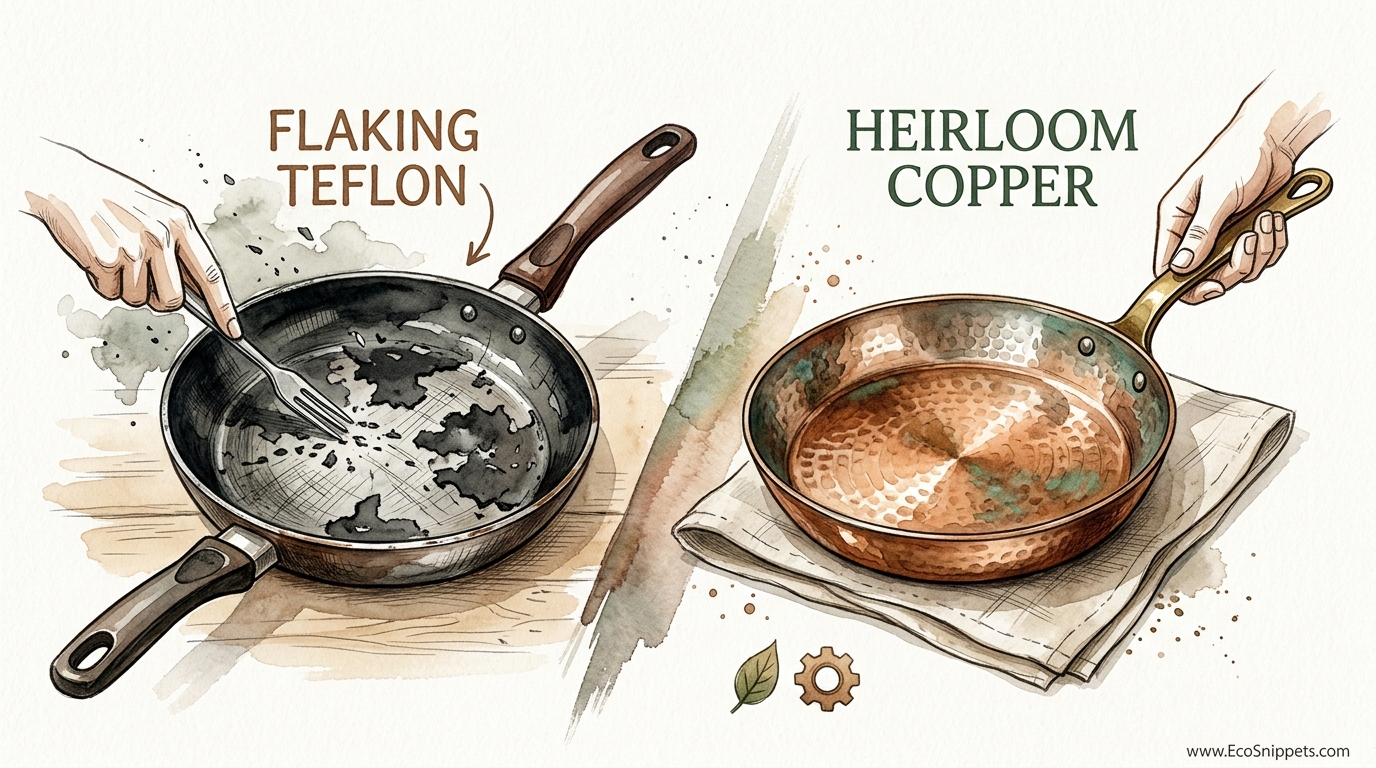
You will buy ten of the pans on the left in your lifetime, but your grandchildren will still be using the one on the right. Industrial ‘convenience’ gave us pans that expire after eighteen months of use. Every time that non-stick coating scratches, it ends up in your food—and then the landfill. Invest in heavy copper or iron once, and you’ve secured a kitchen tool that outlives the grid itself.
Modern kitchens have become stages for a peculiar kind of planned obsolescence. We have been sold the dream of the “slide-off” egg at the cost of our health and our planet. The cheap, lightweight pans found in big-box stores are essentially disposable plastic-coated aluminum. They are designed to fail, forcing you back to the store every two years when the chemical film begins to flake into your morning omelet.
Returning to heirloom materials isn’t about being a luddite; it is about reclaiming the efficiency and safety that our ancestors took for granted. Heavy metals like cast iron, carbon steel, and copper don’t just cook better—they get better with age. When you understand the physics of heat and the chemistry of fat, the need for synthetic coatings simply vanishes.
This guide will walk you through the transition from flaking Teflon to heirloom copper and iron. We will explore how these materials work, how to maintain them, and why they represent the ultimate sustainable choice for a self-reliant kitchen. It is time to stop buying trash and start investing in tools that carry a legacy.
Sustainable Kitchen Alternatives To Non Stick Pans
A sustainable kitchen alternative is any piece of cookware that relies on the inherent properties of the metal rather than a temporary chemical coating. The primary players in this space are cast iron, carbon steel, and copper. Each offers a unique relationship with heat and requires a specific set of skills to master, but all share a common trait: they are virtually indestructible if treated with basic respect.
Cast iron is the heavy-duty workhorse of the bunch. It is thick, slow to heat, but possesses a thermal mass that can sear a steak to perfection without dropping in temperature. Carbon steel is its leaner, more agile cousin, often found in professional French kitchens. It is lighter and more responsive to the flame. Copper is the “king of the kitchen,” offering surgical precision in temperature control that neither iron nor steel can match.
These materials exist because they solve the fundamental problems of cooking without the need for toxic additives. In a real-world kitchen, a seasoned carbon steel pan can fry an egg just as well as any non-stick surface, provided the cook understands heat management. These pans are used in the highest-stakes environments—from the campsites of mountain men to the Michelin-starred kitchens of Paris—because they never fail when the heat is on.
Switching to these alternatives removes “forever chemicals” like PFAS and PFOA from your household. Instead of a synthetic polymer, you are cooking on a layer of polymerized fat—a natural, renewable surface that you create and maintain yourself. It is a closed-loop system where the more you use the tool, the more effective it becomes.
How It Works: The Art of Seasoning and Heat
Understanding how an heirloom pan becomes non-stick requires a quick dive into the world of molecular science. The process is known as polymerization. When you apply a thin layer of fat to a metal surface and heat it past its smoke point, the fat undergoes a chemical change. The individual lipid molecules link together to form a hard, plastic-like solid that bonds directly to the microscopic pores of the metal.
This “seasoning” is not a greasy film; it is a tough, hydrophobic barrier. To achieve a perfect base layer on a new cast iron or carbon steel pan, follow these steps:
- Scrub to the Bone: If the pan is brand new and comes with a factory wax, scrub it with hot water and a stiff brush. Dry it immediately on the stove over low heat to ensure every molecule of moisture is gone.
- The Micro-Coat: Apply a tiny amount of high-smoke-point oil, such as grapeseed or refined avocado oil. Wipe it all over the pan, then use a clean rag to wipe it *off* until the pan looks dry. You only want a layer that is a few molecules thick.
- The Bake: Place the pan upside down in an oven preheated to 450°F (232°C). Bake it for one hour. The heat forces the oil to polymerize and bond.
- The Cool Down: Let the pan cool completely in the oven. This slow cooling helps the new layer settle without cracking or flaking.
For stainless steel and copper pans, the “non-stick” effect is achieved through the Leidenfrost effect. This occurs when you preheat your pan sufficiently so that a drop of water dances across the surface rather than evaporating instantly. When food hits a pan at this temperature, a microscopic cushion of steam forms between the food and the metal, preventing a bond. This is pure physics in action, requiring no chemicals whatsoever.
Maintenance is equally simple but requires a shift in mindset. Forget the dishwasher; it is the enemy of the heirloom pan. A simple rinse with hot water and a gentle scrub is usually enough. If you have stuck-on bits, use a chainmail scrubber or a handful of coarse salt. Always dry the pan on the stove and apply a “maintenance wipe” of oil before storing it in a dry place.
Benefits of Heirloom Metals
The most immediate benefit is your health. Traditional non-stick coatings begin to degrade at temperatures as low as 500°F, releasing toxic fumes that can cause “Teflon flu” in humans and are lethal to birds. Scratched pans leach microplastics and chemical precursors directly into your food. Heirloom metals have no such failure point; if you overheat a cast iron pan, you simply burn off the seasoning, which can be easily reapplied.
Longevity is the next measurable advantage. A non-stick pan is a “consumable” item with a lifespan of 18 to 36 months. Cast iron and copper are generational investments. There are pans currently in use that were forged before the American Civil War. When you buy once and keep forever, you are opting out of the waste cycle that clogs landfills with millions of tons of discarded cookware every year.
From a culinary perspective, these materials are superior. Cast iron provides unparalleled heat retention, essential for a proper crust on proteins. Carbon steel offers the agility needed for stir-frying and delicate fish. Copper provides the most even heat distribution on the planet, eliminating the “hot spots” that ruin delicate sauces or sugar work. You are not just being sustainable; you are becoming a better cook.
Challenges and Common Mistakes
The most frequent error beginners make is “The Oil Pool.” Many people believe that more oil equals better seasoning. In reality, too much oil during the seasoning process results in a sticky, gummy residue that will eventually peel. The goal is to wipe the oil until the pan looks like you’ve made a mistake and wiped it all away. The heat will do the rest.
Another pitfall is the fear of soap. While you shouldn’t soak your iron in a tub of soapy water, a drop of mild dish soap won’t destroy a well-established seasoning. Modern dish soaps are detergents, not the lye-based soaps of the 1800s that could actually strip oil. The real danger is moisture. Leaving a pan to “soak” overnight is a death sentence that invites rust, which is far harder to deal with than a bit of stuck-on egg.
Thermal shock is a silent killer of cast iron. Taking a screaming-hot pan and plunging it into cold water can cause the metal to crack or even shatter. This is especially true for older, thinner vintage pans. Always let your cookware cool naturally to room temperature before introducing water. Patience is a fundamental skill in the sustainable kitchen.
Limitations and Practical Constraints
Heirloom cookware is not without its trade-offs. Weight is the primary hurdle for many. A 12-inch cast iron skillet can weigh over seven pounds, making it difficult for those with wrist issues or limited mobility. Carbon steel offers a lighter alternative, but it still possesses more heft than the aluminum junk you may be used to. You must decide if the physical effort is worth the lifelong payoff.
Reactivity is another factor to consider. Unlined copper and “young” cast iron do not play well with highly acidic foods like tomatoes, vinegar, or citrus. The acid can strip the seasoning and impart a metallic taste to the food. While a well-aged iron pan can handle a quick tomato sauce, long-simmering stews are best left to enameled cast iron or stainless steel-lined copper.
Induction compatibility is also a modern concern. While cast iron and carbon steel work perfectly on induction hobs because they are magnetic, copper and most aluminum-cored stainless steel do not. If you are moving to a modern electric kitchen, you must verify that your “forever tools” are compatible with your heat source. Copper, specifically, requires an interface disk or a specific “induction-ready” base to work on these stoves.
Comparing the Pillars of the Kitchen
| Feature | Cast Iron | Carbon Steel | Heavy Copper |
|---|---|---|---|
| Longevity | Multiple Generations | Lifetime+ | Centuries (if re-tinned) |
| Heat Retention | Maximum | Moderate | Low |
| Responsiveness | Slow | Fast | Instant |
| Maintenance | Medium (Seasoning) | Medium (Seasoning) | High (Polishing/Tinning) |
| Cost | Low to Moderate | Moderate | High |
Practical Tips and Best Practices
If you are just starting out, buy a single 10-inch carbon steel skillet. It is the most versatile entry point into the world of seasoned metal. It is lighter than iron and responds faster to your mistakes. Use it every day. The best way to build a non-stick surface isn’t through fancy oven treatments; it’s by frying potatoes and searing fatty meats. The more oil you pass through the metal at high heat, the faster it matures.
Keep a “dry kit” near your stove. This should include a dedicated lint-free rag for oiling and a small container of high-heat cooking fat. After you wash your pan, put it back on the burner for 60 seconds. Once the water has evaporated, apply a tiny dab of fat and wipe it around. When the first wisp of smoke appears, turn off the heat. This 2-minute habit ensures your pan is always ready for the next meal and never rusts.
Learn to use metal utensils. One of the hidden joys of heirloom metal is that you can use stainless steel spatulas without fear. In fact, a flat-edged metal spatula helps “level out” the seasoning in cast iron over time, scraping away high spots and creating a glass-smooth surface. You don’t have to baby these tools; they were designed to be used with vigor.
Advanced Considerations: Tin vs. Stainless Lining
When you enter the world of high-end copper, you will face the choice between tin-lined and stainless steel-lined pans. This is where the serious practitioners separate themselves. Tin is the traditional lining; it is naturally non-stick and bonds molecularly to the copper, allowing for the best heat transfer possible. However, tin is soft and melts at 450°F. If you leave an empty tin-lined pan on a high flame, you can literally melt the lining off.
Stainless steel-lined copper is a modern invention. It is much more durable and can handle high heat without risk, but it is not naturally non-stick and doesn’t conduct heat quite as efficiently as tin. For sauté pans and skillets, many prefer stainless for the “ruggedness.” For saucepans and sugar pots, tin remains the gold standard. Knowing your own cooking habits is key to making this expensive decision.
Carbon steel also has nuances. Look for pans with a thickness of at least 2.5mm to 3mm. Thinner pans are prone to warping on high-powered burners. A thicker carbon steel pan will offer a hybrid experience—approaching the heat retention of iron while maintaining the smooth, fast surface of steel. Brands from the “French tradition” often use a beeswax coating for shipping; this must be completely melted off before you begin your seasoning journey.
Real-World Scenario: The Perfect Egg
The “egg test” is the benchmark for any non-stick surface. In a chemical pan, it’s effortless. In a carbon steel pan, it requires a bit of craft. Start by preheating your seasoned pan over medium-low heat for at least three minutes. You want the heat to be even and deep. Add a small pat of butter; if it foams gently without browning instantly, the temperature is perfect.
Crack the egg into the pan. Do not touch it for 30 seconds. This allows the proteins to set and the Leidenfrost effect to do its work. Use a thin metal spatula to gently nudge the edge. If the seasoning is healthy and the heat is right, the egg will slide across the metal as if it were on ice. This is the moment of clarity for many cooks—the realization that they never needed the chemicals in the first place.
Compare this to the “Teflon experience.” If you scratch a non-stick pan with a fork, that pan is now compromised. If you scratch your carbon steel pan, you simply cook another steak, and the scratch fills in with new seasoning. One is a fragile facade; the other is a living, self-healing skin. One is a liability; the other is an asset.
Final Thoughts
Choosing sustainable kitchen alternatives is an act of defiance against a culture that treats everything as disposable. By opting for cast iron, carbon steel, or copper, you are making a commitment to quality over convenience. You are choosing tools that require a bit of your time and attention but repay that investment tenfold in performance and longevity.
Transitioning away from non-stick pans is a journey. You may experience a few stuck meals and a little bit of rust in the beginning. Don’t let that discourage you. These materials are forgiving; there is almost nothing you can do to an iron or copper pan that cannot be fixed with a bit of steel wool and a new layer of oil. You are learning a skill that has sustained households for centuries.
Start small, buy the best you can afford, and treat your tools like the heirlooms they are. Your kitchen will become a place of deeper connection to your food and the physical world. In thirty years, when your grandchildren are searing their own meals in the same pans you bought today, the wisdom of this choice will be self-evident. Invest in the things that last.
