How To Become More Self-Sufficient Without Starting a Full-Blown Farm…
Want to start preserving your harvest, making your own soap, or building a backyard root cellar — but not sure where to begin? “Homesteading Advice” gives you instant lifetime access to 35+ practical homesteading books on food preservation, veggie gardening, DIY natural cleaning products (save over $250 per year with this skill alone), brewing, off-grid energy, and a whole lot more…
Click Here To Check It Out Now!
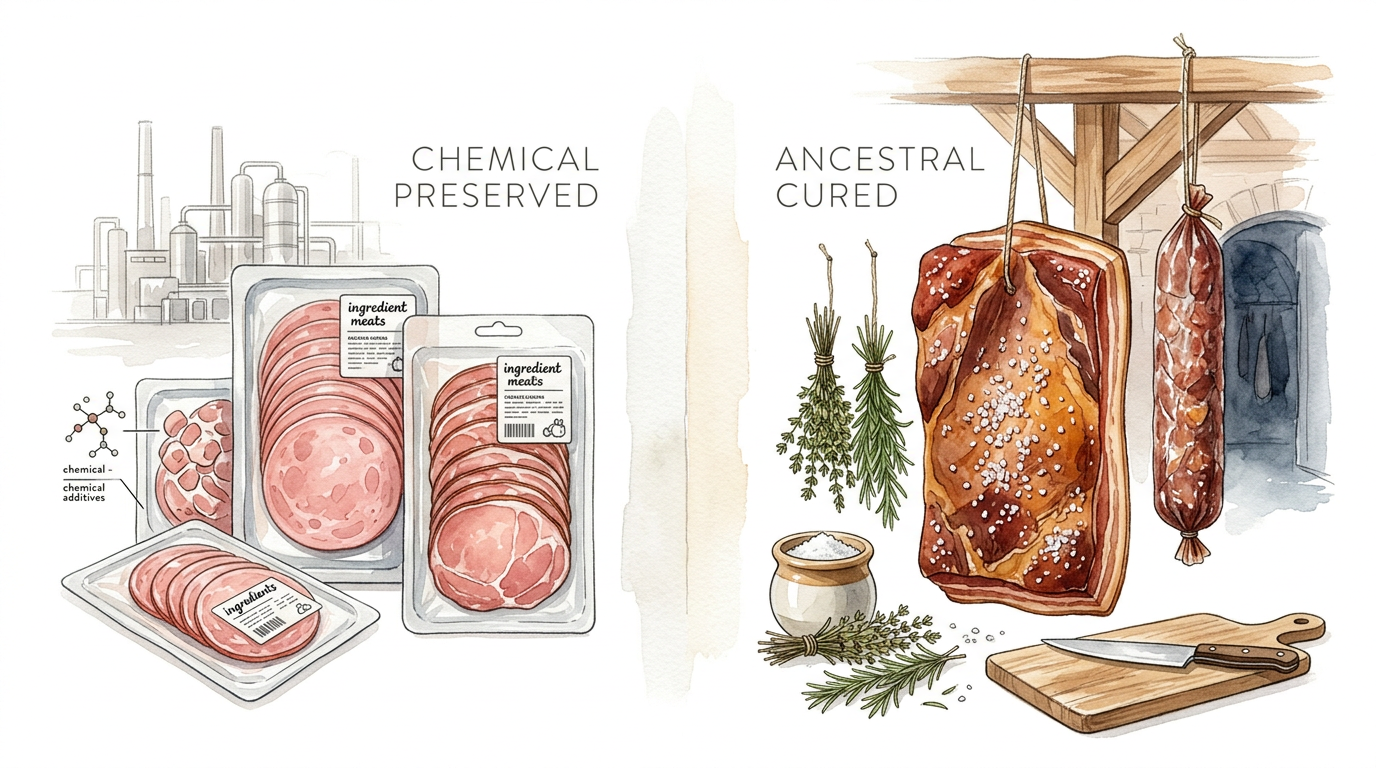
Before refrigerators and synthetic nitrates, our ancestors used two simple minerals to keep meat fresh for years. Modern food processing relies on pink salts and synthetic nitrates to keep meat ‘red’ and shelf-stable. Ancestral curing relies on time, air, and salt to create flavors that chemicals can never replicate. It is time to reclaim the salt-box and the smokehouse for your homestead.
If you have ever felt uneasy about the ingredient list on a package of supermarket bacon, you are not alone. There is a deep, instinctual satisfaction in knowing how to preserve your own harvest using nothing but the elements provided by the earth. This guide will walk you through the grit and grace of traditional meat preservation, helping you master a skill that has sustained humanity for millennia.
Traditional Salt Curing Meat At Home
Traditional salt curing is the process of using salt to draw moisture out of meat, effectively lowering its water activity to a level where spoilage bacteria cannot survive. This method, often referred to as dry curing or salting, transforms a perishable raw ingredient into a shelf-stable delicacy like prosciutto, pancetta, or country ham. It is a biological shield created through mineral application and environmental control.
Historically, this was not a gourmet hobby; it was a seasonal necessity. Ancient Romans valued salt so highly for this purpose that it was used as currency, giving us the word “salary” from the Latin salarium. On the homestead, the “salt-box” was the heart of the winter pantry. Without it, the autumn slaughter would have resulted in waste rather than a winter-long supply of protein.
Today, we use these methods to reconnect with the land and produce food with a depth of flavor that industrial processing cannot touch. While modern factories use chemical injections to “cure” meat in hours, the ancestral way takes weeks or months. This patience allows natural enzymes to break down proteins into savory amino acids, creating that unmistakable umami profile found in high-quality charcuterie.
The Biology of the Salt Box: How Osmosis Works
The primary mechanism behind salt curing is a simple scientific principle called osmosis. When you coat a piece of meat in salt, the high concentration of minerals on the outside pulls water molecules through the cell membranes of the meat to achieve equilibrium. This process essentially dehydrates the meat from the inside out.
Bacteria, including dangerous pathogens like Salmonella and E. coli, require a specific amount of “free” or unbound water to reproduce. As salt moves into the meat and water moves out, the environment becomes hypertonic. This pressure can actually rupture the cell walls of harmful microbes, effectively killing them or at least rendering them dormant.
Another critical factor is the reduction of water activity, often abbreviated as Aw. Fresh meat typically has a water activity level around 0.99. Most spoilage bacteria cannot grow once that level drops below 0.91, and most molds are inhibited at 0.80. Traditional curing aims to lower this water activity through a combination of salt penetration and subsequent air-drying.
Step-By-Step: The Ancestral Dry Cure Process
Mastering the salt-box method requires more than just dumping salt on a brisket. It involves a sequence of steps that ensure the salt reaches the center of the meat before spoilage can take hold at the bone.
1. Selecting and Prepping the Meat
Freshness is non-negotiable when you are not using synthetic preservatives. Start with meat that has been chilled immediately after slaughter. Trim away any loose flaps of fat or “blood spots,” as these can harbor bacteria or become rancid. Traditionalists often leave the skin on for larger cuts like hams to help regulate the rate of moisture loss.
2. The Initial Salt Application
For a traditional “salt-box” cure, you bury the meat entirely in a non-reactive container filled with coarse sea salt or kosher salt. A common rule of thumb for beginners is to use approximately 3% of the meat’s weight in salt if you are using a precision method, or simply ensure every square inch is covered in a thick layer for the traditional method.
3. The Curing Stage (Cold Storage)
Place the salted meat in a cool environment, ideally between 36°F and 40°F. This temperature is low enough to prevent spoilage but high enough to allow the salt to migrate into the muscle fibers. A general guideline is to allow one day of curing for every two pounds of meat, though larger hams may require weeks in the salt.
4. Rinsing and Equalization
Once the salt has done its work, remove the meat and rinse away the excess crystals. The meat will likely feel firm to the touch. The “equalization” phase follows, where the meat sits at the same cold temperature for a few more days without the salt crust. This allows the salt that has already entered the surface to move deeper into the center of the cut.
5. The Drying Phase
This is where the magic happens. The meat is hung in a “curing chamber” or a cool, dark cellar. The ideal conditions are 50°F to 60°F with a relative humidity of 70% to 75%. Over several weeks or months, the meat will lose roughly 30% of its original weight. This concentration of flavor and reduction in moisture is what makes the meat shelf-stable.
Benefits of Traditional Meat Preservation
The advantages of returning to ancestral curing methods extend beyond the kitchen. It is a fundamental pillar of self-reliance that changes your relationship with the food chain.
* Flavor Superiority: Slow-cured meats develop complex, nutty, and savory notes that “quick-cured” industrial meats can never achieve.
* Nutritional Integrity: You control the ingredients. By avoiding synthetic nitrates (like sodium nitrite) and artificial smoke flavorings, you produce a cleaner product.
* Food Security: Knowing how to preserve protein without electricity is a vital homesteading skill. A well-cured ham can hang in a cool pantry for a year without spoiling.
* Waste Reduction: Traditional curing allows you to use every part of the animal, turning less-desirable cuts into high-value pantry staples.
Challenges and Common Mistakes
While the process is simple, it is not without risks. Precision and cleanliness are your best allies in the smokehouse.
One of the most frequent errors is case hardening. This happens when the humidity in your drying area is too low. The outside of the meat dries too quickly, forming a hard, leathery “skin” that prevents the moisture in the center from escaping. This trapped moisture can then rot, leading to a spoiled product that looks fine on the outside but is dangerous on the inside.
Another common pitfall is bone sour. This occurs in large cuts like hams if the salt does not reach the bone quickly enough. Bacteria near the joint can begin to multiply before the salt concentration is high enough to stop them. Maintaining a strictly cold temperature during the initial salting phase is the best way to prevent this.
Finally, do not underestimate the importance of airflow. Stagnant air is the friend of unwanted mold. While a small amount of white, powdery mold (usually Penicillium nalgiovense) is often beneficial and protective, fuzzy green or black molds are a sign of poor ventilation and can ruin a batch.
Limitations of Traditional Salt Curing
Traditional curing is a partnership with nature, and nature has boundaries. It is important to recognize when this method may not be the ideal choice for your situation.
Environmental constraints are the primary hurdle. If you live in a climate with extremely high humidity (consistently above 85%) or extreme heat, you cannot safely air-dry meat without a climate-controlled chamber. Without a steady 55°F environment, the fat in the meat can go rancid or the drying process can stall, leading to spoilage.
Time is another limitation. If you need meat preserved for next week, traditional curing is not the answer. This is a “slow food” practice that requires planning months in advance. Furthermore, some lean meats, like venison, can become excessively tough or “gamey” if dry-cured without the protective fat layer found on pork.
Comparing Ancestral Curing and Chemical Processing
To understand the value of traditional methods, it helps to see how they stack up against modern industrial standards.
| Feature | Ancestral Curing | Industrial Processing |
|---|---|---|
| Primary Preservative | Sea Salt / Rock Salt | Sodium Nitrite / Pink Salt |
| Time to Finish | 30 to 180+ Days | 24 to 48 Hours |
| Flavor Profile | Complex, Umami, Nutty | Salty, Metallic, Sweet |
| Weight Change | Loses 30-35% (Concentrated) | Gains 10% (Injected Water) |
| Skill Level | Intermediate to Advanced | Low (Standardized) |
Practical Tips and Best Practices
If you are ready to start your first batch, keep these “pioneer-grit” tips in mind to ensure success.
* Invest in a Scale: While the “salt-box” method is traditional, beginners should use a digital scale to measure salt as 3% of the meat’s weight. This “equilibrium curing” method ensures you never over-salt the product.
* Use Non-Reactive Containers: Salt will corrode metal. Use food-grade plastic, glass, or traditional earthenware crocks.
* Label Everything: You will not remember the starting weight or the date you hung the meat three months from now. Write it on a tag attached to the twine.
* Sanitation is Key: Wash your hands and tools with hot, soapy water. While salt is a preservative, you don’t want to introduce competing bacteria at the start of the race.
* Watch the Mold: If you see “bad” mold (black or furry green), wipe it off immediately with a cloth dipped in vinegar. If it returns aggressively, re-evaluate your airflow.
Advanced Considerations: The Nitrate Debate
A serious practitioner must eventually decide whether to use “pink salt” (sodium nitrite/nitrate) or stick to pure sea salt. Modern curing salts are dyed pink to prevent accidental ingestion and are used to prevent botulism, especially in sausage making where meat is ground and exposed to more oxygen.
Traditionalists argue that whole-muscle cuts (like a loin or ham) do not require nitrites if the salt penetration is managed correctly. The high salt concentration and drying process are historically sufficient. However, if you are curing at temperatures above 40°F or making fermented sausages, many experts recommend using Prague Powder #2 as a safety net. This is a personal choice based on your comfort with the tradition and your specific environment.
Scenario: The Three-Month Guanciale
Imagine you have just harvested a heritage hog. You have two beautiful jowls (the cheeks) that are rich in hard, white fat. Instead of grinding them into sausage, you decide to make Guanciale.
You rub the jowls with a mix of sea salt, black pepper, and dried thyme. You place them in a glass dish in the back of your refrigerator for seven days, flipping them daily as the salt draws out a small amount of liquid. After a week, the meat feels stiff. You rinse them, pat them dry, and poke a hole through the corner to thread a piece of natural twine.
You hang the jowls in a cool corner of your basement where the temperature stays around 55°F. For the first two weeks, you check them daily. By month two, a thin layer of white mold has appeared—this is a good sign. By month three, the jowl has lost 30% of its weight. You slice into it to find a deep ruby-red center and translucent fat that melts at room temperature. This is the reward for your patience.
Final Thoughts
Traditional salt curing is more than a way to fill a pantry; it is a way to reclaim a piece of human history. When you master the balance of salt, time, and air, you stop being a mere consumer and become a producer. You begin to see meat not as a plastic-wrapped commodity, but as a valuable resource to be respected and preserved.
Start small with a pork loin or a piece of belly. Observe how the meat changes under the influence of the salt. Feel the texture firm up and watch the color deepen. Each batch will teach you something new about your environment and the subtle rhythms of the seasons.
The path of the homesteaders before us was paved with these simple minerals. By keeping these traditions alive in your own kitchen, you ensure that the wisdom of the salt-box is never lost to the hum of the supermarket refrigerator. Experiment, stay curious, and let the salt do its ancient work.
