How To Become More Self-Sufficient Without Starting a Full-Blown Farm…
Want to start preserving your harvest, making your own soap, or building a backyard root cellar — but not sure where to begin? “Homesteading Advice” gives you instant lifetime access to 35+ practical homesteading books on food preservation, veggie gardening, DIY natural cleaning products (save over $250 per year with this skill alone), brewing, off-grid energy, and a whole lot more…
Click Here To Check It Out Now!
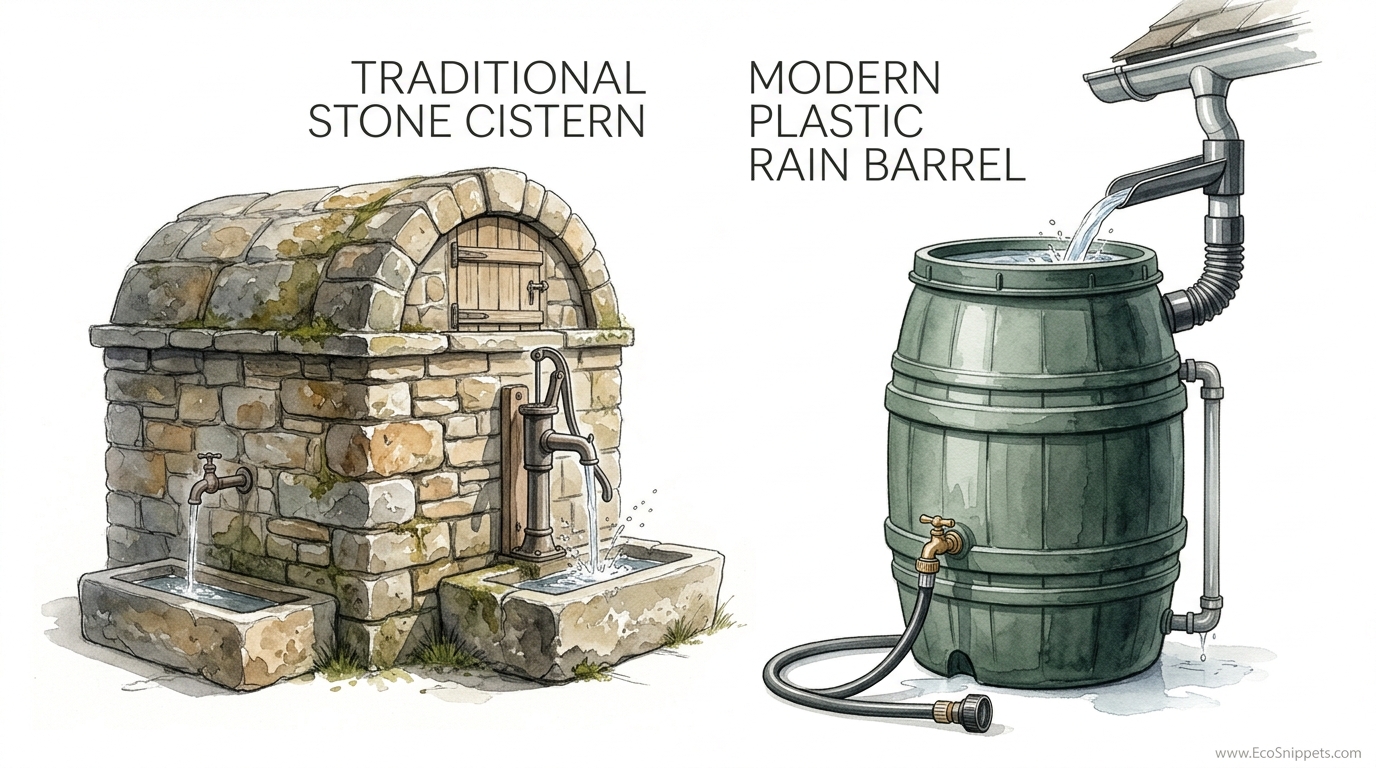
One of these will be a pile of microplastics in twenty years, while the other has already served four generations. We traded 200-year durability for 20-minute convenience. Modern plastic water tanks are failing at an alarming rate due to UV degradation, while ancient stone cisterns continue to provide cool, clean water without adding a single chemical to the environment. It is time to stop buying temporary fixes and start building for the centuries.
Choosing how to store your water is more than a plumbing decision. It is a declaration of how long you intend for your homestead to last. If you are looking for a quick fix that you can throw in the back of a truck, a plastic rain barrel might suffice for a season or two. But if you are building a legacy, you need to look at the materials that have sustained humanity since the Bronze Age.
Ancient civilizations understood a fundamental truth that we have forgotten. Water is a living thing, and the container you put it in dictates its health. While we often think of “modern” as better, the plastic revolution has introduced a host of problems that our ancestors never had to face, from microplastic leaching to catastrophic structural failure under the sun.
Traditional Stone Cisterns Vs Plastic Rain Barrels
Traditional stone cisterns are permanent masonry structures, often built partially or fully underground, designed to store thousands of gallons of water. They represent a high-capital, long-term investment in infrastructure. These structures rely on the sheer mass of stone and the sealing properties of hydraulic lime or modern food-grade mortars to create a vault that keeps water dark, cold, and biologically stable.
Plastic rain barrels, usually made of High-Density Polyethylene (HDPE), are the modern alternative born of the petrochemical age. They are lightweight, relatively inexpensive, and easy to move. They exist because they are easy to mass-produce and ship, serving the needs of a mobile, suburban population that views home ownership as a ten-year cycle rather than a multi-generational stewardship.
You see stone cisterns in the arid hills of the Mediterranean and the old farmsteads of New England. These are regions where people could not afford for their water supply to vanish during a summer drought or a freak freeze. In contrast, plastic barrels are ubiquitous in modern gardens where they serve as a secondary supplement to municipal water. The difference is one of reliability and intent.
How the Systems Compare in the Real World
The physics of water storage are unforgiving. Water is heavy, weighing roughly 8.34 pounds per gallon. A 1,000-gallon tank holds over four tons of weight. Stone cisterns handle this pressure through mass and gravity. They are integrated into the earth, using the surrounding soil to help support the walls and provide insulation.
Plastic tanks, however, must rely on the tensile strength of their polymer chains. When you fill a large plastic tank, the walls stretch. Over time, that constant stress, combined with the oscillating temperatures of day and night, causes the plastic to fatigue. While a stone wall becomes stronger as it settles, a plastic wall is at its strongest the day it leaves the factory and only gets weaker from that point forward.
Consider the environment. A stone cistern is a part of the landscape. It does not off-gas chemicals or shed particles. It is essentially an artificial cave. A plastic tank is a foreign object, a synthetic bubble that is constantly fighting against the elements. Rainwater is naturally slightly acidic, and over decades, this acidity can interact with the various stabilizers and dyes in plastic, whereas it simply finds a neutral balance against the minerals in stone.
The Science of Longevity: UV Degradation vs. Mineral Mass
Plastic tanks are the victims of a process called photo-oxidation. Even the best “UV-stabilized” polyethylene has a shelf life. Ultraviolet radiation from the sun hits the plastic and begins to break the carbon-hydrogen bonds that hold the polymer together. This creates free radicals, which then attack neighboring molecules in a chain reaction.
Signs of this failure are easy to spot if you know what to look for. It starts as “chalking,” where the surface of the tank becomes dull and white. This is the plastic literally turning to dust. Eventually, the material becomes brittle. A tank that could once withstand a hit from a fallen branch will shatter like glass once the plastic has been sufficiently degraded by the sun.
Stone and masonry do not have this weakness. Sunlight does nothing to granite, limestone, or mortar except perhaps grow a bit of moss on the exterior. Because stone cisterns are usually built with thick walls or buried underground, they are completely shielded from UV rays. This lack of light also serves a dual purpose: it prevents the growth of algae. Algae needs photosynthesis to thrive. In the pitch-black environment of a stone cistern, the water remains clear and “dead” in terms of botanical growth, which is exactly what you want for storage.
The Thermal Advantage of Stone
One of the most overlooked benefits of stone is its thermal mass. Water stored in a plastic tank sitting on a wooden deck in July will quickly reach the ambient air temperature. In many climates, this means your “fresh” rainwater is sitting at 85 or 90 degrees Fahrenheit. This is the perfect breeding ground for bacteria, including Legionella and various coliforms.
Stone cisterns, particularly those buried at least three feet deep, stay at the constant temperature of the earth. In most temperate zones, this is between 50 and 60 degrees Fahrenheit. Cold water holds more dissolved oxygen, which helps keep the water tasting fresh and prevents it from becoming anaerobic. When you draw water from a stone cistern in the heat of summer, it is refreshingly cool, a feat no thin-walled plastic barrel can replicate.
Furthermore, the lime used in traditional mortars has a slight alkalizing effect on the water. Rainwater is often slightly acidic because it picks up carbon dioxide as it falls through the atmosphere. Storing it in a masonry environment can help neutralize that pH, making the water less corrosive to your pipes and better for your garden soil.
Challenges and Common Mistakes in Construction
The biggest pitfall in building a stone cistern is the “shortcut” mentality. Many people try to build a stone tank using standard mortar and no liner, only to find it leaks within a month. Water is a persistent traveler; it will find every hairline crack and every porous joint. Traditional builders used hydraulic lime or “Roman cement,” which actually hardens under water and remains flexible enough to handle minor ground shifts.
Another frequent error is improper siting. A stone cistern is incredibly heavy. If you build it on uncompacted fill dirt or near a shifting slope, the structure will crack as the ground settles. You must reach stable, native soil or bedrock before laying your foundation. If you are building a cistern that will be integrated into a house foundation, the engineering must account for the hydrostatic pressure of the water pushing out against the walls.
Sizing the overflow is another area where homesteaders often fail. If your inflow pipe is four inches, your overflow pipe must be at least four inches, preferably larger. During a heavy downpour, a cistern can fill rapidly. If the overflow cannot keep up, the pressure can actually lift the lid or blow out the top of the masonry, leading to expensive repairs and a lost harvest of water.
Limitations: When Stone is Not the Best Choice
Despite the clear advantages of stone, there are situations where a plastic tank is the more logical choice. The primary limitation is mobility. If you are a renter or plan to move in three years, building a stone cistern is a gift to your landlord, not an investment for yourself. Plastic tanks are “portable assets,” whereas stone cisterns are “real property.”
Cost is the other major hurdle. A 2,500-gallon plastic tank might cost you $2,000 and can be installed in an afternoon with two people. A stone cistern of the same capacity could cost $10,000 to $15,000 in labor and materials and take weeks to construct. For some, the high initial barrier is simply too much to overcome, regardless of the long-term savings.
Earthquake zones also require special consideration. While a plastic tank can flex and bounce during a tremor, a rigid stone structure is prone to cracking. If you live in a high-seismic area, a stone cistern must be heavily reinforced with steel rebar or built using specialized techniques to ensure it doesn’t shatter when the ground moves.
Comparison Table: Plastic vs. Stone Water Storage
| Feature | Plastic (HDPE) Rain Barrel | Traditional Stone Cistern |
|---|---|---|
| Expected Lifespan | 10–25 Years (UV dependent) | 100–500+ Years |
| Installation Time | 1–4 Hours | 2–4 Weeks |
| Water Temperature | Fluctuates with air (Warm) | Stable (Cool/Earth temp) |
| Water Quality | Potential leaching, high algae | Mineralized, zero algae |
| Repairability | Difficult/Impossible | Easy (Re-plastering) |
| Initial Cost | Low to Moderate | High |
Practical Tips for Building and Maintaining a Cistern
If you decide to go the traditional route, start by calculating your catchment potential. You can find this by multiplying your roof square footage by 0.6. This gives you the gallons of water collected for every inch of rain. Do not build a cistern that is too small; it is better to have extra capacity than to watch water overflow and waste away during a storm.
Always include a “first flush” diverter. The first few gallons of rain that hit your roof are the dirtiest, carrying bird droppings, dust, and pollen. A simple PVC pipe arrangement can automatically divert this initial “wash” away from your cistern, ensuring that only the cleanest water makes it into your stone vault. This significantly reduces the amount of sediment that builds up at the bottom.
Maintenance for a stone cistern is surprisingly low. Every 5 to 10 years, you should drain the tank and shovel out any fine silt that has accumulated. Inspect the interior walls for any signs of weeping or lime leaching. If you find small cracks, they can usually be patched with a simple application of hydraulic cement. Unlike plastic, which is discarded when it fails, a stone cistern is an infinitely repairable asset.
Advanced Considerations: The Ecosystem of Storage
Serious practitioners often look at cisterns as more than just tanks. They are part of a larger permaculture design. For instance, an underground stone cistern can act as a “coolth” sink. By circulating air through pipes that pass near the cistern, you can provide passive cooling to a root cellar or even a small home in the summer.
You can also use specific stone types to influence water chemistry. If your local water is excessively soft or acidic, using limestone in the construction of your cistern can naturally add calcium and magnesium back into the water. This mimics the natural filtration process of a mountain spring. In contrast, if you need neutral water, you might use granite or basalt with a high-quality food-grade sealer.
Think about the pump system as well. Traditional cisterns used a “pitcher pump” or a simple bucket and windlass. While modern electric pumps are convenient, always design your cistern so that you can access the water manually if the grid goes down. A deep-well hand pump can be installed alongside a submersible electric pump, giving you the best of both worlds: modern convenience and pioneer-grit reliability.
Historical Examples: Lessons from the Past
The Basilica Cistern in Istanbul is perhaps the most famous example of stone water storage. Built in the 6th century, it features 336 marble columns and can hold 80,000 cubic meters of water. Even after 1,500 years, the structure remains intact. It was built using “Khorasan mortar,” a mixture of lime, sand, and crushed brick that created a waterproof seal far superior to many modern materials.
In the United States, early settlers in the Midwest frequently built “bottle cisterns.” These were hand-dug, bell-shaped holes in the clay soil, lined with brick and plastered with lime. Many of these are still found today under the foundations of old farmhouses. They provided the primary source of water for families for a century before rural electric cooperatives brought pressurized well water to the countryside.
These structures prove that longevity is not a mystery; it is a choice of material. The settlers did not have access to plastic, so they built with what they had. But even when they had the choice to use wood or early metals, they chose stone and masonry for their most critical resource because they knew the cost of failure was too high.
Final Thoughts
Investing in a stone cistern is a commitment to the future. It is an admission that the cycles of nature are longer than the cycles of the market. While a plastic rain barrel is a convenient tool for a hobbyist, a stone cistern is a foundational piece of a self-reliant life. It provides security that cannot be melted by the sun or cracked by a freeze.
We often confuse “new” with “improved.” In the realm of water storage, the old ways remain the gold standard. By choosing stone over plastic, you are removing yourself from the cycle of planned obsolescence. You are choosing a path that leads to cooler water, cleaner environments, and a homestead that will still be standing long after the plastic barrels of today have crumbled into the soil.
Start small if you must, perhaps with a masonry trough or a small stone-lined well, but keep your eyes on the goal of a permanent cistern. The peace of mind that comes from knowing your water is safe in a vault of stone is worth every bit of the labor it requires. Build for the centuries, and the centuries will take care of you.
