How To Become More Self-Sufficient Without Starting a Full-Blown Farm…
Want to start preserving your harvest, making your own soap, or building a backyard root cellar — but not sure where to begin? “Homesteading Advice” gives you instant lifetime access to 35+ practical homesteading books on food preservation, veggie gardening, DIY natural cleaning products (save over $250 per year with this skill alone), brewing, off-grid energy, and a whole lot more…
Click Here To Check It Out Now!
One finish creates a plastic shell that eventually fails; the other penetrates the wood to protect it for generations. In the 1950s, we traded permanence for convenience. Modern hardware store “finishes” are just plastic coats that trap moisture and rot your tools from the inside out. Our ancestors used simple, natural oils that breathe with the wood and harden over time. Learn why your survival gear needs a finish that can be repaired, not just replaced.
When you pick up an heirloom tool from a century ago, the handle often feels like velvet. It has a weight and a warmth that modern store-bought shovels and axes simply cannot replicate. That feeling isn’t just age; it is the result of a traditional wood preservation method that works with the biology of the timber rather than against it.
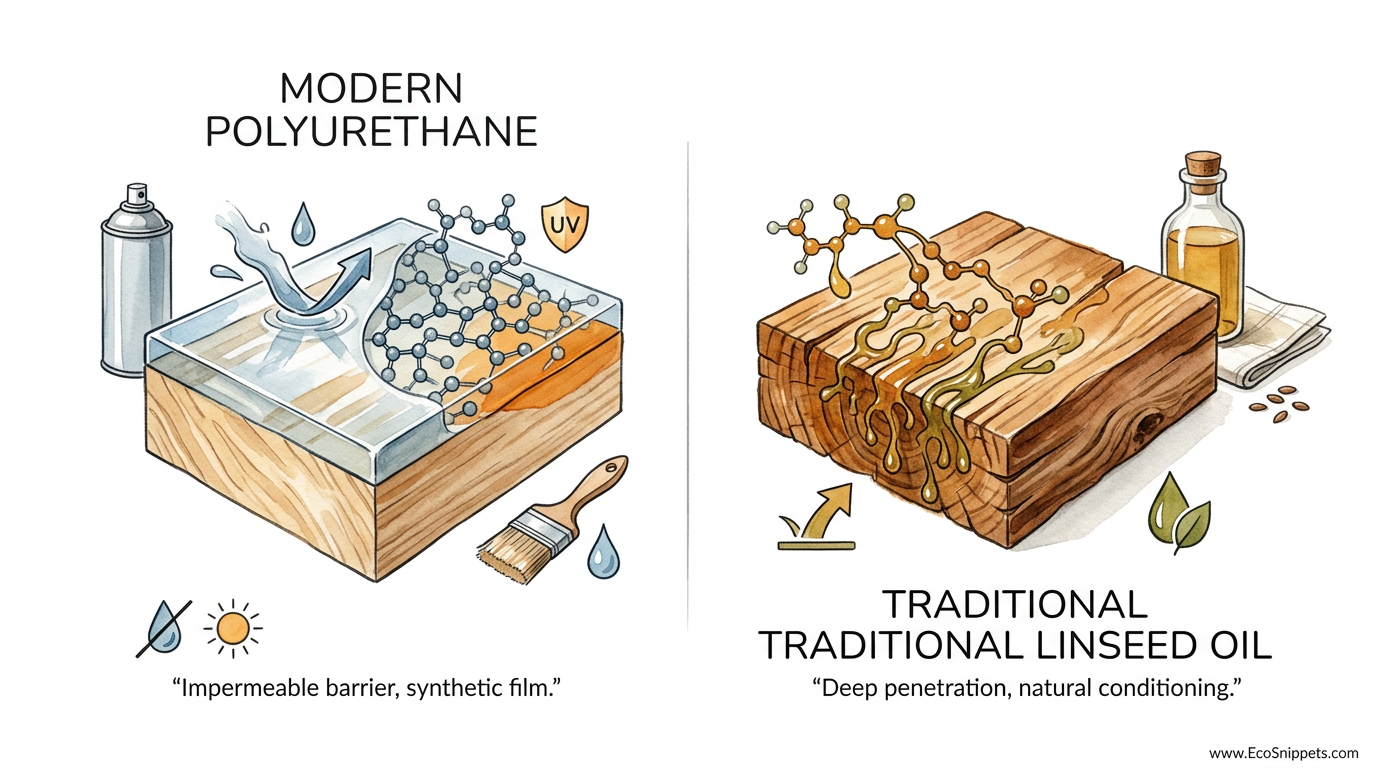
Most modern finishes rely on a chemical film to shield wood from the elements. While this looks shiny on the shelf, it creates a fatal flaw for any tool meant for hard work. Once that plastic skin is nicked or scratched, water finds its way into the wood fibers and stays there, unable to evaporate through the non-breathable barrier. This is the primary cause of handle rot in modern tools.
Understanding traditional finishes means going back to a time when a man’s life depended on the integrity of his gear. Whether you are maintaining a homestead or preparing survival equipment, choosing the right finish is the difference between a tool that lasts five years and one that serves three generations. We are going to explore the chemistry, the application, and the grit required to maintain wood the old-fashioned way.
Traditional Wood Preservation Methods
Traditional wood preservation is the practice of using natural, “drying” oils and resins to saturate the wood grain. Unlike modern stains that sit on the surface, these substances are absorbed into the cellular structure of the wood. Once inside, they undergo a chemical change that turns a liquid oil into a solid, protective polymer.
Historically, the two giants of this world are Linseed Oil and Tung Oil. Linseed oil is pressed from the seeds of the flax plant and has been the backbone of European and American tool maintenance for centuries. Tung oil, often called “China wood oil,” comes from the nuts of the tung tree and offers even higher levels of water resistance and durability.
These methods were born out of necessity. In a world without synthetic polymers, craftsmen needed a way to keep wood from checking, splitting, or rotting in the rain. They turned to nature to find substances that were hydrophobic—meaning they repel water—while remaining flexible enough to move as the wood expands and contracts with the seasons.
Another traditional method involves the use of pine tar. Often mixed with linseed oil and turpentine, pine tar provides a heavy-duty, antifungal barrier used for everything from fence posts to wooden boat hulls. These substances don’t just “beautify” the wood; they actively fight off the microorganisms that cause decay.
How the Polymerization Process Works
To use traditional finishes effectively, you must understand that they do not “dry” through evaporation like a glass of water. Instead, they cure through a process called polymerization. When these oils are exposed to oxygen, a chemical reaction occurs where the oil molecules cross-link and harden into a durable solid.
This process begins the moment you wipe the oil onto the wood. The oil fills the microscopic pores of the timber, essentially replacing air and moisture with a liquid that will eventually turn into a hard, plastic-like substance inside the wood itself. This creates a “case-hardened” effect where the wood becomes denser and more resistant to impact.
However, pure natural oils like Raw Linseed Oil polymerize very slowly. In cold or humid conditions, a single coat can take weeks to fully cure. This led to the development of “Boiled” Linseed Oil (BLO). Historically, the oil was actually boiled to begin the oxidation process early; today, manufacturers achieve this by adding metallic driers like manganese or cobalt to speed up the curing time to about 24 hours.
When you apply these oils, you are essentially creating a composite material. You have the structural strength of the wood fibers supported by the internal “skeleton” of the hardened oil. Because this protection is internal, a scratch on the surface does not compromise the integrity of the tool. You simply rub a little more oil into the scratch, and the protection is restored.
Benefits of Penetrating Oil Finishes
The most immediate benefit of a traditional oil finish is the ergonomics of the grip. Modern polyurethane coatings create a smooth, friction-heavy surface that generates “hot spots” on the hands during heavy use. This is why a new shovel often leads to blisters; your skin is rubbing against a layer of plastic that doesn’t breathe. Oiled wood, however, retains its natural texture, providing a secure grip that is kind to the skin.
Another massive advantage is infinite repairability. If a polyurethane-coated handle cracks or peels, the only solution is to sand the entire tool down to bare wood and start over. With an oil finish, you can perform “spot repairs” in seconds. If a section of the handle looks dry or gets a scuff, you just wipe on a fresh layer of oil, and it bonds perfectly with the old finish.
Longevity is perhaps the most significant factor for the survivalist or serious craftsman. An oiled handle is flexible. As the temperature changes, the wood can expand and contract without the finish cracking. This prevents the “brittle failure” common in modern tools where the coating shatters, leaving the wood exposed to the elements.
Finally, traditional oils offer internal moisture management. While they repel liquid water, they are “vapor open.” This means that any moisture already trapped inside the wood can eventually migrate out and evaporate. This “breathability” is exactly what prevents the interior rot that plagues tools finished with modern hardware store products.
Challenges and Common Mistakes
The greatest challenge with traditional finishes is the risk of spontaneous combustion. Because the curing process of linseed oil is an exothermic reaction—meaning it releases heat—a pile of oil-soaked rags can actually catch fire on its own. If the heat cannot dissipate, the rags will reach their ignition point and burn your workshop to the ground. You must always dry your rags flat and outdoors, or submerge them in water.
Another common error is applying the oil too thick. Because these are penetrating finishes, any oil that remains on the surface after 20 minutes should be wiped off. If you leave a thick layer of oil on top, it will turn into a sticky, gummy mess that never fully hardens. This “tackiness” attracts dirt and makes the tool unpleasant to use.
Many beginners also fail to account for curing times. Just because the wood feels dry to the touch doesn’t mean the polymerization is complete. Using a tool too soon after oiling can cause the finish to “gum up” or rub off on your hands. Patience is a requirement for anyone moving away from modern “quick-dry” plastics.
Using the wrong type of oil for the job is another frequent pitfall. For example, while Boiled Linseed Oil is excellent for tools, it is generally not food-safe due to the chemical driers. If you are finishing a wooden spoon or a cutting board, you must use Raw Linseed Oil or Pure Tung Oil, which are slower to dry but safe for consumption.
Limitations of Traditional Oils
Despite their superior feel and longevity, traditional oils are not “set and forget” finishes. They require periodic maintenance. If you leave an oiled tool in the rain for a week, the oil will eventually wash out or degrade, leaving the wood vulnerable. You cannot expect a single application to protect a tool for a decade of hard use.
Traditional oils also offer very little protection against chemical spills. While they handle water and sweat with ease, strong solvents or acidic substances can strip the oil out of the wood quite easily. In a modern garage environment where brake cleaner or gasoline might be present, you must be careful where you set your oiled tools.
UV resistance is another area where modern synthetics sometimes have an edge. Pure natural oils can “gray” over time if left in direct sunlight constantly. While the structural integrity of the wood remains intact, the aesthetic will change. For many, this “patina” is desirable, but for those wanting a permanent, “factory-fresh” look, oils may be disappointing.
Finally, there is the “thirst” of the wood. Different species of wood absorb oil at different rates. A piece of old, dry hickory might require five or six coats before it stops drinking, whereas a denser wood like oak might be saturated in two. This makes it difficult to predict exactly how much material or time a project will take.
Modern Polyurethane vs. Traditional Linseed Oil
| Feature | Modern Polyurethane | Traditional Linseed Oil |
|---|---|---|
| Protection Mechanism | Surface Film (Plastic Shell) | Internal Penetration (Polymerization) |
| Maintenance | High (Requires stripping/sanding) | Low (Easy re-application) |
| Grip/Feel | Slippery when wet; Blister-prone | Natural texture; Secure grip |
| Durability | Brittle; Cracks with wood movement | Flexible; Moves with the grain |
| Health/Safety | High VOCs; Toxic if burned | Natural; Low-to-no VOCs |
| Rot Resistance | Can trap moisture and cause rot | Breathable; Prevents internal rot |
Practical Tips for Oiling Survival Gear
To get the best results on a tool handle, follow the Old-Timer’s Rule of Oiling: “Once a day for a week, once a week for a month, once a month for a year, and once a year for the rest of your life.” This schedule ensures the wood is completely saturated and that the internal polymer structure is robust.
Before you begin, ensure the wood is clean and “open.” If the handle has an existing factory varnish, you must sand it off entirely. Oil cannot penetrate through a layer of plastic. Use 80-grit sandpaper to remove the finish, then move up to 120 and 150-grit to smooth out the fibers.
When applying the oil, use a lint-free cotton cloth. Apply the oil liberally until the wood stops absorbing it and looks “wet.” Let it sit for 20 to 30 minutes, then vigorously wipe away every bit of excess. You aren’t trying to build a layer on top; you are trying to stuff as much as possible inside.
For added protection on tools like axes and shovels, you can “burnish” the wood after the final coat. Take a smooth piece of hardwood or a rounded bone and rub it hard against the grain of the handle. This compresses the surface fibers and the oil together, creating a glass-like finish that is incredibly tough and water-resistant.
Advanced Considerations for Long-Term Storage
If you are preparing tools for long-term storage in a survival cache, consider a Pine Tar Blend. A mixture of 50% Boiled Linseed Oil, 25% Pine Tar, and 25% Turpentine (often called “The Holy Trinity” of wood preservation) provides an almost indestructible barrier against mold and moisture. The turpentine acts as a solvent to carry the heavy pine tar deep into the grain.
Another advanced technique is the Heat Impregnation Method. By gently warming your linseed oil in a double boiler (never over an open flame) to about 140°F (60°C), you reduce its viscosity. This allowed the oil to penetrate much deeper into the dense heartwood of hardwoods like Hickory and Ash. You can also use a heat gun to warm the wood itself before application.
For items that require absolute waterproofness, such as wooden knife scales or pistol grips, Polymerized Tung Oil is the gold standard. Unlike standard tung oil, the polymerized version has been heat-treated to create larger molecular chains, allowing it to cure harder and faster while remaining completely non-toxic and food-safe.
Consider the “Eye” of the tool. On axes and hammers, the most vulnerable part of the handle is where it meets the metal head. This end-grain acts like a bunch of straws, sucking up moisture and causing the wood to swell and shrink until the head becomes loose. Saturate the eye repeatedly with oil to seal these “straws” and keep your tool heads tight for decades.
Examples of Traditional Preservation in Practice
Imagine you have just purchased a high-quality Swedish forest axe. Out of the box, it likely has a light coating of linseed oil. To truly “set” this handle, you would sand it lightly with 150-grit paper to open the grain. Over the next week, you apply a thin coat of Boiled Linseed Oil every evening before bed, wiping it dry after 20 minutes. By day seven, the handle has a deep, amber glow and feels solid in the hand.
In another scenario, consider a homestead workbench made of thick Douglas Fir. A polyurethane finish would eventually shatter under the impact of chisels and hammers. Instead, you apply a 50/50 mix of Linseed Oil and Beeswax. The oil penetrates the wood, while the wax creates a “self-healing” surface. When the bench gets a dent, the wood doesn’t splinter; it simply compresses, and a quick wipe with more oil-wax mix restores the protection.
Finally, think of a simple wooden shovel handle used in the garden. Left bare, it would gray and crack within a season. Coated in poly, it would eventually rot at the point where the wood meets the steel shovel head. By using a seasonal application of “The Holy Trinity” blend, the wood remains supple and rot-free, even when stored in a damp shed or used in wet soil.
Final Thoughts
The shift toward modern wood finishes was never about quality; it was about the clock. Polyurethane allowed factories to ship products faster and homeowners to ignore their tools for longer. But that convenience comes at the cost of the tool’s soul and its lifespan. When we choose traditional oils, we are choosing to participate in the life of our gear.
There is a profound satisfaction in the ritual of oiling a handle. It forces you to inspect your tools, to look for cracks, and to appreciate the grain of the timber. This connection to our equipment is what defines a true craftsman or survivalist. It turns a mass-produced object into a personal companion that grows better with every year of service.
If you are tired of handles that rot from the inside out and finishes that peel like a sunburn, return to the wisdom of the ancestors. Buy a tin of real oil, find some clean rags, and start the process. Your hands, and the generations that inherit your tools, will thank you for choosing permanence over the plastic coat.
