How To Become More Self-Sufficient Without Starting a Full-Blown Farm…
Want to start preserving your harvest, making your own soap, or building a backyard root cellar — but not sure where to begin? “Homesteading Advice” gives you instant lifetime access to 35+ practical homesteading books on food preservation, veggie gardening, DIY natural cleaning products (save over $250 per year with this skill alone), brewing, off-grid energy, and a whole lot more…
Click Here To Check It Out Now!
The plant you’re trying to kill is actually the best fertilizer you’ll ever own. Most people see weeds; farmers see free nutrients. Stinging nettles are nitrogen bombs waiting to be unlocked. Here is how to brew them into a tea that rivals any commercial fertilizer.
Every homesteader knows the sharp bite of a nettle leaf against an exposed ankle. It is a plant that demands respect and usually receives it through thick leather gloves. However, that defensive sting hides a chemical profile that is nothing short of miraculous for a growing garden.
This guide explores the transformation of a common nuisance into a potent growth stimulant. You will learn to harness the ancestral wisdom of liquid manures to build soil health without spending a dime at the hardware store.
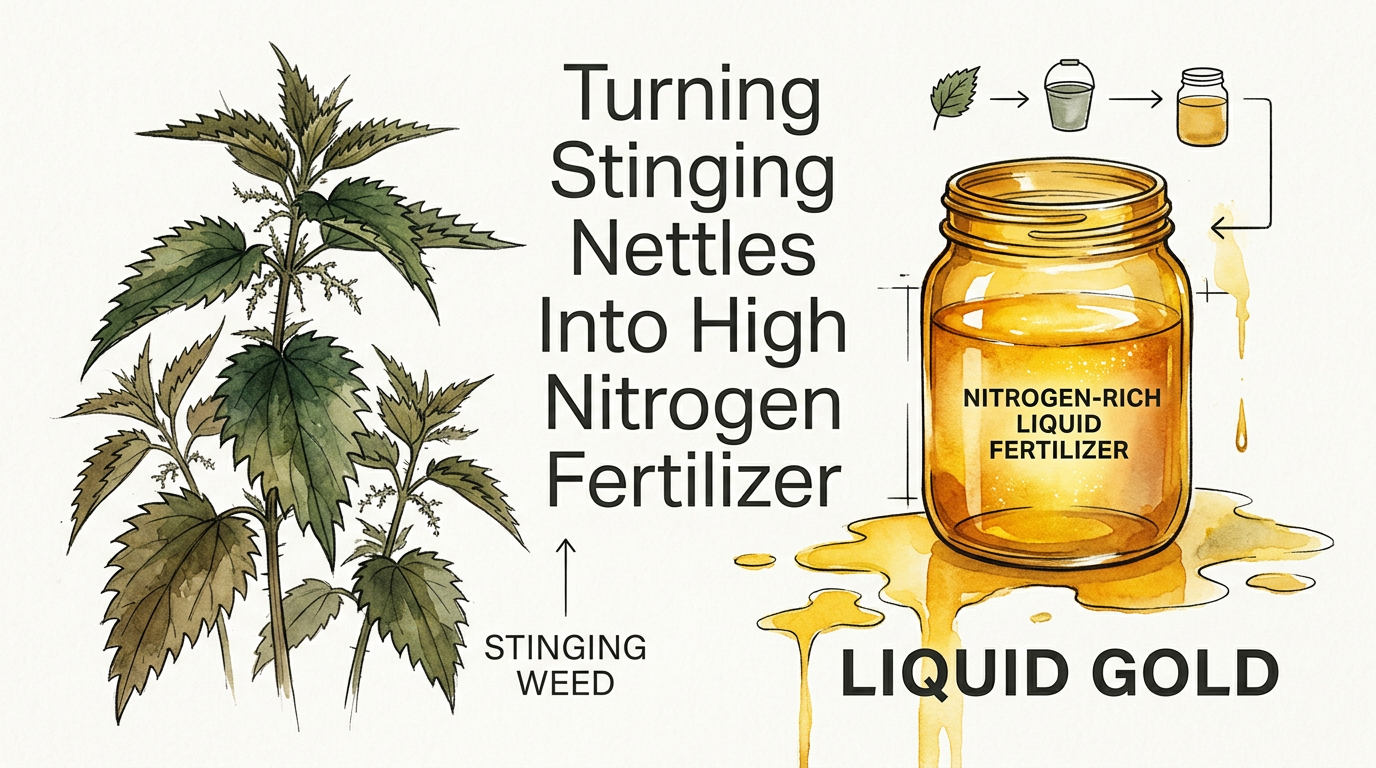
Turning Stinging Nettles Into High Nitrogen Fertilizer
Stinging nettles, or Urtica dioica, are deep-rooted perennials that act as dynamic accumulators. They reach far into the subsoil, pulling up minerals that shallow-rooted vegetables simply cannot reach. This makes them a concentrated source of nitrogen, iron, potassium, and magnesium.
When we turn these plants into a liquid fertilizer, we are essentially creating a predigested “soup” of nutrients. The fermentation process breaks down the tough cellular walls of the nettle, releasing ions into the water in a form that plant roots can absorb almost instantly.
This liquid gold is particularly effective during the early spring and summer months. During this time, leafy greens and heavy feeders like corn or tomatoes require massive amounts of nitrogen to build their structural frames. Nitrogen is the engine of plant growth, and nettles provide a high-octane fuel that synthetic fertilizers struggle to match in terms of bioavailability.
Old-timers often referred to this brew as “stinking tea,” and for good reason. The scent is a sign of microbial activity and the breakdown of organic matter. While the smell might be strong, the results in the garden are undeniable. You are not just feeding the plants; you are inoculating the soil with beneficial bacteria that continue to work long after the initial application.
How to Brew the Perfect Nettle Tea
Making nettle fertilizer is a straightforward process, but it requires patience and a bit of grit. The goal is to encourage a controlled fermentation that extracts the maximum amount of mineral content from the plant material.
Step 1: Harvesting with Care
Timing is everything when it comes to nutrient density. Harvest your nettles in the spring or early summer before they go to seed. Once the plant flowers, much of its energy and nitrogen shifts into seed production, leaving the leaves less potent for fertilizer.
Always wear thick gloves and long sleeves. Use a sharp pair of shears to cut the plants near the base. You want the leaves and the stems, as both contain valuable minerals. If you find yourself stung, look nearby for broadleaf dock or jewelweed; nature often provides the remedy right next to the source of the pain.
Step 2: Preparing the Vessel
Choose a large plastic or ceramic container. Avoid metal buckets, as the fermenting liquid can react with the metal and leach unwanted oxides into your fertilizer. A five-gallon bucket is a perfect starting point for most home gardens, though serious growers often use large rain barrels.
Fill the bucket about half to three-quarters full with chopped nettle plants. Crushing or bruising the leaves as you pack them in helps speed up the decomposition process. This physical breakdown allows water to penetrate the plant tissues more effectively.
Step 3: Adding the Water
Pour water over the nettles until they are completely submerged. Rainwater is the gold standard here because it is free of the chlorine and fluoride found in municipal tap water. If you must use tap water, let it sit out in the sun for 24 hours to allow the chlorine to dissipate before adding it to your greens.
Leave a few inches of headspace at the top of the bucket. As the mixture ferments, it will bubble and expand. If the bucket is too full, you will end up with a messy, stinky overflow on your hands.
Step 4: The Fermentation Period
Place a lid loosely over the container. You want to keep out debris and prevent mosquitoes from breeding, but the gasses produced during fermentation must be able to escape. Store the bucket in a sunny spot to keep the liquid warm, which accelerates microbial activity.
Stir the mixture every couple of days with a long stick. This introduces oxygen and ensures the material is breaking down evenly. After about two weeks, the bubbling will subside and the liquid will turn a dark, murky green. At this point, the tea is ready for use.
The Benefits of Using Nettle Fertilizer
The primary advantage of nettle tea is its high nitrogen content. Nitrogen is essential for chlorophyll production, which allows plants to convert sunlight into energy. Without it, leaves turn yellow, and growth stunts.
Beyond nitrogen, nettles are exceptionally rich in iron. Many garden soils suffer from iron chlorosis, where plants cannot take up enough iron to maintain their green color. Nettle tea provides a foliar-available source of iron that can green up a struggling plant in a matter of days.
Using this homemade brew also fosters a sense of self-reliance. Commercial fertilizers are often derived from petroleum products and involve high-energy manufacturing processes. By brewing your own, you close the loop on your homestead, turning what others call a “weed” into the very fuel that grows your dinner.
Soil health is another major beneficiary. Synthetic fertilizers can often harm the delicate balance of mycorrhizal fungi and beneficial bacteria in the dirt. Nettle tea, being an organic fermented product, actually feeds the soil microbiome. It encourages earthworms to move into the area and helps build a resilient soil structure over time.
Challenges and Common Mistakes
The most common mistake beginners make is failing to dilute the tea before application. This brew is incredibly concentrated. If you apply it “straight” to your plants, the high nitrogen levels and the acidity of the fermentation can actually burn the roots or the foliage.
Another pitfall is the smell. If you place your fermentation bucket right next to your back door or a neighbor’s fence, you will likely regret it. The odor is pungent—reminiscent of manure and rotting hay. Always place your brewing station in a far corner of the property where the wind can carry the scent away.
Neglecting to strain the solids can also cause issues. When you are ready to use the tea, use a mesh sieve or a piece of burlap to strain out the remaining plant fibers. If you try to put unstrained tea into a watering can, the small bits of nettle will clog the rose of the can, leading to frustration and a messy cleanup.
Finally, do not let the tea sit for months on end. While it doesn’t necessarily “expire” in terms of nutrients, it can eventually become anaerobic and harbor pathogens if left neglected in a sealed container for too long. Use your brew within the growing season for the best results.
Limitations: When Nettle Tea is Not Ideal
While nettle tea is a powerhouse for many plants, it is not a universal solution. It is a growth-focused fertilizer, meaning it encourages leaves and stems. This is perfect for kale, spinach, and the early stages of tomato growth.
However, once a plant begins to flower and set fruit, too much nitrogen can be a detriment. If you continue to hit a tomato plant with high-nitrogen nettle tea late in the summer, you may end up with a massive, beautiful green bush but very little fruit. The plant “thinks” it should keep growing leaves rather than putting energy into reproduction.
Root crops like carrots and parsnips should also be treated with caution. Excessive nitrogen can cause carrots to “fork” or grow hairy roots. For these crops, a fertilizer higher in phosphorus and potassium—like a comfrey tea—is often a better choice.
Lastly, nettle tea is not a replacement for good soil structure. If your soil is compacted like concrete or lacks organic matter, no amount of liquid fertilizer will fix the underlying issue. Think of nettle tea as a supplement, not a foundation.
Nettle Tea vs. Commercial Liquid Fertilizer
The choice between a homemade brew and a store-bought bottle often comes down to cost and philosophy. Below is a comparison of how they stack up in a real-world garden setting.
| Feature | Nettle Tea (Homemade) | Commercial Synthetic |
|---|---|---|
| Cost | Free (requires labor) | $15 – $30 per bottle |
| Nutrient Release | Rapid but gentle | Instant (high risk of burn) |
| Soil Health | Improves microbial life | Can degrade soil biology |
| Accessibility | Requires foraging/growing | Available at any store |
| Odor | Strong, pungent | Low to chemical scent |
Practical Tips and Best Practices
Dilution is the secret to success. A standard rule of thumb is a 1:10 ratio for soil drenching. This means one part nettle tea to ten parts water. The resulting mixture should look like weak tea or apple juice.
For foliar feeding, which is spraying the liquid directly onto the leaves, use an even weaker dilution of 1:20. Foliar feeding is incredibly effective because plants can absorb nutrients through their stomata (tiny pores on the leaves). This provides a nearly instant boost to struggling plants.
Apply the fertilizer in the early morning or late evening. If you spray leaves in the heat of the midday sun, the water droplets can act like magnifying glasses, scorching the foliage. Furthermore, applying in the cool of the day ensures the plant has time to absorb the nutrients before the liquid evaporates.
Use the leftover sludge from the bottom of the bucket as a compost activator. The fermented plant matter is teeming with bacteria that will help break down your compost pile much faster. Nothing goes to waste in a self-reliant garden.
Advanced Considerations for Serious Growers
For those looking to take their nettle brew to the next level, consider the role of aeration. Using an aquarium air stone to pump oxygen into the bucket can change the fermentation from anaerobic to aerobic. Aerobic fermentation is faster, smells significantly less, and encourages a different set of beneficial microbes.
You can also create “blended” teas. Mixing nettles with comfrey provides a more balanced N-P-K (Nitrogen-Phosphorus-Potassium) profile. While nettles provide the nitrogen for growth, comfrey provides the potassium for fruit and flower development. A 50/50 mix of these two plants creates a powerhouse “master tea” that can be used throughout the entire season.
Consider the mineral content of your specific local nettles. If you live in an area with particularly mineral-rich soil, your nettle tea will be even more potent. Some growers even add a handful of rock dust or kelp meal to the brew to round out the trace minerals, creating a truly professional-grade bio-stimulant.
Pay attention to the pH of your brew. Long-term fermentation can lead to an acidic product. If you are feeding plants that prefer alkaline conditions, you might want to add a small amount of wood ash to the dilution to buffer the acidity. Most garden vegetables, however, thrive in the slightly acidic environment that nettle tea provides.
Real-World Example: The Tomato Turnaround
Imagine a row of tomato plants in early June. The leaves are a pale, sickly green, and the stems look spindly. This is a classic sign of nitrogen deficiency often seen in gardens where the soil was depleted by the previous year’s crop.
Instead of reaching for a blue-colored synthetic powder, the gardener harvests a basket of nettles from the edge of the woods. After brewing for two weeks, they apply a 1:10 dilution of nettle tea to the base of each plant. Within seven days, the leaves shift to a deep, vibrant forest green.
By July, those same plants have developed thick, sturdy stems and a lush canopy of leaves. Because the gardener switched to a more balanced fertilizer once the flowers appeared, the plants are now loaded with green fruit. This transition from “struggling” to “thriving” was achieved using only water, heat, and a plant most people try to pull out of the ground.
This scenario plays out every year on successful homesteads. It demonstrates that you don’t need a laboratory to create high-quality plant food; you simply need to understand the biological cycles of the plants already growing around you.
Final Thoughts
The plant you’re trying to kill is actually the best fertilizer you’ll ever own. Harnessing the power of stinging nettles is more than just a gardening hack; it is a return to a way of life that values observation and resourcefulness over consumption.
By brewing your own nitrogen-rich tea, you save money, improve your soil’s long-term health, and reduce your dependence on industrial supply chains. It is a simple, effective, and deeply satisfying process that turns a stinging nuisance into liquid gold.
Take a walk to the edges of your property and look for those serrated leaves. Instead of reaching for the weed killer, reach for your gloves and a bucket. Your garden will thank you with the most vigorous growth you have ever seen.
