How To Become More Self-Sufficient Without Starting a Full-Blown Farm…
Want to start preserving your harvest, making your own soap, or building a backyard root cellar — but not sure where to begin? “Homesteading Advice” gives you instant lifetime access to 35+ practical homesteading books on food preservation, veggie gardening, DIY natural cleaning products (save over $250 per year with this skill alone), brewing, off-grid energy, and a whole lot more…
Click Here To Check It Out Now!
Most city dwellers are sitting on a hidden goldmine of wasted space that could be feeding their families. Your backyard isn’t ‘too small’—it’s just too grey. We’ve been trained to value ‘clean’ concrete over the abundance of a wild ecosystem. By peeling back the pavement, you don’t just reduce heat waste; you create a self-sustaining pantry that works 24/7.
Modern urban living often feels disconnected from the cycles of the earth. We rely on fragile supply chains and industrial systems that prioritize shelf-life over nutrition. Reclaiming a small patch of land, even if it is just a balcony or a concrete slab, is an act of quiet rebellion. It is a return to a time when every household understood the value of a compost pile and the secret language of the seasons.
Transforming these small spaces requires more than just planting a few seeds. It demands a shift in perspective. You must stop seeing your outdoor space as a chore to be mowed or a surface to be power-washed and start seeing it as a living, breathing habitat. This guide will walk you through the process of turning even the tightest urban corners into productive, resilient ecosystems.
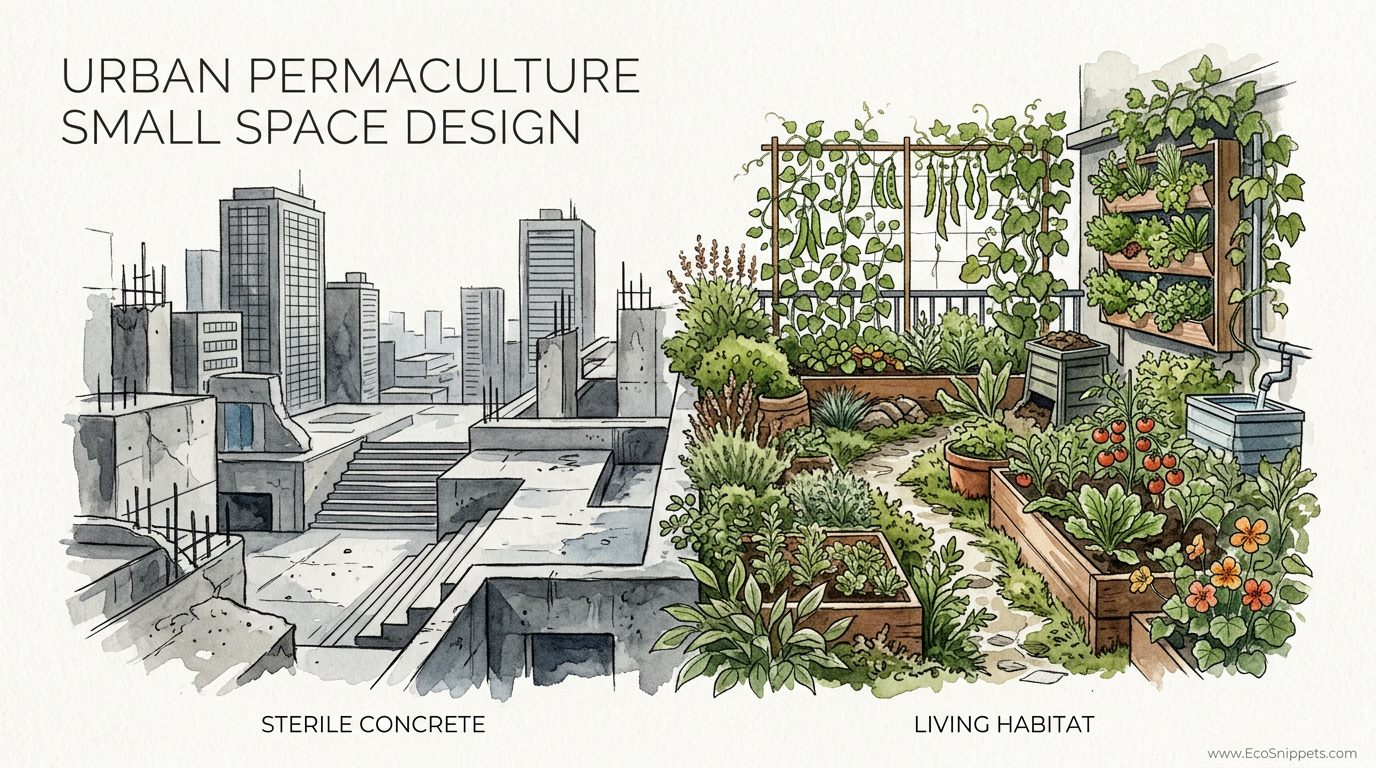
Urban Permaculture Small Space Design
Urban permaculture is the practice of designing sustainable, self-sufficient human settlements within city limits. It is a design philosophy that mimics the patterns and relationships found in nature to produce food, manage water, and build community. Unlike traditional landscaping, which often fights against nature with chemicals and loud machinery, permaculture works alongside it.
The concept exists because cities are notoriously resource-intensive. They consume vast amounts of energy and water while producing mountains of waste. Permaculture seeks to close these loops. In a small urban backyard, this means every element—from the rain gutter to the kitchen scrap—is viewed as a resource rather than a problem. It is used in real-world situations ranging from rooftop gardens in New York to tiny balcony guilds in London.
Think of your small space as a miniature forest. In a forest, there is no “waste.” Dead leaves become soil, and every plant supports its neighbor. Designing an urban space with this mindset involves “stacking functions.” This means every element in your garden should serve at least three purposes. A trellis provides privacy, supports climbing beans for food, and creates a cooling microclimate for shade-loving lettuce.
Small space design also relies heavily on “Sector Analysis” and “Zone Mapping.” Sector analysis is the process of observing external energies—like the path of the sun, the direction of the wind, and even the noise from the street. Zone mapping organizes your garden based on how often you interact with it. Zone 0 is your home, the center of energy. Zone 1 is the area right outside your door where you plant herbs you use daily. Zone 2 might be a small fruit tree or a compost bin that you visit once a week.
How the Transformation Works
Success in a small space depends on thinking vertically and building deep soil health. Traditional gardening often focuses on horizontal rows, which is a luxury urbanites don’t have. Instead, you must learn the art of “stacking” layers of growth.
The Seven Layers of the Food Forest
Even in a ten-by-ten plot, you can emulate the layers of a natural forest. This maximizes every square inch of sunlight and soil.
- The Canopy: In a small space, this might be a dwarf fruit tree like an apple or plum.
- The Low Tree Layer: Small shrubs or espaliered fruit trees that grow flat against a fence.
- The Shrub Layer: Berry bushes like blueberries or currants that thrive in the partial shade of the canopy.
- The Herbaceous Layer: Perennial herbs like rosemary, thyme, and sage that provide food and attract pollinators.
- The Groundcover: Plants like strawberries or creeping clover that protect the soil and suppress weeds.
- The Rhizosphere: Root crops like carrots, garlic, and onions that utilize the space underground.
- The Vertical Layer: Climbing vines like peas, beans, or grapes that utilize fences and walls.
Implementing the “Lasagna” Method
Sheet mulching, often called lasagna gardening, is the most effective way to build fertile soil on top of concrete or compacted urban dirt. This process builds soil upwards, meaning you don’t have to break your back digging.
First, lay down a thick layer of plain brown cardboard to suppress weeds or grass. Soak the cardboard thoroughly. Add a thin layer of nitrogen-rich material like fresh grass clippings or kitchen scraps. Follow this with a thick layer of carbon-rich material like straw, fallen leaves, or woodchips. Repeat these layers until the bed is 8–12 inches high. Over a few months, worms and microbes will break this down into “black gold,” creating a nutrient-dense foundation for your crops.
Designing Plant Guilds
A “guild” is a group of plants that support each other. Instead of a single crop, you plant a community. A classic urban guild for a small container might include a tomato plant (the center), basil (to repel pests and improve flavor), and marigolds (to attract beneficial insects). These plants work together to reduce your workload. Research has shown that urban systems can produce up to 18kg of tomatoes per square meter, compared to only 5.3kg in regular croplands, largely due to this intensive, supportive planting.
Benefits of a Living Urban Habitat
Shifting from concrete to a living habitat offers measurable advantages that extend beyond just a full pantry. The practical benefits are felt in your wallet, your health, and your immediate environment.
Food Security and Freshness: The most obvious benefit is the immediate access to nutrient-dense food. Produce from your backyard hasn’t been sitting in a truck for 1,500 miles. It is harvested at the peak of ripeness, ensuring maximum vitamin content and flavor. Urban farming often performs better per unit of investment and space for various crops compared to large-scale industrial farming.
Microclimate Regulation: Concrete and asphalt absorb heat, creating “Urban Heat Islands” that make cities significantly hotter than rural areas. A lush permaculture garden acts as a natural air conditioner. Plants release moisture through transpiration, which cools the surrounding air. A well-designed garden can lower the temperature of your immediate outdoor space by several degrees during a summer heatwave.
Waste Reduction: In a permaculture system, there is no such thing as “trash.” Kitchen scraps, cardboard boxes, and yard trimmings become the fuel for next year’s harvest. This reduces the strain on municipal waste systems and eliminates the need for expensive, synthetic fertilizers.
Mental and Physical Well-being: The act of stewardship—of watching a seed turn into a meal—provides a sense of self-reliance that is rare in modern life. It fosters a “pioneer grit” that builds resilience. Working in the soil also exposes you to beneficial microbes that have been linked to improved mood and reduced stress levels.
Challenges and Common Mistakes
The road to a self-sustaining pantry is paved with lessons. Beginners often rush the process, leading to avoidable failures.
Neglecting the Sector Analysis: Many new gardeners buy plants because they look good at the store, rather than because they fit the space. If you plant sun-loving peppers in a corner that only gets two hours of light because of your neighbor’s tall fence, they will fail. Observation is the first principle of permaculture. Spend a full season watching where the light falls and where the water puddles before you buy a single plant.
Poor Soil Preparation: Urban soil is often depleted, compacted, or contaminated. Simply digging a hole and dropping a plant in is a recipe for stunted growth. Using untreated urban soil without testing for heavy metals like lead is a frequent error. Lead is the most common contaminant in city soils, and it doesn’t just disappear.
Over-complicating Water Systems: While high-tech hydroponics exist, they are often too fragile for a beginner. A common mistake is relying on a manual hose and then forgetting to water during a busy week. Small spaces, especially those in containers, dry out much faster than large fields. Failure to implement “slow and small” water solutions like mulching or simple drip lines often leads to a withered garden.
Limitations of Small Space Permaculture
Honesty about what a tiny space can do is essential for long-term success. You are building a supplemental pantry, not a commercial farm.
Caloric Density: It is nearly impossible to grow all the calories a family needs on a standard urban lot. Staples like wheat, corn, and large quantities of potatoes require more space than most city dwellers possess. Your focus should be on high-value, nutrient-dense crops like greens, herbs, berries, and specific vegetables that are expensive or poor-quality at the store.
Environmental Constraints: Sometimes the city environment is simply hostile. If your “backyard” is entirely shaded by high-rise buildings, you are limited to shade-tolerant greens and mushrooms. Air pollution in high-traffic areas can also settle on leafy greens. These constraints don’t mean you can’t garden, but they do mean you must adapt your expectations and crop choices.
Legal and Social Boundaries: Homeowners’ associations (HOAs) or local bylaws can sometimes restrict front-yard gardens or the height of fences. While the culture is shifting toward sustainability, these “sterile concrete” mandates still exist in many neighborhoods. Navigating these rules requires patience and, sometimes, creative “edible landscaping” that hides food in plain sight.
Sterile Concrete vs. Living Habitat
Understanding the difference between the two approaches helps clarify why permaculture is worth the effort.
| Feature | Sterile Concrete Space | Living Permaculture Habitat |
|---|---|---|
| Maintenance | Power-washing, weeding cracks, chemical sprays. | Mulching, harvesting, observation. |
| Resource Use | High water runoff, heat absorption. | Water harvesting, carbon sequestration. |
| Yield | Zero food production. | High-density nutrition and herbs. |
| Ecosystem Support | Displaces local wildlife. | Supports bees, butterflies, and soil life. |
Practical Tips and Best Practices
If you are ready to start today, these actionable steps will provide the highest return on your effort.
- Test Your Soil First: Do not guess. Contact your local university extension to test for heavy metals and pH levels. If lead levels are between 75 and 400 ppm, use raised beds with at least 12 inches of clean soil. If levels are above 400 ppm, avoid planting in the ground entirely and stick to containers.
- Maximize the “Edge Effect”: In nature, the most productive areas are where two ecosystems meet (like the edge of a forest and a field). In your garden, create curvy paths instead of straight ones. This increases the surface area for planting and allows for more diverse microclimates.
- Start a Worm Bin: For apartment dwellers or those with tiny patios, vermicomposting is the most efficient way to recycle nutrients. Red wiggler worms can turn pounds of kitchen waste into nutrient-rich castings in a small, odorless bin under your sink.
- Use Bio-Compatible Soaps: If you plan to recycle “greywater” from your shower or laundry to water your trees, switch to soaps that are low in boron and sodium. This ensures your “waste” water remains a healthy resource for your soil.
Advanced Considerations for the Serious Practitioner
For those who have mastered the basics, the next level of urban permaculture involves closing the loop on energy and water.
Greywater Diversion: Moving beyond a simple bucket in the shower, advanced practitioners install diversion valves that direct water from bathroom sinks and tubs into mulch-filled basins in the garden. This water must be used immediately and should never be stored, as it can grow bacteria quickly. A properly designed greywater system can provide a steady “gravity-fed fertilizer delivery system” for fruit trees and berry bushes.
Mushroom Cultivation: Fungi are the great decomposers of the forest, and they are perfect for shady urban corners. You can grow Wine Cap mushrooms (Stropharia rugosoannulata) directly in your woodchip mulch. These mushrooms not only provide a high-protein harvest but also help break down the mulch into rich compost faster, improving the overall health of your garden guild.
Seed Saving in Small Gene Pools: Once your garden is established, start saving seeds from the plants that perform best in your specific microclimate. Over several generations, you will develop “landrace” varieties that are uniquely adapted to your backyard’s light levels, wind patterns, and soil conditions. This is the ultimate form of self-reliance.
Scenario: The 100-Square-Foot Transformation
Imagine a typical urban patio: 10×10 feet of cracked concrete. In a traditional setting, this is a dead space. In a permaculture design, this becomes a high-output pantry.
The practitioner begins by building four deep raised beds around the perimeter, leaving a small central area for a chair and a small table. On the sunniest north-facing wall, they install a sturdy trellis for pole beans and cucumbers. In the center of each bed, they plant a columnar apple tree—a variety designed to grow straight up like a pillar, taking up only two feet of horizontal space.
Underneath the trees, they plant a guild of strawberries, chives, and borage. A simple rain barrel sits under the downspout of the house, connected to a “soaker hose” that winds through the beds. Every kitchen scrap goes into a small Bokashi bin near the door. Within one year, this concrete slab is producing 50 pounds of produce, cooling the back of the house, and providing a sanctuary for the family. The total cost is less than a month’s worth of high-end groceries.
Final Thoughts
The transition from a consumer to a producer starts with a single square foot of soil. Most city dwellers are sitting on a hidden goldmine of wasted space that could be feeding their families. Your backyard isn’t ‘too small’—it’s just too grey. We’ve been trained to value ‘clean’ concrete over the abundance of a wild ecosystem. By peeling back the pavement, you don’t just reduce heat waste; you create a self-sustaining pantry that works 24/7.
Embracing urban permaculture is about reclaiming the ancestral wisdom of stewardship. It requires the grit to get your hands dirty and the patience to observe how nature wants to work. Whether you are growing herbs in a window box or dwarf trees on a patio, you are participating in a global movement toward resilience.
Start small, observe often, and don’t be afraid of failure. Every withered leaf is just a lesson in soil chemistry or sunlight patterns. Over time, your small grey space will transform into a vibrant, living habitat that provides for you and your community. The bounty is waiting; you only need to peel back the first layer.
