How To Become More Self-Sufficient Without Starting a Full-Blown Farm…
Want to start preserving your harvest, making your own soap, or building a backyard root cellar — but not sure where to begin? “Homesteading Advice” gives you instant lifetime access to 35+ practical homesteading books on food preservation, veggie gardening, DIY natural cleaning products (save over $250 per year with this skill alone), brewing, off-grid energy, and a whole lot more…
Click Here To Check It Out Now!
You are flushing your best fertilizer down the drain every single day. Nitrogen is the most expensive nutrient to buy for your farm, yet humans produce a perfect source for free. It is time to talk about ‘Liquid Gold’.
Most folks look at a flush toilet and see a marvel of modern sanitation. I want you to look at it differently. Our ancestors understood something that we have largely forgotten in our rush toward plastic-wrapped solutions: the human body is a precision processing plant for soil nutrients. Every time you pull that handle, you are essentially sending a high-grade, nitrogen-rich resource straight into a sewer system where it becomes a problem instead of a solution.
Pioneer grit was born from the realization that nothing should go to waste. If you are serious about self-reliance and ancestral wisdom, you have to look at the closed-loop systems of the past. Using what your body provides to feed the ground that feeds you is the ultimate act of independence. It is a return to a time when we weren’t disconnected from the cycle of life by a series of porcelain pipes and chemical treatment plants.
Liquid Gold is not a dirty secret. It is a biological goldmine. In the paragraphs that follow, I will guide you through the process of reclaiming this resource, treating it with the respect it deserves, and using it to grow a garden that will make your neighbors wonder what secret magic you are burying in your soil.
Using Urine As Garden Fertilizer
Using urine as garden fertilizer is the practice of diverting human liquid waste from the sanitation stream to use as a primary source of nitrogen, phosphorus, and potassium (NPK). While the modern world often views this as a “gross” or “unconventional” hack, it is actually one of the oldest forms of agriculture known to man. From the fields of ancient Rome to the subsistence farms of modern-day Africa and Asia, this resource has been the backbone of local food security for millennia.
Human urine is roughly 95% water. The remaining 5% is a potent cocktail of urea, minerals, and salts. Specifically, it contains nitrogen, which drives leafy green growth; phosphorus, which supports root development and flowering; and potassium, which regulates the plant’s overall health and water intake. On average, a healthy adult produces enough urine in a year to fertilize a significant portion of the crops they eat, providing the equivalent of several large bags of commercial fertilizer.
Real-world organizations like the Rich Earth Institute in Vermont have spent years proving that this “waste” is comparable to synthetic fertilizers in terms of crop yield. Their research shows that for crops like hay and corn, liquid gold performs just as well as the blue crystals you buy at the big-box store. The difference is that one costs you money and harms the planet during production, while the other is free and currently sitting in your bladder.
Visualizing this concept requires a shift in perspective. Instead of seeing waste, see a liquid nutrient concentrate. Imagine your garden as a hungry living being. Just as you wouldn’t throw away a steak because it wasn’t on a plate, you shouldn’t throw away nitrogen just because it’s in liquid form. It is simply plant food waiting for the right delivery method.
How It Works: The Science of Nitrogen Cycles
Understanding the chemistry of liquid gold starts with a compound called urea. When you consume protein, your body breaks it down and eventually produces urea as a way to safely transport nitrogen out of your system. Urea is the exact same chemical found in many commercial high-nitrogen fertilizers. When this liquid hits the soil, a transformation begins almost immediately.
Soil microbes are the silent workers in this factory. Once urea enters the earth, an enzyme called urease—which is produced by various soil bacteria—breaks the urea down into ammonia and carbon dioxide. This process is known as hydrolysis. Within days, other bacteria (nitrifying bacteria) convert that ammonia into nitrites and then into nitrates. Nitrates are the specific form of nitrogen that plants can actually “eat.”
Phosphorus and potassium are also present in highly plant-available forms. Unlike some organic fertilizers that take months to break down in a compost pile, the nutrients in urine are virtually “ready to go.” This makes it an incredibly fast-acting fertilizer, often showing a visible “greening” effect on plants within just a few days of application. This rapid response is why pioneers often used it to give a boost to struggling crops mid-season.
Carbon-rich environments maximize this process. If you apply urine to a soil rich in organic matter, such as one with plenty of mulch or compost, the carbon acts as a sponge. It holds onto the nitrogen and prevents it from turning into a gas and floating away. This synergy between “yellow water” and “brown carbon” creates a balanced ecosystem where the nitrogen is stabilized and slowly released to the roots of your plants.
Benefits: Why Liquid Gold Beats the Bagged Stuff
Cost is the most immediate advantage. As global supply chains fluctuate, the price of synthetic nitrogen—which requires immense amounts of natural gas to produce via the Haber-Bosch process—continues to climb. Harvesting your own fertilizer removes you from this volatile market. You are essentially manufacturing your own NPK on-site, with zero transportation costs and zero packaging waste.
Environmental stewardship is the second pillar of benefits. When we flush urine into the sewer, it eventually reaches wastewater treatment plants that are often ill-equipped to remove all the nitrogen and phosphorus. These excess nutrients then leak into our rivers and lakes, causing toxic algal blooms that choke out aquatic life. Diverting these nutrients to your garden turns a pollutant into a productivity booster, protecting our local waterways in the process.
Soil microbiome health is often better preserved with liquid gold than with harsh synthetic salts. Recent studies, including those from the University of Birmingham, suggest that soil bacteria are remarkably resilient to urine application. In fact, because urine contains secondary and micronutrients like sulfur, magnesium, and calcium, it provides a more “complete” diet for the soil life than basic NPK synthetics. It encourages a diverse community of microbes that help build soil structure over time.
Water conservation is an often-overlooked perk. The average person flushes the toilet five times a day. If you use a high-efficiency toilet, that’s still roughly 6 to 8 gallons of clean, drinkable water used just to move a few pints of liquid. By collecting and using your urine, you significantly reduce your household water footprint. You are using the water twice: once to hydrate your body, and once to hydrate and feed your land.
Challenges and Common Mistakes
Odors are the primary hurdle for most beginners. Fresh urine has very little smell, but as it sits, the urea converts into ammonia, which has a sharp, pungent aroma. Many people make the mistake of leaving collection containers open to the air, which lets the smell escape and allows valuable nitrogen to evaporate. Keep your containers tightly sealed at all times to preserve the nutrients and your relationship with your neighbors.
Over-application is a frequent error born of enthusiasm. Because urine is so concentrated, applying it undiluted directly to the base of a plant can lead to “fertilizer burn.” This happens because the high concentration of salts and nitrogen pulls moisture out of the plant’s roots, causing the leaves to turn brown or the plant to wither. Always remember that with liquid gold, less is often more. Think of it as a concentrate that needs to be spread out over a large area.
Salt buildup can become a problem in dry climates or with potted plants. Human urine contains sodium chloride (table salt). In a typical garden with regular rainfall, these salts are leached through the soil and don’t cause issues. However, if you are in a desert environment or are fertilizing plants in containers without enough drainage, the salt can accumulate to toxic levels. This stunts plant growth and can eventually ruin the soil’s structure.
Pathogen cross-contamination is the biggest safety concern. While urine is generally free of the dangerous pathogens found in feces, it can become contaminated if the collection method is messy. The “ick factor” is usually tied to the fear of disease. The simplest way to avoid this is to ensure that your collection system (like a funnel or a dedicated jug) is kept clean and that you never mix “number one” with “number two.”
Limitations: When This May Not Be Ideal
Medication use is a significant factor to consider. If someone in your household is taking antibiotics, hormone replacements, or heavy prescription drugs, those substances are partially excreted in their urine. While soil microbes are incredibly efficient at breaking down many complex chemicals, some persistent medications can remain in the soil. Research from the Rich Earth Institute suggests that the uptake in plant tissue is minimal, but most experts recommend avoiding urine from donors on heavy medications when growing food crops.
Specific plant preferences must be respected. Legumes, such as peas and beans, have a special relationship with bacteria in the soil that allows them to “fix” their own nitrogen from the air. Adding high-nitrogen liquid gold to these plants is usually a waste of resources and can actually lead to excessive leaf growth at the expense of bean production. Similarly, plants that prefer very poor, sandy soils might find the nutrient boost too overwhelming.
Local regulations and social taboos can sometimes create friction. In some urban or suburban areas, local ordinances might have strict rules about the handling of human waste. Even if you are doing everything safely and scent-free, the social stigma can be a hurdle. It is often wise to be discreet about your “liquid gold” application if you live in a tightly packed neighborhood where people might not share your pioneer spirit.
Environmental boundaries like high water tables require caution. If your garden sits on land where the groundwater is very close to the surface, heavy application of any nitrogen fertilizer—including urine—can lead to leaching. Nitrogen moves very easily through the soil with water. In these specific cases, it is better to add the urine to a compost pile where it can be stabilized by carbon before it ever touches the ground.
Comparison: SEWER WASTE vs LIQUID GOLD
| Feature | Sewer Waste Approach | Liquid Gold Approach |
|---|---|---|
| Cost | Monthly utility bills and taxes. | Absolutely free. |
| Energy Use | High (pumping and chemical treatment). | Zero (gravity and manual effort). |
| Environmental Impact | Potential for water pollution and algal blooms. | Builds soil fertility and sequesters carbon. |
| Plant Performance | Relies on expensive external NPK bags. | Comparable to synthetic NPK yields. |
| Self-Reliance | Dependent on municipal infrastructure. | Complete independence from supply chains. |
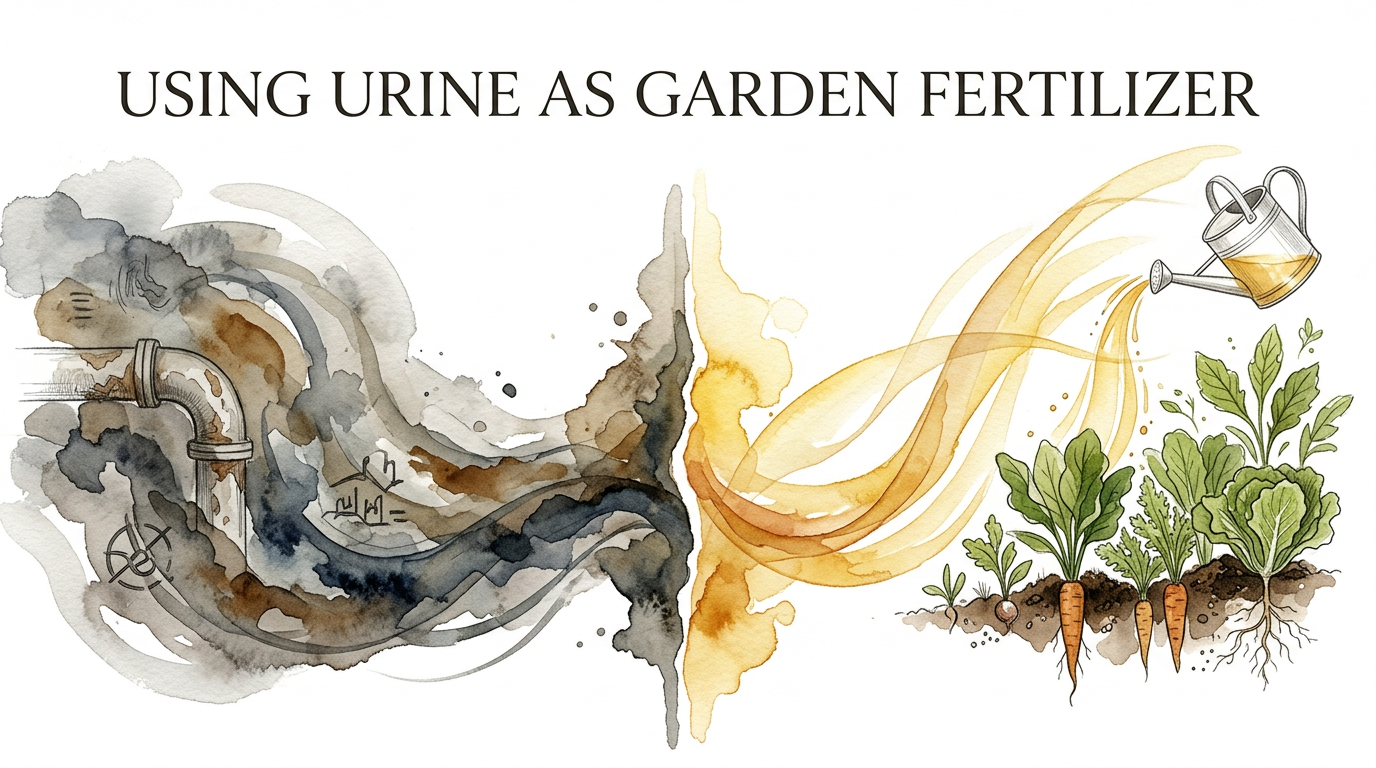
Comparing these two systems reveals a fundamental truth about modern life: we pay to get rid of the very things we then pay to buy back. The sewer system is an “open-loop” model that views nutrients as a disposal problem. The liquid gold approach is a “closed-loop” model that treats the human body as an essential part of the farm’s fertility cycle. One creates a bill; the other creates a harvest.
Practical Tips: Harvesting and Storing Your Resource
Collection starts with a simple, dedicated container. A 5-gallon plastic bucket with a tight-sealing gamma lid is a classic choice for many home gardeners. For a more sophisticated setup, you can use a “cubie” with a funnel. Men can often use a simple jug, while women may find a portable urinal or a “female urination device” helps keep the process clean and prevents any splashing or cross-contamination.
Dilution is the golden rule of application. For established plants in the heat of the growing season, a 1:5 ratio (one part urine to five parts water) is generally safe and effective. If you are feeding young seedlings or sensitive potted plants, go much lighter with a 1:10 or even 1:20 ratio. Diluting the liquid not only protects the roots from burn but also helps the nutrients soak deeper into the soil where they are most needed.
Storage and aging are required if you plan to share your harvest. The World Health Organization suggests storing urine in a sealed container for six months at 20°C (68°F) to ensure total sanitization. During this time, the pH of the liquid rises naturally, creating an alkaline environment that kills off almost all potential pathogens. If you are only using the fertilizer for your own household’s food, many practitioners use it fresh, but for the “gold standard” of safety, aging is the way to go.
Odor control can be managed with a splash of white vinegar. Adding about a cup of vinegar to a 5-gallon collection bucket lowers the pH slightly, which keeps the nitrogen in its liquid ammonium form and prevents it from turning into smelly ammonia gas. This simple trick keeps the “grit” in your gardening without the “stink” in your backyard. Just be sure to water the mixture into the soil immediately after application to lock those nutrients in.
Advanced Considerations: Beyond the Watering Can
Biochar charging is a pro-level move for serious practitioners. Biochar is a highly porous form of charcoal that acts like a “coral reef” for soil microbes. On its own, biochar is empty and can actually pull nutrients away from plants. However, if you soak your biochar in undiluted liquid gold for a few weeks, the charcoal pores fill up with nitrogen and minerals. This “charged” biochar becomes a slow-release fertilizer that can last in your soil for decades.
Compost acceleration is another brilliant use for this resource. A compost pile often stalls out because it has too much “brown” material (leaves, straw, wood chips) and not enough “green” material (nitrogen). Pouring undiluted urine onto a dry, carbon-heavy pile acts like a shot of adrenaline for the decomposing bacteria. It generates heat quickly, helping the pile break down much faster while the carbon in the pile captures and holds the nitrogen.
Scaling up requires a dedicated diversion system. If you are managing a larger farm or a homestead, you might consider installing a urine-diverting dry toilet (UDDT). These systems look like a standard toilet but have a split bowl that sends liquids to a storage tank and solids to a separate composting chamber. This automated separation makes the “harvest” part of your daily routine and provides a consistent supply of fertilizer for larger orchard or pasture applications.
Micro-nutrient management becomes easier with liquid gold. Most commercial fertilizers focus only on NPK, but the human body also excretes significant amounts of sulfur, magnesium, and boron. These trace elements are essential for the production of vitamins and flavors in your vegetables. By using a human-derived fertilizer, you are ensuring that your plants have access to the full spectrum of minerals that your own body needs to thrive.
Real-World Scenarios: From The Corn Patch to the Orchard
The “Heavy-Feeder Corn Experiment” is a perfect example of liquid gold in action. Corn is a notorious nitrogen hog; it will suck every bit of fertility out of the soil if you let it. A gardener in a northern climate once divided their corn patch into two sections. One section received standard compost, while the other received a 1:5 urine drench every two weeks. By harvest time, the urine-fed corn was nearly a foot taller, with darker green leaves and noticeably larger, sweeter ears. The nitrogen boost during the “tasseling” stage made all the difference.
Orchard revival is another area where this method shines. Old fruit trees often become “tired,” producing small fruit or showing yellowing leaves. A homesteader with a struggling apple orchard began a “mulch-mowing” routine where they applied diluted liquid gold around the drip line of the trees and then covered it with a thick layer of wood chips. The combination of nitrogen and carbon revitalized the soil biology, and within two seasons, the trees were producing heavy crops of crisp, healthy apples without a single bag of store-bought fertilizer.
Leafy green production is perhaps the easiest place to start. Spinach, kale, and Swiss chard are essentially “nitrogen-to-leaf” converters. In a small raised bed, applying a 1:10 dilution once a week can lead to a nearly continuous harvest. Because these plants grow so fast, they can utilize the quick-acting nitrogen in liquid gold before it has any chance to leach away. Just remember to apply the liquid to the soil at the base of the plant, never on the leaves you intend to eat.
Final Thoughts
Reclaiming the value of your own waste is one of the most empowering steps you can take toward true self-reliance. It requires you to push past modern squeamishness and see the world through the eyes of a pioneer—a person who understands that the cycle of life is only as strong as its weakest link. By diverting your “liquid gold” from the sewer and putting it back into the soil, you are closing that loop and honoring the ancestral wisdom that nothing truly goes to waste in a healthy ecosystem.
Practical application is simple, but it demands consistency and respect for the science. Start small, perhaps with a single nitrogen-loving crop like corn or kale, and observe the results for yourself. You will likely find that your plants are more robust, your soil is more alive, and your wallet is a little heavier. It is a win for the gardener, a win for the environment, and a win for the independent spirit.
Experimenting with these methods is the best way to learn. Every soil is different, and every climate has its own rhythm. As you become more comfortable with harvesting and using this resource, you will start to see other “waste” streams on your homestead in a new light. Whether it is greywater, biochar, or deep-bedding systems, the path to a productive garden is paved with the things most people are simply too afraid to talk about. Go forth and grow.
