How To Become More Self-Sufficient Without Starting a Full-Blown Farm…
Want to start preserving your harvest, making your own soap, or building a backyard root cellar — but not sure where to begin? “Homesteading Advice” gives you instant lifetime access to 35+ practical homesteading books on food preservation, veggie gardening, DIY natural cleaning products (save over $250 per year with this skill alone), brewing, off-grid energy, and a whole lot more…
Click Here To Check It Out Now!
Stop losing your harvest to ground rot and pests by reclaiming the third dimension. Standard backyard gardens run out of space fast. Pro growers use cattle panels to create vertical ‘tunnels’ of food. It increases airflow, stops rot, and gives you back your walking paths.
Walking through a garden should feel like a journey, not a hurdle jump over sprawling vines. Most beginners watch their squash and cucumbers colonize every square inch of mulch until the paths disappear. This creates a humid, stagnant environment where powdery mildew thrives and fruit rots against the damp earth. You find yourself stepping on hidden tomatoes or losing half your melons to the belly-rot that comes from soil contact.
Traditional gardening focuses on the flat earth, but the most successful growers look up. They recognize that the air above their beds is prime real estate. Taking a lesson from the hard-earned wisdom of farmers who build things to last, many are turning to heavy-duty livestock panels. These aren’t your flimsy hardware store trellises that buckle under a single summer storm. These are built with the grit of the homestead, meant to withstand hundreds of pounds of pressure and decades of sun.
Reclaiming your garden space means shifting from a horizontal mindset to a vertical one. When you train a vine to climb, you expose every leaf to the sun and every fruit to the breeze. It is a cleaner, more efficient way to grow. It honors the plants by giving them the space they naturally crave while protecting the gardener’s back and the harvest’s quality.
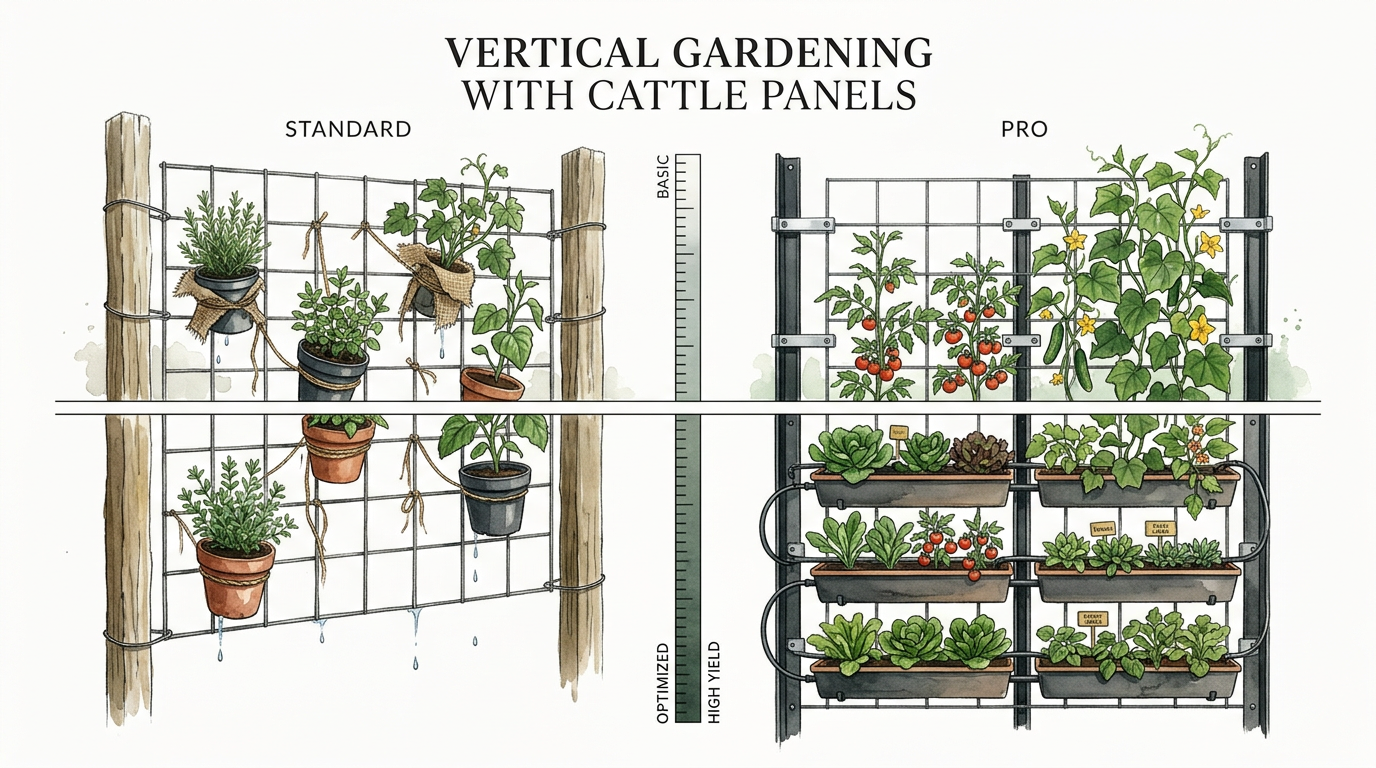
Vertical Gardening With Cattle Panels
Vertical gardening with cattle panels is the practice of using heavy-gauge, galvanized steel livestock fencing to support climbing crops. While these panels were originally forged to keep 1,200-pound steers in their place, they have become a secret weapon for the self-reliant gardener. They offer a rigid, permanent structure that transforms a chaotic patch of dirt into an organized, high-yield food forest.
A standard cattle panel typically measures 16 feet in length and 50 inches in height. It is constructed from 4-gauge wire, which is roughly the thickness of a pencil. This wire is welded into a grid, usually with 4-inch to 8-inch openings. These gaps are large enough for a hand to reach through during harvest but small enough to provide a thousand tiny ladders for a cucumber’s tendrils.
In the real world, these panels are used in several configurations. The most popular is the “cattle panel arch,” where the 16-foot length is bent into a U-shape and anchored to the ground. This creates a walk-through tunnel. Others use them as flat vertical walls or A-frame “tents.” Regardless of the shape, the goal remains the same: get the food off the ground and into the air.
Imagine the difference between a cucumber vine crawling through the mud and one draped over a silver arch. On the ground, the plant is a target for slugs and moisture-loving fungi. On the panel, the fruit hangs down, perfectly straight and clean, cooled by the wind and kissed by the sun. It is a simple shift that mimics the way wild grapes or peas climb the edges of a forest, reaching for the light.
How to Build Your Vertical Empire
Building a cattle panel structure requires more sweat than a typical weekend project, but the result stays standing long after the wooden alternatives have rotted into the soil. You will need a few specific tools to get the job done right. Gather four T-posts (at least 6 feet tall), a 16-foot cattle panel, a post driver or sledgehammer, and heavy-duty zip ties or galvanized wire.
Start by selecting a location that receives at least eight hours of full sun. Vertical structures cast shadows, so orient your trellis from north to south if possible. This ensures that as the sun moves across the sky, both sides of your “tunnel” get equal light. If you place it east to west, the north side might remain in deep shade for much of the day.
Measure the width of your path or the distance between two raised beds. For a comfortable walk-through arch, aim for a base width of 5 to 6 feet. Mark the four corners of this rectangle. Use your post driver to sink the T-posts at these corners. Drive them at least 12 to 18 inches into the dirt. Make sure the “studs” or notches on the T-posts face inward toward the arch.
Bending the panel is the most challenging part of the process. This is a job for two people. Position one end of the 16-foot panel against the inside of two T-posts on one side. While one person holds that end steady, the other person walks the opposite end toward the other set of posts, forcing the panel to bow upward into an arch. Once the second end is tucked inside its T-posts, the tension of the steel will hold it in place temporarily.
Secure the panel to the T-posts using your wire or zip ties. Attach it at the bottom, middle, and top of each post. If you are using zip ties, choose UV-resistant ones to prevent them from becoming brittle in the sun. For a truly permanent “pioneer” build, use 14-gauge galvanized wire and a pair of pliers to twist the connections tight. This structure is now ready to support hundreds of pounds of produce.
The Practical Benefits of Going Vertical
Airflow is the primary defense against the diseases that ruin a harvest. When plants are bunched together on the ground, moisture gets trapped between leaves. This creates a breeding ground for powdery mildew and blight. Elevating the plants allows air to circulate through the entire canopy, drying the leaves quickly after a rain or morning dew. This natural ventilation keeps the foliage healthy without the need for chemical sprays.
Harvesting becomes a pleasure rather than a chore. Instead of hunching over and digging through prickly vines to find a hidden squash, you simply walk under the arch. The fruit hangs at eye level or chest height. It is easy to spot pests early, and you can pick your vegetables while standing upright. This saves your back and ensures you don’t miss any “monster” zucchinis that grew too large because they were hidden under a leaf.
Path reclamation is a massive benefit for small-scale gardens. By moving the vines upward, you free up the walking space between your beds. This allows you to bring in a wheelbarrow or move through the garden without stepping on the very plants you are trying to grow. You effectively double your square footage by utilizing the vertical volume of the garden rather than just the surface area of the soil.
Cleanliness and quality of the fruit improve dramatically. Cucumbers and melons grown on a cattle panel don’t have that “yellow belly” from sitting on the dirt. They are perfectly uniform in color and shape. Because they are off the ground, they are also less accessible to slugs, sowbugs, and other soil-dwelling critters that love to take a bite out of a ripening fruit. Your yield stays pristine from the vine to the kitchen.
Challenges and Common Pitfalls
Transportation is the first hurdle many face. A 16-foot panel does not fit in a standard truck bed without significant overhang. Many growers solve this by bowing the panel into a large “U” shape and securing it in the bed of a truck or a small trailer. Some farm supply stores will deliver, which is often worth the small fee to avoid a dangerous highway situation. Do not attempt to fold these panels; they are meant to bow, but a sharp kink will ruin the structural integrity.
Weight management is a concern for heavy crops like cantaloupe or winter squash. While the cattle panel itself won’t break, the heavy fruit can sometimes pull itself off the vine before it is fully ripe. Serious practitioners use “fruit slings” made of scrap mesh or old pantyhose to support the weight of the fruit. You simply tie the sling to the cattle panel and nestle the melon inside, allowing the panel to carry the weight while the vine remains unstrained.
Improper anchoring leads to leaning structures. In loose or sandy soil, a 6-foot T-post might not be enough to hold a heavy arch against high winds. If your garden is in a windy corridor, consider using longer T-posts or reinforcing the base with heavy stones. Never rely on wooden garden stakes to hold a cattle panel; the tension of the bent steel will snap them or pull them out of the ground within weeks.
Neglecting early training can result in a mess. Plants like cucumbers and beans will naturally find the trellis, but heavier vines like tomatoes or squash may need a little guidance. If you wait too long to guide the vines onto the panel, they will sprawl across the path, defeating the purpose of the structure. Check the garden every few days in early summer to weave the new growth into the wire grid.
Limitations and Constraints
Permanent placement is a double-edged sword. Once these panels are wired to T-posts, they are not easily moved. This makes crop rotation more difficult. If you grow tomatoes on an arch one year, you shouldn’t grow them there the next year to avoid soil-borne diseases. You must plan your garden several years in advance to ensure you aren’t planting the same family of crops on the same permanent trellis year after year.
Shadowing can be a problem for neighboring plants. An 8-foot-tall arch covered in dense bean foliage is essentially a giant wall. If you place it on the south side of your garden, it will shade out the sun-loving peppers or eggplants behind it. Understanding the path of the sun in your specific yard is essential before you drive the first post. The arch must be a tool for growth, not a barrier to it.
Cost is higher upfront compared to string or plastic netting. While a single cattle panel and its posts might cost between $40 and $60, a roll of plastic netting is less than $10. However, the cattle panel is a one-time purchase. The plastic netting will be in a landfill within two years. For the gardener focused on self-reliance and long-term value, the initial investment is justified by the decades of service the steel provides.
Comparing Trellis Materials
Selecting the right material for your garden depends on your long-term goals and budget. Standard wood trellises provide a rustic look but suffer in humid climates. Cattle panels offer an industrial, farm-ready durability that wood cannot match.
| Feature | Cattle Panel | Wooden Trellis | Plastic Netting |
|---|---|---|---|
| Durability | 20+ Years | 3–5 Years | 1–2 Seasons |
| Load Capacity | Very High | Medium | Very Low |
| Maintenance | None | Staining/Repair | Replacement |
| Rot Resistance | Immune | Low | High |
| Ease of Install | Moderate (Needs 2 people) | Moderate (Carpentry) | Easy |
The table shows that cattle panels dominate in longevity and strength. While wood may look more traditional in a cottage garden, it eventually bows and breaks under the weight of wet foliage and heavy fruit. Cattle panels maintain their shape and strength regardless of the weather, making them the superior choice for the productive homestead.
Practical Tips and Best Practices
Training your plants early is the key to a beautiful tunnel. When the vines are about 12 inches long, gently weave the tip through the wire openings. Most climbing plants have tendrils that will lock onto the 4-gauge wire and pull the plant upward. For tomatoes, which do not have tendrils, use soft garden twine or strips of old t-shirts to tie the main stem to the panel every 6 inches as it grows.
Winter care is surprisingly minimal. You do not need to take the arches down when the frost hits. In fact, leaving them up provides a structural element to the winter garden. However, you must remove the dead vines in the fall. Leaving old, brittle foliage on the wire can harbor pests and disease spores over the winter. A quick pass with a pair of garden shears and a brisk pull will clear the panel for next spring.
Mulching the base of the panel is essential. Because you are concentrating a high volume of growth in a small footprint, the soil at the base of the arch works hard. Keep it covered with straw, wood chips, or leaves to retain moisture and suppress weeds. This ensures that the water you provide goes to the thirsty vines rather than evaporating into the air.
Checking the connections once a season keeps the structure safe. Zip ties can eventually snap if they aren’t UV-rated. Every spring, walk your arches and give them a firm shake. If anything wobbles, add a new wire tie. This simple five-minute check prevents a mid-summer collapse when the vines are at their heaviest.
Advanced Considerations for Serious Growers
Intercropping under the arch is a brilliant way to maximize space. While the top of the arch is covered in heat-loving squash, the ground underneath remains in cool, dappled shade. This is the perfect environment for “second-season” crops like spinach, lettuce, or radishes that would typically bolt in the summer heat. You are essentially creating a micro-climate that allows for a longer harvest season.
Fertilization must be targeted. A 16-foot vine requires a lot of energy to move nutrients from the roots all the way to a melon hanging 7 feet in the air. Focus your compost and organic fertilizers at the base of the arch where the main stem enters the ground. A liquid seaweed or compost tea foliar spray can also provide a boost to the leaves that are furthest from the soil.
Pollination can be improved by the vertical structure. Because the flowers are more visible and accessible to bees and butterflies, pollination rates are often higher than on the ground. To further improve this, consider planting “pollinator pockets” of marigolds or alyssum at the very base of the T-posts. This draws beneficial insects directly into the tunnel where your vegetables are waiting.
Real-World Example: The Cucumber Tunnel
Consider the case of a standard 10×10 garden plot. Traditionally, three cucumber plants would take up about 30 square feet of ground space. This leaves only 70 square feet for everything else, and the center of the garden becomes a “no-go” zone because you don’t want to step on the vines.
By installing a cattle panel arch across the center path, those three cucumber plants now take up only 4 square feet of actual soil at the base of the T-posts. The vines grow up and over the path. The gardener can now use those 26 “saved” square feet to plant three rows of bush beans or a dozen pepper plants. The yield per square foot nearly doubles, and the garden becomes easier to navigate. This is the power of the third dimension.
In this scenario, the gardener also noted a 40% reduction in fruit loss. On the ground, cucumbers were frequently hit by “belly rot” or hidden from view until they became yellow and bitter. On the arch, every cucumber was visible. They were harvested at the perfect size, and not a single fruit was lost to soil-borne disease.
Final Thoughts
Embracing the cattle panel method is about more than just saving space; it is about building a garden that works with you rather than against you. It is a return to a more deliberate way of growing, where structures are built once and built right. The sight of a lush, green tunnel heavy with hanging fruit is a testament to the efficiency and beauty of a vertical system.
Take the time to plan your layout and invest in the heavy-duty materials that will last. While the work is harder at the start, the reward of a clean, rot-free harvest and a clear walking path is worth every ounce of effort. Your garden will thank you with higher yields and fewer diseases, and you will find a new sense of pride in the structural integrity of your homestead.
Experiment with different shapes and crops. Maybe this year is a cucumber arch, and next year it is a wall of cherry tomatoes. The versatility of the cattle panel ensures it will remain the most valuable tool in your shed. Start small if you must, but once you reclaim the third dimension, you will never go back to gardening on the flat earth again.
