How To Become More Self-Sufficient Without Starting a Full-Blown Farm…
Want to start preserving your harvest, making your own soap, or building a backyard root cellar — but not sure where to begin? “Homesteading Advice” gives you instant lifetime access to 35+ practical homesteading books on food preservation, veggie gardening, DIY natural cleaning products (save over $250 per year with this skill alone), brewing, off-grid energy, and a whole lot more…
Click Here To Check It Out Now!
Grow oranges in the snow with this ancient underground secret. Standard greenhouses are at the mercy of the weather. A Walipini uses the earth’s constant thermal mass to stay warm all year for free.
If you have ever stood in a glass greenhouse during a January blizzard, you know the sound of a losing battle. The wind howls, the glass rattles, and the heater works overtime just to keep the frost from claiming your tomatoes. It is a fragile system, one that relies on expensive energy to fight the natural world. But there is a better way, an older way, that works with the land instead of against it.
An underground greenhouse, or Walipini, is a sanctuary for the self-reliant grower. It is a simple concept: you dig deep enough to tap into the steady heartbeat of the earth. While the surface world swings between extremes, the soil a few feet down remains remarkably stable. This is not just a garden; it is a legacy of ancestral wisdom that allows a pioneer to harvest fresh greens while the neighbor is still shoveling snow.
This guide will walk you through the grit and the glory of building your own subterranean garden. We will cover everything from the initial dig to the fine art of moisture control. Whether you are looking to escape the rising cost of groceries or simply want to prove that nature can be outsmarted with a shovel and some sense, you are in the right place.
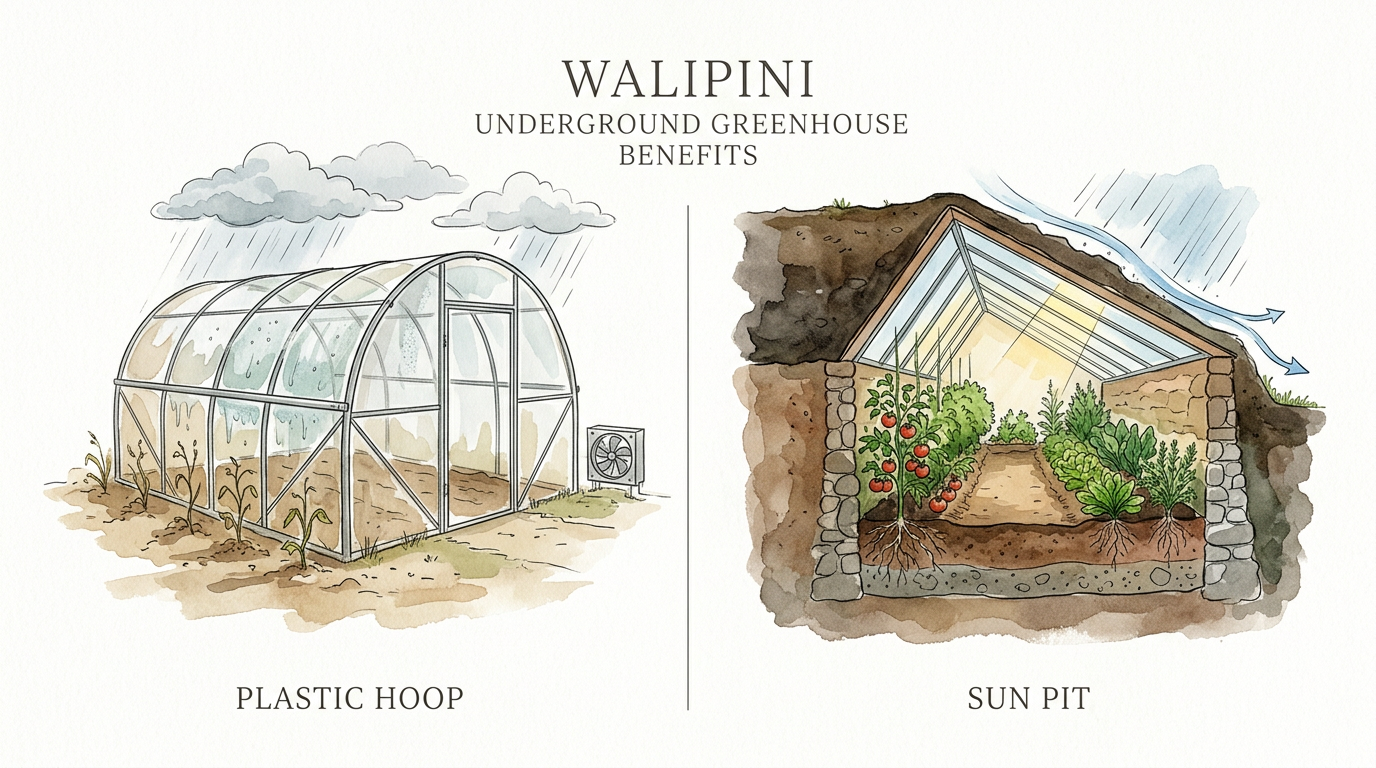
Walipini Underground Greenhouse Benefits
The word Walipini comes from the Aymara Indian language, meaning “place of warmth.” It was refined in the high, cold plains of Bolivia by the Benson Agriculture and Food Institute to give local farmers a way to grow food year-round in an environment that is often hostile to life. Unlike a traditional greenhouse that sits on the surface, a Walipini is a semi-subterranean structure that relies on the earth’s natural insulation to maintain a consistent growing environment.
The core principle is simple: the earth acts as a massive thermal battery. In most parts of the world, once you get about six to eight feet below the surface, the soil temperature stays between 50 and 60 degrees Fahrenheit regardless of what is happening above. When you combine this geothermal stability with passive solar gain from a clear roof, you create a microclimate where tropical plants can survive in temperate zones.
Think of it like a root cellar that has been given a window to the sky. It exists to bridge the gap between the seasons, providing a frost-free haven for crops that would otherwise perish. In real-world situations, these pits are used to grow everything from kale and carrots to lemons and avocados in climates where such things should be impossible. They are the ultimate tool for the modern pioneer who values resilience over convenience.
How the Walipini Works: The Science of Thermal Mass
To understand why a Walipini works, you have to understand the “flywheel effect.” During the day, the sun’s rays pass through the clear roofing material and hit the floor and walls of the pit. Darker soils, stones, or water barrels inside the structure absorb this heat energy. Instead of the heat escaping into the cold air—as it does in a standard glass house—the surrounding earth holds onto it.
When the sun goes down and the air temperature drops, the earth walls begin to slowly release that stored energy back into the space. This prevents the temperature from plummeting. Radiation warms the surfaces, conduction moves heat through the walls, and convection keeps the air moving. This cycle repeats every day, creating a stable environment that requires little to no external heating.
Another critical factor is the angle of the roof. To maximize the sun’s power in the winter, the roof must be angled so that it is perpendicular to the sun during the winter solstice. This ensures the maximum amount of light enters the pit when the plants need it most. If the angle is too shallow, the sun’s rays will simply bounce off the plastic, leaving your plants in the cold and dark.
Step-by-Step Construction: Building Your Sun Pit
Building an underground greenhouse is back-breaking work, but the rewards are measured in years of free heat. You must start with the site. Look for a location with full southern exposure in the Northern Hemisphere. Avoid low spots where water might pool, as a flooded Walipini is nothing more than an expensive mud hole.
The excavation is the most intensive phase. Most successful designs are dug to a depth of six to eight feet. This gets you well below the frost line in most climates. You should aim for a rectangular shape, with the longest side facing the sun. As you dig, save the topsoil to use for your growing beds later and use the deeper, heavier subsoil to build up a berm on the back (northern) side of the structure.
Reinforcing the walls is non-negotiable. While some soils like heavy clay may seem stable, they can collapse after a heavy rain or a freeze-thaw cycle. You can use rammed earth, earthbags filled with soil, stone, or even recycled tires packed with dirt. These materials not only hold back the weight of the earth but also add to your thermal mass. Ensure the walls have a slight inward slope to help resist the pressure of the surrounding ground.
Drainage is the secret to a long-lasting Walipini. You must install a French drain or a thick layer of gravel at the bottom of the pit before you even think about planting. The floor should have a slight slope that leads to a sump or a drainage pipe that carries excess water away from the structure. Without this, your greenhouse will eventually become a swamp, and your crops will rot from the roots up.
Practical Benefits of the Sun Pit
Choosing a subterranean design over a standard surface-level structure offers several measurable advantages. The most obvious is energy efficiency. A Walipini can retain up to 90% more heat than a traditional greenhouse, which loses thermal energy through every square inch of exposed glass. This translates to a massive reduction in operating costs, as you rarely need to pay for supplemental heat.
Protection from the elements is another major factor. High winds that might tear the plastic off a hoop house or shatter the panes of a glass house simply blow over the top of a Walipini. The earth protects the structure from the physical stress of snow loads and storms. For a gardener living in a prairie or a mountainous region, this structural durability is worth the extra labor of the initial dig.
Resource conservation is the third pillar of the Walipini’s value. Because the structure is enclosed and partially underground, it loses significantly less water to evaporation. The humid, stable air means you spend less time and money on irrigation. It is a closed-loop system that mimics the natural cycles of the earth, making it the perfect choice for an off-grid homestead where every drop of water and every watt of power counts.
Common Pitfalls and Mistakes to Avoid
Many beginners fail because they treat an underground greenhouse like an above-ground one. The most frequent error is neglecting the water table. If you dig an eight-foot pit in an area with a high water table, you are essentially building a well. Always check the depth of your local water table before you break ground. Your floor needs to be at least five feet above the highest seasonal water level to remain dry.
Ventilation is another area where people stumble. Because the structure is so well-insulated, humidity can skyrocket. Without proper airflow, your plants will succumb to powdery mildew and mold. You must install vents at both the high and low points of the structure to encourage natural convection. A trap door in the roof and a vent at the base of the back wall can create a “chimney effect” that pulls fresh air through the space.
Ignoring the roof angle is a recipe for disappointment. If you live at a high latitude, the winter sun is low on the horizon. A roof that is too flat will reflect the sun rather than absorb it. You must calculate the angle based on your specific latitude—usually by adding 15 to 23 degrees to your latitude—to ensure the sun hits the back wall of the pit during the shortest days of the year.
Limitations: When This Method May Not Work
While the Walipini is a miracle of engineering, it is not a universal solution. It is less effective in extremely humid or rainy climates where the ground stays saturated for months at a time. In these areas, keeping the pit dry can become a full-time job that requires expensive pumps and complex waterproofing. If the soil is too sandy, the walls will lack the structural integrity to stay upright without massive and expensive reinforcement.
Light levels can also be a constraint. In the deep winter of northern latitudes, the days are short, and the sun is weak. Because the plants are deep in a pit, they may not receive enough direct sunlight to fruit, even if the temperature is warm enough. In these cases, you might need to supplement with LED grow lights, which slightly diminishes the “free energy” appeal of the design.
Finally, the labor and cost of excavation are significant barriers. If you cannot operate a mini-excavator yourself or do not have the health to spend weeks with a shovel, the professional labor costs can make a Walipini more expensive than a high-end traditional greenhouse. It is a long-term investment in self-reliance, not a quick weekend project.
Comparing the PLASTIC HOOP vs SUN PIT
When deciding how to extend your growing season, you will likely choose between a standard high tunnel (plastic hoop) and a subterranean sun pit (Walipini). Each has its place in a resilient garden.
| Feature | Plastic Hoop (High Tunnel) | Sun Pit (Walipini) |
|---|---|---|
| Initial Cost | Low to Moderate | High (Labor/Excavation) |
| Heating Cost | High in Winter | Near Zero |
| Durability | Vulnerable to Wind/Snow | Very High |
| Ease of Access | Simple (Walk-in) | Challenging (Ramp/Stairs) |
| Temperature Stability | Fluctuates wildly | Extremely Constant |
A plastic hoop house is excellent for extending the season by a few weeks on either end. However, once the ground freezes, the hoop house loses most of its utility unless it is heated. The sun pit, by contrast, is a true year-round producer. If your goal is total food security through a harsh winter, the pit is the superior choice despite the higher initial effort.
Practical Tips for a Successful Harvest
Success in an underground garden requires a shift in how you manage your plants. Because the soil temperature is stable, you can often plant much earlier than you think. Start with cold-hardy greens like spinach, kale, and Swiss chard. These will thrive in the 50-degree soil and provide a constant harvest even if the air above is chilly.
Use the “battery” to your advantage. Placing black water barrels along the back wall will absorb even more solar heat during the day and release it at night. This can raise the interior temperature by another 5 to 10 degrees. You can also mulch your beds heavily with straw to keep the roots warm and the moisture in the soil where it belongs.
Pests can still find their way in, and because the environment is so stable, they can flourish. Check your plants regularly for aphids or whiteflies. Introducing beneficial insects like ladybugs early in the season can help keep these populations in check without the need for chemicals. Remember, you are managing a delicate micro-ecosystem, not just a row of vegetables.
Advanced Considerations for the Serious Grower
For those who want to take their Walipini to the next level, consider integrating a Ground-to-Air Heat Transfer (GAHT) system. This involves burying pipes deep in the earth beneath the greenhouse and using a small solar-powered fan to pull air through them. This uses the earth’s temperature to either heat or cool the greenhouse air actively, providing even more stability than passive thermal mass alone.
Aquaponics is another advanced strategy that fits perfectly in an underground setting. The stable temperatures are ideal for raising fish like tilapia, and the nutrient-rich water from the fish tanks can be used to fertilize the plants. Because the water acts as an additional heat sink, it further stabilizes the environment, creating a highly productive and resilient food system.
Think about scaling your design. While a small pit is great for a family, a larger, multi-chambered Walipini can provide a surplus of food for a small community. You can dedicate different sections to different climate zones—keeping one area cooler for brassicas and another warmer for citrus by using internal partitions and varying the depth or glazing type.
Example Scenarios and Real-World Results
Consider a gardener in the high desert of Utah, where winter nights often drop below zero. By building a 10×20 foot Walipini dug 7 feet deep, they are able to maintain an interior temperature of 55 degrees without any supplemental heat. In this space, they grow enough lettuce, carrots, and herbs to supply their family and still have enough room for two dwarf orange trees that produce fruit in February.
In another scenario, a homesteader in a windy part of the Midwest uses a sun pit to protect sensitive seedlings that would be crushed by the spring gusts. By starting their peppers and tomatoes in the pit six weeks before the last frost, they get a massive head start on the season. When the outdoor garden is finally ready, the plants are already strong and established, leading to a much higher yield.
These are not hypothetical dreams. They are the practical results of using the earth’s natural energy. A well-designed Walipini pays for itself in a few years through grocery savings alone. More importantly, it provides the peace of mind that comes from knowing your food supply is not dependent on the local power grid or a global supply chain.
Final Thoughts on the Subterranean Secret
The Walipini represents more than just a gardening technique; it is a return to a mindset of self-reliance and clever adaptation. By looking down instead of up for warmth, you tap into a resource that has been available for millennia. The earth is a generous provider, but it requires the grit to dig deep and the wisdom to build with care.
Do not be intimidated by the labor or the technical requirements. Start with a small, manageable pit and learn how the sun and soil interact on your specific piece of land. Each year, you can refine your drainage, adjust your vents, and experiment with new crops. The goal is progress, not perfection.
As you harvest your first winter salad or smell the blossoms on an underground lemon tree, you will realize that the effort was worth it. You are no longer at the mercy of the weather or the price of fuel. You have built a place of warmth that will serve you and your family for years to come. Now, pick up a shovel and get to work—the earth is waiting to keep your garden warm.
