How To Become More Self-Sufficient Without Starting a Full-Blown Farm…
Want to start preserving your harvest, making your own soap, or building a backyard root cellar — but not sure where to begin? “Homesteading Advice” gives you instant lifetime access to 35+ practical homesteading books on food preservation, veggie gardening, DIY natural cleaning products (save over $250 per year with this skill alone), brewing, off-grid energy, and a whole lot more…
Click Here To Check It Out Now!
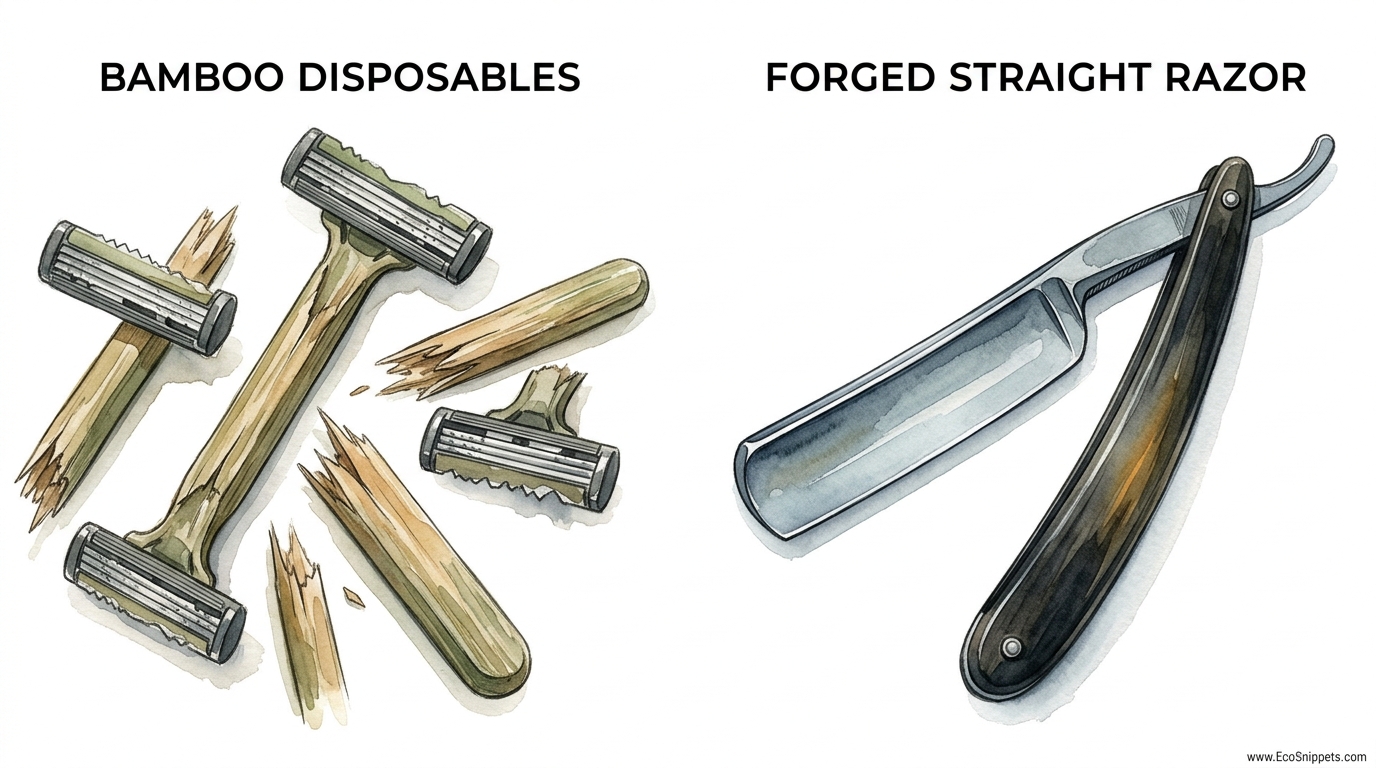
One is a ‘better’ version of trash; the other is a lifetime of precision that your grandson will eventually use. Most people think switching to bamboo razors is the peak of sustainability, but you’re still throwing away plastic heads and buying new handles every month. The real pros go back to a single piece of forged steel. No cartridges, no waste, and a closer shave than any 5-blade gimmick can provide.
Choosing a forged straight razor is more than a grooming choice; it is a commitment to a standard of self-reliance that has largely vanished from the modern world. We live in an era of “disposable everything,” where convenience is often a mask for poor quality and environmental neglect. While bamboo disposables attempt to fix the plastic problem, they often fail to address the core issue: the cycle of consumption itself. A forged blade breaks that cycle. It demands your attention, your respect, and a little bit of your time, but in return, it offers a level of performance that no mass-produced cartridge can ever replicate.
Understanding the difference between these two worlds requires looking past the marketing and into the metallurgy, the physics of the edge, and the economics of a tool that lasts a century. If you are tired of paying a subscription fee just to keep your face clean, it is time to look at the ancestral wisdom of the barber’s bench.
Why Pro Barbers Ditch Bamboo Razors For Forged Steel
Professional barbers and master craftsmen have long understood that a tool is only as good as its stability. Bamboo razors, despite their eco-friendly marketing, are often lightweight and lack the structural rigidity required for absolute precision. When a barber holds a forged straight razor, they are holding a tool with a balanced center of gravity, designed to let the weight of the metal do the work rather than the pressure of the hand.
The primary reason professionals avoid the “eco-disposable” route is consistency. A forged blade is a static variable. You know exactly how it will behave because you are the one who maintains its edge. Cartridges and bamboo-handled disposables rely on thin, stamped steel blades that are often held at fixed angles by plastic clips. These blades flex during the stroke, which is the primary cause of the “tug and pull” sensation that leads to razor burn and ingrown hairs.
In the real world, a forged razor represents a mastery of the craft. It is used in high-end shops because it allows for “shaping” a beard or a neckline with surgical accuracy. You cannot see exactly where the blade meets the skin with a bulky multi-blade head in the way. With a straight razor, the edge is fully visible, allowing the user to navigate the contours of the jaw and the sensitive skin of the neck with total confidence.
The Anatomy of the Forged Blade: Metal and Grind
Not all steel is created equal. When you step away from the world of disposables, you enter the realm of metallurgy, where the choice between carbon steel and stainless steel determines the soul of your razor.
Carbon Steel vs. Stainless Steel
Most traditionalists swear by high-carbon steel. This alloy is prized for its ability to take a frighteningly sharp edge. Carbon steel is “softer” in the sense that it responds better to a honing stone, allowing you to achieve a “keenness” that stainless steel often struggles to match. However, carbon steel is a jealous mistress; it will rust if left damp for even a few hours. It requires a thin coat of mineral oil and a dry environment to stay in peak condition.
Stainless steel, on the other hand, is the choice for the modern man who may not want to oil his blade every morning. While it is harder to sharpen, it holds its edge for a longer duration between honing sessions. It is resistant to the humid environment of a bathroom, making it a “low-maintenance” heirloom tool.
The Importance of the Grind
The “grind” of a razor refers to the shape of the blade’s cross-section. A “full hollow” grind is thin and flexible, often producing a distinct “singing” sound as it cuts through stubble. This is the hallmark of a high-quality forged blade. In contrast, a “wedge” grind is thick and heavy, providing a very stable and forgiving shave that is excellent for those with particularly coarse or thick hair. Understanding these nuances allows you to tailor your tool to your specific facial topology.
The Economics of Permanence: Cost Breakdown
One of the greatest myths in the grooming industry is that straight razors are “too expensive.” This perspective only holds true if you look at the next thirty seconds. When you look at the next thirty years, the math shifts dramatically in favor of forged steel.
The initial investment for a quality forged straight razor, a leather strop, and a basic honing stone might range from $200 to $450. To someone used to a $10 bag of bamboo disposables, this feels like a steep barrier. However, consider the recurring cost of replacements. A typical bamboo razor subscription or high-quality cartridge system can easily cost $15 to $20 a month. Over a single year, you have already spent nearly the cost of a lifetime setup.
By year five, the straight razor user has spent $0 on blades, while the disposable user has funneled over $1,000 into the trash. A forged blade is a “buy it for life” (BIFL) investment. It does not require a subscription, it does not have “planned obsolescence,” and it does not rely on a supply chain that might disappear. It is the ultimate tool for a self-reliant lifestyle.
The Ritual: How to Master the Straight Razor Shave
Shaving with a straight razor is not a chore; it is a meditative practice. It forces you to slow down, to focus on the task at hand, and to respect the edge. Mastering the technique requires patience, but the results are worth the effort.
- Preparation: Never shave cold. Use a hot towel or a warm shower to soften the keratin in your hair. Apply a high-quality shaving soap with a brush to lift the hairs away from the skin.
- The Angle: Hold the blade at roughly a 30-degree angle to your skin. Too flat, and it won’t cut; too steep, and it will scrape.
- The Grip: Rest your first three fingers on the back of the shank, with your thumb on the underside near the pivot. Your pinky should rest on the “tang” or the curved tail of the blade. This gives you maximum control.
- Short Strokes: Do not try to clear your whole cheek in one go. Use short, controlled strokes of about one inch. Let the weight of the forged steel do the cutting—never press into your skin.
- Grain Direction: For the first pass, always shave “with the grain” (the direction your hair grows). For a closer shave, you can perform a second pass “across the grain,” but “against the grain” should only be attempted by those with significant experience.
The Practical Benefits of a Single Edge
Switching from a multi-blade bamboo razor to a single forged edge provides immediate physiological benefits for your skin. Multi-blade systems are designed to “lift and cut.” The first blade pulls the hair up, and subsequent blades cut it below the skin line. This is the primary recipe for ingrown hairs and “razor bumps,” as the hair often gets trapped under the surface as it regrows.
A straight razor cuts the hair exactly at the skin level. Because there is only one blade passing over the skin, there is significantly less friction and irritation. This makes forged steel the ideal choice for men with sensitive skin or those prone to breakouts. Additionally, the exfoliating properties of a single sharp edge leave the skin feeling smoother and healthier than the “scrubbing” action of a plastic cartridge.
Challenges and Common Mistakes
The learning curve is the most significant hurdle for new users. Transitioning from a safety-oriented disposable to an open blade requires unlearning bad habits.
Applying Pressure: This is the most common error. Modern disposables are so light that users are trained to “press” the razor against their face to get a close shave. If you do this with a 6/8 inch forged blade, you will cut yourself. You must learn to trust the sharpness of the edge and the gravity of the metal.
Poor Stropping: A straight razor must be stropped before every single shave. Stropping doesn’t “sharpen” the razor in the sense of removing metal; it realigns the microscopic “teeth” of the edge that get bent during the shave. Failing to strop properly—or stropping with too much pressure—can actually round off the edge and make the razor feel dull.
Neglecting Moisture: If you are using a carbon steel blade, moisture is the enemy. Many beginners leave their razor on the sink edge or in a damp cabinet. This leads to “pitting” or micro-rust on the edge, which ruins the shave quality. Always dry the blade thoroughly with a soft cloth and store it in a dry place.
Limitations and When Forged Steel May Not Be Ideal
Despite its superiority in many areas, the straight razor has realistic constraints. It is not a tool for the man in a rush. If you only have two minutes to shave before running out the door, a straight razor is a dangerous choice. It requires a dedicated 10 to 15 minutes of focus.
Travel is another limitation. Due to modern security regulations, you cannot carry a straight razor in a carry-on bag during flights. For frequent travelers who do not check luggage, a bamboo safety razor or a shavette (which uses disposable halves of safety blades) might be a more practical, though less “ancestral,” compromise.
Environmental limitations also play a role. If you live in an extremely humid, tropical climate, maintaining a carbon steel razor becomes a constant battle against oxidation. In these environments, a stainless steel forged blade is almost a necessity rather than a preference.
Bamboo vs. Forged Steel: A Sustainability Reality Check
When we talk about “green” products, we have to look at the entire lifecycle. Bamboo is a fast-growing, renewable resource, which makes it a great material for a handle. However, the manufacturing of the blade heads still involves high-energy industrial processes, and the resulting waste—even if the handle is compostable—is still a multi-material “nugget” that most recycling centers won’t touch.
| Feature | Bamboo Disposable | Forged Straight Razor |
|---|---|---|
| Lifespan | 1–4 weeks per head | 50–100+ years |
| Waste Production | Monthly plastic/metal waste | Zero (blade is permanent) |
| Maintenance | None (Replace head) | Daily stropping, annual honing |
| Shave Quality | Standard / Moderate irritation | Superior / Low irritation |
| Long-term Cost | High (Recurring fees) | Low (One-time investment) |
Practical Tips for the Transition
Moving from a disposable mindset to a forged steel mindset takes about 30 shaves. This is the “magic number” where your muscle memory begins to take over and the fear of the blade vanishes.
To start, consider only shaving your cheeks with the straight razor for the first week, using your old razor for the difficult areas like the chin and neck. As your confidence grows, expand the territory of the forged blade. Always keep a “styptic pencil” or alum block nearby for the inevitable tiny nicks that happen during the learning phase. These tools stop bleeding instantly and act as an antiseptic.
Invest in a wide strop—at least 3 inches. A wider strop allows you to pull the blade straight down without needing the complex “X-pattern” stroke, which is much easier for beginners to master. Keeping the strop taut is essential; a sagging strop will “roll” the edge and dull your razor faster than any beard ever could.
Advanced Considerations: Honing and Edge Tuning
For the serious practitioner, the journey doesn’t end with shaving. Learning to “hone” your own razor is the final step in total self-reliance. Honing involves using ultra-fine abrasive stones (starting at 3,000 grit and going up to 12,000 or even 20,000 grit) to remove microscopic amounts of metal and create a new edge.
Most users only need to hone their razor three or four times a year. If you find that stropping no longer brings back that “buttery” feel, it’s time for the stones. The process is similar to stropping but requires even more precision. You must keep the blade perfectly flat against the stone, ensuring the spine and the edge move as one. This is how you maintain a tool that can be handed down through four generations.
The “Heirloom” Scenario: A Practical Example
Imagine a young man who buys a forged carbon steel razor today for $250. He spends 10 minutes every morning in a ritual of stropping and shaving. He learns the grain of his face, the temper of his steel, and the patience of a craftsman. He spends about $50 a year on high-quality soaps and creams—luxuries that make the experience enjoyable.
Forty years later, that razor has lost maybe an eighth of an inch of width from decades of honing, but it is just as sharp as the day it was forged. It has cost him significantly less than a lifetime of “cheap” disposables. More importantly, it has become an extension of his identity. When he passes it to his grandson, he isn’t handing over a piece of “better trash.” He is handing over a functional piece of history, a tool that has touched his skin every day of his adult life. That is something a bamboo disposable can never achieve.
Final Thoughts
One is a ‘better’ version of trash; the other is a lifetime of precision that your grandson will eventually use. The choice between a bamboo disposable and a forged straight razor is a choice between participating in a throwaway culture or reclaiming a tradition of quality. While bamboo offers a softer landing for the environmentally conscious, it remains tethered to the same cycle of convenience and replacement that defines modern waste.
Forged steel asks more of you, but it gives back in ways that cannot be measured in a simple cost-benefit analysis. It offers skin health, financial freedom from subscriptions, and the deep satisfaction of mastering a difficult but rewarding skill. It is a return to the “pioneer-grit” mentality—the idea that our tools should be as resilient and enduring as we are.
If you are ready to stop buying trash and start investing in yourself, put down the cartridge and pick up the blade. Experiment with the different grinds, learn the dance of the strop, and discover the shave that your ancestors knew was the only way to do the job right. The steel is waiting.
