How To Become More Self-Sufficient Without Starting a Full-Blown Farm…
Want to start preserving your harvest, making your own soap, or building a backyard root cellar — but not sure where to begin? “Homesteading Advice” gives you instant lifetime access to 35+ practical homesteading books on food preservation, veggie gardening, DIY natural cleaning products (save over $250 per year with this skill alone), brewing, off-grid energy, and a whole lot more…
Click Here To Check It Out Now!
The Living Soil: Choosing Ancestral Wisdom Over Synthetic Dependency
One feeds the plant for a day; the other builds a soil that feeds your family for a decade. Chemical fertilizers are a drug your soil gets addicted to. Worm castings are the cure. Switching to vermicompost creates a resilient, living system that thrives even when the stores are empty.
Modern gardening often feels like a series of transactions. You buy a bag of blue crystals, dump them in the dirt, and watch a temporary surge of green growth. This cycle repeats every season, leaving your soil dustier, thirstier, and more dependent on the next purchase. Ancestral wisdom suggests a different path, one where the gardener acts as a steward of life rather than a technician of chemistry.
True self-reliance begins beneath your fingernails. Understanding the difference between a synthetic nutrient fix and the raw power of worm castings is the first step toward a garden that doesn’t just survive but matures. This guide explores how to break the cycle of dependency and rebuild the foundational strength of your land.
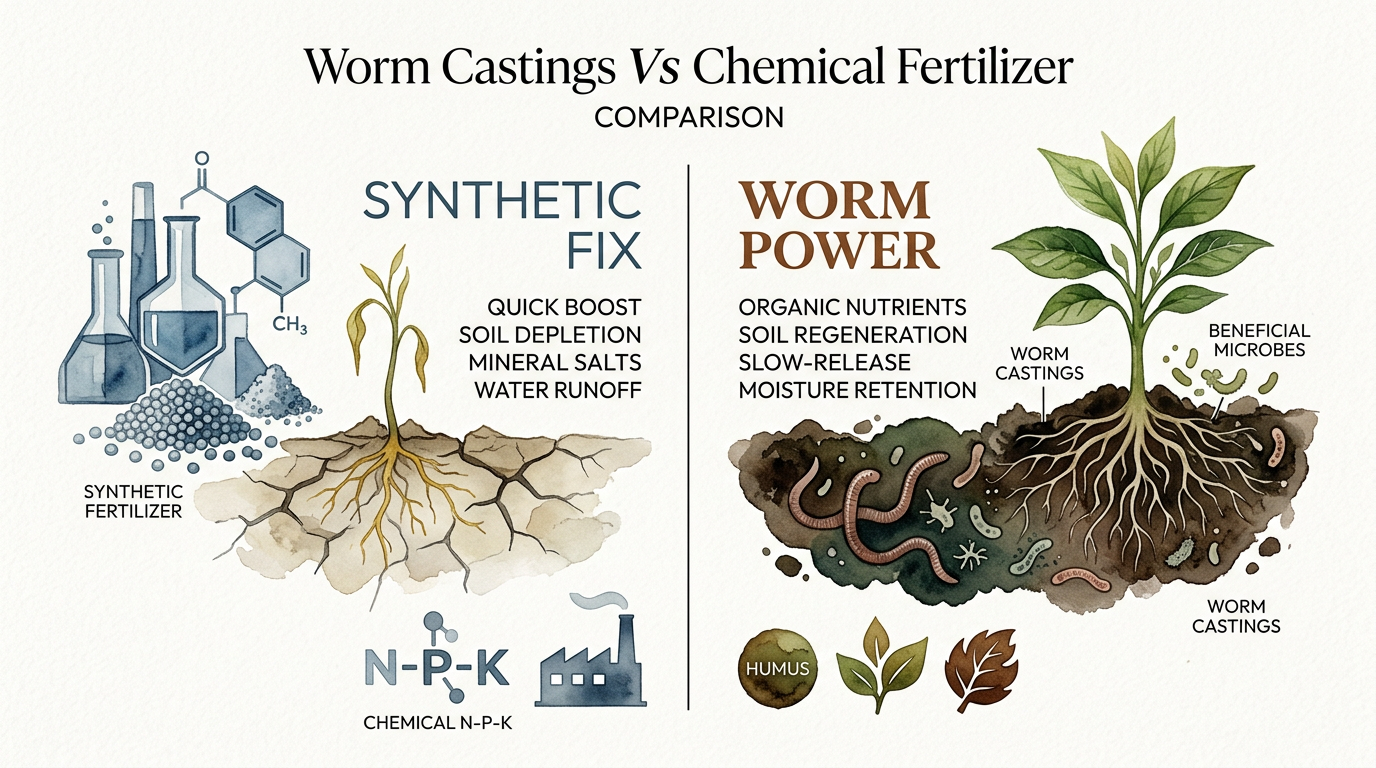
Worm Castings Vs Chemical Fertilizer Comparison
Worm castings and chemical fertilizers represent two fundamentally different philosophies of land management. Chemical fertilizers, often derived from petroleum or mineral salts, are designed to deliver high concentrations of Nitrogen, Phosphorus, and Potassium (NPK) directly to the plant’s roots. This approach treats the soil as an empty vessel, a mere medium to hold the plant while it is force-fed nutrients.
Worm castings, or vermicompost, are the byproduct of earthworms digesting organic matter. This substance is not just a fertilizer; it is a biological engine. It contains a modest amount of NPK, but its true strength lies in the rich diversity of beneficial bacteria, fungi, and enzymes it introduces to the earth. It treats the soil as a living organism that, when healthy, provides everything the plant needs in a sustainable, slow-release format.
Real-world application shows that while chemical fertilizers produce rapid growth, they often lead to “salt burn” and the destruction of the soil’s natural microbiome. Worm castings, on the other hand, improve soil structure, increase water retention, and provide a buffer against disease. One is a temporary patch; the other is a permanent upgrade to the garden’s ecosystem.
Homesteaders and serious growers use worm castings to build “banked” fertility. This means the soil gets better every year you use them. Chemical fertilizers offer no such legacy, as their nutrients either wash away into the groundwater or are consumed immediately, leaving the soil poorer than before.
The Alchemy of the Worm: How Biological Systems Function
Nature has a way of concentrating life. When an earthworm consumes a piece of decaying leaf or a bit of kitchen scrap, it passes that material through a digestive tract filled with specialized microbes. These microbes break down complex molecules into forms that plants can immediately recognize and absorb. This process is essentially the highest form of composting known to man.
Worm castings are coated in a thin layer of mucus that acts as a natural time-release capsule. This mucus prevents the nutrients from washing away during heavy rains, a common failure of synthetic alternatives. This slow-release mechanism ensures that the plant has a steady supply of food throughout its life cycle, rather than a feast-and-famine routine.
The microbial life within castings is the most critical component. These bacteria and fungi form symbiotic relationships with plant roots, known as mycorrhizal networks. These networks act like an extended nervous system for the garden, allowing plants to “trade” sugars for minerals deep in the soil. Chemical fertilizers often kill these delicate organisms because the high salt content dehydrates their microscopic bodies.
Humic and fulvic acids are also present in high concentrations within vermicompost. These substances act as chelators, which is a fancy way of saying they grab onto minerals in the soil and hand-deliver them to the plant. This makes the existing minerals in your dirt more available, essentially “unlocking” the hidden wealth already present in your backyard.
The Lasting Legacy: Benefits of the Worm Power Approach
Long-term soil health is the primary advantage of choosing worm power over the synthetic fix. Soil treated with castings develops a crumbly, dark texture known as “tilth.” This structure allows air and water to move freely, preventing the compaction that often plagues gardens managed with heavy chemical inputs. Plants in high-tilth soil grow deeper, stronger root systems that can withstand drought.
Water retention is another measurable benefit. Research suggests that soil rich in organic matter and worm castings can hold significantly more water than depleted soil. This reduces the need for frequent irrigation and provides a safety net during hot, dry spells. For the self-reliant gardener, water efficiency is just as important as nutrient density.
Pest and disease resistance improve naturally when you focus on soil biology. Many of the microbes found in worm castings are predatory toward harmful pathogens. These “good” microbes occupy the space around the roots, leaving no room for “bad” fungi or bacteria to take hold. Furthermore, the chitinase found in castings—an enzyme that breaks down the shells of insects—can actually repel certain pests like aphids and mites.
Nutrient density in the final harvest is the ultimate reward. Plants grown in a living soil system often contain a wider array of trace minerals and phytonutrients compared to those grown in a sterile, chemical-dependent environment. When you eat from a garden fueled by vermicompost, you are consuming the concentrated vitality of the earth itself.
Common Pitfalls: Navigating the Challenges of Vermicomposting
Patience is often the first hurdle. Gardeners accustomed to the overnight “green-up” of synthetic nitrogen may feel that worm castings are “slow.” This perception ignores the fact that the castings are building a foundation rather than just painting the leaves green. Expecting instant results can lead to over-application or frustration.
Source material matters more than most beginners realize. If you feed your worms nothing but bleached paper and cardboard, their castings will lack the nutrient diversity found in worms fed a variety of vegetable scraps, crushed eggshells, and coffee grounds. Quality in equals quality out. Using contaminated bedding, such as wood treated with pesticides, can kill your worm colony and ruin your compost.
Moisture management is a frequent point of failure. A worm bin that is too wet will become anaerobic, leading to foul smells and a mass die-off of the worms. A bin that is too dry will cause the worms to retreat to the center or die from dehydration. Maintaining the consistency of a wrung-out sponge is the golden rule for success.
Temperature extremes can also derail a vermicomposting operation. Unlike traditional hot compost piles that generate their own heat, worm bins are sensitive to the environment. Freezing temperatures will kill the worms, while temperatures above ninety degrees Fahrenheit will cook them. Successful practitioners often keep their bins in basements, crawlspaces, or shaded areas to maintain a steady climate.
Real-World Boundaries: Limitations of the Biological Method
Scale remains the primary limitation for worm castings. Producing enough castings to cover a hundred-acre field of corn is a massive logistical challenge compared to simply spraying a liquid fertilizer. For large-scale industrial agriculture, the synthetic fix is often chosen for its sheer convenience and speed, despite the long-term cost to the land.
Initial nutrient concentrations are lower in worm castings than in concentrated bags of 10-10-10 fertilizer. If a soil test reveals an extreme deficiency in a specific mineral, relying solely on castings may take several seasons to correct the balance. In these emergency cases, some gardeners use organic mineral amendments like rock phosphate or greensand alongside their castings.
Space and time are required to produce high-quality vermicompost. While a chemical bag can be bought in five minutes, a proper harvest of castings takes months of biological processing. This requires the gardener to plan ahead and maintain a “working” bin throughout the year. It is a commitment to a process rather than a one-time purchase.
Environmental factors like soil pH can also influence how effective castings are in the short term. While castings generally help buffer pH toward a neutral range, extremely acidic or alkaline soils may still require specific amendments like lime or sulfur to reach an optimal state for most vegetables. Biology is powerful, but it still operates within the laws of chemistry.
Comparing the Two Paths: Cost, Effort, and Resilience
Choosing between these two methods involves weighing the immediate cost against the long-term value. Synthetic fertilizers are cheap to buy but expensive to maintain, as they provide no residual benefit. Worm castings are expensive to buy but nearly free to produce once you have a system in place.
| Feature | Chemical Fertilizer | Worm Castings (Vermicompost) |
|---|---|---|
| Initial Cost | Low to Moderate | High (if bought) / Free (if made) |
| Soil Structure | Degrades over time | Improves over time |
| Application Frequency | Every 2-4 weeks | 1-2 times per season |
| Environmental Impact | High (run-off, salt buildup) | Low (regenerative, carbon-sequestering) |
| Resilience | Dependent on supply chains | Self-sustaining on-site |
Supply chain dependence is a critical factor for the modern homesteader. If the local farm store closes or prices spike due to fuel costs, the chemical gardener is in trouble. The vermicomposter, however, continues to produce top-tier fertilizer using nothing but kitchen scraps and local worms. This is the definition of true resilience.
Practical Tips: Mastering Your Vermicompost System
Starting a worm bin requires a container with adequate ventilation and drainage. Plastic totes are common, but wooden bins allow for better airflow. Use “Red Wigglers” (Eisenia fetida) rather than common garden earthworms; Red Wigglers stay near the surface and are much more efficient at processing organic waste in a confined space.
Bedding should be a mix of carbon-rich materials. Shredded newspaper, cardboard, and dried leaves work well. Moisten the bedding before adding the worms, ensuring it is damp but not dripping. Adding a handful of native soil provides the “grit” worms need in their gizzards to grind up food particles.
Feeding the worms requires a light touch. Bury the food scraps under the bedding to prevent fruit flies and odors. Avoid citrus, onions, garlic, and meat, as these can disrupt the pH or attract unwanted scavengers. Overfeeding is the most common mistake; only add more food once the previous batch has mostly disappeared.
Harvesting the castings can be done by moving the finished compost to one side of the bin and adding fresh food and bedding to the other. The worms will naturally migrate toward the new food source, leaving the “black gold” behind for you to collect. Sifting the castings through a quarter-inch mesh screen creates a fine, professional-grade product ready for the garden.
Using the castings is straightforward. For new transplants, place a handful directly into the planting hole to give the roots an immediate biological boost. For established plants, “top-dress” by spreading a layer of castings around the base and lightly scratching it into the soil. Rain or irrigation will wash the nutrients and microbes down into the root zone.
Advanced Considerations: The Science of Soil Stewardship
Serious practitioners often look beyond basic castings and explore the world of “Worm Tea.” This involves steeping worm castings in aerated water, often with a catalyst like unsulphured molasses to stimulate microbial growth. This liquid extract can be used as a foliar spray, delivering beneficial microbes directly to the leaves to combat powdery mildew and other airborne pathogens.
Fungal-to-bacterial ratios are another advanced metric. Different plants prefer different soil balances. Most vegetables thrive in a bacteria-dominant soil, which worm castings naturally provide. However, if you are growing fruit trees or perennial shrubs, you can “steer” your castings toward a more fungal dominance by adding more woody materials and fungal inoculants to the worm bedding.
Mineralization is a concept where you add rock dusts—like azomite or basalt—directly into the worm bin. The worms ingest these tiny mineral particles and, through their digestive process, make the minerals much more bioavailable. This creates “super-castings” that contain nearly every element on the periodic table, ensuring your plants never hit a nutritional ceiling.
Seasonal adjustments are necessary for outdoor vermicomposting. In the winter, insulating the bin with hay bales or moving it into a garage ensures the biological activity doesn’t grind to a halt. In the summer, using a “cooling” layer of damp burlap can prevent the core temperature from rising to dangerous levels. Understanding these rhythms is part of the “pioneer-grit” required for long-term success.
The Homesteader’s Success: A Tale of Two Gardens
Consider a typical garden plot that has been treated with chemical 10-10-10 for five years. The soil is likely pale, crusty when dry, and hard as a brick when wet. The plants grow quickly but are plagued by aphids and require constant watering. To fix this, the gardener must buy more fertilizer and more pesticide, a cycle that drains both the wallet and the land’s vitality.
Compare this to a plot that has been managed with worm castings and organic mulch. The soil is dark, smells like a forest floor, and is teeming with life. When a drought hits, these plants stay green for days longer than their chemical neighbors because the soil’s organic matter holds onto every drop of dew. The gardener spends their time harvesting rather than managing crises.
Transitioning from the synthetic fix to worm power doesn’t happen overnight. It usually takes two to three seasons for the soil biology to fully recover from years of chemical use. During this time, the gardener might see a slight dip in raw volume, but the quality, flavor, and resilience of the crop will begin to climb immediately. By the third year, the “worm-powered” garden often out-produces the chemical one, and it does so with zero input costs.
Measurement of success in the self-reliant world isn’t just about the size of the pumpkin. It is about the independence of the grower. Producing your own fertility means you are no longer a customer of the industrial machine; you are a producer in your own right. This shift in mindset is the most valuable harvest of all.
Final Thoughts: Building for the Future
Building soil is an act of faith and a testament to ancestral wisdom. While the world looks for the next high-tech solution to food security, the humble earthworm continues the work it has done for millennia. Choosing worm castings over chemical fertilizers is a rejection of the “fast and cheap” culture in favor of something that lasts.
Every handful of castings you add to your garden is an investment in a decade of fertility. You are not just feeding a plant; you are feeding a complex web of life that will, in turn, feed you and your family. This biological approach builds a legacy of health that synthetic salts can never replicate. The path of the pioneer is often slower, but it leads to a destination that is truly sustainable.
Start small, observe your worms, and watch how your plants respond to the “black gold.” As your soil comes back to life, you will find that gardening becomes less of a chore and more of a partnership with nature. Experiment with different bedding materials, try brewing your first batch of worm tea, and take pride in the fact that your fertility comes from your own back door rather than a plastic bag.
