How To Become More Self-Sufficient Without Starting a Full-Blown Farm…
Want to start preserving your harvest, making your own soap, or building a backyard root cellar — but not sure where to begin? “Homesteading Advice” gives you instant lifetime access to 35+ practical homesteading books on food preservation, veggie gardening, DIY natural cleaning products (save over $250 per year with this skill alone), brewing, off-grid energy, and a whole lot more…
Click Here To Check It Out Now!
We traded 100-year durability for 10-minute convenience, and our food security is paying the price. Our grandparents didn’t have a ‘waste’ problem because they didn’t have ‘disposable’ solutions. Every time you buy plastic wrap, you’re buying trash. Transitioning back to high-quality glass and stone isn’t just about being eco-friendly; it’s about building a larder that survives for generations.
The modern kitchen is often a graveyard of single-use plastics and flimsy containers that leach chemicals into our sustenance. We have forgotten that for thousands of years, humans preserved the harvest without a single roll of cling film or a plastic vacuum bag. True food security comes from mastering techniques that rely on biology and physics rather than petroleum.
By returning to these ancestral methods, you are not just saving money or reducing your carbon footprint. You are reclaiming a lost skill set that ensures your family eats well regardless of supply chain hiccups or power grid failures. This guide will walk you through the grit and grace of preserving food the way it was meant to be: permanent, pure, and waste-free.
Zero Waste Food Preservation Methods
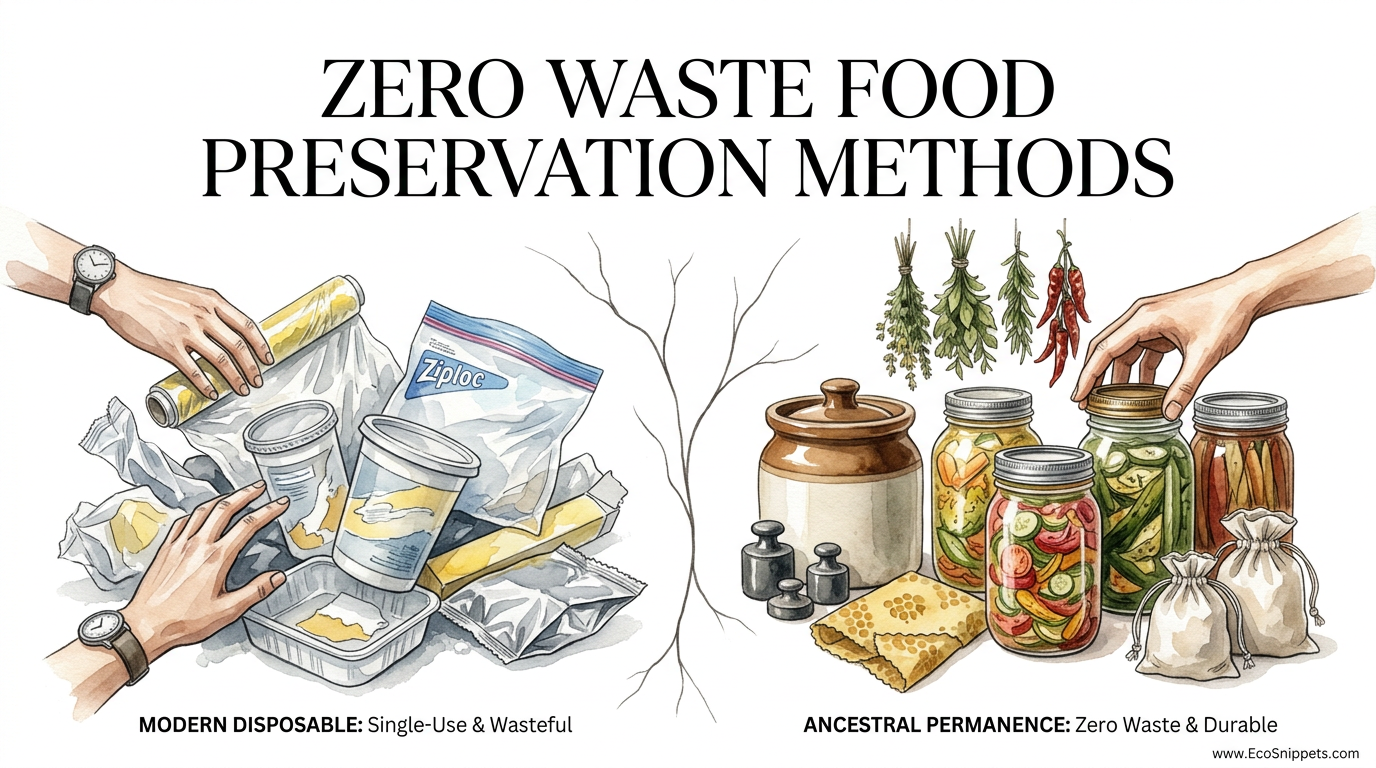
Zero waste food preservation is the art of extending the life of your harvest using materials and processes that do not result in landfill waste. In a world obsessed with ‘disposable’ solutions, this approach prioritizes reusable vessels like stoneware crocks, glass jars, and natural materials like sand or salt. It is a philosophy rooted in Ancestral Permanence, where the tools of the trade are passed down through families rather than tossed in the bin after one use.
These methods exist because nature has its own built-in preservation systems. Fermentation uses beneficial bacteria to guard against rot, while dehydration removes the moisture that spoilage microbes need to survive. In the real world, you see these methods at work in the sourdough starter on a baker’s counter or the braided garlic hanging in a Mediterranean cellar.
Understanding these methods means looking at food not as something that inevitably “goes bad,” but as something that can be transformed. Whether you are living in a city apartment or a sprawling homestead, these techniques allow you to capture the peak nutrition of the season and carry it through the winter without generating a scrap of plastic waste.
The Mechanics of Timeless Preservation
To preserve food without waste, you must understand the four horsemen of spoilage: moisture, oxygen, light, and heat. Traditional methods work by neutralizing one or more of these factors. For example, Lacto-fermentation works by creating an anaerobic (oxygen-free) environment where lactic acid-producing bacteria thrive. These “good” bacteria lower the pH of the food, making it too acidic for harmful pathogens like botulism to grow.
Canning is another pillar of the zero-waste larder, but it requires a shift in mindset regarding equipment. Instead of relying on single-use metal “flats” that are discarded after one seal, serious practitioners use reusable canning lids made of glass or heavy-duty BPA-free plastic with separate rubber gaskets. These gaskets can be sterilized and reused for years, eliminating the constant cycle of buying and throwing away metal lids.
Root cellaring and sand storage are perhaps the most passive forms of preservation. By utilizing the earth’s natural thermal mass, you can keep root vegetables in a state of “suspended animation.” Burying carrots or parsnips in a bucket of damp sand mimics their natural environment, preventing moisture loss while keeping them cool enough to stop growth but warm enough to prevent freezing.
Practical Advantages of Waste-Free Systems
The most immediate benefit of zero waste food preservation is the quality of the food itself. Unlike commercial canned goods that often contain high levels of sodium and synthetic preservatives, home-preserved food is a “living” product. Fermented vegetables are rich in probiotics that support gut health, a benefit you simply won’t find in a pasteurized, plastic-wrapped alternative from the supermarket.
There is also a significant economic advantage to Ancestral Permanence. While the initial investment in high-quality stoneware crocks or Tattler reusable lids might be higher, these items pay for themselves within a few seasons. You stop being a customer of the “disposable industry” and start being a producer with a self-sustaining system.
Furthermore, these methods provide a level of resilience that modern convenience cannot match. If the power goes out, a freezer full of food is a liability. A larder filled with fermented crocks, dried herbs, and root-cellared vegetables is an asset. These systems require zero electricity to maintain, making them the ultimate insurance policy for your food security.
Challenges and Common Pitfalls
The learning curve is the primary hurdle for those transitioning away from modern convenience. In a disposable culture, we are used to “set it and forget it” solutions. Traditional preservation requires observation and intuition. You have to learn the difference between the healthy, tangy smell of a ferment and the “off” smell of spoilage.
A common mistake is failing to maintain the proper environment. For instance, in root cellaring, storing apples and carrots together can lead to disaster. Apples release ethylene gas, which causes carrots to become bitter and spoil prematurely. Understanding these biological interactions is crucial to preventing waste during the preservation process itself.
Another pitfall is the misuse of equipment. Reusable canning lids, for example, have a different tightening protocol than disposable metal lids. If you tighten them too much before processing, the air cannot escape the jar, and you won’t get a proper vacuum seal. This is why “pioneer grit” is required—you must be willing to study the mechanics and practice until the process becomes second nature.
Limitations of Traditional Methods
While these methods are powerful, they are not universal. Environmental factors like high humidity can make air-drying food nearly impossible without a dedicated dehydrator. If you live in a region with very mild winters, a traditional root cellar may not stay cool enough to keep vegetables dormant, necessitating more active forms of preservation like fermentation or canning.
There is also a “space tax” associated with zero waste living. Glass jars and stone crocks are heavy and take up significantly more room than vacuum-sealed plastic bags. For those in small urban dwellings, this requires creative organization and a realistic assessment of how much food can actually be stored.
Finally, some foods simply do not preserve well using zero-waste methods. While you can salt-cure meat or dry certain fruits, the texture will change significantly. If you are expecting a home-dried apricot to look and taste like a sulfur-treated, plastic-bagged commercial version, you will be disappointed. These methods honor the food’s natural transformation rather than trying to freeze it in time.
Modern Disposable vs. Ancestral Permanence
| Feature | Modern Disposable | Ancestral Permanence |
|---|---|---|
| Primary Material | Plastic, Foil, Single-use Metal | Glass, Stone, Wood, Salt |
| Waste Output | High (Wraps, bags, lids) | Near Zero (Reusable components) |
| Nutritional Value | Often degraded by heat/processing | Enhanced (Probiotics, raw enzymes) |
| Energy Cost | High (Constant refrigeration) | Low (Passive cooling/drying) |
| Longevity of Tools | Measured in days/weeks | Measured in decades/generations |
Best Practices for the Zero-Waste Larder
Success in food preservation begins with immaculate cleanliness. While you don’t need a laboratory-grade clean room, your jars, crocks, and weights must be thoroughly scrubbed and often sterilized. This ensures that the only bacteria thriving in your ferments are the ones you want. Using natural cleaners like vinegar and hot water keeps the process chemical-free from start to finish.
Labeling is your best friend. In a zero-waste system, you often have dozens of identical-looking glass jars. Use a grease pencil or a small piece of masking tape to note the contents and the date of preservation. This allows you to follow the “First In, First Out” rule, ensuring that nothing sits at the back of the shelf for too long.
Always use the highest quality ingredients you can find. Food preservation is not a way to “save” rotten produce; it is a way to “lock in” the nutrition of the best produce. If a carrot is already limp or a tomato is bruised, the quality of the final product will suffer. Harvest at the peak of ripeness and process as quickly as possible for the best results.
Advanced Considerations for the Serious Practitioner
For those looking to scale their efforts, mastering the Science of Brines is essential. Moving beyond simple recipes to understanding salt-to-weight ratios allows you to ferment almost any vegetable safely. A kitchen scale is a vital tool here; measuring salt by weight rather than volume accounts for differences in grain size and ensures consistent acidity levels every time.
Another advanced technique is the use of Zeer Pots (pot-in-pot refrigerators). This is an evaporative cooling system made by nesting one earthenware pot inside another with a layer of wet sand in between. As the water evaporates through the outer pot, it pulls heat away from the inner chamber. This is a game-changer for those without a basement who still want to store produce without electricity.
If you are preserving meat, you must delve into the world of curing salts and humidity-controlled curing chambers. This is the pinnacle of the preservation arts and requires strict adherence to safety protocols to prevent botulism. However, the reward—home-cured hams and salamis that contain no synthetic nitrates or plastic packaging—is well worth the effort.
Scenario: The Suburban Harvest Transformation
Imagine a household that receives a 20-pound crate of organic carrots in October. Instead of tossing them into a plastic crisper drawer where they will go limp in two weeks, the zero-waste practitioner takes three distinct paths. Five pounds are shredded and packed into a stone crock with salt to become Fermented Ginger Carrots, a probiotic side dish that will last six months.
Ten pounds are placed in a wooden box, nestled into layers of clean, damp sand, and moved to the coolest corner of the garage. These will remain crisp and sweet for roasting well into February. The remaining five pounds are sliced and dried on a solar rack or in a low oven, creating shelf-stable carrot chips for snacks or rehydrating into soups later in the year.
By the end of the day, 20 pounds of produce have been secured for the winter. Not a single piece of plastic was used, and the only “waste” produced was the carrot tops, which were tossed into the compost bin to feed next year’s garden. This is the efficiency of a system built on Ancestral Permanence.
Final Thoughts
Zero waste food preservation is more than a set of kitchen hacks; it is a return to a relationship with our food that is based on respect rather than convenience. When we move away from disposable solutions, we stop treating our resources as trash in waiting. We begin to see the beauty in a row of glass jars and the security in a well-stocked root cellar.
The transition takes time and a bit of “pioneer grit,” but the rewards are tangible. You will eat better, waste less, and build a level of self-reliance that modern systems simply cannot provide. Whether you start with a single jar of sauerkraut or a full-scale basement cellar, every step away from plastic is a step toward a more resilient future.
Start small, observe the natural processes at work, and don’t be afraid to experiment. The wisdom of our grandparents is still available to us; we just have to be willing to pick up the stone and glass and leave the plastic behind. Your larder, your health, and the planet will thank you for it.
