How To Become More Self-Sufficient Without Starting a Full-Blown Farm…
Want to start preserving your harvest, making your own soap, or building a backyard root cellar — but not sure where to begin? “Homesteading Advice” gives you instant lifetime access to 35+ practical homesteading books on food preservation, veggie gardening, DIY natural cleaning products (save over $250 per year with this skill alone), brewing, off-grid energy, and a whole lot more…
Click Here To Check It Out Now!
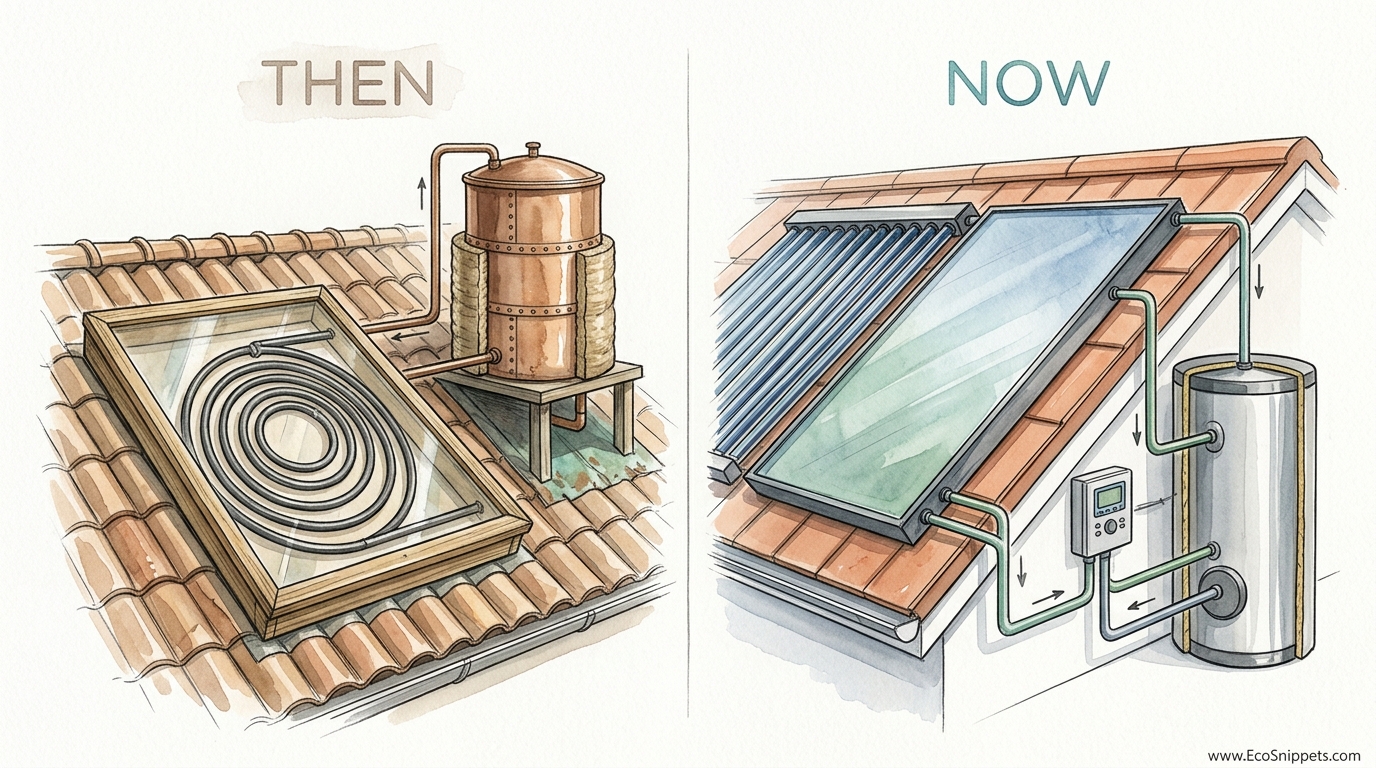
We traded 100 years of reliability for ‘smart’ features that break the moment the warranty expires. In the 1920s, thousands of homes had free hot water using zero electricity. These ‘Then’ systems had no pumps, no sensors, and no moving parts to break. ‘Now,’ we rely on fragile electronics and a power grid to do the same job. Is the modern way actually progress, or just a new way to stay dependent?
The quest for hot water has defined domestic comfort for centuries. Before the era of the smart home, early 20th-century pioneers mastered a technology that was as silent as the sunrise. By 1897, roughly 30 percent of homes in Pasadena, California, were already equipped with solar water heaters. These systems did not need a smartphone app or a lithium battery; they simply used the laws of physics to provide a hot bath at the end of a long day.
Today, we think of solar energy as a high-tech “future” solution, yet we have largely forgotten the robust simplicity of the 1920s. By looking back at how these systems were built and why they lasted for decades, we can reclaim a level of self-reliance that modern “efficient” appliances cannot match. This guide explores the mechanics, history, and practical application of traditional solar water heating.
Traditional Solar Water Heating Secrets
Traditional solar water heating is built upon the foundational principle that heat naturally wants to move. Unlike modern “active” systems that use electric pumps to force water through pipes, traditional “passive” systems rely on the thermosyphon effect. This is a natural loop created by the difference in density between hot and cold water.
In the late 1800s, the first commercial solar water heater, known as the Climax, was patented by Clarence Kemp. It was essentially a “batch heater”—several black-painted tanks inside a glass-topped wooden box. While it provided hot water during the day, it lacked insulation and would cool down rapidly once the sun set. It was a simple “Then” solution that worked, but it had limitations that needed refining.
The real breakthrough came in 1909 when William J. Bailey patented the Day and Night solar water heater. Bailey’s secret was separation. He moved the water storage tank away from the sun-exposed collector and into an insulated area, often the attic or a separate closet. By separating the “heating” part from the “storage” part, he ensured that the water heated during the day stayed hot all night long. This design was so successful that by 1941, over 60,000 units were installed in Miami alone.
These secrets were not hidden; they were common knowledge for thousands of families in California and Florida. The systems thrived because they were integrated into the home’s architecture. They utilized the sun’s 1,000 watts of energy per square meter (roughly 93 watts per square foot) to provide a luxury that, at the time, would have otherwise required expensive coal or gas.
How It Works: The Physics of the Thermosyphon
To understand why these systems are so reliable, you have to look at the physics of natural convection. When water is heated, its molecules move faster and take up more space. This makes the hot water less dense (lighter) than the cold water around it. In a properly designed loop, this hot water will naturally rise to the highest point in the system.
The Collector and the Tank
A traditional system consists of two main parts: a flat-plate collector and an insulated storage tank. The collector is usually a series of copper pipes attached to a black-painted metal plate, all enclosed in a “hot box” with a glass or plastic cover. As the sun strikes the black plate, the temperature inside the box can easily reach 80°C to 120°C (176°F to 248°F).
The Gravity Loop
The storage tank must be placed higher than the collector. Cold water sits at the bottom of the tank and, being heavier, flows down a pipe into the bottom of the collector. As the sun heats the water inside the collector’s pipes, that water becomes lighter and begins to rise. It travels up the collector and through a return pipe into the top of the storage tank.
Automatic Regulation
This cycle continues as long as the sun is shining. There is no need for a controller to tell the system to “turn on.” If the water in the collector is hotter than the water in the tank, it moves. If the sun goes behind a cloud and the water in the collector cools down, the flow simply stops. It is a self-regulating, elegant loop that functions entirely on gravity and thermal energy.
Benefits of Passive Solar Heating
Choosing a traditional passive system over a modern active one offers several measurable advantages, particularly for those focused on long-term resilience and low operational costs. These benefits extend beyond just “saving money” and touch on the core of self-reliance.
- Zero Electricity Requirement: Because there are no pumps or sensors, the system works even during a total grid failure. This makes it an ideal solution for off-grid living or emergency preparedness.
- Unmatched Reliability: With no moving parts, there is nothing to burn out. A well-constructed copper collector and a high-quality insulated tank can last for 30 to 50 years with minimal intervention.
- Low Maintenance: Unlike modern systems that require checking pump seals, pressure sensors, and electronic control boards, a thermosyphon system mostly needs occasional glass cleaning and a check of the sacrificial anode rod.
- Consistent Performance: In sunny regions, a passive system can provide 50% to 80% of a household’s annual hot water needs. The “Day and Night” design ensures that you have hot water for your morning shower even after a cool night.
From a purely financial perspective, the ROI (Return on Investment) of a passive system is often superior to active systems. While the upfront cost of materials like copper can be high, the lack of repair costs and the zero-utility bill for heating mean the system pays for itself much faster than a complex high-tech alternative.
Challenges and Common Mistakes
While the principles are simple, execution requires precision. The most common mistakes in traditional solar water heating usually involve ignoring the laws of physics that make the system work. If you fight gravity or ignore insulation, the system will fail to perform.
Tank Elevation
A frequent error is placing the tank too low or too far away from the collector. For a thermosyphon to work, the bottom of the storage tank must be at least 30 centimeters (12 inches) above the top of the solar collector. If the tank is too low, the pressure difference won’t be strong enough to overcome the friction in the pipes, and the water will simply sit there and boil in the sun without moving to the tank.
Air Pockets
Air is the enemy of a natural convection loop. Any “hump” or high point in the plumbing that isn’t the storage tank will trap air bubbles. These air pockets act like a physical plug, stopping the flow of water entirely. All piping must have a continuous upward slope toward the tank to allow air to escape into the tank’s expansion space.
Pipe Sizing
Using pipes that are too small is another common pitfall. Modern pressurized systems can use 1/2-inch (13mm) lines because a pump forces the water through. In a passive system, you need larger diameters—typically 3/4-inch to 1-inch (20mm to 25mm)—to minimize friction. Think of it like a slow-moving river; it needs a wide bed to flow without resistance.
Limitations and Environmental Constraints
No system is perfect for every environment. Traditional solar water heaters have specific limitations that were the primary reason they were historically concentrated in places like Florida, Arizona, and California. Understanding these constraints is vital for anyone outside those regions.
Freeze Damage: The greatest threat to a “direct” passive system (where the actual tap water flows through the collector) is freezing. If the water in the copper pipes freezes, it expands and bursts the pipes. In climates where temperatures regularly drop below 0°C (32°F), a direct system must be drained during winter or designed as an “indirect” system using non-toxic antifreeze (propylene glycol) and a heat exchanger.
Weight and Structural Load: Water is heavy. A standard 300-liter (80-gallon) tank weighs approximately 300 kilograms (660 pounds) plus the weight of the tank itself. Placing this on a roof requires significant structural reinforcement. Many 1920s homes were built with this in mind, but modern “lightweight” roof trusses may require an engineer’s assessment before installation.
Hard Water Scaling: In areas with high mineral content, calcium carbonate (scale) will eventually build up inside the hot collector pipes. This acts as insulation, making the system less efficient, and can eventually clog the pipes entirely. Regular descaling with a mild acid like vinegar or using an indirect loop can mitigate this issue.
Comparison: Passive (Then) vs. Active (Now)
To help visualize the trade-offs between the 1920s approach and the modern approach, the following table compares the two philosophies based on real-world performance factors.
| Feature | Passive (Then) | Active (Now) |
|---|---|---|
| Power Source | None (Gravity/Buoyancy) | Electricity (Pumps/Sensors) |
| Lifespan | 30 – 50 Years | 10 – 15 Years (Electronics fail sooner) |
| Thermal Efficiency | Moderate (35% – 50%) | High (50% – 70%) |
| Maintenance Level | Low (Clean glass, descale) | Moderate (Pumps, controllers, fluid) |
| Installation Complexity | Low (Plumbing only) | High (Plumbing + Electrical) |
While the modern active system is more efficient in extracting every possible watt of heat, it does so at the cost of complexity. The passive system is less “efficient” on paper, but it is far more “effective” over a multi-decade timeline where simplicity equals survival.
Practical Tips for Success
If you are looking to build or restore a traditional system, these best practices will ensure you get the most out of the sun’s rays without the headaches of modern failures.
- Insulation is Everything: The storage tank should have a minimum of R-30 insulation. In the 1920s, they often used sawdust or cork; today, high-density mineral wool or closed-cell foam is much better. Don’t forget to insulate the “hot” pipe from the collector to the tank to prevent heat loss during transit.
- Optimal Tilt: For year-round hot water, tilt your collector to an angle equal to your latitude. For better winter performance (when the sun is lower), add 15 degrees to that number.
- Southern Exposure: Ensure the collector faces true south (in the northern hemisphere) and has zero shade between 9:00 AM and 3:00 PM. Even a single tree branch casting a shadow can drop efficiency by 40% or more.
- Sacrificial Anodes: If you are using a steel tank, always use a magnesium anode rod. This rod “sacrifices” itself to corrosion so that your tank doesn’t rust through. Replace it every 3-5 years.
One trick used by early installers was to use a tempering valve at the house faucet. Solar-heated water can reach temperatures well above 70°C (158°F), which can cause severe scalds. A simple mechanical mixing valve adds cold water to the output to keep it at a safe 49°C (120°F).
Advanced Considerations for the Serious Practitioner
For those living in colder climates or areas with very hard water, the “Indirect Loop” is the advanced configuration you need. Instead of heating your shower water directly, you fill the collector and the tank’s “jacket” with a mixture of distilled water and food-grade propylene glycol. This fluid circulates through a heat exchanger (a coil of copper inside the storage tank), transferring heat to your domestic water without ever mixing with it.
This setup solves two problems at once: it won’t freeze at -30°C (-22°F), and since the collector fluid is never changed, it won’t build up mineral scale. It adds a slight bit of complexity, but it preserves the passive, no-pump nature of the system while expanding its geographic range.
Another advanced optimization is the use of selective surfaces. While flat-black paint is traditional and cheap, modern selective coatings (like black chrome or blue sputtered surfaces) absorb more solar radiation while emitting significantly less infrared heat. This can boost your water temperature by an additional 10°C to 15°C even on hazy days.
Example Scenario: A Family of Four
Consider a household in a region like the American Southwest or Australia. A family of four typically uses about 240 to 300 liters (60 to 80 gallons) of hot water per day for showers, dishes, and laundry. To meet this demand with a traditional thermosyphon system, the math is straightforward.
A standard rule of thumb is to allow 4 square meters (about 43 square feet) of collector area for this volume of water. In a 1920s-style setup, this might be two collectors measuring 1 meter by 2 meters (roughly 3 feet by 6.5 feet) each. They would be connected to a 300-liter insulated tank located in the attic or on a reinforced roof platform.
On a clear day, this system would begin heating by 8:30 AM. By 2:00 PM, the entire 300-liter tank would be sitting at 60°C (140°F). The family uses half that water for evening showers and chores. Because the tank is heavily insulated, the remaining water only drops to 55°C (131°F) by the next morning—plenty hot for a morning wake-up shower before the sun starts the cycle all over again. Total cost of energy: $0.00.
Final Thoughts
The history of solar water heating is a reminder that technical complexity is not always a sign of progress. The “Then” systems of the 1920s were not abandoned because they failed; they were sidelined by the temporary abundance of cheap natural gas and the marketing push of electric utilities. We chose convenience over durability, and in doing so, we traded our independence for a monthly bill.
Reclaiming this technology is more than just a DIY project; it is a return to a mindset of “build once, use for a lifetime.” Whether you are building a simple batch heater for an outdoor shower or a full thermosyphon loop for a modern homestead, the principles remain the same. The sun is the most reliable “smart” feature we have, and it never asks for a subscription fee.
If you feel inspired to explore further, look into the specific plumbing techniques of gravity-fed systems or the history of passive solar architecture. The wisdom of a hundred years ago is still waiting for us, perfectly preserved in the physics of a hot copper pipe and the morning light.
