How To Become More Self-Sufficient Without Starting a Full-Blown Farm…
Want to start preserving your harvest, making your own soap, or building a backyard root cellar — but not sure where to begin? “Homesteading Advice” gives you instant lifetime access to 35+ practical homesteading books on food preservation, veggie gardening, DIY natural cleaning products (save over $250 per year with this skill alone), brewing, off-grid energy, and a whole lot more…
Click Here To Check It Out Now!
Ditch the earplugs and the fumes for a tool that never runs out of fuel and never jams.
No more tangled plastic line. No more mixing two-stroke fuel. Just the quiet ‘swish’ of steel against grass and a meditative morning workout.
The ancestral scythe isn’t just a relic; it’s a precision instrument that makes grass management a joy instead of a chore. For the modern homesteader, reclaiming this skill offers more than just a tidy lawn. It provides a deeper connection to the land and a reprieve from the mechanical chaos of modern life.
Stepping into a dew-covered meadow with a sharp blade feels fundamentally different than wrestling with a pull-start engine. You begin to hear the birds again. You notice the texture of the soil and the specific varieties of herbs growing at your feet.
This guide explores why the scythe is making a massive comeback on small farms and homesteads. We will look at the mechanics, the mindset, and the practical application of rhythmic steel over the gas-guzzling alternatives.
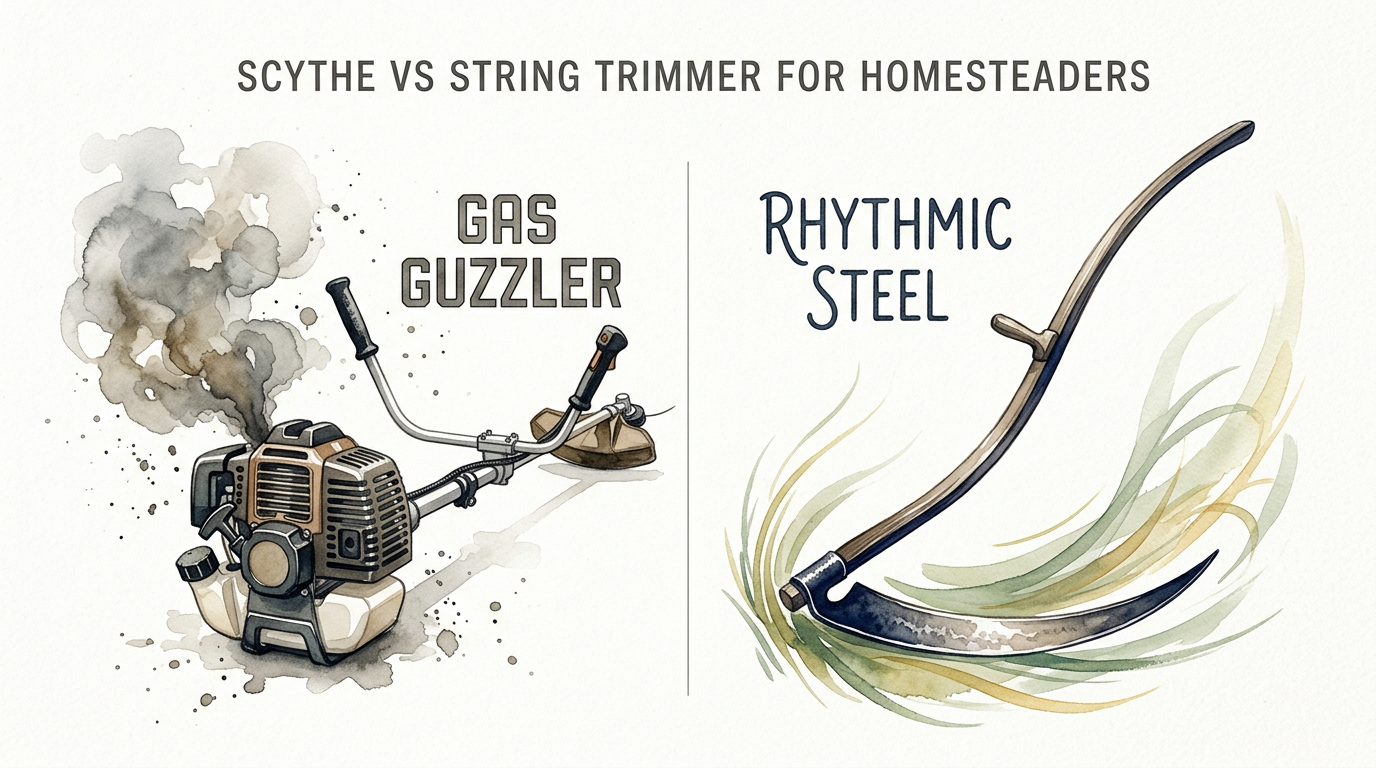
Scythe Vs String Trimmer For Homesteaders
Homesteading is often about finding the most efficient, self-reliant way to manage resources. While a gas-powered string trimmer is the default choice for many, it carries a heavy burden of maintenance and noise. The scythe, by contrast, represents a closed-loop system where the only fuel required is a good breakfast.
The string trimmer relies on high-speed rotation to “shatter” vegetation. This process often leaves ragged edges on the grass, which can lead to browning and disease. It also creates a cloud of micro-plastics as the line wears down, scattering synthetic debris across your growing space.
The scythe operates on the principle of a slicing cut. A razor-sharp blade moves in a horizontal arc, severing the grass cleanly at the base. This clean cut promotes faster recovery for the plants and preserves the nutritional value of the grass if you are harvesting it for animal fodder or mulch.
In real-world homesteading, the scythe excels in areas where machines struggle. It handles tall, wet grass that would bog down a trimmer. It operates in total silence, allowing you to work early in the morning without waking the neighbors or the livestock.
Choosing between these tools often comes down to your philosophy of land management. If you view mowing as a task to be “defeated” as quickly as possible, you might stick with the motor. If you view it as a rhythmic part of your daily stewardship, the steel blade wins every time.
How the Scythe Works: Mechanics and Movement
Understanding the scythe begins with its three main components: the snath (handle), the blade, and the hardware that connects them. Unlike the heavy, clunky “Death” scythes often seen in cartoons, a high-quality Austrian or European scythe is incredibly light and balanced.
The snath is ergonomically curved to allow the mower to stand upright. You do not hunch over when using a well-fitted scythe. Instead, you maintain a straight back and move the blade using a rotation of the torso, similar to a golf swing or a Tai Chi movement.
The blade is the heart of the tool. European blades are made of relatively soft, thin steel that is “peened” or cold-hammered to a microscopic edge. This thinness allows the blade to slide under the grass and slice through stems with almost zero resistance.
To use the tool effectively, you must master the “crescent stroke.” The blade should always stay in contact with the ground, sliding on its “beard” or belly. You aren’t swinging at the grass; you are sweeping the floor with a very sharp broom.
The leading edge of the blade should be slightly elevated to prevent it from digging into the dirt. This is controlled by the “pitch” or “hang” of the blade. Adjusting this angle is a fundamental skill that allows you to tailor the tool to your specific height and the terrain you are mowing.
The Importance of the “Hanging” Angle
The relationship between the blade and the snath determines how much effort you exert. If the blade is “open,” it takes a bigger bite of grass but requires more strength. If it is “closed,” it takes a smaller, easier slice.
Beginners should always start with a closed position. This reduces the risk of the blade getting stuck or “choking” on thick clumps of vegetation. As your rhythm improves, you can open the angle to increase your speed and efficiency.
The Practical Benefits of Choosing Steel
Switching to a scythe offers several measurable advantages that go beyond simple nostalgia. The first is the total elimination of “hidden costs.” There are no spark plugs to change, no filters to clean, and no expensive trips to the gas station.
Ergonomic Health: Using a string trimmer involves carrying a vibrating weight suspended from your shoulders. This often leads to lower back pain and “white finger” from the constant vibration. Scything is a full-body workout that builds core strength and improves flexibility without the joint-jarring impact of machinery.
Resource Recovery: When you mow with a scythe, the grass falls in neat “windrows.” This makes it incredibly easy to gather for hay or garden mulch. A string trimmer pulverizes the grass into a messy spray, making it nearly impossible to collect for secondary use.
Wildlife Protection: Small animals like frogs, toads, and ground-nesting birds have a chance to escape a scythe. The slow, rhythmic movement gives them time to move. A high-speed trimmer head is often too fast and destructive for the local ecology to survive the encounter.
Longevity: A well-maintained scythe can literally last a lifetime. Many homesteaders use blades passed down through generations. A gas trimmer has a planned obsolescence, often ending up in a landfill after five to ten years of use.
Challenges and the Learning Curve
The biggest hurdle for most people is the initial skill gap. You cannot simply pick up a scythe and be an expert in ten minutes. It requires a “feel” for the metal and the grass that only comes through practice.
One common mistake is trying to “muscle” the cut. If you find yourself sweating and gasping for breath, your technique is wrong. The power should come from the legs and the rotation of the hips, not the arms and shoulders.
Another challenge is the sharpening process. A scythe must be “honed” with a whetstone every five to ten minutes of use. This keeps the edge at peak performance. If you ignore this, the tool becomes frustrating and difficult to use, leading many to give up prematurely.
Peening the blade is the most daunting task for novices. This involves using a small hammer and anvil to draw out the steel at the edge. It is a form of cold-forging that hardens the metal while keeping it thin. Without peening, the blade will eventually become too thick to take a sharp edge.
Lastly, the scythe requires a specific type of focus. You have to watch for rocks, hidden stumps, and wire fences. Hitting a stone with a thin European blade can cause a “dent” or a crack that requires significant repair work with the hammer and anvil.
Limitations: When the Scythe Stays in the Shed
Despite its many virtues, the scythe is not a universal solution for every landscape. It is a precision instrument designed for soft tissues—grass, weeds, and light grains. It is not a machete or an axe.
If you are clearing thick, woody brush or saplings over half an inch thick, a standard grass blade will fail. You would need a specialized “brush blade,” which is shorter, thicker, and heavier. Even then, a heavy-duty brush mower might be more practical for clearing acres of neglected forest edge.
Terrain also plays a role. While a scythe works beautifully on slopes, extremely rocky or uneven ground can be a nightmare. If your “lawn” is mostly gravel and exposed tree roots, the constant risk of damaging the blade makes the string trimmer a safer, if noisier, choice.
Time is the final constraint. If you have five acres of grass to knock down and only two hours of free time, the scythe is not the right tool unless you have a team of mowers working in tandem. It is a tool for the “slow-homesteading” movement, where the process is as valuable as the result.
Comparative Analysis: Rhythmic Steel vs. Gas Guzzler
| Feature | European Scythe | String Trimmer |
|---|---|---|
| Power Source | Human Energy (Calories) | Gasoline / Electricity |
| Noise Level | Silent (Swish sound) | High (90-105 dB) |
| Maintenance | Honing & Peening | Engines, Plugs, Filters, Line |
| Initial Cost | $150 – $250 (High Quality) | $100 – $400 (Varies) |
| Lifespan | 30 – 50+ Years | 5 – 10 Years |
| Best For | Meadows, Hay, Silence | Edges, Fence Lines, Speed |
Practical Tips for Best Results
To get the most out of your scythe, timing is everything. The best time to mow is in the early morning when the dew is still on the grass. The moisture acts as a natural lubricant for the blade and adds weight to the grass, causing it to stand upright and offer more resistance to the cut.
Keep your whetstone in a holster filled with water at your waist. Honing should be a frequent, almost unconscious habit. Five or six quick strokes on each side of the edge every few minutes will keep the blade “biting” into the vegetation without effort.
Focus on your stance. Keep your feet shoulder-width apart and take very small steps forward with each stroke. You should only be moving forward about 2 to 4 inches at a time. This ensures you are always cutting fresh grass and not overlapping too much on your previous path.
Wear appropriate footwear. While the imagery of barefoot mowing is romantic, a slip can be dangerous with a razor-sharp blade. Sturdy leather boots provide the necessary grip and protection for a long morning in the field.
Listen to the sound of the blade. A “pinging” sound means you are hitting the grass correctly. A dull “thud” or “crunching” sound usually means your blade is too high or your edge has become dull. Let the tool tell you when it needs attention.
Advanced Considerations: The Alchemy of Peening
For those who want to master the scythe, peening is the ultimate skill. It is the process of drawing out the edge of the blade by hammering it against a small anvil. This does two things: it thins the metal to a hair-fine edge and work-hardens the steel.
Unlike grinding, which removes metal and creates heat that can ruin the temper, peening reshapes the metal cold. This preserves the integrity of the steel. A properly peened blade will stay sharp much longer than one that has been sharpened solely with a stone.
You can use a “peening jig” if you are a beginner. This tool uses a guided cap to ensure the hammer strikes the metal at the perfect angle. As you gain experience, you may move to a “narrow-point anvil” and a specific peening hammer, which allows for more control over the shape of the blade.
Advanced mowers will even “profile” their blades for specific tasks. A blade meant for a lawn might be hammered extremely thin, while a blade meant for a mountain meadow with hidden obstacles will be left slightly thicker for durability.
Real-World Example: The Two-Acre Meadow
Imagine a homesteader named Elias who has a two-acre meadow intended for winter goat fodder. In the past, he used a tractor-mounted mower. This compacted the soil and required significant fuel costs, plus the noise upset his herd for hours.
Elias switched to a 75cm Austrian grass blade on a customized wooden snath. He spends 45 minutes every morning before the sun gets too hot mowing a section of the field. Because he mows in sections, the grass stays fresh, and he can dry it into hay in manageable batches.
By the end of two weeks, the entire meadow is cut. He has burned zero gallons of fuel and hasn’t spent a dime on mechanical repairs. More importantly, he has lost five pounds, improved his cardiovascular health, and spent his mornings in peaceful observation of his land.
The hay he produces is higher quality because it wasn’t shattered or contaminated by exhaust fumes. His goats prefer the “sliced” hay, and Elias feels a sense of accomplishment that a machine could never provide. This is the practical reality of integrating rhythmic steel into a modern homestead.
Final Thoughts
The scythe is more than just a tool; it is a testament to the idea that “newer” isn’t always “better.” In an age of increasing complexity and noise, returning to a manual instrument offers a rare form of clarity and independence. It requires you to be present, to be skilled, and to be in tune with the natural rhythms of your environment.
While the learning curve can be steep, the rewards are measured in silence, health, and a perfectly managed landscape. Whether you are looking to save money on fuel or simply want to find a more meditative way to care for your property, the scythe stands ready to serve.
Start small, invest in high-quality equipment, and be patient with yourself as you learn the dance. Soon, the ‘swish’ of the blade will become the soundtrack to your most productive mornings. You might find that the most “advanced” tool on your homestead is the one designed hundreds of years ago.
