How To Become More Self-Sufficient Without Starting a Full-Blown Farm…
Want to start preserving your harvest, making your own soap, or building a backyard root cellar — but not sure where to begin? “Homesteading Advice” gives you instant lifetime access to 35+ practical homesteading books on food preservation, veggie gardening, DIY natural cleaning products (save over $250 per year with this skill alone), brewing, off-grid energy, and a whole lot more…
Click Here To Check It Out Now!
Stop trading your back health for livestock hydration by letting the earth’s natural heat do the work. Hacking ice out of troughs every morning is a 19th-century chore we don’t need to keep. Using a ‘thermal chimney’ design allows you to tap into the constant heat of the earth to keep your water flowing even at 20 below zero—without a single watt of electricity.
The challenge of winter livestock management often centers on a single, stubborn element: frozen water. When the mercury drops and the wind begins to howl across the pasture, a standard stock tank becomes a liability rather than an asset. It robs you of your time, strains your physical health, and, most importantly, threatens the well-being of your herd. Animals that cannot access clean, liquid water will quickly stop eating, leading to weight loss, reduced milk production, and a compromised immune system. Traditional solutions like electric tank heaters are notorious power hogs, often costing upwards of three dollars per day to operate, while also presenting risks of stray voltage and fire.
Tapping into the earth’s reservoir of warmth offers a better way. Deep beneath the frozen crust of the winter soil, the ground maintains a remarkably consistent temperature, usually between 45 and 55 degrees Fahrenheit. This latent heat is a gift from the land itself. By building a system that bridges the gap between that subterranean warmth and the surface water, you create a self-sustaining environment where ice struggles to take hold. This is the essence of the thermal chimney—a marriage of ancestral common sense and modern thermal physics.
How To Stop Stock Tanks From Freezing
To stop stock tanks from freezing, you must move beyond the idea of fighting the cold and instead focus on inviting the heat. Most traditional troughs fail because they are designed to shed heat as efficiently as possible. A galvanized metal tank sitting on the frozen ground is essentially a massive radiator for the cold air. To keep water liquid without electricity, you must utilize the earth’s geothermal energy through a process often called “earth-coupling.”
This method involves installing a vertical “thermal chimney”—typically a large-diameter culvert or pipe—that extends deep into the ground, well below the local frost line. This pipe acts as a conduit for the 50-degree air and soil heat to rise and warm the bottom of the water tank. It is a passive system that relies on the natural movement of heat from a warmer area to a colder one. In the middle of a blizzard, while the surface air is negative thirty, the bottom of your tank is being bathed in a constant stream of earth-born warmth.
These systems are used across the coldest regions of North America, from the high plains of Wyoming to the rugged pastures of Saskatchewan. They are particularly favored by ranchers who manage remote pastures where running electrical lines is cost-prohibitive. Whether you are watering a small flock of sheep or a hundred head of cattle, the principle remains the same: use the soil as your battery and the thermal chimney as your conductor.
The Physics of the Thermal Chimney
Understanding how a thermal chimney works requires a basic grasp of heat transfer. Heat always moves toward cold. In a standard tank, the heat from the water escapes into the air and the frozen ground until the water reaches 32 degrees and freezes. A thermal chimney reverses this dynamic by providing a continuous source of heat from below that is warmer than the freezing point.
The culvert creates a pocket of air that is insulated from the surrounding frozen topsoil. Because the bottom of the culvert is open to the deep, warm earth, the air inside the pipe stays significantly warmer than the outside air. This warm air rises through convection, making contact with the underside of the water trough. As the water on the surface of the tank loses heat to the atmosphere, the warmer water at the bottom of the tank (heated by the chimney) rises, creating a slow, natural circulation within the tank itself.
This process is most effective when the tank is partially buried or heavily insulated. By surrounding the tank with a barrier that prevents the cold wind from stripping away the earth-sourced heat, you create a micro-climate. The thermal chimney is the engine of this system, providing the “fuel” (heat) while the insulation acts as the “vessel” that holds that energy where it is needed most.
Building Your Own Geothermal Waterer
Constructing a DIY geothermal waterer is a project of grit and measurement. The most critical factor is depth. You must know the frost line for your specific region. If the frost line in your area is four feet, your thermal chimney needs to reach at least eight to ten feet deep to ensure it reaches truly stable, warm soil.
First, you will need a large-diameter pipe, such as a 12-inch to 24-inch double-walled plastic culvert. Dig a vertical hole using an auger or an excavator to the required depth. Place the culvert in the hole, ensuring the bottom is resting on a bed of clean gravel to allow for drainage and better heat transfer from the earth. The top of the culvert should be level with the ground where the base of your tank will sit.
Next, run your water supply line up through the center of this culvert. It is vital that the water line enters the chimney well below the frost line. This prevents the incoming water from being pre-chilled by the frozen topsoil. Once the pipe and culvert are in place, backfill the area around the outside of the culvert with soil, tamping it down firmly to prevent air gaps that could allow cold surface air to “short-circuit” the system.
The Advantage of Earth-Sourced Heat
Choosing a geothermal approach over electrical or manual methods offers several measurable benefits. The most immediate is the elimination of the monthly utility bill. Operating a single electric heater can cost several hundred dollars over the course of a long winter. Over five to ten years, a geothermal system pays for itself many times over in energy savings alone.
Beyond the financial aspect, there is the matter of reliability. Electrical systems are prone to failure during the very storms when they are needed most. Power outages, blown fuses, or chewed wires can lead to a frozen tank in hours. A thermal chimney has no moving parts and requires no grid connection. It is a “set it and forget it” solution that works as long as the earth remains warm.
Livestock health also sees a marked improvement. Animals are often deterred from drinking by the “stray voltage” sometimes found in electric waterers, which can give them a tiny, uncomfortable shock when their nose touches the water. A geothermal system is electrically “silent,” encouraging more frequent hydration. Furthermore, the water coming from a deep-well source and kept warm by the earth is often more palatable than ice-cold water, which helps maintain the animal’s core temperature and metabolic efficiency.
Common Pitfalls and Why Systems Fail
Even the best-designed systems can fail if the details are overlooked. The most frequent mistake is shallow burial. Many builders underestimate how deep the frost can penetrate during a prolonged cold snap. If the thermal chimney does not reach deep enough into the constant-temperature zone of the earth, it will simply circulate cold air, and the tank will freeze.
Another common failure point is air infiltration. If there is a gap between the top of the culvert and the bottom of the water tank, cold wind will blow into the chimney. This “draft” will quickly strip away the earth’s heat and freeze the supply line. You must ensure a perfectly airtight seal between the chimney and the tank. Many successful setups use heavy-duty rubber gaskets or expanding spray foam to bridge this gap.
Finally, low animal traffic can be a silent killer of these systems. The movement of water—livestock drinking and the tank refilling with fresh, 50-degree water—is a key part of the heat equation. If only one or two animals are using a large tank, the water may sit still long enough for the surface to freeze. Matching the tank size to the herd size is essential for maintaining the thermal balance.
Limitations and Environmental Constraints
Geothermal waterers are not a magic bullet for every situation. In regions with extremely high water tables, digging a ten-foot hole for a culvert may result in the pipe filling with water, which changes the thermal dynamics and can lead to structural issues. Similarly, in very rocky soil, the cost of excavating the required depth may outweigh the benefits of the system.
Wind is perhaps the greatest enemy of the geothermal tank. Even if the bottom of the tank is kept at 45 degrees by the earth, a forty-mile-per-hour wind at zero degrees can strip heat from the water surface faster than the earth can replace it. In these environments, the geothermal system must be paired with windbreaks and highly insulated lids to succeed.
It is also worth noting that in the most extreme Arctic climates—where the frost line can reach twelve feet or more—a purely passive geothermal system may only be able to keep a small “drinking hole” open rather than the entire surface of the tank. In these cases, the system should be viewed as a way to drastically reduce energy needs rather than eliminate them entirely.
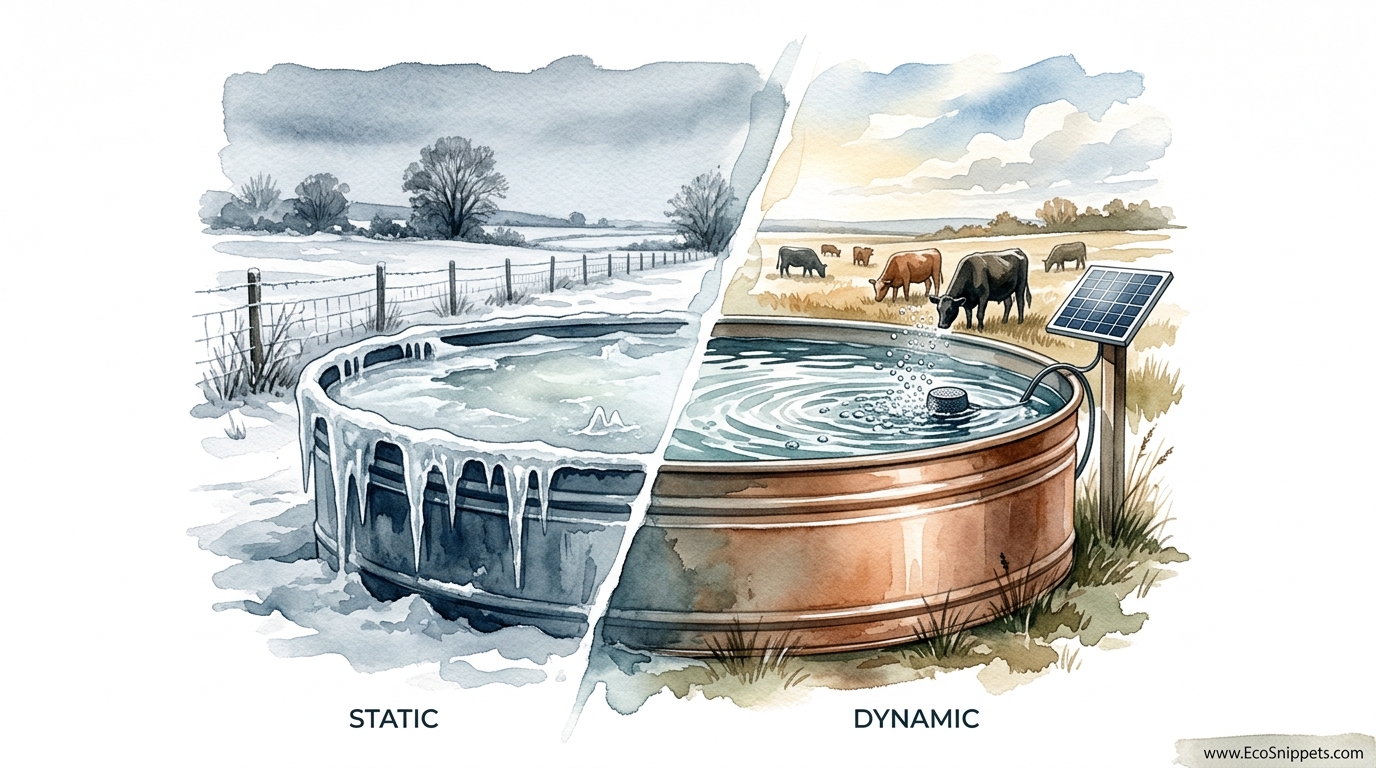
Comparing Static vs. Dynamic Water Systems
When evaluating frost-free options, it is helpful to look at how different designs handle the water. Most DIY thermal chimney setups are “static” systems, meaning the water sits in the tank until it is consumed. This relies entirely on the thermal mass of the water and the heat rising from the chimney.
In contrast, some commercial geothermal units utilize a “dynamic” or “continuous flow” system. These may use a thermal-sensitive valve that opens when the water temperature drops near freezing, allowing a small amount of water to drain out and fresh, warm water to flow in. While this is highly effective at preventing ice, it requires a place for the overflow water to go, such as a leach field or a drainage ditch.
| Feature | Static (Thermal Chimney) | Dynamic (Continuous Flow) |
|---|---|---|
| Electricity Required | None | None |
| Water Waste | Zero | Low to Moderate |
| Complexity | Medium (Deep Digging) | High (Valves & Drainage) |
| Ideal For | Most Pastures | Extreme Cold/Low Traffic |
Practical Tips and Best Practices
If you are planning to install a thermal chimney this season, start by insulating the exterior of your tank. Use two-inch thick closed-cell foam board, which does not absorb water. Wrap the tank and then protect the insulation from the animals’ teeth by shielding it with plywood or a secondary metal skin. The “nibble factor” is real; bored livestock will destroy exposed foam in a single afternoon.
Limit the surface area of the water. Instead of an open 100-gallon tank, use a well-insulated lid with a smaller “drinking hole” just large enough for the animal’s muzzle. This reduces heat loss from evaporation and convection by as much as 70 percent. You can also use a floating “pancake” of insulation that the animals push down to reach the water, which acts like a thermal blanket for the surface.
Position your tank in a spot that receives maximum winter sunlight. While the geothermal heat comes from below, solar gain from above is a powerful ally. A dark-colored tank or a south-facing setup can gain several degrees of warmth during the day, providing an extra buffer for the long, cold night ahead.
Advanced Considerations: Thermal Mass and Soil Type
Serious practitioners of earth-heated systems often consider the conductivity of their soil. Sandy soils drain well but may have lower thermal conductivity than moist, heavy clay. If you are in sandy ground, you may need a deeper chimney or a wider diameter to capture enough heat. Some advanced builders even fill the bottom of their culverts with large river rocks to increase the surface area for heat exchange.
The material of the tank also plays a role. While galvanized steel is traditional, polyethylene (plastic) tanks actually have better natural insulating properties. A double-walled plastic tank with the gap filled with spray foam is the gold standard for off-grid winter watering. It holds the earth’s heat much longer than a single sheet of cold-conducting metal.
For those in truly brutal climates, consider the “tank-within-a-tank” method. Place your watering trough inside a larger, insulated box. The thermal chimney feeds the air space between the two vessels. This creates a “warm jacket” around the entire water supply, ensuring that even the edges of the tank remain ice-free during the deepest part of the night.
A High-Plains Scenario: The System in Action
Imagine a ranch in Montana where the temperature has dipped to fifteen below. A traditional tank would have six inches of ice on it by daybreak, requiring the rancher to haul a sledgehammer and spend thirty minutes clearing it. Instead, this rancher has a 150-gallon poly tank sitting over a 24-inch culvert that reaches ten feet deep.
The water enters the chimney at 52 degrees from a buried line. As it sits in the tank, the cold air above tries to freeze it, but the constant 50-degree air rising from the chimney warms the bottom of the tank. The rancher has installed a heavy plywood lid with two 12-inch drinking holes. Because the cows drink throughout the morning, they are constantly drawing in new, warm water from the well.
By noon, despite the sub-zero temperatures, the water remains liquid. There might be a thin “skin” of ice near the edges of the drinking hole, but the cows can easily break it with a nudge of their nose. The rancher spends his morning checking fences and moving hay instead of fighting a losing battle against a block of ice.
Final Thoughts
Mastering the art of geothermal livestock watering is about more than just convenience. It is an act of stewardship that aligns your ranching practices with the natural rhythms and resources of the land. By looking downward for warmth rather than upward at the power lines, you create a more resilient, self-sufficient operation that can withstand the harshest seasons.
Implementing a thermal chimney requires an upfront investment of labor and a willingness to dig deep, but the rewards are measured in decades of service. You gain peace of mind, your livestock stays hydrated and healthy, and your bottom line is protected from the volatility of energy costs.
As you look toward the coming winter, consider what it would mean to retire the ice axe for good. The earth is ready to provide the heat you need. All you have to do is build the chimney that lets it in. Experiment with insulation, respect the frost line, and let the natural wisdom of the soil do the heavy lifting for you.
