How To Become More Self-Sufficient Without Starting a Full-Blown Farm…
Want to start preserving your harvest, making your own soap, or building a backyard root cellar — but not sure where to begin? “Homesteading Advice” gives you instant lifetime access to 35+ practical homesteading books on food preservation, veggie gardening, DIY natural cleaning products (save over $250 per year with this skill alone), brewing, off-grid energy, and a whole lot more…
Click Here To Check It Out Now!
That white stuff on your driveway isn’t just a chore; it’s a slow-release nitrogen bomb for your spring soil. They call snow ‘The Poor Man’s Fertilizer’ for a reason. As it falls, it captures atmospheric nitrogen and sulfur, delivering them directly to your soil as it melts. Instead of piling it on the curb, pile it on your beds. It insulates your roots from the deep freeze and feeds them the moment they wake up.
Ancestors knew this long before laboratory soil tests existed. They watched the fields turn a deeper, richer green following a winter of heavy accumulation. This wasn’t magic or coincidence; it was the result of a complex dance between the atmosphere and the earth. Snow acts as a bridge, bringing down elements that are often locked away in the air we breathe.
Working with the seasons means understanding that winter is not a dead time for the garden. It is a period of rest and replenishment. If you treat snow as a resource rather than a nuisance, you are practicing the kind of self-reliance that built sturdy farms for generations. Every shovel full of clean snow moved onto a dormant vegetable bed is an investment in the coming harvest.
Modern gardeners often focus on what they can buy in a plastic bag at the store. However, the most effective soil amendments often fall for free from the sky. Understanding how to manage this frozen asset is the difference between a garden that struggles in April and one that thrives. Let’s look at how to harness this winter gift correctly.
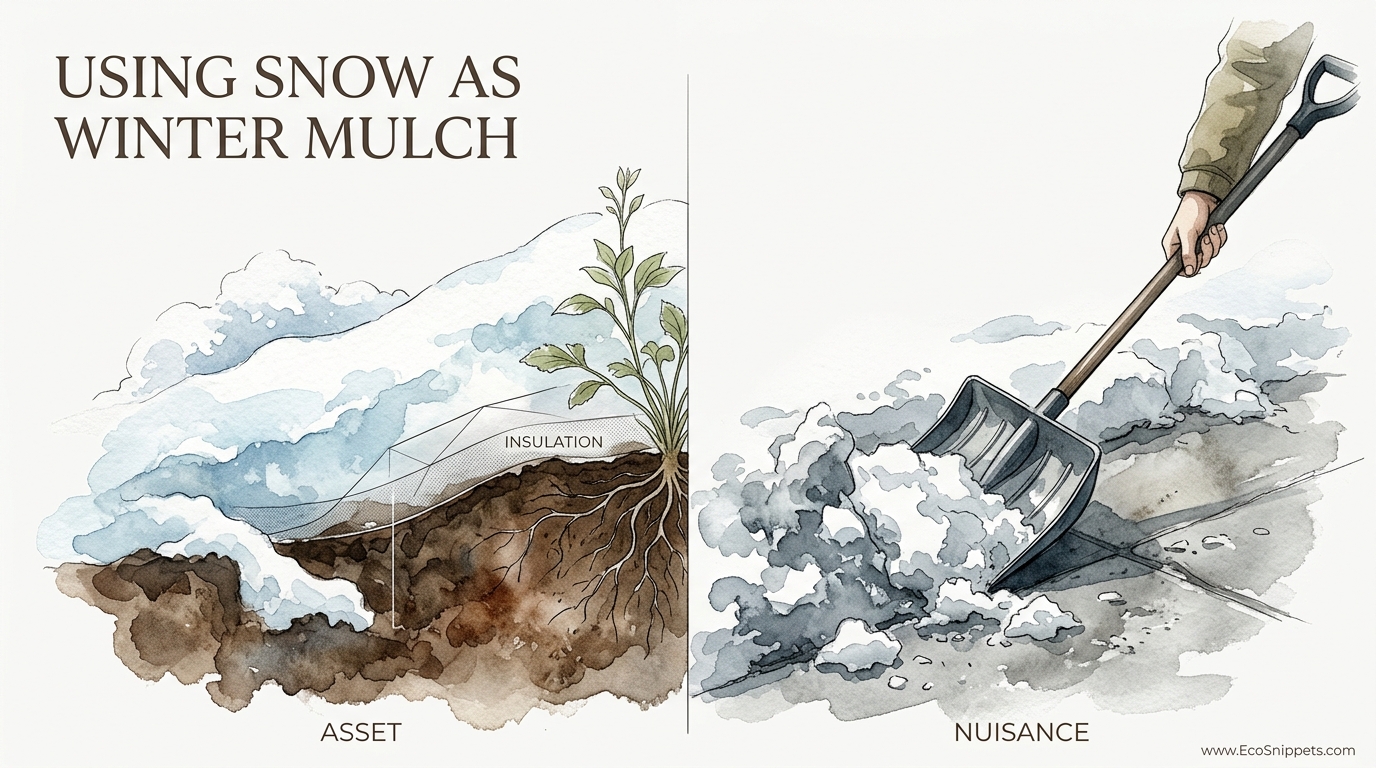
Using Snow As Winter Mulch
Snow is essentially a frozen blanket that protects the hidden life within your soil. While it feels cold to the touch, its structure is mostly comprised of trapped air. This high air content makes it one of the most effective insulators provided by nature. In the world of building and homesteading, we talk about R-values, and snow has a surprisingly high one for something made of water.
New, fluffy snow provides about one R-value per inch of depth. A foot of undisturbed powder can keep the soil temperature near freezing even when the air temperature above it drops into the negatives. This stability is vital for the survival of perennials, bulbs, and the beneficial microbes that live in the top layers of the earth. Without this protection, the ground is subject to deep, killing frosts that can penetrate several feet down.
Farmers in the northern reaches have long relied on “permanent” snow cover to protect winter wheat and cover crops. In a home garden, this translates to protecting your garlic beds and strawberry patches. The snow prevents the ground from becoming a frozen block that shatters root systems. It keeps the environment beneath the surface consistent, which is exactly what dormant plants need to survive until the thaw.
Think of snow as a temporary mulch that applies itself. Traditional mulches like straw or wood chips are excellent, but they require hauling and spreading. Snow does the heavy lifting for you, filling in the gaps and leveling the temperature across the entire landscape. It is the original “low-maintenance” garden strategy used by those who lived off the land.
The Science of Atmospheric Nitrogen Capture
Nitrogen makes up about 78 percent of our atmosphere, but most plants cannot use it in its gaseous form. It must be “fixed” into a form like nitrate or ammonium to become plant-available. This process usually happens through soil bacteria or industrial manufacturing. However, nature has its own high-energy method involving lightning and precipitation.
When lightning strikes, the intense heat breaks the strong bonds of nitrogen molecules in the air. These atoms then combine with oxygen to form nitrogen oxides. Snowflakes, as they form and fall through these layers of the atmosphere, act as tiny scrubbers. They collect these nitrogen compounds along with sulfur and trace minerals from dust particles floating in the air.
Research indicates that precipitation can deliver anywhere from 2 to 12 pounds of nitrogen per acre annually. While this might seem small compared to a bag of commercial fertilizer, the quality of delivery matters. Because snow melts gradually, the nitrogen isn’t washed away in a single heavy downpour. It seeps into the root zone slowly, coinciding perfectly with the moment plants begin to wake from dormancy.
Sulfur is another critical component delivered by snowfall. It is essential for the production of proteins and enzymes in plants. Together with nitrogen, these elements provide a “green-up” effect in the spring. This is why a snowy winter often leads to a more vigorous start for the growing season than a dry, cold winter. Nature is essentially top-dressing your garden while you wait by the fire.
Benefits: Insulation, Hydration, and Nutrition
Insulation is perhaps the most immediate benefit of a thick snowpack. It protects against “frost heave,” a phenomenon where the soil expands and contracts during rapid freeze-thaw cycles. This movement can physically eject small plants or bulbs from the ground, exposing their roots to the air. A consistent layer of snow keeps the ground frozen and still, preventing this mechanical damage.
Hydration is the second great gift of the snow. Unlike rain, which often hits frozen or hard-packed ground and runs off into the nearest ditch, snow stays where it falls. As temperatures rise, the melt occurs from the bottom up and the top down. This slow percolation ensures that the water moves deep into the subsoil, recharging the moisture levels for the upcoming heat of summer.
Nutrition, as we’ve discussed, comes from the atmospheric capture of nutrients. But there is another layer to this: the boost to soil biology. When the soil is insulated and kept at a steady temperature just below or at freezing, microbial activity doesn’t completely stop. Certain “psychrophilic” or cold-loving microbes continue to break down organic matter under the snow, preparing a feast of nutrients for the spring.
The combination of these three factors—warmth, water, and food—creates an ideal environment for early spring success. Garlic, specifically, thrives under these conditions. The bulbs need the cold to divide, but they also need the insulation to prevent rot and the moisture to establish strong roots early. Snow provides the perfect balance for these hardy crops.
Challenges: Salt, Weight, and Compaction
Road salt is the primary enemy of the winter gardener. Sodium chloride, used to de-ice streets and sidewalks, is toxic to most plants. It causes “physiological drought” by making it harder for roots to absorb water, even when the soil is wet. Never shovel snow from the edge of a salted road or a treated driveway onto your garden beds. This can lead to stunted growth or plant death in the spring.
Weight and breakage are serious concerns for woody shrubs and evergreens. Heavy, wet snow (often called “heart-attack snow”) can pull branches away from the trunk or snap them entirely. While you want snow around the roots, you must be careful about how much weight you allow to accumulate on the canopy. Gentle upward brushing with a broom can clear excess weight without damaging the frozen, brittle wood.
Compaction ruins the very benefits we are trying to harness. When you walk on snow or pack it down with a shovel, you squeeze out the air pockets. This turns a high-performance insulator into a block of ice. Icy, compacted snow conducts cold directly to the ground and takes much longer to melt in the spring. This can delay the warming of your soil and push back your planting dates by weeks.
Snow mold is another potential issue, particularly for lawns. In areas with long-lasting, deep snowpacks, certain fungal pathogens can thrive in the cool, moist environment between the grass and the snow. This usually appears as gray or pink patches in the spring. While it rarely kills the grass permanently, it is a reminder that even too much of a good thing requires management and observation.
Limitations: Climate and Soil Constraints
Warm climates rarely see enough snow to reap these benefits. In regions where snow falls and melts within 24 hours, the insulating effect is non-existent. In these areas, the nitrogen boost is more akin to a light rain. Gardeners in the South must rely more heavily on traditional organic mulches and cover crops to protect their soil during the winter months.
Soil type also dictates how effective snowmelt will be. Heavy clay soils can become waterlogged if a massive snowpack melts too quickly during a spring heatwave. This can lead to anaerobic conditions that harm root health. On the other hand, extremely sandy soils may allow the nitrogen-rich meltwater to leach through the root zone too quickly, losing the nutrients to the deeper water table before the plants can grab them.
Frozen ground presents a barrier to entry. If the soil freezes hard before the first snow falls, the initial meltwater will simply slide off the surface. The “Poor Man’s Fertilizer” works best when the snow falls on relatively soft, unfrozen ground, or when the spring thaw is gradual. Understanding your local frost depth and timing is part of the “pioneer-grit” wisdom required for successful winter management.
Urban environments face unique limitations. Air pollution can lead to “acid snow,” where the nitrogen capture is accompanied by high levels of pollutants or heavy metals. While this is less common today than in the mid-20th century, it is still something to consider in industrial areas. For most home gardeners, the benefits of the natural nitrogen far outweigh the risks of trace pollutants.
Snow vs. Traditional Winter Mulches
Traditional mulches like straw, shredded leaves, or wood chips are foundational to a good garden. They provide year-round protection and eventually break down into humus. Snow, however, has some distinct advantages that these materials lack. Its ability to capture atmospheric gases is unique, and its “self-applying” nature makes it more efficient during the height of winter.
| Feature | Snow (Poor Man’s Fertilizer) | Traditional Organic Mulch |
|---|---|---|
| Nutrient Content | High in Nitrogen and Sulfur | Varies (High in Carbon) |
| Insulation Value | R-1 per inch (uncompacted) | High, consistent throughout winter |
| Water Management | Slow-release hydration | Prevents evaporation/runoff |
| Application Cost | Free | Cost of material or labor |
| Lifespan | Temporary (melts) | Permanent/Long-term |
The most resilient gardens use a combination of both. Applying a layer of straw or leaves in the autumn provides the base layer of protection and carbon. When the snow falls on top of this mulch, it creates a “super-insulator” that traps even more heat and slowly feeds the decomposing mulch with the nitrogen it needs to break down. This is the ultimate self-sustaining system.
Wood chips are excellent for pathways and perennial beds, but they can sometimes tie up nitrogen as they decompose. Adding snow on top of a wood chip mulch helps balance this by providing the “green” nitrogen component to the “brown” carbon of the chips. It speeds up the natural composting process right on the surface of your soil.
Practical Best Practices for Gardeners
Shovel with purpose. When you clear your paths or patio, don’t just throw the snow into a random pile. Target your raised beds, the base of fruit trees, and your berry bushes. Moving snow to where it is needed most is a productive way to handle a chore. Focus on the “drip line” of trees, which is where the most active feeder roots are located.
- Use Only Clean Snow: Ensure the snow you move onto your beds is free of road salt, automotive fluids, and gravel.
- Keep it Fluffy: Avoid walking on the snow once it’s in the bed. Toss it lightly with the shovel rather than packing it down.
- Manage the Depth: A depth of 6 to 12 inches is ideal for most garden beds. Any more can lead to delayed warming in the spring.
- Protect the Canopy: If you are piling snow around shrubs, keep it around the base. Do not bury the entire plant if it has fragile branches.
Watch the weather for “ice dams” on your garden beds. If a mid-winter thaw is followed by a flash freeze, a layer of ice can form on top of the snow. This can seal off oxygen to the soil and the plants. If this happens, use a garden fork to gently poke holes through the ice layer to allow the soil to breathe. This is a subtle but important part of winter stewardship.
Monitor your drainage points. As the snow begins to melt in late winter, ensure that the water has a place to go. You want the moisture to sink in, not sit on top and drown the emerging crowns of your plants. Clearing a small channel in the snow at the edge of the bed can help manage heavy meltwater and prevent erosion of your precious topsoil.
Advanced Insights: Microbes and pH
Soil biology is much more active in winter than many realize. Beneath a thick blanket of snow, the soil temperature stays around 32°F (0°C). This is warm enough for a whole host of fungi and bacteria to remain active. These organisms work on the organic matter you left behind in the fall—spent roots, fallen leaves, and mulch. They turn these materials into plant-ready nutrients.
The nitrogen delivered by snow helps “fuel” these microbes. Decomposing organic matter requires nitrogen to fuel the bacteria doing the work. If the soil is nitrogen-poor, decomposition slows to a crawl. The Poor Man’s Fertilizer provides that essential spark, ensuring that by the time you stick your spade into the earth in April, the soil is friable and rich with life.
pH levels can also be subtly affected by snowfall. In some regions, snow can be slightly acidic due to atmospheric carbon dioxide and nitrogen oxides. While this isn’t usually enough to cause a drastic shift, it can help slightly lower the pH in alkaline soils, making minerals like iron and phosphorus more available to plants. It is a natural “balancing” mechanism that occurs over thousands of years.
Practitioners of “No-Till” gardening find snow especially useful. Since they aren’t turning the soil, they rely on surface-applied nutrients and natural processes to move fertility down. The slow melt of snow is the perfect mechanism for this. It carries dissolved nutrients down through the macropores created by earthworms and old root channels, feeding the soil deeply without any mechanical intervention.
A Real-World Winter Scenario
Imagine a gardener named Elias in Zone 5. He has a 20×20 vegetable plot and several rows of raspberries. In November, he plants his garlic and covers the bed with three inches of shredded maple leaves. When the first big storm of January hits, he spends the morning clearing his long driveway. Instead of blowing the snow into the woods, he directs it onto his garlic bed and around the base of the raspberries.
By midday, he has a 10-inch blanket of clean, white snow over his garden. A week later, a polar vortex brings the air temperature down to -20°F. Because of that snow, the soil at the garlic’s root level never drops below 28°F. The garlic bulbs are safe and sound, protected by the trapped air in the snow. Meanwhile, the snow is slowly absorbing trace nitrates from the cold, crisp air.
In March, the sun begins to stay up longer. The snow starts to recede, losing an inch a day. This meltwater, loaded with the winter’s collection of nitrogen and sulfur, sinks deep into the leaf mulch and the soil beneath. When the garlic sprouts emerge in April, they aren’t pale and yellow; they are a vibrant, dark green. Elias didn’t spend a dime on fertilizer; he just used what was already falling on his head.
Final Thoughts
Treating snow as a resource is a hallmark of the wise gardener. It is a practice that respects the natural cycles and makes use of every available asset. The science behind “The Poor Man’s Fertilizer” confirms what our ancestors observed by simply watching the land. We don’t always need complex solutions when nature provides a perfect system of insulation and nutrition for free.
Embrace the winter work. Moving snow isn’t just a way to clear a path; it’s a way to feed the future. Every flake represents a tiny bit of fertility that can transform your garden. By managing this frozen mulch correctly—avoiding salts, preventing compaction, and targeting your most valuable plants—you are setting the stage for a spring that is as productive as it is beautiful.
Next time you see those clouds rolling in and the first flakes begin to drift down, don’t just reach for the shovel with a sigh. Reach for it with the knowledge that you are about to receive a delivery of the finest, most natural fertilizer available. Let the snow do its work, and you’ll see the rewards in every green leaf and sturdy stem that breaks through the soil come springtime.
