How To Become More Self-Sufficient Without Starting a Full-Blown Farm…
Want to start preserving your harvest, making your own soap, or building a backyard root cellar — but not sure where to begin? “Homesteading Advice” gives you instant lifetime access to 35+ practical homesteading books on food preservation, veggie gardening, DIY natural cleaning products (save over $250 per year with this skill alone), brewing, off-grid energy, and a whole lot more…
Click Here To Check It Out Now!
Your soil test says the nutrients are there, but your plants are starving – here is the invisible reason why. Standard gardening stops at the chemical level, but pro-level soil health is all about the biology. If you don’t have the fungal networks and microbial life to transport those nutrients, you’re just throwing money in the dirt. It’s time to trade the fertilizer bag for a microscope.
Modern agriculture has spent nearly a century teaching us to think like chemists. We stare at N-P-K ratios on the back of a bag as if those three numbers are the holy trinity of life. But our ancestors knew a different truth. They didn’t have bags of ammonium nitrate; they had the rot of the woods, the waste of the barn, and the wisdom to know that life begets life. When you apply a synthetic salt to your soil, you aren’t feeding the earth; you are bypassing its natural digestive system.
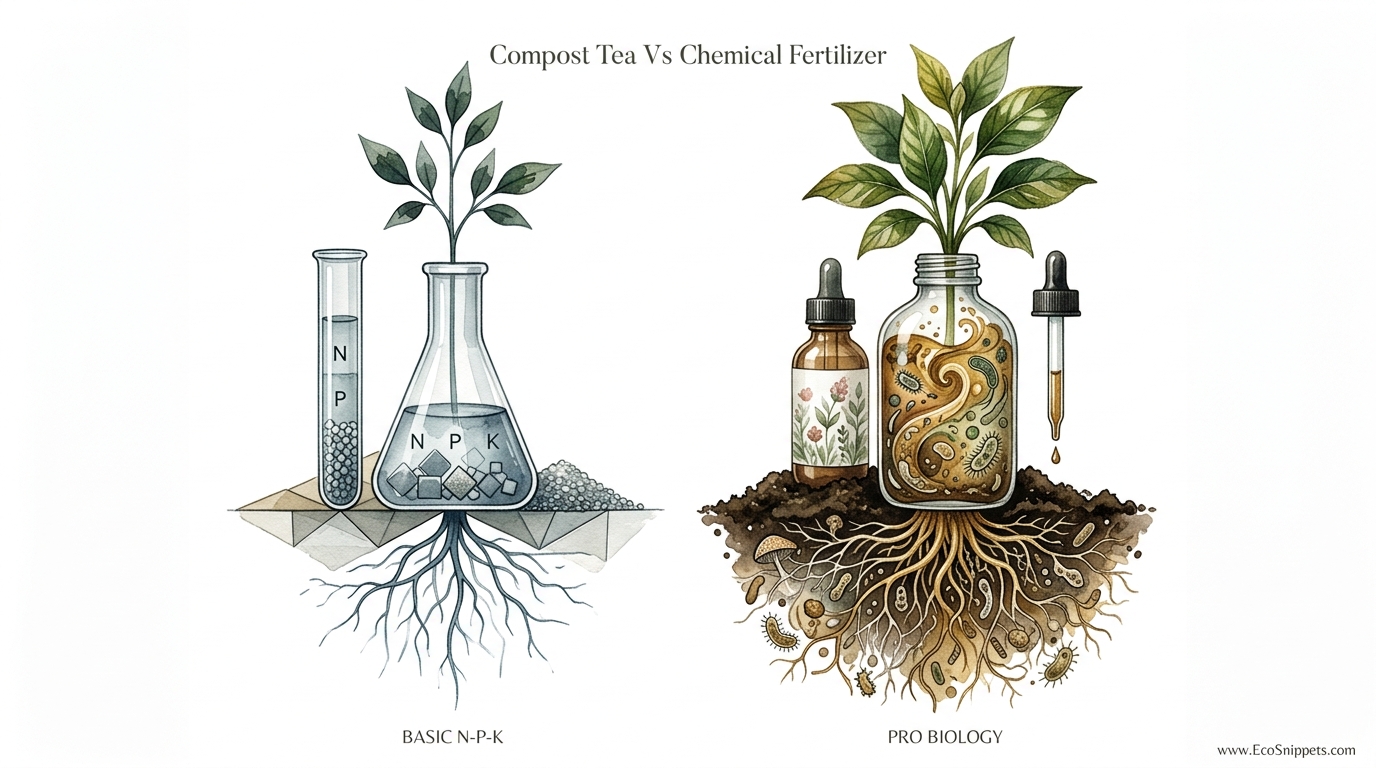
The difference between a thriving homestead and a struggling plot often comes down to who is doing the heavy lifting. You can either spend your days hauling bags of chemicals and nursing “addicted” plants, or you can recruit an army of trillions to do the work for you. Understanding the transition from BASIC N-P-K vs PRO BIOLOGY is the first step toward true self-reliance.
Compost Tea Vs Chemical Fertilizer
To understand the divide between compost tea and chemical fertilizer, you have to understand the difference between a meal and a medical IV drip. Chemical fertilizers are essentially concentrated salts. They are highly soluble in water, meaning they dissolve instantly and are forced into the plant’s roots through a process called osmotic pressure. The plant has no choice but to take them up. This leads to a quick flush of green growth, but it comes at a terrible cost to the soil’s long-term health.
Compost tea, specifically Actively Aerated Compost Tea (AACT), is not a fertilizer in the traditional sense. It is a biological inoculation. Think of it as a probiotic for your land. Instead of providing raw minerals that wash away with the next rain, you are introducing a massive, diverse population of beneficial bacteria, fungi, protozoa, and nematodes. These organisms are the “invisible workers” that build the infrastructure of your soil.
In the real world, chemical fertilizers are used for speed and convenience. Large-scale industrial farms rely on them because their soil biology has been decimated by tillage and pesticides. They are stuck in a cycle of dependency. Compost tea is used by regenerative farmers, market gardeners, and traditionalists who want to restore the soil’s natural ability to feed itself. It’s the difference between buying a fish every day and owning the entire pond.
How the Underground Economy Works
Plants are far more intelligent than we give them credit for. They have spent millions of years perfecting a trade system with the soil life. Through their roots, plants exude up to 40% of the energy they create during photosynthesis in the form of “exudates”—mostly sugars, proteins, and carbohydrates. They aren’t just “leaking” these nutrients; they are putting out a “help wanted” sign.
Bacteria and fungi are attracted to these root exudates. The bacteria consume the sugars and, in turn, mine minerals from sand, silt, and clay particles that the plant roots could never reach. Fungi grow long, thread-like structures called hyphae that act as an extended root system, bringing in water and phosphorus from yards away. When these microbes die, or when they are eaten by larger organisms like protozoa and nematodes, the nutrients they gathered are released right at the root zone in a form the plant can actually use.
Chemical fertilizers break this contract. When you flood the soil with easy-to-grab synthetic nitrogen, the plant stops producing exudates. It “fires” its microbial workforce because it thinks it doesn’t need them anymore. Without the microbes to build soil structure and provide defense, the soil becomes compacted, the fungal networks wither, and the plant becomes a “ward of the state,” entirely dependent on the next bag of salt you provide.
How to Brew Actively Aerated Compost Tea
Brewing a high-quality biological tea requires more than just dunking a bag of compost in water. If you leave compost in a bucket of stagnant water, you aren’t making tea; you’re making a “leachate” that will quickly turn anaerobic. Pathogens like E. coli and Salmonella thrive in low-oxygen environments. To get the “pro-level” results, you must use oxygen.
The Basic Setup
- A 5-Gallon Bucket: The standard vessel for most home-scale operations.
- Air Pump and Bubbler: You need an aquarium-style pump capable of putting out at least 0.05 to 0.1 cubic feet of air per minute per gallon. A powerful “air stone” or a DIY bubble ring at the bottom is essential to keep the water churning.
- Compost Bag: A mesh bag (400-micron is ideal) allows microbes to be washed out while keeping the large organic chunks contained.
- High-Quality Compost: This is the most critical ingredient. Your tea will only be as good as the biology you start with. Use well-aged, diverse compost or vermicompost (worm castings).
The Brewing Process
Step one is to fill your bucket with water. If you are using municipal water, you must remove the chlorine first. Chlorine is designed to kill bacteria, which is exactly the opposite of what we want. Let the water sit with the air pump running for 24 hours to off-gas the chlorine, or add a pinch of humic acid to neutralize it instantly.
Step two involves adding your microbial “foods.” For a bacterial-dominant tea (great for vegetables and grasses), add a tablespoon of unsulfured blackstrap molasses. For a fungal-dominant tea (better for trees and shrubs), add fish hydrolysate or kelp meal. These inputs provide the fuel for the microbes to multiply exponentially over the next 24 to 36 hours.
Step three is the “extraction.” Place two to four cups of compost into your mesh bag and suspend it in the water. Turn on the air pump. The water should look like a rolling boil. Over the next day, the “washing” action of the bubbles will pull the microbes off the compost particles and into the liquid, while the added foods will allow their populations to explode.
Benefits of the Biological Approach
The shift from chemicals to biology offers more than just environmental satisfaction; it provides measurable, practical advantages that make your land more resilient.
Disease Suppression: When you spray compost tea on the leaves of your plants (foliar application), you are covering the surface with beneficial microbes. These “good guys” occupy all the space and eat all the food, leaving no room for pathogens like powdery mildew or blight to take hold. This is known as competitive exclusion.
Improved Soil Structure: Fungi produce a sticky substance called glomalin, which acts as “soil glue.” This glue binds tiny soil particles into aggregates. Aggregated soil has better pore space, allowing air and water to penetrate deeply. This reduces compaction and prevents the “crusting” often seen in chemically treated soils.
Drought Resistance: Microbe-rich soil holds onto water like a sponge. Fungal hyphae can store water and transport it to the plant during dry spells. In a world of unpredictable weather, this biological insurance policy can be the difference between a harvest and a total loss.
Nutrient Efficiency: Because the nutrients are being cycled by living organisms, they don’t leach away. Chemical nitrogen is notorious for washing into groundwater and local streams. Biological nitrogen is held within the bodies of the microbes until the plant asks for it.
Challenges and Common Mistakes
Stepping away from the simplicity of a “scoop and spread” fertilizer requires a bit more attention to detail. The most common pitfall is allowing the brew to go anaerobic. If your tea smells like rotten eggs, sewage, or anything sour, do not put it on your plants. This is a sign that the oxygen levels dropped too low and the “bad guys” have taken over. This usually happens if the air pump is too weak or if you added too much sugar (molasses).
Another mistake is using “dead” compost. If your compost pile was never turned, or if it sat in a stagnant pile for years, the beneficial aerobic microbes may have already died off. Your tea is only an extraction of what is already there; it cannot create life out of nothing. Always start with compost that smells like a fresh forest floor.
Temperature also plays a role. Microbes are most active between 65°F and 80°F. If you try to brew in a freezing garage in November, the microbial “bloom” will be sluggish. Conversely, if the water gets too hot, the oxygen-carrying capacity of the water drops, and the tea can crash.
Limitations: When Biology Isn’t a Quick Fix
It is important to be realistic. If your soil is severely deficient in a specific mineral—say, it has zero phosphorus or is dangerously low in calcium—compost tea cannot conjure those minerals out of thin air. It is an optimizer and a transporter, not a creator of matter. In cases of severe mineral deficiency, you may still need to add raw amendments like rock phosphate or lime.
Furthermore, compost tea has a very short shelf life. Once you turn off the air pump, the trillions of microbes will quickly use up the remaining dissolved oxygen. You generally have a window of about 4 to 6 hours to apply the tea before the population starts to die off and the brew turns sour. This makes it difficult to use on a massive scale without specialized on-site equipment.
A Comparison of Approaches
| Feature | Chemical Fertilizer | Actively Aerated Compost Tea |
|---|---|---|
| Speed of Result | Immediate greening (days) | Gradual health improvement (weeks/months) |
| Soil Impact | Depletes life, increases salts | Builds life, improves structure |
| Cost | Recurring expense per bag | Low (mostly setup and homemade compost) |
| Environmental Risk | High leaching and runoff | None; bio-available and stable |
| Required Skill | Low (read the label) | Moderate (requires “eyes-on” brewing) |
Practical Tips for the Modern Pioneer
If you want to get the most out of your biological applications, follow these best practices derived from years of soil stewardship:
- Clean Your Equipment: After every brew, scrub your bucket and air stones with a mild hydrogen peroxide solution. Biofilms (slimy layers of bacteria) can build up on the equipment and contaminate your next batch with the wrong kind of life.
- Apply at the Right Time: The UV rays in mid-day sun can kill the very microbes you are trying to introduce. Apply your tea in the early morning or late evening when the soil is cool and the sun is low.
- Use as a Drench and a Spray: Pouring the tea on the roots (drenching) builds the soil food web, while spraying it on the leaves (foliar) provides immediate disease protection. Both are essential.
- Keep the Water Moving: If you are using a backpack sprayer, keep it agitated. Some microbes, especially larger ones like protozoa, can settle at the bottom of the tank.
Advanced Considerations: Tailoring Your Biology
Once you have mastered the basic 5-gallon brew, you can start to “tune” your tea for specific needs. The world of soil successional stages teaches us that different plants prefer different microbial balances.
Grasses and “weedier” annual crops thrive in bacterial-dominant soils. To encourage this, use high-nitrogen compost (like aged poultry manure) and simple sugars like molasses. These provide the quick-burning fuel that bacteria love.
Perennials, shrubs, and trees prefer fungal-dominant soils. To achieve this, use a compost based on woody materials (like leaf mold or wood chips). You can “pre-condition” your compost by adding a small amount of oatmeal or soybean meal a week before brewing to wake up the fungal spores. When you brew, use fish hydrolysate instead of molasses, as the complex proteins are a better food source for fungi.
Serious practitioners eventually invest in a basic microscope. Being able to see the “movement” in your tea—the darting of ciliates, the slow crawl of amoebae, and the long strands of fungal hyphae—removes the guesswork. It turns gardening from a hopeful hobby into a precise biological science.
Examples of Biological Transformation
Consider a typical “dead” suburban lawn that has been treated with chemical fertilizers for a decade. The soil is likely hard as a rock, the grass has shallow roots, and every summer it turns brown unless it’s watered daily. If you were to stop the chemicals and immediately apply a thick compost drench once a month, you would see a transformation.
In the first season, the “pioneer” bacteria from the tea would start breaking down the accumulated “thatch” (dead grass material) that the chemicals couldn’t digest. By the second season, you would notice the soil becoming softer and darker as the fungal networks start to aggregate the clay. By the third season, the grass would require significantly less water because the biological “sponge” is now fully functional.
Another example is a vegetable patch struggling with “blight” every year. Instead of reaching for a fungicide—which would kill the good fungi along with the bad—a grower could use weekly foliar sprays of a diverse compost tea. By populating the leaf surface with a “bio-film” of beneficial organisms, the blight spores find no place to land and no food to eat. The problem is solved through health, not through poison.
Final Thoughts
The transition from a chemical mindset to a biological one is perhaps the most important shift a grower can make. It is a move away from the “war” on nature—fighting pests with poisons and soil with salts—and toward a partnership with the living world. Your soil is not just a medium to hold up plants; it is a complex, breathing ecosystem that deserves your respect and stewardship.
Trading the fertilizer bag for a microscope is an act of defiance against a system that wants you dependent on the store. It is a return to the “pioneer grit” that built the foundations of our food system. When you focus on the biology, you aren’t just growing a better tomato or a greener lawn; you are restoring the legacy of the land.
The beauty of this approach is that it is accessible to anyone with a bucket, a pump, and a bit of “rot.” Start small, watch your plants closely, and trust the ancient wisdom of the soil. The life is already there, waiting for you to give it the oxygen and the environment it needs to thrive. Experiment with your own mixes, learn the smells of a healthy brew, and enjoy the satisfaction of knowing that you are finally working with the earth, rather than against it.
