How To Become More Self-Sufficient Without Starting a Full-Blown Farm…
Want to start preserving your harvest, making your own soap, or building a backyard root cellar — but not sure where to begin? “Homesteading Advice” gives you instant lifetime access to 35+ practical homesteading books on food preservation, veggie gardening, DIY natural cleaning products (save over $250 per year with this skill alone), brewing, off-grid energy, and a whole lot more…
Click Here To Check It Out Now!
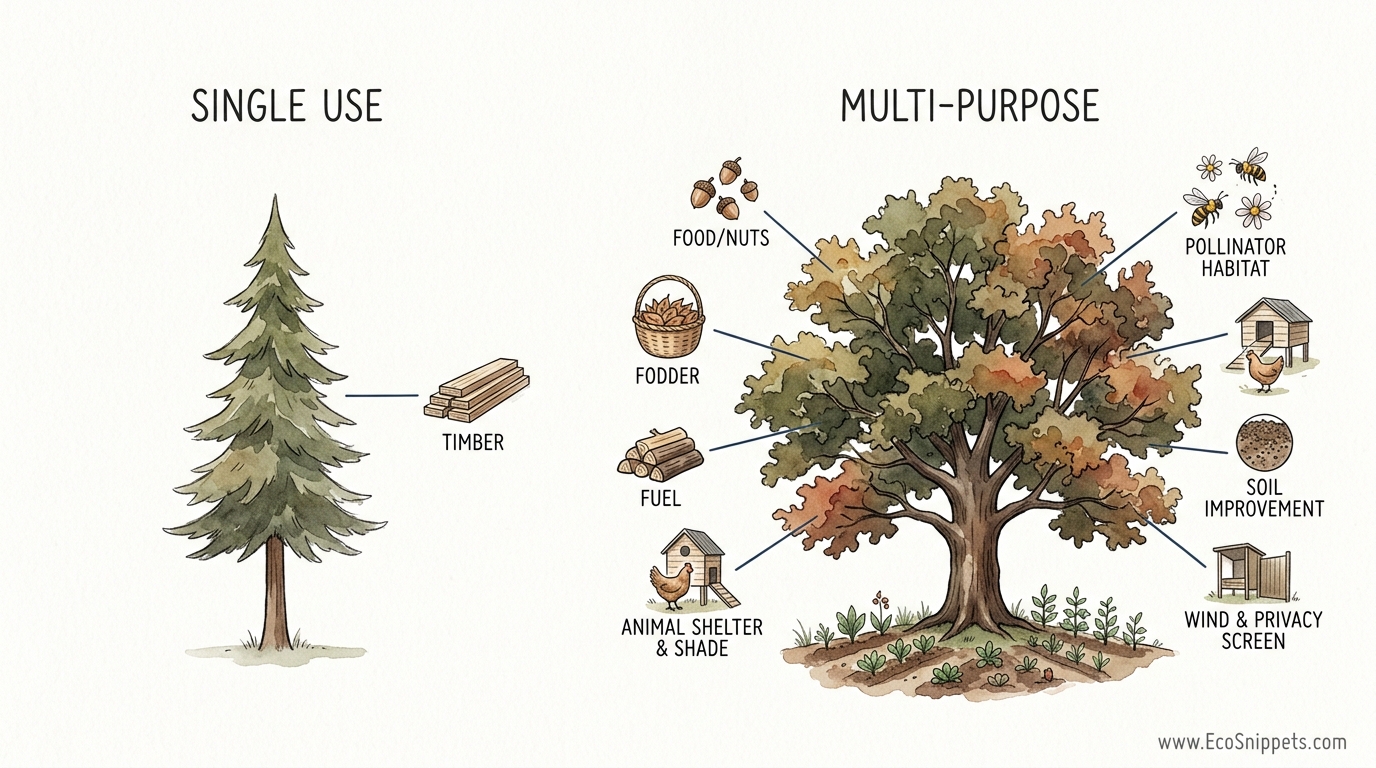
Every tree on your land should have at least three jobs – is yours just sitting there taking up space? In a self-sufficient system, ‘single-use’ is a luxury you cannot afford. While a standard shade tree is nice, a multi-use tree like Tagasaste fixes nitrogen into your soil, provides year-round high-protein fodder for livestock, and keeps your bees fed in the dead of winter. It’s time to plant a grocery store, not just a decoration.
Establishing a self-reliant homestead requires a shift in how you view the landscape. Ancestral wisdom dictated that every element of the farm had to pull its weight. A tree wasn’t just for looking at; it was a source of fence posts, a medicine cabinet, and a buffer against lean years. When you select species that offer multiple yields, you create a resilient ecosystem that thrives even when external supply chains fail.
Focusing on multi-purpose trees allows you to stack functions. Instead of planting a row of pines for a windbreak, you can plant a row of Black Locusts that provide the same wind protection while also offering rot-resistant timber and nectar for honey production. This approach maximizes the utility of every square foot of your soil.
Best Multi-Purpose Trees For Self-Sufficiency
Multi-purpose trees are the workhorses of the permaculture and homesteading world. These species are selected because they provide more than one significant benefit to the land and the steward. In a real-world scenario, a single tree might act as a “nurse” to smaller plants, provide shade for grazing animals, and drop nutrient-dense fruit or pods in the autumn.
These trees exist as a bridge between wild forests and intensive agriculture. They are often “pioneer species,” meaning they are hardy enough to grow in poor soils and improve the environment for everything around them. For the modern homesteader, they are a form of biological capital. Once established, they require minimal input while yielding dividends in the form of firewood, animal feed, and improved soil fertility.
Consider the difference between a decorative maple and a Mulberry. The maple offers shade and perhaps a bit of syrup if you have the climate and patience. The Mulberry, however, offers shade, high-protein leaves that can replace 50% of commercial grain for ruminants, and thousands of pounds of fruit for your family and your poultry. It is a biological powerhouse that transforms sun and soil into tangible self-reliance.
The Pioneer’s Selection: Top Multi-Purpose Trees
Tagasaste (Tree Lucerne)
Tagasaste is arguably the king of the “three-job” trees. In temperate and Mediterranean climates, this evergreen shrub can reach heights of seven meters and provides an incredible array of services. Its foliage is highly palatable and contains 17% to 30% crude protein, making it a viable alternative to alfalfa for sheep, cattle, and goats.
Beyond fodder, Tagasaste is a nitrogen-fixer. Its deep roots reach down as far as ten meters to pull up subsoil nutrients, depositing them back onto the surface through leaf drop. For beekeepers, it is a lifesaver. It blooms in the “dead” of winter—specifically from July to September in many regions—providing critical pollen and nectar when almost nothing else is flowering.
Black Locust (Robinia pseudoacacia)
Black Locust is a tree with “pioneer grit.” It grows rapidly, often adding several feet of height per year, and is famous for its extremely dense, rot-resistant wood. Posts made from Black Locust heartwood have been known to last 40 years or more in the ground without chemical treatment, making it the premier choice for organic fencing.
While it builds your infrastructure, it also builds your soil. As a member of the legume family, it fixes between 75 and 150 kg of nitrogen per hectare annually. In the spring, its fragrant white blossoms provide a massive nectar flow for bees, resulting in “acacia honey” which is light, floral, and slow to crystallize. Its leaves are also a high-protein fodder source, though caution must be used as the bark and seeds are toxic to horses.
Honey Locust (Gleditsia triacanthos)
Do not confuse the Honey Locust with the Black Locust. While they share a name, their functions differ. The Honey Locust is prized in silvopasture systems for its “dappled” shade. Its tiny leaflets allow enough sunlight to reach the ground so that high-quality pasture grasses can still grow underneath the canopy.
The primary yield for the homesteader is the large, sugary seed pods. A single mature tree can drop up to 400 kg of pods in a season. These pods are rich in carbohydrates and can be self-harvested by cattle, sheep, and pigs during the late autumn and winter when grass growth slows down. Always look for the “inermis” or thornless variety to avoid the massive, tractor-tire-puncturing thorns found on wild specimens.
Mulberry (Morus spp.)
Every homestead should have a Mulberry tree near the chicken coop. The fruit is a nutritional “superfood” for both humans and livestock, but the real secret lies in the leaves. Mulberry leaves are among the most digestible tree forages available, with a crude protein content that rivals commercial concentrates.
In many parts of the world, Mulberries are pollarded—cut back to a main trunk every year—to provide a constant supply of fresh greens for rabbits and goats. The wood is also excellent for smoking meats, giving a sweet, tangy flavor similar to apple wood. It is a long-lived tree that acts as a nutrient pump, bringing deep minerals to the surface.
Willow (Salix spp.)
Willow is the ultimate medicine chest and utility tree. The bark contains salicin, the precursor to aspirin, and can be used to make teas that reduce fever and inflammation in both humans and livestock. It is also a vital early-season food source for bees, as its catkins appear early in the spring.
Beyond medicine, Willow is a champion of biomass. It can be coppiced (cut to the ground) every two to three years to provide flexible rods for basketry, garden trellises, or even fuel for wood-gasifiers. Its leaves contain condensed tannins, which act as a natural dewormer for sheep and goats, reducing the need for chemical parasiticides.
How to Integrate Multi-Purpose Trees into Your Land
Success with multi-purpose trees starts with a design that respects the “pioneer-grit” of these species. You cannot simply stick them in the ground and walk away. You must plan for their eventual size, their interaction with other plants, and your own harvesting needs.
Silvopasture and Alley Cropping
One of the most efficient ways to use these trees is through silvopasture—the intentional integration of trees, forage, and livestock. Plant trees like Honey Locust or Black Locust in wide-spaced rows (alleys). This allows you to graze animals or grow hay in the space between. The trees provide wind protection and shade, which reduces livestock stress and prevents “evapotranspiration” of the grass, keeping it green longer into the summer.
Coppice and Pollard Systems
To maximize the “jobs” a tree does, you must manage its growth. Coppicing involves cutting a tree down to a stump (the “stool”) to encourage many small, straight shoots to grow back. This is ideal for Willow or Hazel when you need materials for fencing or basketry. Pollarding is similar but involves cutting the branches back to a trunk about six feet high. This keeps the new growth out of reach of browsing animals, allowing you to harvest the fodder when you choose rather than letting the animals strip the tree bare.
Fodder Banks
If you have limited space, you can create a “fodder bank.” This is a high-density planting of trees like Tagasaste or Mulberry that is managed specifically for “cut-and-carry” feeding. You harvest the branches by hand or with a mower and bring them to the animals. This ensures the trees aren’t overgrazed and allows you to precisely control the animals’ protein intake.
The Tangible Benefits of a Productive Canopy
Shifting to a multi-purpose canopy offers measurable advantages over traditional landscaping or single-crop orchards. The primary benefit is **resilience**. If a drought kills your pasture grass, your deep-rooted trees like Tagasaste or Mulberry can still provide green feed because they access water tables that grass cannot reach.
Soil Fertility and Health
Nitrogen-fixing trees like Black Locust and Tagasaste act as “biological fertilizer.” Through a symbiotic relationship with bacteria on their roots, they pull nitrogen from the air and store it in the soil. When leaves fall and decompose, or when you prune the branches, that nitrogen becomes available to the surrounding grass and vegetables. This eliminates the need for synthetic fertilizers, saving money and protecting soil microbes.
Energy Independence
Heating a home with wood is a cornerstone of self-sufficiency. Multi-purpose trees like Black Locust and Black Wattle provide high-BTU firewood that burns hot and long. Because these trees grow so rapidly, a well-managed woodlot can provide a lifetime of heating fuel on a relatively small footprint. Black Locust wood is so dense that it is often compared to coal in its heat output.
Animal Health and Feed Savings
Feeding animals is the largest expense on most homesteads. By using trees as fodder, you can significantly reduce your grain bill. Willow leaves provide tannins that block the mouthparts of parasitic worms in sheep. Mulberry leaves provide the amino acids necessary for growth in pigs and poultry. Honey Locust pods provide the late-season calories needed to put fat on livestock before winter. These aren’t just “supplements”—they are the foundation of a closed-loop system.
Challenges and Common Management Mistakes
The greatest mistake a homesteader can make is treating a multi-purpose tree like a “set-and-forget” plant. These trees are often vigorous and aggressive. Without management, they can quickly become a liability.
The Trap of Invasiveness
Many of the best multi-purpose trees, such as Black Locust and certain Acacias, are considered invasive in some regions. Their ability to grow in poor soil and spread via root suckers means they can out-compete native vegetation. Always check your local regulations before planting. If you do plant them, you must commit to management. This means regular pruning and ensuring that seeds are not spread by birds or water into protected wild areas.
Overgrazing and Tree Death
Livestock love these trees—often too much. If you allow sheep or goats unrestricted access to young Tagasaste or Mulberry, they will strip the bark and kill the tree within days. Protection is non-negotiable during the first three to five years. Use heavy-duty tree guards or temporary electric fencing. A common mistake is removing the protection too early; goats, in particular, will climb and break branches of even semi-mature trees.
Poor Species Selection for Climate
Not every multi-purpose tree works everywhere. Tagasaste is frost-sensitive when young and will die if the ground remains waterlogged. Honey Locust needs a certain amount of summer heat to produce a high-sugar pod. Planting a tree outside its “comfort zone” results in a tree that might survive but will never perform its “jobs” effectively.
Limitations: When This Approach May Not Work
Practical boundaries exist for the use of multi-purpose trees. Environmental constraints often dictate what is possible. For instance, if you are on a very small urban lot, the root system of a Black Locust can damage foundations and pipes as it searches for moisture.
Time to Maturity
Trees are a long-term investment. While a Willow can provide biomass in two years, a Honey Locust may take seven to ten years to produce a significant pod crop. If you are on a short-term lease or plan to move soon, the work of establishing these systems might not benefit you directly. Self-sufficiency via trees requires a “generational” mindset.
Labor Intensity
The “cut-and-carry” fodder system is labor-intensive. It requires physically harvesting branches and hauling them to pens. While this saves money on feed, it costs time. For a homesteader with a full-time off-farm job, a system that relies on manual pollarding may become a burden rather than a benefit.
Comparison: Multi-Purpose vs. Single-Use Trees
| Feature | Single-Use (e.g., Pine/Maple) | Multi-Purpose (e.g., Black Locust) |
|---|---|---|
| Primary Yield | Shade or Timber (Long-term) | Fodder, Fuel, Nectar, and Nitrogen |
| Soil Impact | Neutral or Acidifying (Pine) | Actively increases Nitrogen/Fertility |
| Maintenance | Low (Once established) | Moderate (Requires pruning/harvesting) |
| Ecosystem Value | Shelter for birds | Critical forage for bees and livestock |
| Resilience | Moderate | High (Multiple backup yields) |
Practical Tips for Success
Managing multi-purpose trees requires a set of skills that go beyond simple gardening. These are the practices that turn a collection of trees into a functioning farm system.
- Sharpen Your Blades: When pruning for fodder or biomass, always use clean, sharp tools. Blunt blades, especially on mechanical slashers, can bruise the tree and lead to fungal infections. For Mulberry and Tagasaste, an upward cut prevents stripping the bark.
- Timing is Everything: For maximum nutritional value, harvest Tagasaste before it flowers. Flowering diverts the tree’s energy and reduces the protein content of the leaves. Conversely, if your goal is honey, you must allow the tree to bloom fully.
- Observe the “Broccoli” Shape: In fodder systems, aim to keep the trees in a “broccoli” shape through regular pruning. This keeps the high-protein young shoots within reach and prevents the tree from becoming a tall, spindly pole with all its leaves at the top.
- Plant in Blocks by Ripening Date: If you are using trees like Persimmon and Mulberry for hog feed, plant them in blocks based on when the fruit drops. Move the hogs from the “Mulberry block” in early summer to the “Persimmon block” in late autumn. This “rotation of the mast” mimics natural forest foraging.
Advanced Considerations: Tree Guilds and Succession
For the serious practitioner, multi-purpose trees are the anchor points for “tree guilds.” A guild is a group of plants that support one another. For example, you might plant a Mulberry (the anchor) surrounded by Comfrey (a nutrient accumulator), Nitrogen-fixing clover (ground cover), and flowering herbs like Dill to attract beneficial insects.
Nutrient Pumping and Dynamic Accumulators
Deep-rooted trees like Mulberry and Willow act as nutrient pumps. They pull minerals like potassium and calcium from the deep subsoil. By “chop-and-dropping” the leaves around the base of the tree, you make these minerals available to shallow-rooted vegetables or fruit trees planted nearby. This is ancestral wisdom refined by modern ecology—using the tree’s natural biology to replace the fertilizer bag.
Succession Planning
Multi-purpose trees often have different lifespans. Willow and Tagasaste are relatively short-lived (15-30 years) but grow very fast. Oaks and Black Walnuts are slow but live for centuries. A smart design uses the fast-growing “pioneer” trees to provide immediate shade, fodder, and nitrogen while the slower “climax” trees have time to establish. Eventually, the shorter-lived trees are removed for firewood, leaving behind a matured, highly productive forest.
Example Scenario: The One-Acre Closed-Loop System
Imagine a one-acre homestead designed for self-sufficiency. Along the northern boundary, a thick hedge of Tagasaste acts as a windbreak. In the winter, the owner cuts the Tagasaste branches and feeds them to three dairy goats, providing 20% of their protein and reducing the need for expensive alfalfa.
In the center of the pasture stand four “inermis” Honey Locusts. Their dappled shade keeps the grass cool during the July heat, allowing the goats to graze comfortably. In October, these trees drop several hundred pounds of pods, which the goats “self-harvest” from the ground, putting on the necessary weight before winter breeding.
Near the chicken coop, two large Mulberries drop fruit directly into the run for three months. The chickens process the fruit into eggs and nitrogen-rich manure. The owner pollards the Mulberry branches every autumn, using the leaves for rabbit feed and the wood for the smoker. This is not a hypothetical dream; it is the practical application of choosing trees that have at least three jobs.
Final Thoughts
Every decision on a self-sufficient homestead should move you closer to a closed-loop system. When you plant a tree that only offers shade, you are wasting the potential of your soil and your time. By choosing multi-purpose trees like Tagasaste, Black Locust, and Mulberry, you are investing in a system that feeds your animals, heals your soil, and warms your home.
This approach requires more management than a standard orchard, but the rewards are measured in resilience. You are creating a landscape that works as hard as you do. In an era where inputs are becoming more expensive and climates more unpredictable, a tree that does three jobs isn’t just a clever idea—it’s a necessity for anyone serious about the pioneer spirit of self-reliance.
Experiment with these species on a small scale. Plant a few Willows in a wet spot or a Mulberry near your poultry. Once you see the tangible benefits—the reduction in feed costs, the improvement in soil texture, and the activity of the bees—you will never look at a “single-use” tree the same way again.
